
Category: WM Special

WM Special

The Secret Shame of Children’s Jails

In jails we found many young minors behind bars without proper recreation, education, exercise, food, sanitation and legal assistance. This is the secret shame of the Philippines, hidden away from the media and the public; hundreds, if not thousands, of children suffer humiliation and deprivation of sub-human jail conditions every year.

Pope Francis’ Pearls

They are so many, the hints and stimuli to reflection and conversion that come to us from Pope Francis, that it is almost impossible to keep up with the pace. Sometimes they are just gestures, more eloquent than an entire document. Sometimes they are half sentences thrown there as if en passant in the middle of a speech: but, as soon as you hear them, you understand that you cannot overlook them.  Pope Francis often relies on homespun language to make his points. Once, for instance, he compared overly grim Christians to “pickled peppers.” On another occasion, he said that gossip in the Church is like eating honey: it tastes sweet at first, but too much gives you a “stomachache.” Indeed, he even told a worldwide assembly of women Religious: “A theoretical poverty is no use to us.” Pope Francis became visibly moved, speaking to a packed audience in St. Peter’s Square, saying that wasting food is like “stealing from the poor.”  And to convince his priests to go to the people, he has repeatedly said that a “shepherd must carry on himself the smell of the sheep.” The following are some of the pearls of this extraordinary teacher.   Inhabiting the frontiers – “We are created children in the likeness of God and the Blood of Christ has redeemed us all! And we all have a duty to do good. And this commandment for everyone to do good, I think, is a beautiful path towards peace. If we, each doing our own part, do good to others, if we meet there, doing good, and we do it slowly, gently, little by little, we will make that culture of encounter: we need that so much. We must meet one another doing good. ‘But I don’t believe, Father. I am an atheist!’ But do good: we will meet one another there” (homily of May 22).   – “Poverty in the world is a scandal. In a world where there is so much wealth, so many resources to feed everyone, it is unfathomable that there are so many hungry children, that there are so many children without an education, so many poor persons. Poverty today is a cry. You can’t speak of poverty in the abstract: that doesn’t exist. Poverty is the flesh of the poor Jesus, in that child who is hungry, in the one who is sick, in those unjust social structures. Go forward; look there upon the flesh of Jesus. But don’t let wellbeing rob you of hope, that spirit of wellbeing that, in the end, leads you to becoming a nothing in life. Young people should bet on their high ideals, that’s my advice. But where do I find hope? In the flesh of Jesus who suffers and in true poverty. There is a connection between the two (To the pupils of Jesuit Schools, June 7).   – “Your proper place is the frontiers. This is the place of the Jesuits. Wherever in the Church, even in the

The Commandment Of Love

Unlike his predecessors John Paul II, who labored to be the global shepherd and Benedict XVI, the theologian and the guardian of the Magisterium, Pope Francis, the mystic, wants to inject anew a Christ-like dynamism into the ministry. It is apparent to the Pope that the crisis of the Church today stems from its failure to use its imagination to be culturally visible, proactive and participative in the performance of the most fundamental, most powerful and the greatest commandment, that of Love. The Pope said: “The Church has appeared prisoner of her rigid languages. Perhaps the world seems to have made the Church like a shipwreck of the past, insufficient to face the questions of the present: maybe the Church had answers for humanity in its infancy but not for its adult age.” To this disillusioned humanity, the Pope wants us to respond bridging the many gaps that separate us, going to meet the poor who are everywhere on the increase lest they lose patience and do not wait for the announcement of the Gospel. Some thought Pope Francis had taken the world by storm in the interview by his Jesuit confrere Antonio Spadaro, editor of Civiltà Cattolica, when he said: “We cannot insist only on issues related to abortion, gay marriage, and the use of contraceptive methods.” Yet, it was not a new statement. In the plane, on his way back from Rio de Janeiro, the journalist Patricia Zordan had asked the Pope: “In Brazil, a law has been approved which extends the right of abortion and has allowed matrimony between people of the same gender. Why didn’t you speak about this?” The Pope answered: “It was necessary to speak about positive things that open the way to youngsters… The Church has already expressed herself perfectly about what you said. Moreover, young people know very well what the position of the Church is.” The journalist insisted: “What is the position of Your Holiness, can you tell us?” “That of the Church. I’m a child of the Church” said Pope Francis. The surprise of the media is sign of a certain amnesia of what Benedict XVI himself had said, speaking to the bishops of Switzerland on November 9, 2006: “I remember when I used to go to Germany in the 80’s and in the 90’s, that I was asked to give interviews and I always knew the questions in advance. They concerned the ordination of women, contraception, abortion and other such constantly recurring problems. If we let ourselves be stuck in those questions, we give the impression that we are moralists with a few somehow antiquated convictions, and not even a hint of the true greatness appears. I, therefore, consider it essential always to highlight the greatness of our faith which is a commitment from which we must not allow such situations to divert us.” Pope Francis explained that his re-evangelization praxis is not a game-changing scheme, but more of an attitude shift. To discard doctrines will be self-defeating. Pope

The Culture Of Encounter

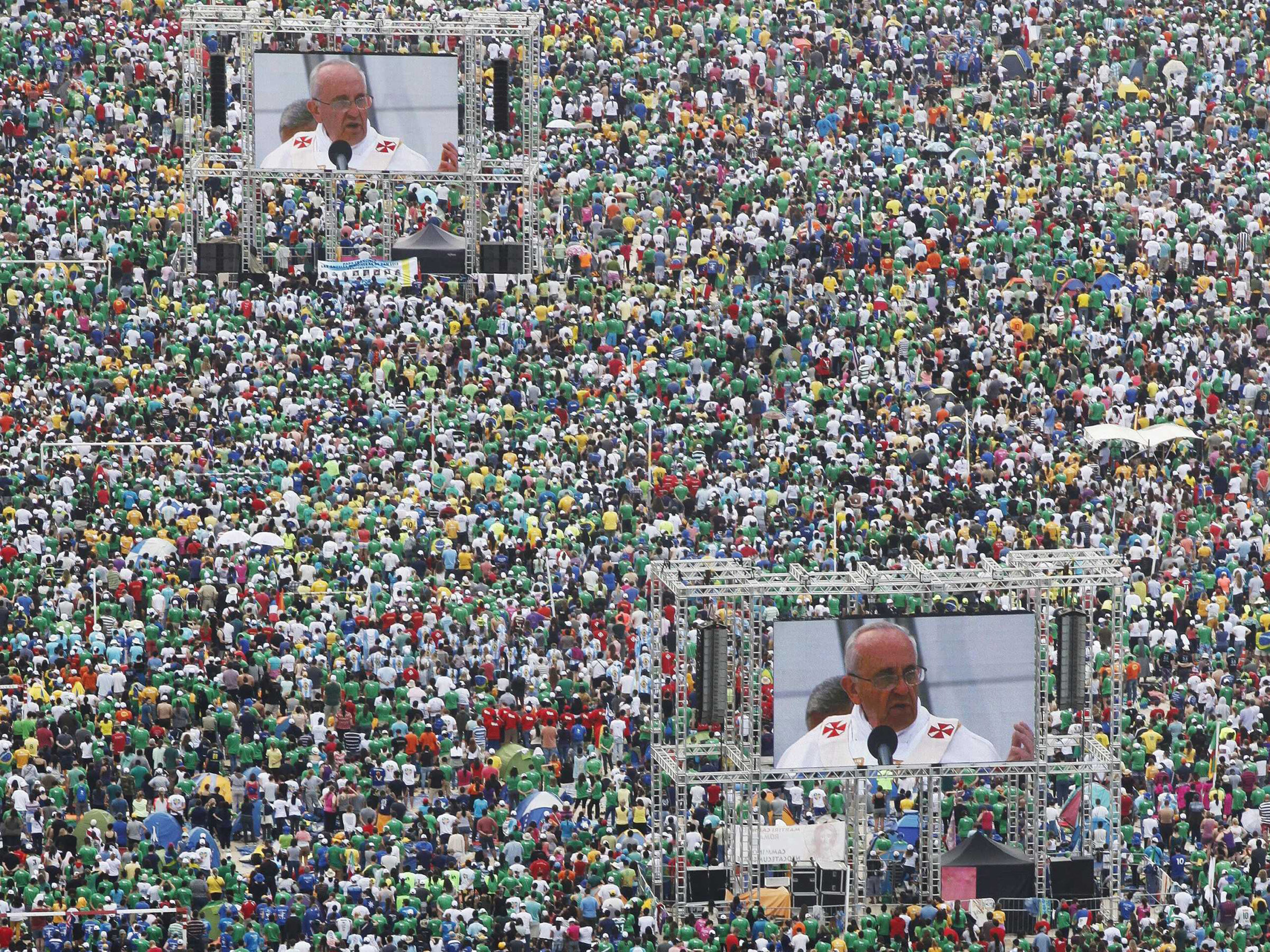
Only nine months have passed from the election of Jorge Mario Bergoglio to the pontifical see, which happened on March 13, but great changes have taken place. Not so much in the doctrinal area but on the style of communication.  These are the unusual gestures that Pope Francis started with and have immediately changed the atmosphere around the pope. First of all, the courageous choice of the name Francis, a name totally new in the history of the popes, a name of which he himself gave a very clear interpretation: love for the poor, peace, integrity of creation. The request of a blessing from the people themselves crowding St. Peter’s Square and linked by media throughout the whole world: an unusual request the new pope made spontaneously, bending his knees and inclining his head to receive it.  The third sign was the way he washed the feet of the young convicts, kneeling on the ground six times, not a formal rite! And, lastly, his decision to reside in House Sancta Martha together with many of his collaborators, a most innovative decision for those who consider the Vatican setup. Of all the images from his first week in office, perhaps the most striking came when Pope Francis visited the Vatican’s small Church of St. Anne to say Mass on Sunday, March 17, ahead of his first Angelus address. Run by the Augustinian Order, St. Anne is where the roughly four hundred people, who live on Vatican grounds, have what can be considered a normal parish life. After Mass, Pope Francis stood outside the church and greeted people as they left, patting kids on the head and kissing them, shaking hands and exchanging hugs, with a quick word and a smile for everybody. It’s a scene that one can see every Sunday at Catholic parishes across the world, but one rarely sees a pope doing it. “A simple gesture is not always a simple gesture when it is the pope’s gesture” (Theologian Robert Dodaro). The choice of the new pope has stirred an extraordinary interest in the whole world. Around six thousand mass media operators had come to Rome to cover the conclave, but then the interest has continued. Also because of his open style, the requests of shooting documentaries on Pope Francis or to have interviews are numerous and, generally, they manifest a genuine and sincere interest in the person of the new pope. The interviews by the editor of Civiltà Cattolica, Fr. Antonio Spadaro S.J. and with Eugenio Scalfari, founder of Repubblica have made history.   The global “parish priest” Everybody has noted the number of people coming to Pope Francis’ weekly audiences. The crowds seem to grow by the week. They are becoming enormous, forcing police to close the area around St. Peter’s Square to traffic as if Mother Teresa or Padre Pio were being canonized. Vendors across Rome report a boom in sales of papal objects, always a reliable sign of popular enthusiasm. He is filling an obvious

Christ At Lampedusa

On July 8, less than two weeks before his scheduled trip to Brazil, Pope Francis, in a surprising move, chose the tiny island of Lampedusa, which lies between Africa and Italy, as the target of his first trip as a pope, in order to meet the plight of the immigrants; he himself being the son of Italian immigrants to Argentina.  An estimated 8,000 people entered Europe through Italy in the first six months of this year. From 1994 to 2012, more than 6,000 of them died at sea in the attempt. Even now, as I write, after the Pope’s visit, hundreds of bodies are recovered from the cruel waters of the Mediterranean sea. On arrival, Pope Francis was taken out to sea in a Coast Guard boat, and he threw a wreath on the water in memory of those who had died in the passage. He embraced the refugees, some of whom had arrived that very day, then he delivered a homily directed not to the immediate hearers, but to the world. The Pope said: “Immigrants dying at sea, on boats which were vehicles of hope and became vehicles of death. This tragedy has constantly come back to me like a painful thorn in my heart. So I felt that I had to come here today, to pray and to offer a sign of my closeness, but also to challenge our consciences lest this tragedy be repeated.  “Adam, where are you?” This is the first question which God asks man after his sin. Adam lost his bearings, his place in creation. Harmony was lost. “The other” is no longer a brother or sister to be loved, but simply someone who disturbs my life and my comfort. God asks a second question: “Cain, where is your brother?” His blood cries out to Me, says the Lord. This is not a question directed to others; it is a question directed to me, to you, to each of us. Today, no one in our world feels responsible; we have lost the sense of responsibility for our brothers and sisters. The culture of comfort leads to the globalization of indifference.  But I would like us to ask a third question: “Has any one of us wept for the death of these brothers and sisters? Has any one of us shed tears for these people who were on the boat? For the young mothers carrying their babies? For these men who were looking for a means of supporting their families? We are a society which has forgotten how to weep, how to experience compassion: the globalization of indifference has taken from us the ability to weep!” The Pontiff’s visit made headlines around the world for bringing up the issue of immigration in a completely different light: from viewing immigration as a problem to understanding the plight of the immigrants. Moreover, the Pope meant for the Church to fulfill the call of the outskirts of the world to announce the Gospel. Lampedusa is really the outskirt

The Reasons Of Our Joy

This is the first word I would like to tell you: joy! Don’t be ever men and women of sadness! A Christian cannot be a sad person! Long faces cannot proclaim good news! Ours is a joy which comes from having met with a Person: Jesus, who is in our midst,” these are Pope Francis’ words on Palm Sunday, March 24, only a few days after his election and are like the motto of his pontificate.  Speaking to the thousands of seminarians and novices, on July 8, he said: “Every Christian, especially you and I, is called to be a bearer of this message of hope that gives serenity and joy: God’s consolation, his tenderness towards all.” Then, leaving out the paper and continuing in a spontaneous way, the Pope told the future priests and nuns to keep “freshness and joy” in their lives, and took to task seminarians and novices who are “too serious, too sad.” “Something is not right here. There is no sadness in holiness,” he said. “A true Christian is a person of joy. There are people who masquerade as Christians, and sin by being excessively superficial or overly rigid, forgetting that a true Christian is a person of joy who rests their faith on the rock of Christ. Some think they can be Christian without Christ; others think being Christian means being in a perpetual state of mourning. The former have a superficial happiness. The others do not know what Christian joy is. They do not know how to enjoy the life that Jesus gives us.”  These words that the Pope delivered in one of his spontaneous homilies in the chapel of Santa Martha makes one think of the movie “Babette’s Feast,” a movie very dear to Pope Francis, where the French refugee, Babette, an accomplished cook, fills with joy and tolerance her stern Calvinist hosts by preparing a sumptuous dinner and making them enjoy God’s creatures in a kind of contemplative experience.   From the experience of suffering Jorge Mario Bergoglio was born in Flores, a barrio of Buenos Aires, on December 17, 1936. He was the eldest of five children of Mario José Bergoglio, an Italian immigrant from Portacomaro, in the Province of Asti, in Italy. His father had followed his three brothers to Argentina, when the Advent of Fascism and the notorious dictator Benito Mussolini had forced many to leave Italy. Pope Francis remembers that his grandmother, Rose, arrived in Buenos Aires sweltering in the heat, clinging to her coat with a fur collar and didn’t want to let it go because, sawn inside that collar, were all the monies they had put together by selling their property in Italy in order to face the unknown. Very soon, the Bergoglios were affected by the Great Depression and life became a struggle. The four brothers had to part company. Life became bearable when Papa Mario José found a job as an accountant. After the fifth child, Jorge’s mother was struck by partial paralysis;

The Time Of Dialogue

For sure Christianity and Islam, already the theme of two articles published in World Mission, have many rich experiences of spiritualities which help us to understand better how God is working in these two religions. But the challenge that we pose here is to understand that also in other religions, and even outside the formal traditional religions like indigenous religions, there are forms of “spiritualities.” This helps us to explore more the spiritual dimension of life and the mystery of life, helping us to go beyond the limits of our understanding and discover more the aspirations of each person. It brings us to the richness of each person as a creature of God who needs to love and to be loved. It is a need like that of a breath of air to live. In fact, the root word of “spirituality” comes from the Latin verb spirare that means “to breathe,” while the correspondent adjective spiritualis means “of or belonging to breathing or to air.” We can see from the root word of spirituality that this word group is related to life, for it is only through breathing that a human being can stay alive. This is a manifestation of God and His love that is always alive.  There was a time in history when the term “spirituality” or “spiritual” was understood in a negative way. Today, there is great attention to spirituality because it is part of life and we can discover forms of spiritualities also among those who claim that they do not have any religion, but they have “spiritual aspirations” manifested in their search for meaning in life and in their commitment for the common good and their respect for “humanity” and “ethics” that help them to listen to the “voice of the conscience.” Thus, we can say that there are many “spiritualities” inside and outside religions.  What we have done in presenting the two previous modules of the mystical dimension of Islam and of Christianity is to explore more the “mystery of life” and have an experience of what we believe in can guide us beyond the structure of religions, including the holy books and the beliefs and rituals of our own faith. Our faith generates the dynamic energy of the “spirit” and the need to live what we believe in. Many are not able to experience the richness of “spirituality” because they are not pure in heart and believe that they are too busy to listen to God’s presence. Entering the spirit of “self-transcendence” must be part of our life and it is the aspiration that many follow.  In our “search for more,” Jesus advises us to become “simple as children,” telling us clearly: “Blessed are the pure in heart; they will see God” (Mt. 5:8). We find in all religions those who search for more and reach a high level of spirituality, starting from what they believe in. One example is the experience of Al-Gazali, a famous and respected Muslim scholar and Sufi of

Mission: Anchored In Living Faith

The Pope continued: “The present document has, as its goal, an interior renewal of faith and Christian life. For missionary activity renews the Church, revitalizes faith and Christian identity, and offers fresh enthusiasm and new incentive. Faith is strengthened when it is given to others! It is in commitment to the Church’s universal mission that the new evangelization of Christian peoples will find inspiration and support” (RM 2). It is John Paul’s view that “in the Church’s history, missionary drive has always been a sign of vitality, just as its lessening is a sign of a crisis of faith” (RM 2). Note carefully the emphasis that the Pope places on the centrality of faith in accomplishing the Church’s mission. He reiterates this “faith-mission” relationship in other parts of Redemptoris Missio: “It is only in faith that the Church’s mission can be understood and only in faith that it finds its basis” (RM 4). Succinctly stated, the Pope asserts: “Mission is an issue of faith, an accurate indicator of our faith in Christ and His love for us” (RM 11). Mission is the evident fruit of genuine faith: “The Lord is always calling us to come out of ourselves and to share with others the goods we possess, starting with the most precious gift of all – our faith” (RM 49). Pope Emeritus Benedict XVI has frequently written and spoken about faith. In his first encyclical in 2005 Deus Caritas Est (DCE) one reads: “Faith tells us that God has given His Son for our sake and gives us the victorious certainty that it is really true: God is love! It thus transforms [us]…. Faith, which sees the love of God revealed in the Pierced Heart of Jesus on the Cross, gives rise to love” (DCE 39). “Faith by its specific nature is an encounter with the living God” (DCE 28). In his 2007 encyclical Spe Salvi (SS), Benedict asks: Is Faith for Christians of today “a life-changing and life-sustaining hope? Is it ‘performative’ for us – is it a message which shapes our lives in a new way, or is it just ‘information’ which, in the meantime, we have set aside…?” (SS 10). “Faith is the substance of hope” (SS 10). “God is the fountain of hope: not just any god, but the God who has a human face and who has loved us to the end, each one of us and humanity in its entirety” (SS 31). Such a deep “God-encounter” in faith should necessarily bear fruit in concrete deeds of love, witness, and commitment to mission. Local bishops’ conferences have also noted the “faith-mission” relationship. For example, the Catholic Bishops’ Conference of the Philippines (CBCP), in their 2011 pastoral exhortation “Year of the Pontifical Mission Societies” (YPMS), wrote: “We bishops of the Philippines, wishing to fan the flame of mission, declare the year 2012 as the ‘Year of the Pontifical Mission Societies.’ It is to be a grace-filled year, marked by a renewed enthusiasm for dedicated service as

Exploring True Belief

For a deeper appreciation of the “faith-mission” relationship, one necessarily must delve into the meaning and dimensions of the gift of faith. A simple, descriptive definition of faith can serve us: Faith includes our whole life in God, Father, Son and Spirit; it is our free, reasonable, and total response to a loving, Trinitarian God – and His personal revelation. Another brief description might be: Faith is a fundamental act or disposition by which human beings respond to God’s revelation and then enter into a saving relationship with a personal God. Traditionally, faith was clarified with the terms: fides quae and fides qua. Fides quae (“faith which”) refers to the knowledge and acceptance of revealed truth as content, teaching, doctrine, or dogma. The Church has always had a concern for correct doctrine; this involves knowledge and an intellectual assent to propositions which describe the very content of what is believed. Fides qua (“faith by which”) refers to a personal, self-surrendering act of trust to a personal God who reveals His inner divine life and invites individuals into a personal relationship of communion and friendship. Belief in doctrinal teaching is integral and necessary for a complete understanding of faith; yet it is secondary and subordinate. The primary and essential element is one’s personal commitment to the God of love, revealed definitively in the person of Christ. The Youcat (Youth Catechism of the Catholic Church) defines faith using these two traditional categories: “Faith is knowledge and trust” (No. 21).  A contemporary, integral understanding of faith certainly incorporates these two dimensions; however, emphasis is also to be placed on a third aspect of faith. One might term this third dimension the “missionary” or “witnessing” dimension of faith. Emerging from one’s personal friendship with God in Christ, as well as a genuine acceptance of revealed truths, one actively seeks to share one’s God-experience with others; one is impelled into mission, desiring to evangelize others. One’s faith-encounter leads to active witness and dynamic evangelization. Thus, faith demands entrusting oneself to God, knowledge and acceptance of basic Church teaching, and a dynamic commitment to spread the faith, to “tell the world of His love!” Indeed, where one or another of these three characteristics is lacking, faith must be judged to be immature or imperfect.   Schematic Expressions of Integral Faith. The three pivotal elements essential to a complete understanding of faith can be expressed using a variety of terms and images; although various expressions are employed, the same three dimensions of faith are always expressed. A schematic – and often alliterative – presentation will hopefully elucidate the profound meaning of holistic faith. And, at the same time, one will perceive why mission and evangelization are always integral to genuine faith. Blessed John Paul II’s assertion that “Mission is an issue of faith” (RM 11) is probably best understood within this triple perspective of faith. Faith always includes (see illustration above):   Various Approaches to Understanding Faith. The Jesuit Cardinal Avery Dulles wrote extensively on many areas

Women Theologians A Unique Contribution To Evangelization

In an epoch–making book published in 1968 titled The Age of Discontinuity – Guidelines for our Changing Society, Franz Peter Ducker, the father of the modern science of management, asserts that the potentialities and the dynamism of revolutions started in the 18th and 19th centuries such as representative democratic, the end to colonialism, engine and transport, communication via radio, have come to an end. A new era has set in, characterized not by the continuity of the past but by a radical novelty, and for the purpose of this article, we add that the event of Vatican II, as well as the growing presence and active role of women in human history have been vital stones in the mosaic of discontinuity which is unfolding before the eyes of all.  Pope John XXIII in Pacem in Terris (1963) had interpreted three major social events of those years as signs of the times – occurrences of extraordinary importance for the coming of the Kingdom and the configuration of a new world order in line with God’s dream. One of them was the rise of women to public office; in other words; women as full–fledged subjects of history, not less than their male counterparts. In the very year of the encyclica’s publication, three women were carrying the responsibility of premiership in their countries: Golda Meir in Israel, Indira Gandhi in India and Sirimavo Bandaranaike in Sri Lanka. As we probe into the factors that contributed to enhance the subjectivity of women in society, let us name some of them:     The Universal Declaration of Human Rights by the United Nations on 10th December 1948 in San Francisco, whereby all human beings, regardless of sex, religion and social status, were recognized as persons with equal dignity and subjects of rights and duties. Much has been achieved since then, with regard particularly to the promotion of those who, in a given society, have been sidelined or marginalized: for instance, women, minorities and the migrants.   Education accessible to all: For ages, education had been almost exclusively male oriented due to the fact that only men then took social, political and public responsibilities. Women, on the contrary, were home–bound and education for them was considered an unnecessary luxury. Such mentality was prevalent in all continents, and the role of tradition kept a heavy grip on any possible change. It was only after the Second World War that the possibility for higher education was extended to all – a move that reflected the change of mentality taking place, since education is of itself a great factor of subjectivity.     The distinction between sex and gender in the context of sociology and anthropology. Physical differences cannot be identified with masculinity and femininity, both highly conditioned by cultures and local traditions. Today we define such identity as gender. These cultural elaborations have been highly dominated by male prestige, power, control. Some jeopardize even women’s physical integrity such as female genital mutilation and domestic violence.    The rewriting of history from

Shopping Cart