Category: World Touch

Nepal

Prize Goes to Human Trafficking Fighter

Shakti Samuha, a group of former Nepali sex slaves that frees Asian women and girls from human trafficking in India and China, is among the five recipients of the ‘Ramon Magsaysay Award’ for 2013. Viewed as Asia’s Nobel Prize, the award recognizes people and organizations that have distinguished themselves for changing their societies for the better. The Filipino government, which established the award in 1958, announced.

Africa

125 Million Mutilated Women and Girls

The true extent of female genital mutilation or cutting is huge, a report from UNICEF last July revealed. It says that a total of 125 million women and girls are now living with the consequences of FGM – and yet the report suggests that the practice continues only because of social convention, while most women and men wish it would end.

World Touch

Church Should Master the ‘Grammar of Simplicity’

On papal trips, what one usually gets are pieces of a pope’s vision, meaning speeches targeted for special groups or occasions that beckon one emphasis or another. Every now and then, however, a pope has a chance to lay out his views in a programmatic fashion, and brought one of those rare moments in a speech Francis delivered to Brazil’s bishops. Jesuit Fr. Federico Lombardi, the Vatican spokesman, said the Pope’s speech was the longest of Francis’ papacy so far and, if not its most important, certainly “very significant.” Five ideas loomed over the rest:

Springtime In The Church

Cardinal Oswald Gracias underlined the positive impact of Pope Francis in India and Asia during an interview, in Rome, with Gerard O’Conell from the Vatican Insider/La Stampa. When asked about the 100 first days of the pontificate, he was rather enthusiastic about its effect on India: “Very, very positive! Very positive, in the sense that here’s a country with a lot of poverty also while there’s been great progress, and he’s struck a cord immediately with his consistent concern for the poor, the marginalized, and also telling the Church to be for the poor. India’s Catholics have been very impressed as well as the general populace who are not Catholic. He’s getting lots of publicity, everything he says is covered by the secular press, and his pictures appear very often in our papers.”

U.S.A.

Priest Gives Lifeline to Former Prisoners

Last fall, Dwain Adkins was about to be released from prison after serving a six-year sentence for aggravated assault. He had no family to return to on the outside and had not been accepted into a halfway house. “My biggest fear was being homeless,” he said. “It was hard for me to fathom that. It tore me up.” Finally, one week before his release, Adkins got word from Dismas House in Nashville that he would have a place to stay. “Dismas gives guys like me an opportunity, and for that I’m grateful,” he told the Tennessee Register, newspaper of the Nashville diocese.

El Salvador

Country Eagerly Awaits Romero’s Beatification

The Vatican communiqué issued after the meeting between Pope Francis and the President of El Salvador, Carlos Mauricio Funes Cartagena, expressly mentions the late Archbishop Oscar Arnulfo Romero. If any further confirmation was needed about the speeding up – since the arrival of the new Pope – of the beatification cause for the prelate who was gunned down by death squads in 1980, that arrived promptly. And not just in the form of a statement by some influential figure or other, but with a phrase written in black and white on a high-level, official document, like those which are published after visits by heads of state to the Vatican.

End of Shackles in Three Months

The plan had begun on Jan 23, starting at Bang Kwang central prison near Bangkok, with 563 inmates seeing their shackles unlocked and removed for the last time. At the end of May, some gathered for a ceremony, led by Prime Minister Yingluck Shinawatra, to officially kick off the policy, kick off the chains, and put the shackle era to an end for good.

Priest Wins Human Rights Prize For Migrant Work

Solalinde received his award as Mexico comes to a crossroad. Pena took office amid protests just 10 days earlier, but public opinion polls show a sense of optimism among Mexicans – something expressed every six years with the transition of power: that the new president can keep his promises to calm violence in the country, combat poverty and corruption and pull Mexico out of an economic malaise. But Pena’s party, which ruled for most of the last century and retook power after 12 years in opposition, has a checkered reputation for human rights and sour relations with the Catholic Church. Pena, who called Solalinde “a good Samaritan,” said the priest’s call for a more just Mexico and leaders closer to the people “are aligned with this government’s project for the country.” That Solalinde would win such an award – a medal and recognition – surprised a few. He surged into the public spotlight over the past five years for his defiance of corrupt local officials in Oaxaca State – who, he says, belonged to Pena’s own party – and unwillingness to be cowed by organized crimes, which threatened his Brothers of the Road’s shelter for migrants. He left the shelter and Mexico during the spring of 2012 because of threats against him. The National Human Rights Commission, which sponsored the prize, reported more than 11,300 migrant kidnappings – often at the hands of organized criminal groups and abetted by crooked police and public officials – over a six-month period in 2010. Solalinde said, last November, that the Peña administration has reached out to those – including Catholic priests and religious – protecting undocumented migrants, but expressed reservations at the time. Political observers say publicly awarding the prize to Solalinde sets a new tone for the incoming presidential administration, which already has signed a comprehensive cooperation pact with the country’s three main parties to achieve structural reforms in the areas of education, economy and energy. “It’s a gesture of political communication,” said Aldo Munoz Armenta, political science professor at the Autonomous University of Mexico State. “The message is trying to convince those who are incredulous, in political terms, that the situation toward those seeking social justice has changed.” 

Rethinking Urban Poverty

One of every seven people on earth lives in urban poverty; many of them reside in overcrowded informal settlements with inadequate water, sanitation, health care and social amenities. But simplistic income–based and nutrition–based poverty lines – including the widely used US$1 per day poverty line – yield a poor understanding of this issue, according to authors Diana Mitlin and David Satterthwaite. “If we are to use a monetary measure for defining and measuring whose income or consumption is insufficient… this measure has to reflect the cost of food and of non–food needs,” Mitlin affirmed.  The authors also criticize the emphasis on ‘income poverty.’ “Focusing only on income poverty can mean that a low–income household  – with a secure home with good quality provision for water, sanitation and drainage, access to health care and with their children at school – is considered just as poor as a low–income household with none of these,” they write in a book summary. “Almost all official measurements of urban poverty are also made with no dialogue with those who live in poverty and who struggle to live with inadequate incomes,” the summary states. “It is always the experts’ judgment that identifies those who are ‘poor’ who may then ‘targeted’ by some programs; at best, they become ‘objects’ of government policy, which may bring some improvement in conditions, but they are rarely seen as citizens with rights and legitimate demands who also have resources and capabilities that can contribute much to more effective poverty reduction programs.”  

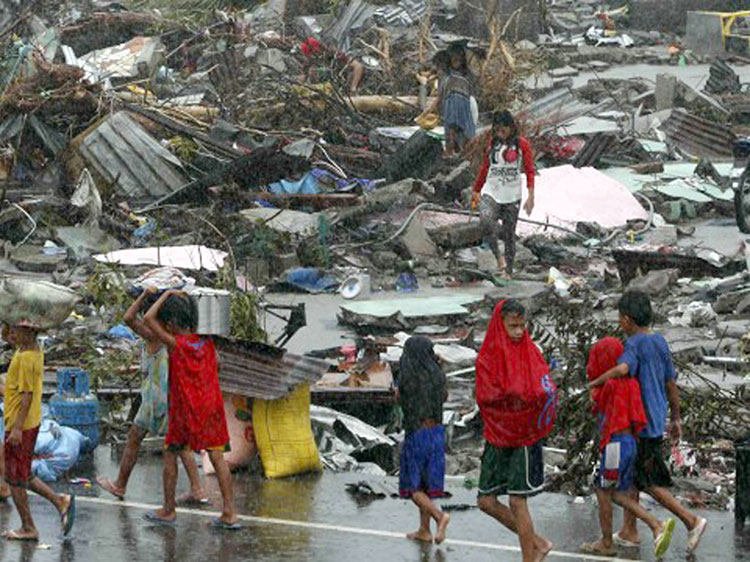
Haiyan: Desperate Survivors In Flattened City

The coastal city of 222,000 inhabitants bore the brunt of the 195mph winds of the strongest storm ever recorded, tearing off roofs and destroying evacuation centers. The storm that surged six meters (20ft) in height turned roads into rivers of sewage and seawater, landing whole ships on top of houses, and obliterating bridges and roads. At least 10,000 people are thought to have died so far in Leyte province alone, with the toll expected to rise.  Without clean water, food or medicine, Tacloban survivors have begun raiding houses, shops and malls to find supplies. One shop owner was photographed defending his premises with a pistol, while reports emerged of aid convoys being hijacked and cash point machines being looted. Local officials warned Philippine President, Benigno Aquino III – who visited Tacloban on Sunday – that residents from nearby towns were entering the city to steal supplies and pleaded with him to declare martial law. Even Tacloban’s airport was reduced to a mere shell. But, now, survivors, authorities and media all crowd into the building through ragged gaps in its walls. The airport is both a makeshift command center – from which the army finally began, on Sunday, to deliver much-needed supplies – and the only way out for many survivors who are queuing hundreds-deep in an effort to leave the chaos behind. More grimly, the airport has been turned into a makeshift morgue for the growing number of bodies found stacked in churches, snagged on tree branches or underneath rubbles. Mass graves have been dug to accommodate the corpses; with Police Chief Elmer Soria reckoning that most victims either drowned or were crushed to death by crumbling buildings. “It was like a tsunami,” said Philippine Interior Secretary Mar Roxas, who visited Tacloban on Sunday by helicopter. “I don’t know how to describe what I saw. It’s horrific.” With communications still inoperative across vast swaths of the hardest-hit areas, it is impossible to judge the scale of the destruction. Aid agencies warn that they cannot reach all those affected, with airports and harbors across the Philippines either entirely closed or badly disrupted. Emergency teams have been forced to try to reach survivors by foot; in many cases walking for hours over debris to access remote and ravaged areas. Luiza Carvalho, the U.N.’s resident and humanitarian coordinator for the Philippines, said it was vital that aid agencies reach those who are stranded in isolated areas. “They are at risk of further threats such as malnutrition, exposure to bad weather and unsafe drinking water,” she said. More than 350,000 people are awaiting supplies in 1,220 evacuation centers, with 4.3M people across the country affected by Haiyan, said Orla Fagan of the U.N. Office for the Co-ordination of Humanitarian Affairs (OCHA). Rescue teams, deployed in Bogo City and San Remigio, on the island of Cebu, said some buildings have been flattened to the ground, with significant damage to both homes and sugar plantations, which have served as many residents’ primary source of income in

Shopping Cart