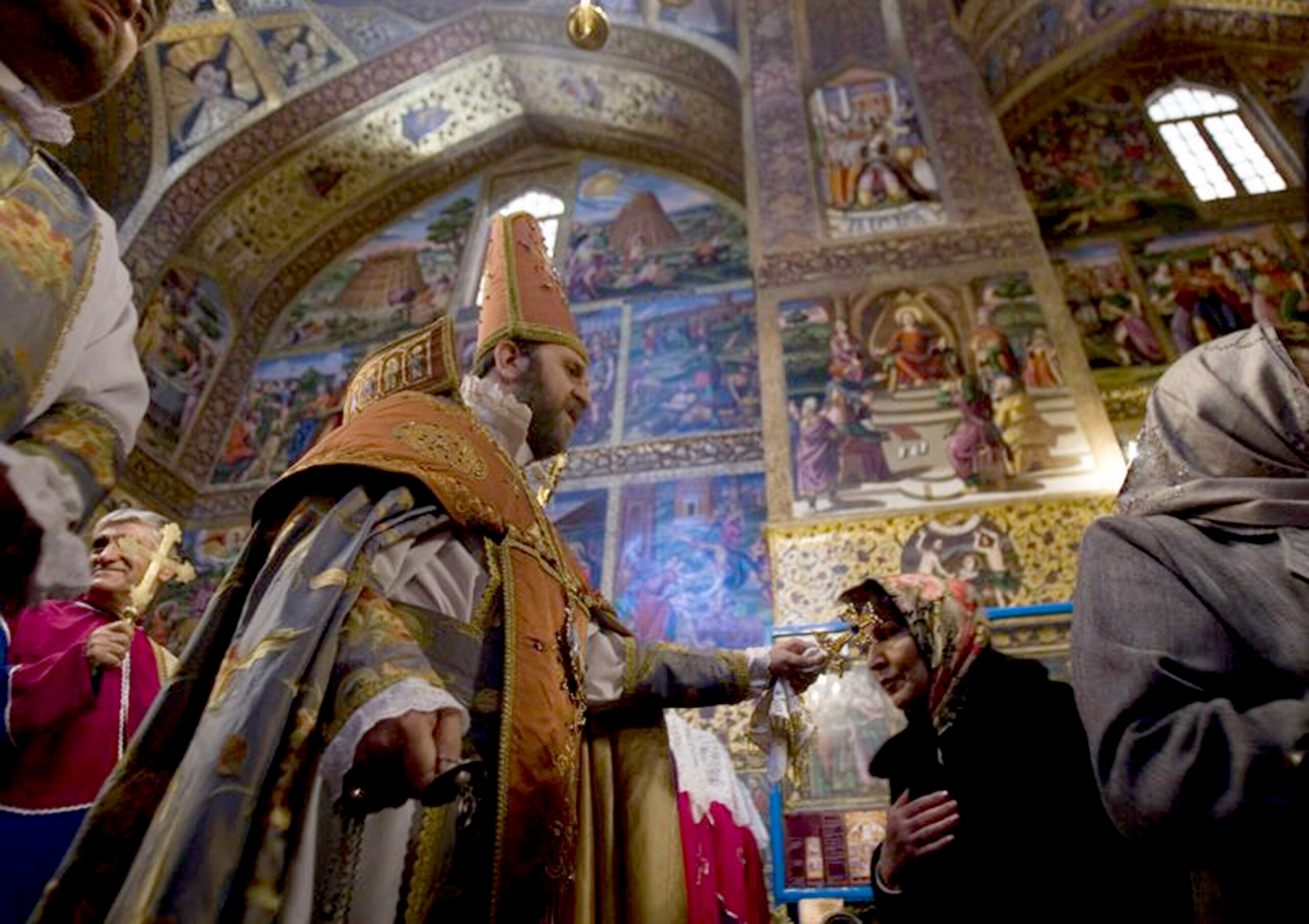

ARMENIANS. Armenia, part of modern Turkey, was under Soviet rule until 1991, when Communism fell. At various stages of its history, it was under Arab, Byzantine, and Turkish rule. The monk Mechitan sought safety in Venice. His followers formed the congregation of the Mechitists, which started the development of Armenian culture. Only 4% of the population are Roman Catholics, while the majority (94%) are “Armenian Apostolic Catholics.” A “Katholikos” heads the Roman Catholics. They were banned from attending the Council of Chalcedon in 451, which condemned the heresy of monophysitism, that is, Christ has only one divine nature, despite His earthly birth, life, death, and resurrection. Later, they accepted conciliar decrees of the Council of Ferrara-Florence in 1453, and confirmed the union with the Roman Catholic Church. In 1996, Pope John Paul II and Katholikos Karekin I (+1999) signed a joint declaration to bridge the gap between the two Churches. The Armenian Apostolic Catholics (or Oriental Orthodox) had also accepted the decrees of Chalcedon. For political reasons, the Byzantine Emperor, influenced by the monphysites, opposed them. They reunited with Rome for more than two centuries (1198-1375), but internal conflicts prevented total union among themselves. CHALDEANS. They form a minority group today in Iran, Iraq, and Turkey. Already mentioned in ancient writings, the Old Testament considered them people with magical powers. They are either Nestorians, who admit a divine and human nature in Christ, but which are merely accidentally united in Him, or Oriental Rite Roman Catholics. The Chaldean Catholics trace their roots to the Latin Crusaders, and they had always sought reunion with the Roman Catholic Church. But centuries of conflict due to circumstances of time, place, and persons, have always blocked their efforts. In 1552, their patriarch, Simon III Baida, journeyed to see Pope Julius III. Refusing election to the Patriarchate twice, they forced him physically to accept the position. The following year, the Pope proclaimed Sulaqa as the Patriarch of the Chaldeans, an event which marks the official establishment of the Chaldean Catholic Church. COPTS. The name is Arabic for “Egyptian.” St. Mark brought the Christian Gospel from Alexandria to Egypt and Abyssinia. Wrongly thinking that monophysitism was the orthodox doctrine, for it was supposedly taught by St. Cyril of Alexandria, the Patriarch of Alexandria accepted the heretical teaching. The Byzantines, too, had accepted the decrees of Chalcedon, and their followers are known as “Melkites,” or the “King’s men.” But the traditionalists in Egypt resented the “upstart” Byzantines, and so, to promote peace, Emperor Justin II created a Melkite Patriarchate and a non-Chalcedonian Patriarch. The majority went with the non-Chalcedonian Patriarch, and observed a modified Alexandrian liturgy, while the Melkites followed the Byzantine. Their Arab conquerors subjected them to taxes, tributes, or Islam – or death. Many embraced Islam. The first attempt of reunion with Rome occurred during the Council of Ferrara-Florence (1439). Pertinent documents were issued, but their Church leaders refused to sign them. In 1600, a Franciscan friar was named their Vicar and, in