
In Gadhat, a Gujarati village on the outskirts of Surat, the 49-year-old Indian Jesuit arrives by jeep with one hand raised in the form of a fist and his other making a victory sign. “Jai adivasi!,” he cries, as the jeep pulls up. In the state of Gujarat the word that accompanies the traditional Hindu greeting of namaste (“hands held together and raised to the forehead”) has been replaced by jai adivasi, a rebellion against the dominant religion. Adivasi is the word for the indigenous people of India, the “tribals,” who have hunted and fished in the green forests of the subcontinent since time immemorial. To India’s Hindu majority, the adivasi are unclean, casteless, untouchable.
The Jesuit is Fr. Stanny Jebamalai, accompanied by a woman lawyer who has come, like a knight on a white charger, to defend the rights of the tribals of Gadhat. “A woman lawyer?” asks one of the villagers, astonished. In his world, a woman can become at most a primary school teacher or nurse, but never a professional. The shock is even greater when the community is told that the lawyer is 26-year-old Sonal Gamit, an adivasi just like them.
Gadhat was, until recently, one of the thousands of forgotten villages in India’s rural regions, where 80 million tribals live without electricity or running water, in tents made waterproof by mud and straw. India’s independence from Britain, in 1947, was disastrous for these people; they were expelled from their lands and denied access to health and education. Their impoverishment was justified by discrimination of the most brutal sort, one which made any kind of empathy almost impossible. Why help a people who, if you but touch them, will infect you with the impurities of previous unhappy lives?
THEY ARE OUR HIDDEN TREASURE
Even after 30 years of working with the tribals, the Jesuit, known affectionately as Stannybhai, or “Brother Stanny,” is still furious at the effects on them of India’s religious apartheid. “The caste system, conceived 2,000 years before Christ, may be the most devilish human invention ever,” he says, shaking his head. “By classifying people according to intangible mythological principles, the system robs them of their most precious possession: “self-esteem.” Stannybhai has worked to counter the stigma of the scattered tribals through his NGO, which forms community leaders who encourage the adivasi to assert their rights as Indian citizens like any others. His mentor is the Brazilian educationalist Paulo Freire.
His other hero is Mahatma Gandhi, who inspired him with the model of peaceful activism rooted in the community and in the service of the poorest. Gujarat was the Mahatma’s base; it was from here that the Mahatma began the long struggle for Indian independence, calling for justice for the untouchables. Like the Mahatma, Stannybhai practices yoga, and believes that people must first master themselves before confronting their oppressors. It was this “citizens’ yoga,” Stannybhai believes, “which decisively broke the ability and will of the British to oppose India’s independence.”
The son of landowners from the south of India, Stannybhai arrived as a Jesuit missionary in Gujarat in 1969. In the village, where he worked, there was a dispute over access to a well. The upper castes declared themselves sole owners, refusing to share it with the tribals for fear of being contaminated and losing their status. It was a powerful image of what Stannybhai has spent his life combating.
The Jesuit knew that, as a Catholic priest, he could easily become yet another factor of division in a heavily divided society: another source of authority, another denomination. So he became a bridge. He abandoned his clericals, dropped the title of “Father” and became simply “Brother Stanny.” He felt that to announce the Kingdom of Heaven among the tribals meant helping the tribals to remember their own, ancestral kingdom: the adivasi, he says, are “the hidden treasure of our culture, present long before the arrival of Hinduism.”
HUNDREDS OF LEGAL BATTLES
Their rootlessness became even more pervasive after Independence, when successive governments declared tribal lands to be areas of national security. Self-sufficient farmers were thrown off their land to make way for grand irrigation schemes run by upper-caste Indians. Promises of compensation seldom translated into money. Some 60% of the adivasi left their villages to fill the shanty towns, finding work for meager salaries, such as cutting cane or working in mines and factories. Many women became prostitutes.
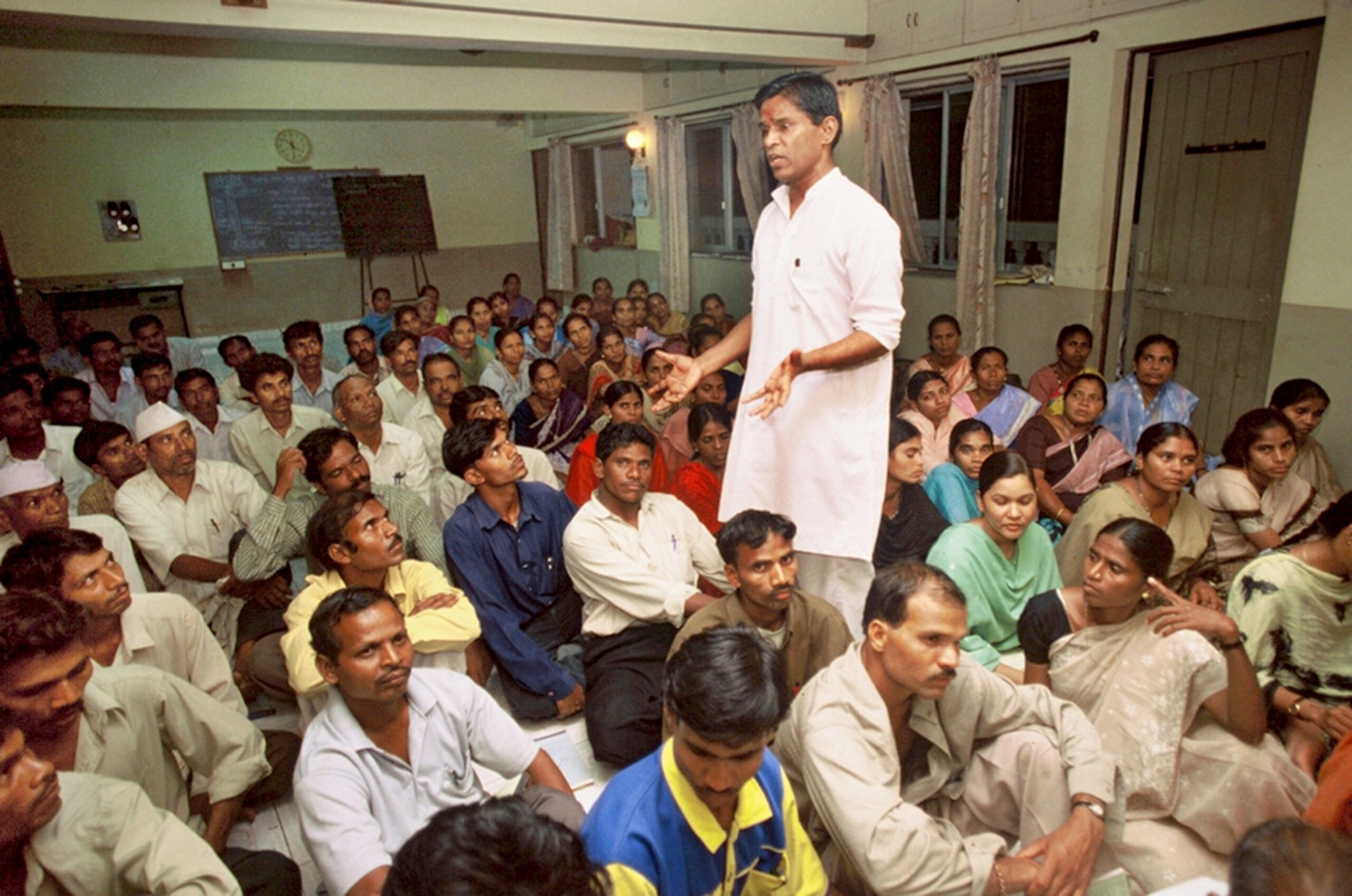
Stannybhai became convinced that the law could be made to work for the tribals. He trained in law and trained others to do the same. They, in turn, trained others. His Legal Aid Center (LAC) now has offices throughout Gujarat, offering courses of 8-12 months in which the adivasi learn basic concepts of civil, criminal and labor law. More than 300 “barefoot lawyers” have been trained at the Center; the brightest have been sent on to universities to qualify. A team of 24 adivasi lawyers now bring cases, on behalf of their communities, to India’s courts. In defiance of ancestral norms, the grants are open to women: 15 of those 24 are women like Sonal Gamit. Women, explains Stannybhai, know better than anyone the consequences of the social disintegration to which the adivasi have been subject.
The barefoot lawyers are kept busy with hundreds of legal battles over land. The first major appropriation was in 1967, when the Ukai dam displaced 50,000 inhabitants. There are now 300 similar projects under way in tribal lands. The Center brings cases for the return of land and for compensation, while helping the farmers who remain on their land to acquire title deeds. The court cases are backed by an awareness-raising campaign, bringing the plight of the tribals to national attention. Last year, when work on the Songarh Dam began, the adivasi organized a demonstration of unprecedented magnitude, marching through the streets of Surat.
A measure of the Center’s success is that local governments now feel obliged to negotiate with villages affected by construction projects. When a deal is struck, compensation agreements in land or money are supervised by lawyers from the LAC. “This has only been possible because the people have been made aware of their rights,” the woman lawyer, Sonal Gamit, says. “We’ve taken control of our destiny,” she adds, smiling, “and one day, not far off, we will be fully integrated into society.”
THE ELDEST ARE A SIGN OF GOD’S WILL
The barefoot lawyers have also transformed adivasi community life. In the past, disputes among the tribals had to be resolved by going to the courts, where they would have to hand over precious possessions, “a buffalo, a parcel of land,” to corrupt, incompetent, greedy court officials, with little prospect of winning their cases. Now, without spending a rupee, the cases are resolved almost always outside the court, with the adivasi being represented by the barefoot lawyers. The parties go to a LAC office, accompanied by their lawyers and village leaders, and each side makes their case. Some 90% of the disputes “mostly over marital relations, violence against women, or land ownership” lead to agreements guaranteed by the village leaders, who are given the last word. “As well as ensuring a lasting peace,” says Stanny, “the process is in keeping with an ancestral adivasi tradition which says that where the eldest are, there God’s will is.”
This novel approach has proved so popular in Gujarat that the adivasi far prefer Jebamalai’s parallel legal process to the state police and legal system where they have always known discrimination and extortion. Since it was created three years ago, the LAC has resolved more than 2,000 cases. “Our objective has been not just to find peaceful solutions, but to bring peace to villages divided over disputes between its members,” says Stannybhai. The success of the Center “and of his adivasi movement, in general,” has led to a new anxiety for Stannybhai – the prospect of being co-opted by politicians. He is also looking over his shoulder at the growing strength of the ruling Hindu nationalist party, the BJP, which also governs Gujarat. The BJP does its best to paint Stannybhai as just another missionary trying to cajole Indians into following Jesus.
Which is why it is important that Fr. Jebamalai has international recognition from the Ashoka Foundation in Washington D.C. which, last year, awarded him a prize. It is not he but the adivasi who need the recognition, insists the Jesuit. Maybe, but hundreds of thousands of tribals in Gujarat look up to him as a friend and liberator, the harbinger of a new era of dignity and freedom.
Wherever he goes in his jeep, Stannybhai receives a rapturous welcome; he brings with him the gifts of confidence, self-esteem, and dignity, the tools of a new and better future for the wretched of this corner of the earth. No wonder he likes to make the victory sign. www.thetablet.co.uk