
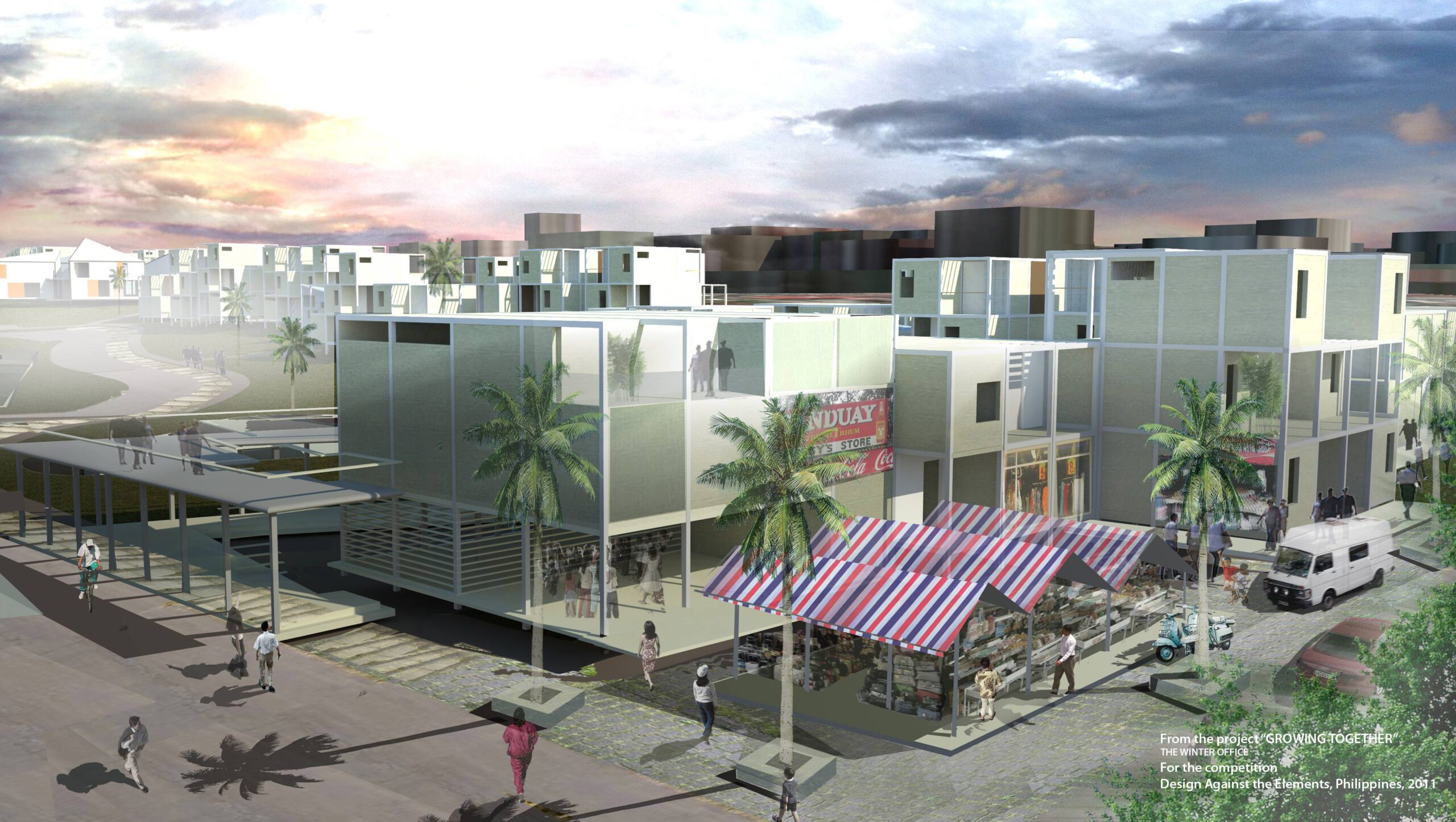
The concept village, submitted by Johanna Ferrer Guldager of Denmark, is designed around elevated housing clusters. Each house employs green building technologies, such as the use of sustainable materials like bamboo for the floors, walls and roof. Roofs are used as a rainwater collection system leading to a water conservation tank, while small gardens between houses ensure food production even in times of disaster.
The concept won the global architectural design competition dubbed Design Against the Elements (DAtE), which aims to build the first green, livable, affordable and disaster-resilient village in the country. A panel of international and local jurors picked the winning architectural design from among 119 entries submitted by professionals and students from 30 countries.
“We were very impressed with the different ideas from all over the world,” said architect Eleena Jamil of Malaysia, who served as one of the jurors. Jamil, who designed a school made of bamboo that won the Millennium School Design Competition for disaster-resilient schools organized in 2008, said that the winner was chosen because of its sustainability and practicality. “The ideas in the winning design are very easy to implement but it considers a holistic approach. It considers the way people interact within the community and how they could grow their own food,” she added.
Criteria for the judging of entries factored in disaster-resiliency, innovative construction technology, socio-economic sustainability, cost-effectiveness and adaptability to other sites. Since the village will actually be a resettlement site for marginalized families, the design also needed to be practical to build.
Another design that allows houses to float by Dao Thanh Hai of Vietnam won in the student category of the competition. The design envisions a two- layered house, the core made of bamboo and wood set on floats and enclosed inside a wind and storm-proof frame made of ecobags, ecobeams and concrete frames. This ensures that the house inside floats up as floods rise while preventing the structure from being swept away.
According to DAtE, approximately 44% of the country’s population lives in informal squatter settlements which offer no shelter from possible climate disasters. In Quezon City alone, the largest city in Metro Manila, as many as 26,974 families live in what are considered danger zones, according to the Urban Poor Affairs Office. Houses of informal settlers hang precariously along the backs of creeks and waterways, near or under power transmission lines, along sidewalks and on dumpsites, making them the hardest hit when disaster strikes.
“Sustainable housing and environmentally safe villages should not only be the privilege of the well-to-do, but should be accessible also to the poor who are physically the most vulnerable to disasters,” said Quezon City Mayor Herbert Bautista. The local government has promised to build the pilot village to be called the House of San Miguel, after corporate sponsor San Miguel Corporation – which co-funded the competition – to accommodate roughly 500 families. “We hope to build this as soon as possible. We will be prioritizing the poor who are most vulnerable to climate change,” the mayor told media. Bautista stressed the importance of preparing for disasters especially with the ill effects of climate change being seen around the world.
The Philippines ranks as one of the ten most afflicted countries in the world in terms of lives and property lost due to climate change. In September 2009, Typhoon Ketsana dumped an average rainfall of an entire month in only six hours and cost 240 million dollars in damages. On average, the country is battered by 20 typhoons every year, and stronger typhoons, as well as droughts, are on the rise. As part of the Pacific typhoon belt, more than 7,000 islands that make up the country are susceptible to sea level rise and storm surges with extreme changes in temperature.
Green building trends seen in the exhibited designs include roof and pocket areas for urban farming, use of solar panels, maximizing natural light sources, rainwater filtration systems, and gray water recycling. Kara Santos / www.ipsnews.net