
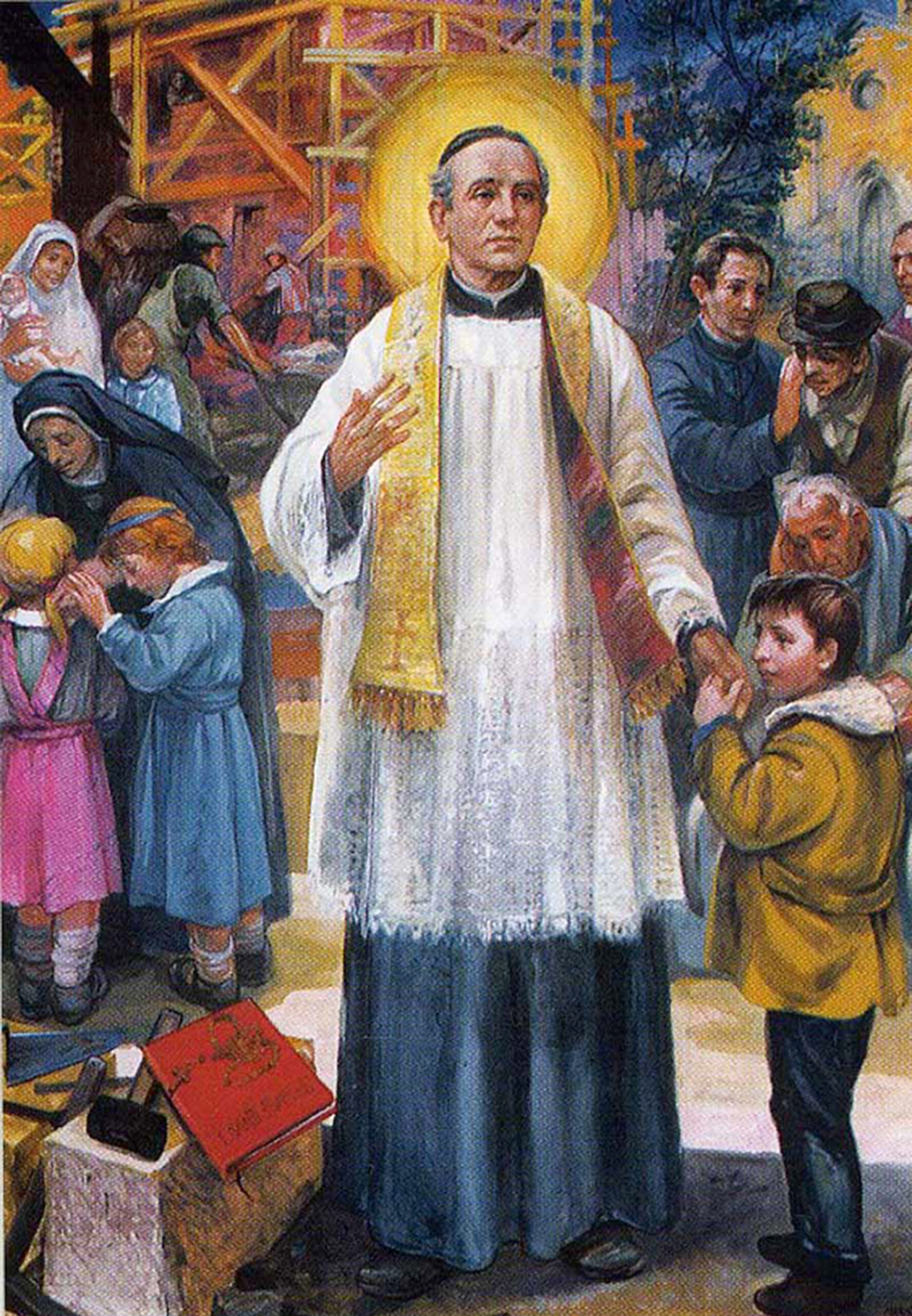
On an evening in April 1886, a little boat slipped into the quiet Como lake at Pianello, in Northern Italy, and traveled through the night to the city of Como. Two Sisters and four orphans were its passengers and it transported an assortment of furniture which the priest responsible, Fr. Aloysius Guanella (1842-1915), described as “a square table missing one leg, a chair that had seen better days, and a bed that was a miracle of balance.” This was the nucleus of the future “Little House of Providence,” the institution to which the poor and the afflicted of all ages came. In 1890, they were already 200: never before in Como had so much human misery gathered into one place.
It was truly a “Noah’s Ark” where a heterogeneous humanity found the simple but dignified welcome of somebody who could discern in suffering individuals the face of Christ. It gathered people of all ages and of every condition: little orphans, young students and craftsmen, domestic workers, deaf-mutes, abandoned elderly people, chronically sick people and “the good children,”
Fr. Guanella’s affectionate term for the developmentally disabled who in those days were otherwise brutally referred to as fools and idiots.
This is how it had all begun. In 1881, a pious priest, Fr. Coppini, had just died in the town of Pianello Lario, on the shore of Lake Como, leaving behind a small home for orphans and the aged, which he had entrusted to the care of a group of young women who had an inclination toward the religious life. In 1878, with five of these women as its members, the bishop had authorized Fr. Coppini to establish a religious community. No one seemed willing to assume the burden of carrying on Fr. Coppini’s work until the bishop remembered Fr. Guanella, one of his most zealous priests, whom he, therefore, sent to Pianello.
In the beginning, Fr. Guanella found great diffidence in the young women because his arrival had been forestalled by unkind rumors: “He is a priest with too many ideas”; “he is hot-headed” and “he is a person to beware of.” It was enough, however, for Marcellina Bosatta, the future co-foundress, to share a dish of polenta and a few leaves of salad with him to understand that the desires of this priest’s heart had the light and savor of Heaven. From that time, Fr. Guanella was invited to visit the house and to look after them, taking over the direction and formation of the group and focusing their objectives. In five years, with the cooperation of their leader, Sr. Marcellina, he established the foundation of his charitable work and became the founder of the Congregation of the Daughters of St. Mary of Providence. It was then that he thought it best to transfer the headquarters of the work to Como where it could be of great service to the entire diocese.
There, also some young men came to follow Fr. Guanella; he guided them and established a congregation of priests and brothers, the “Servants of Charity.” And just when, in the first years of the 20th century, Fr. Guanella was asking the Church to recognize his Congregation, he found himself paradoxically hindered by his own generous urge to open his arms wide to all who were suffering: the scope of his Congregation seemed too wide. Yet, it was this extension of charity to all, in every place and circumstance, that gave his works their distinct originality and brought unanimous honor and merit, universal admiration for and recognition to Fr. Aloysius Guanella.
A PRIEST FOR THE YOUNG AND POOR
Aloysius Guanella was born on December 19, 1842, on a snowy night, in Fraciscio, a small village of Valchiavenna, a mountainous area on the road leading to Switzerland through the Spluga Pass. He was the ninth of the thirteen children of Lawrence and Maria Guanella. The day after his birth, his father carried him in his arms down to the Valley of Campodolcino to be baptized.
The family maintained a simple but comfortable home high on the Italian Alps. His father Lawrence was the respected mayor of the little town of Campodolcino. Their land was used for pasture, and young Aloysius worked tending the family sheep and carrying wood and other items long before he had had any schooling. These mountain people were hard working. They had no animals to help with the work: horses and wagons were almost unknown. For their living, they depended on agriculture and cattle or sheep rearing and they cultivated every tiny strip of land between the rocks and precipices.
A marked characteristic of those mountain people, in addition to their modesty and their capacity for hard work, was their piety. This stretch of land has been called the Valley of the Saints: stations of the Cross and metal and wooden crosses decorate the roadsides and the walls of the houses are adorned with sacred images of the Virgin Mary and photos of religious celebrations to be remembered.
From his family, Aloysius learned many lessons he would later put into practical use in his apostolate. He learned how to use his hands to build things, rather than depend on having money to purchase ready-made items. He learned the value and some of the skills of agriculture. Best of all, he learned that a loving spirit of sacrifice can work miracles.
At the age of twelve, Louis wanted to enter the seminary. With thirteen children to provide for, his father was uncertain whether he would be able to afford this. Luckily, through the offices of an uncle, Aloysius was able to obtain a scholarship. His record at school was excellent and he completed high school in 1859. After this, further studies at the seminary in Como were possible only by sacrifice on the part of his family. One day, at the seminary, a fellow student came down with a contagious disease and became critically ill. While others used every precaution and avoided the student when possible, Aloysius disregarded all warnings and cared for the patient until all danger was past.
He was ordained in 1866. His first priestly duty was that of an assistant to an elderly pastor. Here his zeal for souls and his sense of responsibility toward them were exemplary. He was a priest who went from his private prayers to the village square and never lingered in the sacristy. He could be found exchanging a few words in the street, he would visit the sick in their homes, he walked for kilometers to visit the shepherds in the neighboring valleys and he comforted those who had suffered misfortunes and adversities. He sought every opportunity to be close to the poor. While seeing to their needs, he appealed to their sense of duty and never abandoned men or women “feeble of mind,” finding ways for them to be looked after. He himself took care of one “simple-minded and crippled” girl whose mother had died; he refused to send her to an institution and found foster parents for her.
In the valleys of Lombardy at that time, the only thing that was not lacking was poverty: lonely old people needed a home and company; children needed healthy food and school; the ordinary people needed a minimum of basic education and moral and Christian guidance; many of the disabled needed humane treatment to protect them from derision in the streets or, even worse, the squalor of mental institutions. Those were the people who became Fr. Guanella’s world.
LEARNING FROM DON BOSCO
From 1875 to 1878, Fr. Guanella, with his bishop’s permission, went to stay with Don Bosco at the Oratory in Turin. As soon as he arrived at the Oratory, he met Don Bosco and warmly greeted him. Don Bosco at once said: “Would you like to go to America?” A few minutes earlier, he had decided to accept the missions in South America. “I would indeed,” replied Fr. Guanella in whose head was a load of projects, and whose coming to Turin was more than anything a kind of apprenticeship.
In this account of the first meeting, we have in miniature the whole drama of Fr. Guanella’s staying with Don Bosco. On one side, is the Saint who wanted to take him over completely; on the other side, is the intention that brought Fr. Guanella to Turin: to learn, see and experience. His bishop wanted him back in the diocese and, finally, some interior instinct told him that the Lord wanted something different of him.
Don Bosco did not let him go easily. “My dear Fr. Aloysius,” he wrote to him, “if you allow yourself to be carried away by every thought that comes into your head, you will find it hard to know God’s will… Dear Fr. Aloysius, help me to save souls. Europe and America are crying out for apostolic laborers. Don’t desert me in the fight…” But God had other plans for Fr. Aloysius Guanella.
A year or so after Don Bosco’s death, Fr. Guanella wrote to Don Rua, Don Bosco’s successor: “I want to record my immense attachment to Don Bosco. Certainly, leaving him was like leaving home.” Looking back nostalgically upon the years spent at the Oratory, he spoke in these terms: “There I had the example of so many virtues, and the spiritual direction of Don Bosco who did so much to all. Don Bosco’s heart was like a magnet which drew all to himself. My eternal gratitude goes to Don Bosco and his work.”
Back in his diocese, Fr. Guanella was given the late Fr. Coppini’s enterprise and that was the beginning of his love affair with the handicapped brothers and sisters that lasted his whole life. About them, he wrote: “Freed from the oppression of a mental hospital structure, it is possible to restore dignity to these people, beginning by letting them live in a place where each one is, as it were, lord and master because the providence of the houses and the things that the Lord sends through benefactors are for the residents. We must, therefore, make these residents believe the truth, that they are in their own home and may live there in full confidence.”
THE CHAMPION OF DIVINE PROVIDENCE
“The Lord ordinarily wants everything here on earth to follow a natural course,” Fr. Guanella used to say. He believed that the help of Providence was merited by faith, prayer and work. Sometimes, however, the ordinary course of events gave way to the extraordinary. At one time, Fr. Guanella decided to rebuild the chapel. Patients, workers, and Fr. Guanella himself were working happily one day when he suddenly gave the order to halt and directed all the workers to leave the area. Within minutes, the scaffolding crashed to the ground without a single person being injured. On another occasion, the superior at one of the schools discovered that there was no food for dinner. When she told Fr. Guanella, he replied: “It is only 11:30; Providence still has half an hour to provide.” The Sister asked the students to pray, and at noon a cart delivered a sack of rice. No one knew where the cart had come from.
Humorous incidents often arose from what some considered Fr. Guanella’s foolish charity. Once, when some of the Sisters tried to prevent him from giving away some money, he literally threw money out the window to a poor man standing outside. Another time, not having any money to give, he tossed out a pair of new shoes. A friend and contemporary of Pope Pius X, Fr. Guanella often appealed to him for help in his work. When the Pope asked him if all his responsibilities did not worry him a great deal, the priest replied: “I worry until midnight and from then on I let God worry. I even sleep too much. Sometimes when I am in the streetcar, I miss my stop because I fall asleep. Then, quietly, and well rested, I return without telling anyone so they will not make fun of me.”
“But if too many come seeking a home, where will you put them?” a priest asked him one day. “Just let them get in the door,” Fr. Aloysius answered, “and Providence will take care of them.” His confidence, as always, was vindicated. “Let us confide and hope in God,” was his maxim. “Let us avoid sin, then shortly God will work.” He, himself, lacked neither foresight nor human prudence, nevertheless, he could say with complete conviction: “One grain of confidence is worth more than one hundred grains of foresight and human prudence.”
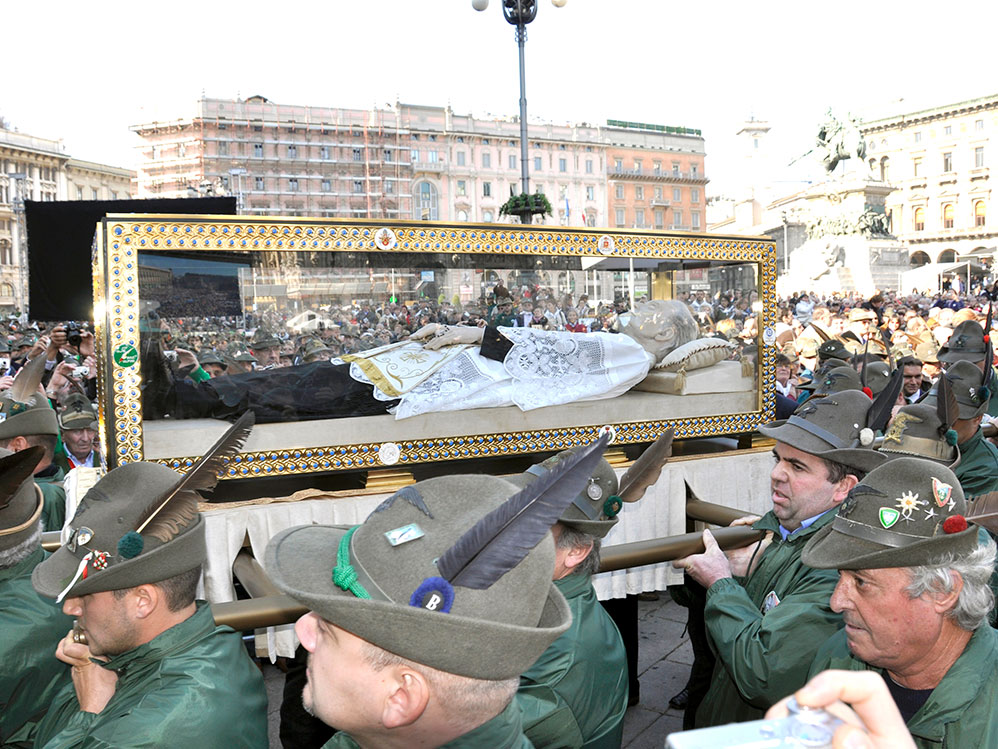
Fr. Guanella did much to rescue the victims of the Italian earthquakes of 1905 and 1915. He assisted at the disaster sites and sheltered refugees in his homes all over Italy. During World War I, he was active in relief and aid and was presented with a gold medal for his outstanding work. Aloysius Guanella died on October 24, 1915. He was beatified by Pope Paul VI in 1964. Benedict XVI made him a saint last October 25.