
On the last day of our week-long desert pilgrimage in the footsteps of Charles de Foucauld, we celebrated the Eucharist at Tamanrasset in the small chapel of the Sisters of the Sacred Heart – one of the more than a dozen congregations and lay associations that derive their charism from Charles de Foucauld’s inspiration and spirituality. It was Saturday evening and All Saints Day. The day’s reading of the Beatitudes from the Gospel of St. Matthew seemed eminently appropriate to what we had seen and experienced over the previous week. “Happy are the poor in spirit, happy are the peacemakers.” Our chief celebrant was Msgr. Claude Rault, the bishop of Laghouat, a diocese of extremes in the Southern Algerian desert. His must be among the largest dioceses in the world in size, with a Christian presence of a mere 100 persons among 3.5 million Muslims! In his homily, Bishop Rault spoke engagingly of the challenges of living the Beatitudes in these extreme circumstances and of identifying others in the surrounding environment with whom to build alliances across boundaries of religion and culture for the furtherance of the Kingdom.
We were a group of fourteen pilgrims, mostly French, all inspired by the life story of Charles de Foucauld, this recently beatified modern ‘desert father’ and his Nazareth model of spirituality. Many, the world over, consider him to be one of the most influential spiritual personalities of the 20th century. Charles de Foucauld’s mud-walled hermitage in Tamanrasset nicknamed ‘La Frégate’ and the fortified structure – the so-called ‘bordj’ – where he was killed in 1916 have become increasingly popular visiting places for both pilgrims and a growing number of desert tourists.
A RADICAL SEEKER OF THE ABSOLUTE
By contrast, when on December 1, 1916 Charles de Foucauld was shot dead at the age of 58 by a group of Tuareg rebels, very few took notice of the decidedly unremarkable end of this radical seeker of the Absolute. His love affair with the North African desert and its peoples had begun during his youth – when he served in the French colonial army and was dishonorably discharged and set off on a voyage of exploration of Morocco on his own initiative. The experience of the religious fervor and warm hospitality of the Muslim population brought about a profound inner change in the loose living young man that he was. It was the beginning of his spiritual search: “My God, if you exist, make me to get to know you.” After his conversion at the age of 28 under the guidance of Abbé Huvelin, who would remain his lifelong spiritual accompanier, he set off on a radical religious quest which led him to spend three years in Nazareth living a life of prayer and manual labor in the utmost simplicity. Here he discovered his personal vocation which was to take as a model the hidden life of Jesus in Nazareth. Like Jesus in Nazareth he wished to live a life of solidarity with the poor, living among them as a brother whilst procuring his own livelihood, and setting aside considerable time for prayer and adoration.
He subsequently joined the Trappists in Syria but, after a number of years, decided this was not where God was calling him and returned to plough his own singular furrow in the North African desert among his beloved Tuareg. He eventually settled in the Southern Algerian desert in the small hamlet of Tamanrasset in 1905. From then on, he spent most of his time studying the Tuareg language and culture and living a life of prayer. When, due to an excess of austerity and poor nutrition he fell seriously ill, he experienced what could be called a second conversion. His illness made him totally dependent on the help of his destitute Tuareg neighbors. He no longer had anything to give but could only receive. This experience became a turning point in his life. He discovered that he was called not only to give but also to receive. His very weakness and fragility became the channel through which people drew closer to him and solid bonds of friendship were forged. Above all, he learned to listen. To one of his friends, a medical doctor and a Protestant he once said: “I am here not to convert the Tuareg but to try to understand them (…) You are Protestant, Teissère (a French military officer) is an agnostic, the Tuareg are Muslims, I am convinced that God will receive us all if we deserve it.”
SOME ASK ME TO PRAY FOR THEM
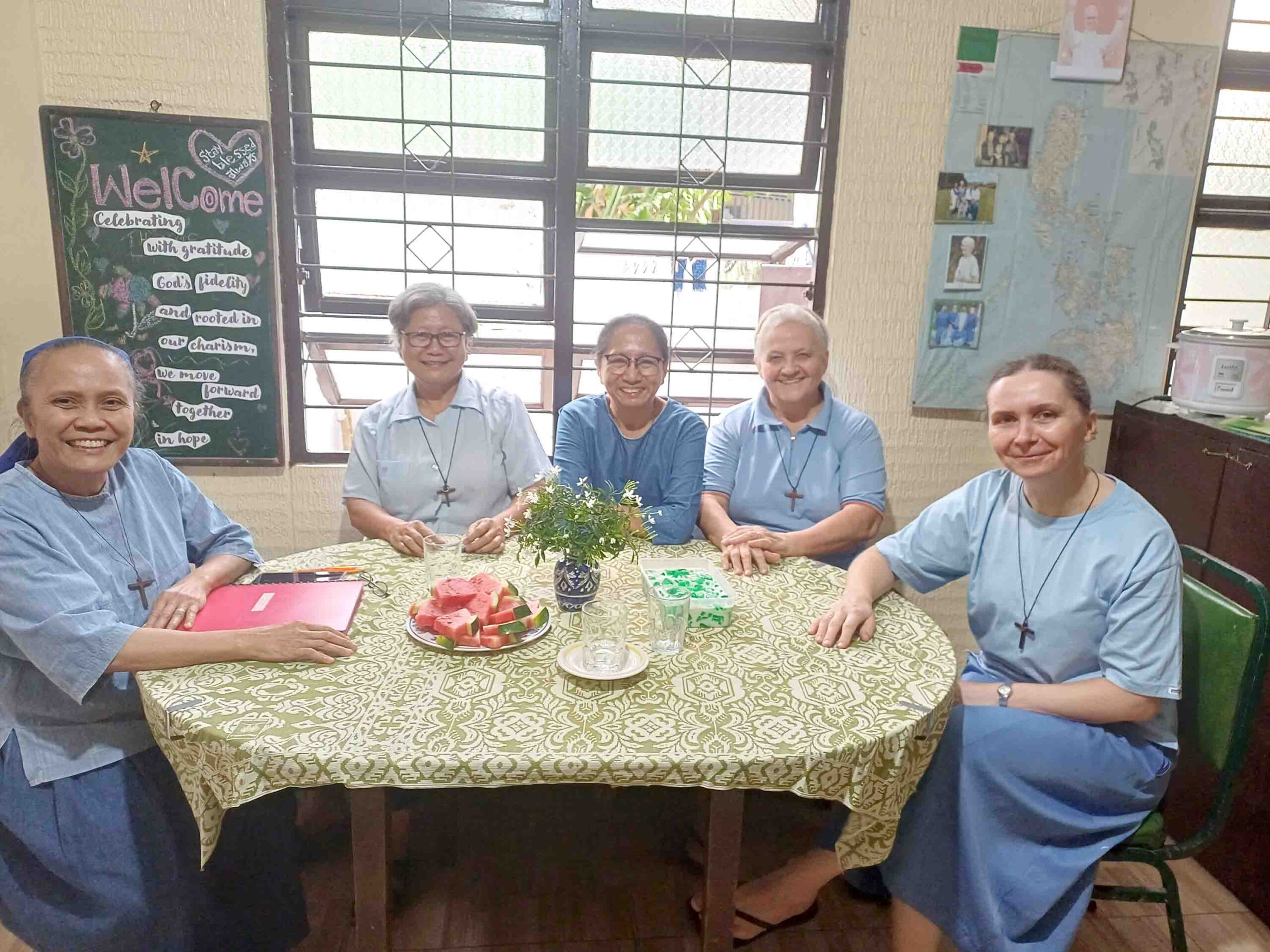
Renewing and deepening the acquaintance with this spiritual giant in his own chosen environment and meeting small communities of Little Sisters and Brothers, during our pilgrimage, was a profoundly moving experience. Martine, one of the Little Sisters of the Sacred Heart at Tamanrasset, spoke to us about her work with women and her care for the handicapped. “Little by little we establish bonds of friendship and they often ask me why I don’t become a Muslim. They want me to be saved like them! But, lately, there has been a significant change: some now ask me to pray for them. This is new. Like Charles de Foucauld a hundred years ago, we are still at the stage of attentive listening to the other. Our presence in this town of Tamanrasset and in this country remains very delicate.”
I had imagined Tamanrasset to be a sleepy small desert town lost in the vast expanse of the Southern Algerian desert only marginally developed from the 80 or so tiny houses and reed huts which Charles de Foucauld describes in his letters. To my considerable surprise, I found a sprawling urban agglomeration with elegant ochre colored buildings and large tarred avenues. The population of the town – now at around 120.000 and growing – exploded in the 1990s during Algeria’s season of terror. Many people from the North sought refuge in this desert town which was not touched by the mindless violence raging in the coastal region, and never returned. Considerable numbers of black African migrants also pass through this ‘gateway to the desert’ in search of a passage to Europe but frequently end up in prison where they languish without assistance in often appalling conditions.
THE SCRIPTURES CAME ALIVE
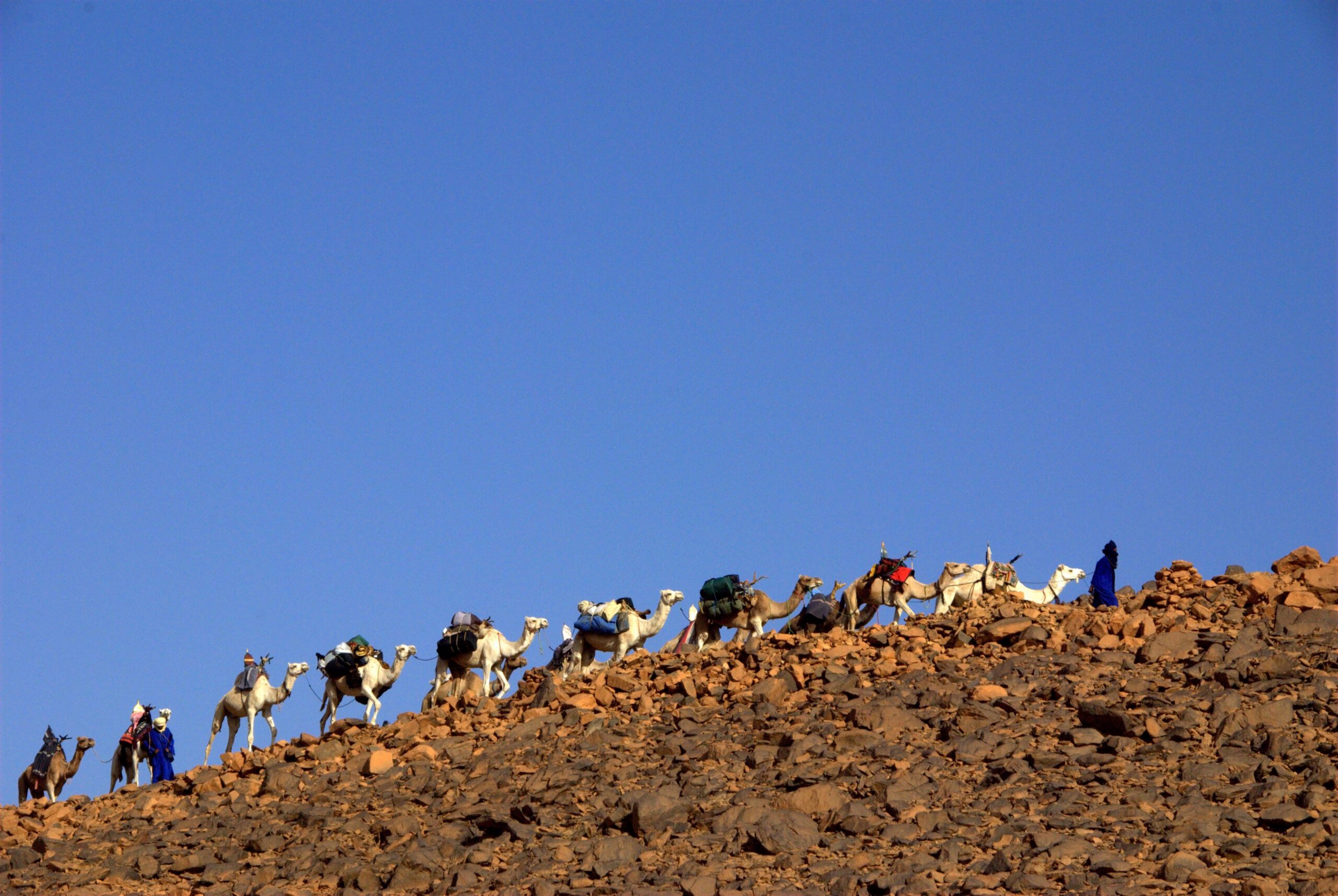
From Tamanrasset, we made our way on foot to the hermitage of Charles de Foucauld at Assekrem, some 75 km away, over a period of five days accompanied by a group of Tuareg guides and 17 camels. Almost immediately the stark beauty of the mountainous desert landscape we traversed imposed itself upon us. There were no elegantly shaped sand dunes as we might have expected but sandy meandering dry river beds and towering rocky outcrops often shaped into strangely recognizable forms by wind and sand. A feeling of wonder at the beauty of creation took hold not unlike the sentiments expressed in some of the psalms which we prayed together each morning. The desert, of course, is a persistent theme in the Scriptures and actually walking in this environment makes the Scriptures come alive with added poignancy.
The discovery of a great variety of life in the heart of this stony wasteland – an abundant variety of little flowers, plants, insects, the occasional oasis – gave a concrete feel to many a prophetic promise in the Bible. But the absence of water – we could not wash for a week – the overwhelming silence of these vast spaces, the lack of human habitation underlined the stripping down effect of such a desert experience. As we progressed on our pilgrimage, periods of walking in silence naturally alternated with lively personal conversations and occasional deep sharing. A rhythm of prayer together in the early morning and Eucharist at night gave a meditative structure to our day.
YOUR LIFE IS THE GOSPEL
Putting up camp at the foot of the Assekrem plateau and climbing the final lap to the hermitage at 2,700m with its breath-taking view of the Atakor mountain peaks constituted a fitting climax to our week-long trek. A small community of three Little Brothers of Jesus, Polish, French and Spanish, live here in utmost simplicity. Brother Ventura whose turn it was to welcome the visitors that day – a stunning 15,000 people, mostly tourists, come to visit here each year – offered us a small glass of tea when we arrived. As there were more groups expected, he had little time to share his knowledge and experience with us. But the next morning he was more forthcoming: The Little Brothers came to live here in 1953 and built other hermitages in addition to the one established by Charles de Foucauld.
Theirs is a life of great asceticism. (“Your very way of life should cry the Gospel from the rooftops,” Charles de Foucauld wrote in the Rule he composed for his followers.) All they have for sustenance is a daily diet of potatoes and onions with an occasional chicken when they can have one brought in from Tamanrasset. With a yearly ration of water of just 10,000 liters, not a drop can go to waste. The three Brothers strive to make their mountain dwelling a place of encounter. The Algerians who come to visit generally are ignorant of the origin and purpose of the hermitage. When they discover that this is a praying Christian community, they often express astonishment and delight because they have the impression that European Christians do not pray!
“Islam transformed the life of Charles de Foucauld,” Brother Ventura finished by saying. His own, no doubt, equally has been deeply affected by his long sojourn in this prayerful isolated Christian enclave in the middle of the Algerian desert. Maybe the imaginative title of Bishop Claude Rault’s recently published book, ‘Désert, ma cathédrale,’ aptly sums up our common pilgrim’s experience.