
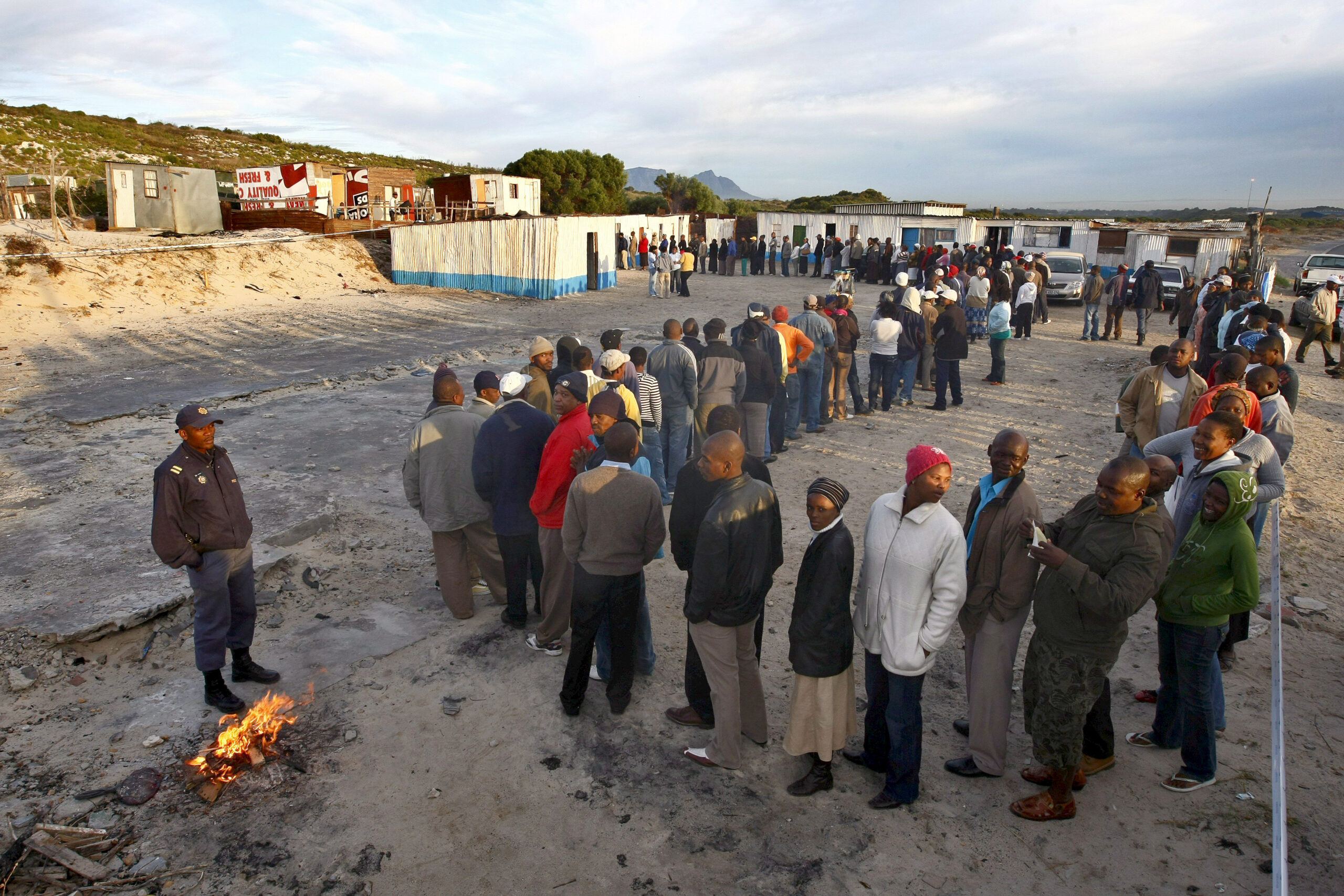
Fifteen years after the miraculously peaceful transition from half-a-century of apartheid oppression to the first democratic election, South Africans had another election in April. The truly historic ‘Mandela moment’ is a distant memory now. The collective descent from the heights of that transfiguring experience to the harsh realities of unemployment, poverty and the faults and failings of the present political leadership has been a painful one. Not so long ago, at a gathering in Nairobi, I overheard Archbishop Desmond Tutu’s plaintive sigh: “Is this what we fought for?” At the time of the inauguration of President Barack Obama – America’s ‘Obama moment’ – there was a palpable sense of solidarity and recognition here in South Africa and the press was full of somewhat nostalgic questioning on ‘what happened to our own supreme moment’? The present mood is one of growing disillusionment and sometimes despair.
“South Africa has so much going for it, if you look at the magnificent roads, the industrial infrastructure, and the mineral wealth. I have great hopes for South Africa as the motor for development in the rest of Africa and a model for democratic change. But then, when I look at the shenanigans of the political class, I fear they may end up going down the road of our own autocratic regimes,” Fr. Emmanuel Omollo, who hails from Uganda, told me on a recent visit. And there are indeed plenty of reasons for concern. The media carry regular stories of corruption in high places and there is evidence of growing impunity. Rampant poverty and a high level of unemployment are no doubt largely responsible for South Africa’s horrifying crime rate and the recent targeting of foreign migrants. In a month alone, two priests were killed in armed robberies.
A LONG WAY TO GO
Confidence in the democratic process is severely tested by the newly-elected president, Jacob Zuma, whose moral integrity is in severe doubt because of a corruption charge, dropped just a few days before the elections. The Southern African Bishops Conference published a wake-up call in the middle of February appropriately entitled: “Awake! Awake! Protect our democracy.” In it, Archbishop Buti Tlhagale makes a passionate appeal for voters to guard against blind loyalty, intolerance, intimidation as well as corruption. “Every citizen must ask whether the party they have supported in the past is making a real contribution to the progress of our people…. Freedom of speech does not give a person the right to speak abusively about others…. We all need to demand continuous accountability and a spirit of service from our leaders at all levels.”
Turning the tide of half-a-century of apartheid marginalization and systematic disenfranchisement of the majority Black population is, of course, a Herculean task and was never going to be easy. Maybe South Africans have been expecting too much too soon. Expectations were indeed dizzyingly high when Nelson Mandela was inaugurated. A lot of ground has been covered since. The Rural Development Program, for instance, has provided simple but decent housing for hundreds of thousands. But there is still a long way to go.
The well-known South African author, André Brink, in his recently-published autobiography, beautifully captures both the impatience at the slow pace of reform and the quiet hope for an integrated ‘rainbow nation’ in this endearing anecdote: “These days, when I am tempted to give in to the temptation of discouragement, or to succumb to the uncertainty that lies just under the skin of the new South Africa, I find hope in a small incident that happened to a friend of mine in the Cape. His little son had just started school. And to the great satisfaction of my friend, who is White, his son very quickly struck up a friendship with a small Black boy. Within a few weeks they became truly inseparable. Then one afternoon, after a few months, the dad of the Black boy came to fetch him from school after class. His little White friend just looked at him in silent amazement. The next morning, at the crack of dawn, he hurried back to school to wait for his mate to reappear. When he arrived, the little White boy ran to meet him at the gate and, out of breath with excitement, blurted: “You never told me that your dad was Black!”
Comments André Brink: “If this is what is happening to racial perceptions, we’re on the right track.” This is just a small anecdote but it says something about the changes in South Africa. And this is the only place where this can start: with our children.
A SENSE OF HOPE
When my congregation of the Mill Hill Missionaries accepted an invitation to come to South Africa, to the diocese of Kroonstad, during the second half of the 1990’s, reconciliation – promoting better understanding and integration between Whites, Blacks and people of mixed race (the so-called ‘Coloreds’) – featured high on the agenda. What, I wondered, had happened to this lofty missionary ideal over the past decade or so? On a three-month sabbatical in Cape Town, I was in an ideal position to pay a visit to the small contingent of missionaries now active in a number of parishes around the industrial town of Sasolburg, in what could be described as the heartland of white Afrikaner farm country.
At the end of a three-day visit, I came away with a sense of quiet satisfaction and hope for the future. President Obama’s famous ‘Yes, we can!’ best describes my – admittedly brief and limited – experience and assessment of our missionary involvement in the area. Six missionary priests and three students are now active in this Northern part of the diocese of Kroonstad. They themselves, coming as they do from very diverse national and cultural backgrounds – Kenya, India, UK, Cameroon and Uganda – in many ways model the ‘rainbow nation’ ideal held up by Nelson Mandela. In how far their living together in mixed communities has an impact on the still largely racially separate – a legacy of apartheid – communities and the sometimes deeply entrenched prejudices that go with it is, of course, a matter of conjecture.
“We believe in small steps,” Fr. John Doran told me as he showed me the Church’s signboard at Viljoenskroon. Attitudes are particularly unshakable here, I was told. He had recently changed the English text to include a ‘welcome’ message in both Afrikaans and seSuthu. Each one had their own stories to tell of lingering prejudice and slow progress towards better understanding. When Fr. James Juma could only celebrate one Mass on All Saints Day and decided it would be in the Black township, he invited the White community to cross over to the Black township. For the first time, over a dozen or so Whites made the move! The ministry of reconciliation and the change of attitudes clearly demands courage as well as infinite patience and tolerance. When the father of a White bride-to-be pronounced his veto on the blessing of her marriage by a Black priest, Fr. James Juma, who himself is Kenyan, had to call upon all his diplomatic skills, without compromising his sense of justice, to handle the matter. Eventually, his patience paid off and the father relented. The integration of youth ministry is still a matter of fierce debate, as I discovered, and lays bare the root of much hesitation in this field as elsewhere, namely: fear.
TRUE CELEBRATION
Celebrating the Sunday liturgy with Fr. Emmanuel Omollo in two Black townships was a real tonic. It gave me a sense of how far these communities have moved in self-confidence and legitimate pride since I first visited this area more than a decade ago. Admittedly, active Involvement in parish life still leaves much to be desired, but the enthusiastic participation in Sunday liturgies may be a good launching pad for further involvement.
One of my fellow participants in this sabbatical course, a Black priest from a diocese in the North of the country, puts it this way: “On Sundays I celebrate in three separate communities: the White parish in town always finishes within the hour and is very sedate; the ‘Colored’ community is a bit more lively. But when I get to the Black township, then ooh…”, his arms go up and his face shines. No need for words. This sense of celebration is undoubtedly Black Africa’s special gift to the universal Church!