
It is easy to hear that a singer, an actor, a movie, or a fashion has entered into a myth. The movie King-Kong “has become a myth,” it was said in the 30s, when the film that narrated the feats of the monster was attracting crowds of spectators. It is in our own time that Harry Potter has earned a “mythical income” because of the millions of copies sold, etc…
The scholars of anthropology, history of religions and psychology naturally propose a wider definition: myth is an attempt to answer the great questions that, sooner or later, we put to ourselves about the world, the past, life, death, happiness, evil. Questions and answers that every generation puts and gives to itself and then passes over to the next.
We find myths in every culture and they have the same dynamics: stories that greatly use the imagination and have the task of representing whatever reason and experience cannot fully explain. The cosmos in which we live is not seen as something mute, cold, still… It is perceived as loaded with meaning, carrier of messages, as something that speaks and becomes understandable by the very myth. Myth has always something mysterious, hidden like the seed within a fruit and somehow offers the explanation, the interpretation.
Myths are many: they deal with the universe, the heavens, weather phenomena, the beginning of life, social organization, etc…. It has been calculated that only in Africa, that myths, popular stories and legends that contain them, could be as many as 250,000.
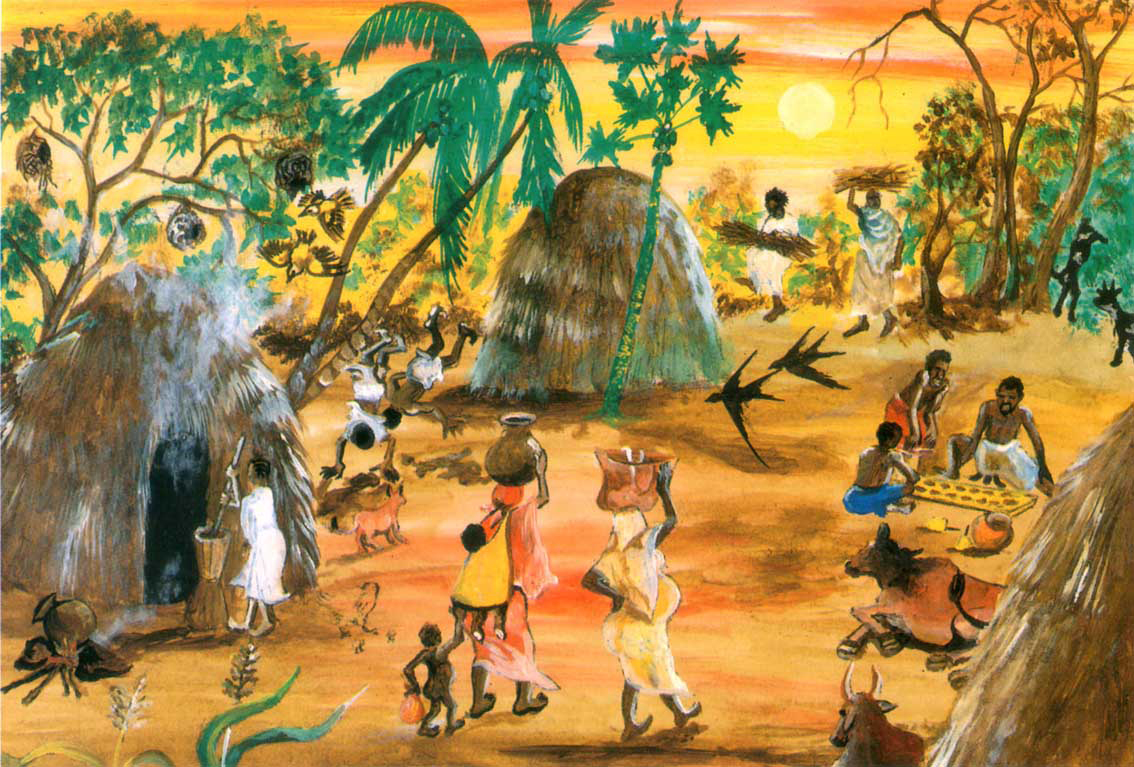
They do not pass from one generation to another only under the form of simple stories, repeated at night around the fire in order to entertain children and make them sleep. They are almost always transmitted by means of rites, ceremonies, dances, invocations and celebrations that allow the individual to integrate with nature, with the invisible and not to remain at the mercy of the events that are transient, above all of suffering and death.
THE FORBIDDEN TUBER
Many myths refer to creation, to how the universe was put in orde. In almost all, there comes back the notion of “high” and “low”: the Divinity is “up there” in heaven; human beings, animals and plants are “down here” on earth. Almost always, human beings appear last. A Kiga (Uganda) myth narrates that Imana (The-One-who-dwells-with-us) in the beginning created two countries: one above the clouds made up of the sun, the moon and the stars and the other, below the clouds. It is this second one that we inhabit, together with the trees and the animals created by Imana.
In the stories, we see a golden age, when the Divinity was living close to the human beings and was sending messages entrusting them to the so- called “mythical ancestors,” whom anthropology calls “cultural heroes.” The Gbaya people of the Central African Republic speak of the mythical ancestor, the first human being, the cultural hero who brought people the seeds of plants and taught them how to cultivate the land. He was cunning, if necessary, a liar, a provoker and anti-conformist. The Chagga people of Tanzania tell that God had a servant to whom he used to entrust the tasks to be executed. It was this servant who discovered that humans, disobeying God’s order, had eaten a certain type of tuber. God then decided to punish them with sickness, famine, war and death.
GOD AS A POTTER
As for the circumstances and ways that have accompanied the arrival of the human beings in this world, there is a large variety of versions. In one of his works of 1938, after inspecting more than 2,000 African myths, Herman Baumann wrote that “the idea of the creation of human beings from clay is very widespread in the continent.” In order to mold the human being, God acted like a potter. Shilluk people (Sudan) think that God used clay of different colors and this would explain the different pigmentation of human groups. The Bambuti pigmies of the Democratic Republic of the Congo say that the Divinity (Arebati) shaped the first human being with clay; he then covered him with skin and poured blood on the lifeless body: only then the first human being started breathing and became alive. The Batwa pigmies state that they are “children of God.” The Tivs (Nigeria) narrate that the first human beings didn’t know how to cultivate the land until the day when Aondo taught them; from that day, great was the joy of all. To the Bambuti, God taught blacksmithing so that they might build for themselves the weapons and the necessary implements for a life of hunting in the forest: “You will never lack game” is what Kmvum swore them.
THE SIN OF DISOBEDIENCE
Then came the separation of the two worlds, with ill-omened results for humanity. The communication between God and people was interrupted; the messages destined to human beings are no longer there or are no longer understood. Many myths explain how the happy relationship between the Creator and humanity ended in a definite way. Most accounts attribute this to an open disobedience on the part of the human beings: God imposed laws on them but they didn’t respect them; neither did they take them seriously. An Ewe’s (Togo) myth tells us that God had decided to live with the people He had created. He was coming down regularly on earth, sliding down a rope. He was thus able to encounter His creatures and, being near, solve their problems. He, however, had ordered: “Let nobody touch this rope for no reason whatsoever.” But, one day, a woman, driven by curiosity, decided to touch the rope. God then got angry; He went back to heaven, cut the rope and swore that He would never come back among the people any more. Bari, Fajulu, Toposa and Madi (Sudan and Uganda) share the story that, in the beginning, heaven and earth were united by a rope or a bridge and that God, from time to time, was coming down on earth to spend time with people. The rope, however, broke up accidentally or was eaten by the hyena so the link between God and humanity came to an end.
Without paying attention to the reason that brought about God’s estrangement from the earth – whether because a disobedience or an unwelcome accident provoked by humans – in all the stories, it is evident the that those who drove humanity into perdition were the human beings themselves. John Mbiti comments in African Religion and Philosophy: “It appears that the African image of happiness was tied to God’s presence among the people, to whom He was warranting food, shelter, peace, immortality and a moral code. As far as I know, no solution that could remedy this great loss of human beings appears in any myth. Humans have accepted their separation from God and, in different ways, they try to recover the contact with Him by means of acts of worship.”
THE LAZY ANIMALS
Several are the myths that try to explain the entrance of death into the world. Life and death are the greatest unknown factors of human experience. In many cases, death is attributed to a “message that never arrived.” According to several stories, God sent His life and death messages entrusting them to animals. In particular, to a dog and a hare. To the former, He entrusted the life message; to the latter, the death message. They both set out running. The dog, however, came across a bone, and stopped to gnaw it, whereas the hare continued the journey. This is how the message received by the human beings came about: “God said that you will die.”
An Ashanti (Ghana) myth tells us that, after having gone far from humans, the Divinity (Onyankopon) sent them a goat with this message: “There is something called death. One day, it will kill one of you. Even if you die, however, you will not be completely lost: you will come to Me in heaven.” A little while along the road, the goat stopped to graze. Seeing this, Onyankopon sent a ram with the same message. Upon arrival, however, the ram changed the content of the message: “Onyankopon lets you know that death is for everybody.” When the goat arrived and passed on God’s exact words, nobody paid attention. There are also myths about the end of the world or cosmos. According to a story of the Songo (Tanzania), when the end of the world is near, the sun will become dark. Then another two suns will appear: one from the East and the other from the West. The two celestial bodies will meet in the middle of their route and then the world will end. When this takes place, Khambegu, the hero-god of the traditional religion, will come down on earth and save the Songo people, while the rest of humanity will be lost.
AT THE SERVICE OF AUTHORITY
In all communities, from family to larger ethnic groups, the problem of authority is one of the most important: how one inherits it or conquers it, and how one keeps it. The motivations by which the different cultures justify the transmission or the exercise of power are often of a mythical nature. In his book Le Renard Pale, Marcel Griaule wrote that “myths have authority and serve to justify very concrete reality of social life: land property, social status, political authority, etc….” Myths create a world in which there enter infancy memories, attachment to the known realities and the security warranted by a given system: all things that end by justifying a certain submission. As a matter of fact, the powers attributed to sovereigns and chiefs underline the origin of the power from above and keep track of a founding myth. The chief can condemn to death, slavery or exile. He is called to assure the prosperity, also to protect his people from drought or flood. Chiefs are seen as mediators between their community and the Divinity and their praises are sung by the Griots who, by the power of their word, may confirm, lift up and consecrate their power. To confirm the people in their conviction that chiefs are called to shelter their social groups from evil is the central theme of all myths.
THE POWER NEEDS MYTHS
Many are the scholars who believe that inherited myths are in crisis. The rites that insure the continuity of the vital forces, good or bad, that contain benediction or curse and transfer, from one generation to another, keys of interpretation and guidelines of behavior don’t speak any more as in the past. Oral traditions are weakened; the power structures, that the modern political language exalts or puts down without much of a problem, do not need justifications, propitiatory rites or exorcisms. “The Griots’ culture has already disappeared, especially in the cities,” the weekly magazine Jeune Afrique wrote in 2002. The music and the ideas offered by radio and television are much different from those of the minstrels of years gone by.
We can say, in the end, that myths endure but change. From the true and real mythology, they pass to the lower mythology of folklore, including the political one. Michael Korda wrote in 1975, in Power! How to get it, how to use it: “Every power needs rituals and myths. It has always been like this. Those who aspire to power must be ready to follow the rituals of power and occupy their place in the local mythology. In Ethiopia, the 1955 Constitution stated that Emperor Haile’ Selassie’ was the 252nd descendant of the dynasty born from the biblical love story between the Queen of Saba and King Solomon and that “his person was sacred, his dignity inviolable and his power unquestionable.”
The ‘personality cult,’ both in regimes of the right and left, in Africa, during the last century, legitimized dictatorships that sometimes passed into history for their ferociousness. For decades, it drew from the mythological language, introducing certain chiefs not only as exceptional individuals, but as supernatural, infallible beings. A minister of the late Congolese President Mobutu used to say: “Mobutu has come in the name of our ancestors; sent by them, he has brought peace, understanding and fraternity… He is forever.” We can eventually say that even some religious movements, generous in prophecies, healings and promises of prosperity, seem to want to capture the space left free by the vanishing myth. They light up the minds of the faithful, offering them surprising solutions to the problems that are troubling them. More or less, as myths always did.