
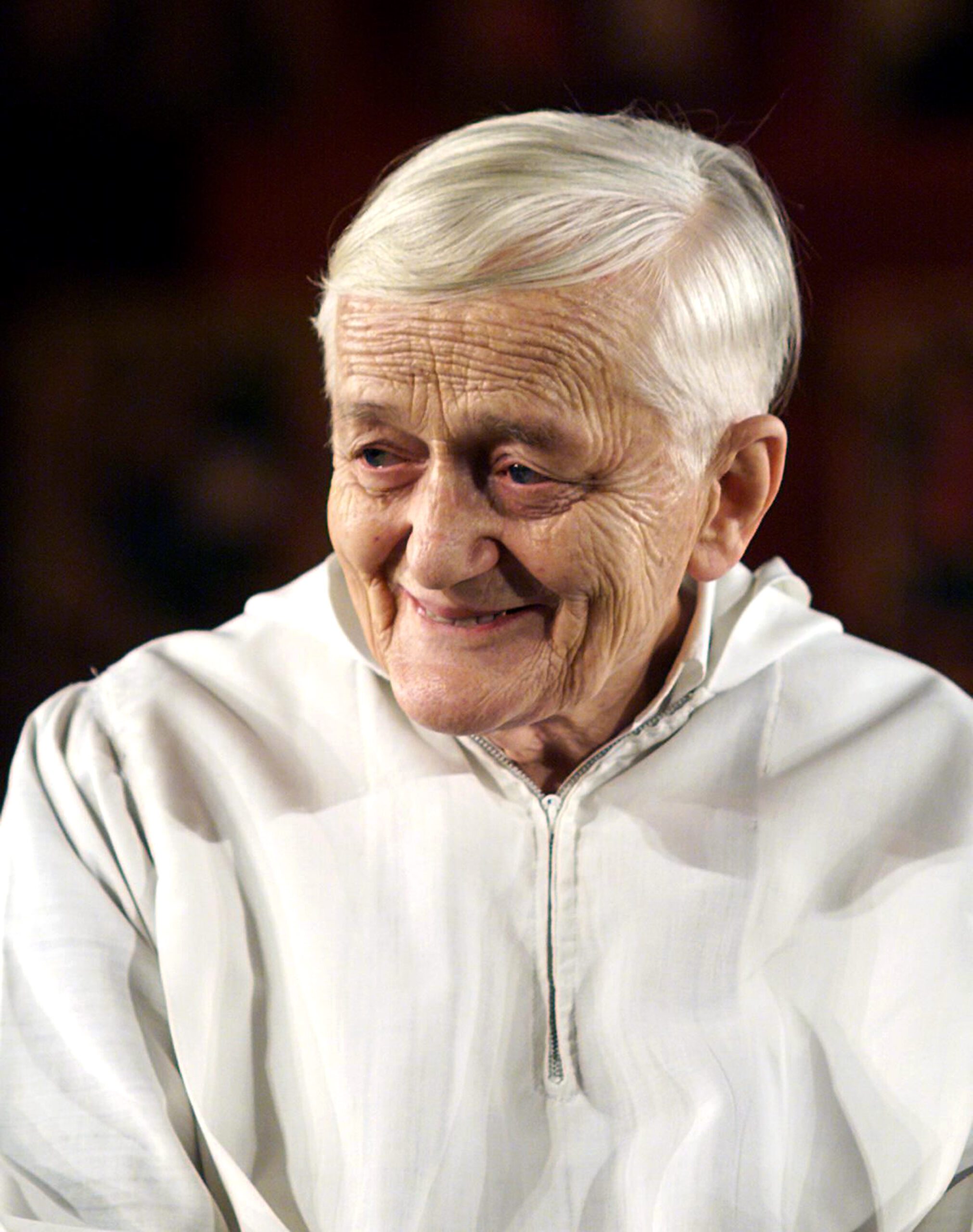
Thousands of people, most of them young, gathered at Taizé, in France, on Tuesday, August 23, 2005, for the solemn funeral of Brother Roger Shultz, the founder of the “ecumenical monastery” of the same name and an internationally renowned religious figure who had fallen victim to a deranged woman only a week before. Brother Roger’s sudden and tragic death was a shock to the whole world but especially to many hundreds of World Youth Day pilgrims who were spending some days at Taizé on their way to Cologne and to their first encounter with the newly-elected Pope Benedict XVI.
The crowd on the hills of Eastern France, under leaden and showery skies, reflected the spirit, and also the popularity, of Brother Roger Schultz. Notwithstanding the inclemency of the weather, the atmosphere was festive even if subdued. Eventually, about fifteen thousand people gathered in and around the huge monastery chapel.
Brother Roger’s simple coffin, a wooden icon lying upon it, was carried into the church by the Taizé Brothers. It was followed by a group of Romanian children who had been visiting the community when Brother Roger was killed.
Although Roger Schultz was a Protestant, he received a Catholic funeral in accordance with his own wishes. Brother Roger had pursued many ecumenical dreams during his long life but, in death, one of them came true: his funeral was a Catholic Mass presided over by Cardinal Walter Kasper, the president of the Vatican’s Council for the Unity of Christians. Brother Roger’s many friends, including President Horst Köhler of Germany and the retired archbishop of Paris, Jean-Marie Lustiger, attended the liturgy.
During his homily, Cardinal Kasper said: “Yes, the springtime of ecumenism has flowered on the hill of Taizé.” in this way repeating a famous expression of Pope John XXIII, during his first meeting with Brother Roger, many years before.
“SHE DOES NOT KNOW WHAT SHE DID”
Ninety-year-old Brother Roger was mortally stabbed by a Romanian woman on Tuesday, April 17. The attack took place at around nine in the evening, during vespers, in the Reconciliation Church where more than 2,500 youths were present. According to the reconstruction of the crime, the woman managed to gain access to the Brothers’ choir; she approached Brother Roger and knifed him three times in the neck and in the back. At first, no one noticed anything: the victim remained seated and it was only after a while that people became aware of the pouring blood.
Bro. Roger was taken home where efforts by a doctor from among the crowd to assist him proved useless. Brother Roger died immediately afterwards. Romanian officials and acquaintances of Luminita Solcan, 36, said that she was a highly intelligent woman who had plunged into paranoia and religious mania after the death of her father seven years before and had been turned away by several convents. During the funeral, Brother Roger’s successor, Fr. Alois Leser, a Roman Catholic priest from Germany, prayed for forgiveness: “With Christ on the cross we say to you, Father, forgive her, she does not know what she did.”
A DREAM CAME TRUE
The Taizé monastic community encompasses, today, more than 100 members from 30 countries and virtually every major Christian denomination, with a presence also in Brazil, Senegal and South Korea. The four Roman Catholic priests from among the members concelebrated the funeral Mass with Cardinal Kasper.
Pope Benedict, in his message, called the killing: “A very sad piece of news which touches me all the more in that I received only yesterday a moving letter from him.” The pontiff also revealed: “In the letter that Brother Roger wrote, he had expressed the desire to come to Rome as soon as possible to meet with me and to tell me that the Taizé community wished to walk along in communion with the Holy Father.” The pope concluded: “We know for sure that Brother Schultz is in the hands of God’s everlasting kindness and love; he has reached eternal joy.”
The generous words of Benedict XVI remind us of a circumstance that did not escape the attention of the world media: the Protestant Brother Roger received Communion from the then Cardinal Joseph Ratzinger at Pope John Paul II’s funeral in St. Peter’s Square. Although intercommunion is forbidden at Taizé − only Catholic priests are allowed to celebrate the Eucharist − characteristically, even during Brother Roger’s funeral, Communion was given to all the people who came for it without discrimination. Was it carelessness or culpable negligence of Church laws? I don’t think so. I think that, perhaps, exceptionally, just for once, Brother Roger’s dream came true for all!
UNDER THE SHADOW OF THE GREAT CLUNY
Roger Schultz was born in the Swiss Jura, in 1915, the youngest son of a Lutheran pastor and a French Protestant mother from Burgundy. As a young man, he showed an interest in Catholic spiritual writers, like Blaise Pascal and others. When he began his theological studies at the University of Lausanne, he chose as the subject for his thesis: “Is Saint Benedict’s ideal of the monastic life in conformity with the Gospel?”
In 1940, he visited the village of Taizé, in Burgundy, only a 10-minute drive from Cluny, the site of Europe’s largest and best-known monastic abbey before its destruction during the French Revolution. With the idea of founding a Protestant monastic community, he bought two derelict houses and there he started helping the war victims: abandoned children, Jews fleeing Nazi persecution on their way to Switzerland, members of the Resistance.
He was forced to flee from the Gestapo in 1942, after being denounced to the collaborationist Vichy regime. Back in Switzerland, he was joined by a group of ecumenically-minded friends among whom Max Thurian, “theologian” of the Swiss Reformed Church. Together with them, he returned, in 1944, to Taizé to set up a community. As he explained: “I discovered my Christian identity by reconciling within myself my Protestant origins and my faith in the Catholic Church.”
Five years later, the first Brothers took the three traditional monastic vows, in a slightly modified form: celibacy, sharing of possessions and acceptance of an authority. Brother Roger drew up the first rule of Taizé, which was summed up in the phrase: “Preserve at all times an interior silence to live in Christ’s presence and cultivate the spirit of the Beatitudes: joy, simplicity, mercy.” The community did not seek official recognition, and although it was viewed with suspicion by the mainstream Churches, both Protestant and Catholic, it grew rapidly. The Brothers numbered 12 in 1950, 65 in 1965.
In 1969, the head of the French hierarchy, Cardinal Marty, authorized Catholics to join the community. Today, Catholics are in the majority and some Protestants feel that Taizé has sold out to the Catholic Church. Brother Roger never concealed his Catholic sympathies. He always defended clerical celibacy and even accepted the “universal ministry of the Pope” in the perspective of a reunited Church.
THE ATTRACTION OF A CATHOLIC MASS
Brother Roger was on excellent terms with Rome. John XXIII defended the community when he was nuncio in France and, when he became pope, he invited Roger and Max Thurian to attend the Second Vatican Council as observers. Pope John Paul II visited Taizé in 1986, “impelled,” as he put it, “by an interior need.” He congratulated the members of the Taizé community for “desiring to be themselves a “parable of unity.”
Brother Roger never concealed his inclination towards the Catholic Church, yet he never took the final step to join it, thinking that his vocation was to remain on the threshold in order to be a bridge-maker for his Protestant brothers or maybe because he did not think it was necessary to renounce his roots in order to be in union with the Catholic Church. That was not the case for his companion Max Thurian who was received into the Catholic Church and was given the Holy Orders in a discrete ceremony conducted by the Archbishop of Naples, Cardinal Ursi. Obviously, the desire to celebrate the Catholic Eucharist proved too strong for Max Thurian!
Today, people of all confessions flock to the hill of Taizé. The Youth Council, organized by Taizé in 1974, attracted 40,000 participants, including an Anglican bishop, an Orthodox Metropolitan bishop and no fewer than five cardinals. Since then, it was repeated in different parts of Europe. For decades, Taizé has been a center for the spiritual renewal of tens of thousands of youths from across the world. And along the many years that saw him grow extremely old, Brother Roger continued to be the center of Taizé’s attraction and inspiration. Among many others, in 1988 he was awarded the UNESCO prize for peace education, and in 1992 the Robert Schuman prize for European unity.
Brother Roger’s charisma was founded in his unique religious witness expressed in his beautiful language, high ideals and moving prayers. He succeeded in channeling the revolt of the 1968 generation into the calmer waters of spirituality. He remains one of the main protagonists of the religious renewal among the youth of Europe and beyond, flanking founders of movements like Chiara Lubich and Don Giussani and personalities like Mother Teresa of Calcutta, to whom he was linked in a strong spiritual friendship.