
The war between the Communists from the North and the Southern forces backed by the Americans was raging in Vietnam when Bishop Francis-Xavier Nguyen Van Thuan was named Coadjutor of the Archbishop of Saigon by Pope Paul VI in 1975. That took place just few days before the South Vietnamese capital fell to the Communists and was renamed ‘Ho Chi Minh City.’ Bishop Van Thuan was 48. After only three months, on August 15, 1975, the solemnity of the Assumption, he was arrested and thrown into prison both because of his faith and his family connections (his uncle was a former president, assassinated in 1963).
There he remained, without a trial and a sentence, for 13 years, including 9 in isolation, until November 21, 1988. As he himself wrote, they were terrible years during which he did not allow himself to be overcome by despondency or even passive resignation. He made efforts to live out his captivity, “filling it with love.” He was helped by the prayers of his faithful but especially of his mother who, from the moment of his arrest, never ceased to ask the Lord that her son be faithful to the Church.
AN UNUSUAL CHALICE
Bishop Van Thuan was first driven 450 kilometers north, in the area of his former diocese of Nha Trang, where he was shut up alone, within earshot of the sea and of the bells of his former cathedral. “They tear at my heart,” he wrote in his little book, Five Loaves and Two Fish. Later, the Viet Cong took him north in the hull of a ship with 1500 starving prisoners. He was set to work in a “re-education” camp.
At the moment of his arrest, they allowed him to write a letter to ask his relatives the most necessary things. He thought of asking a little wine as medicine against stomach-ache. His faithful understood very well that that wine would serve him to celebrate the Eucharist. They, therefore, sent him a little bottle with the label: “Against stomachache.” With that wine, he managed to say mass, using tiny hosts and the palm of his hand as a chalice.
He wrote: “The Eucharist has been for me and many others in prison the only strength, the only hope. What can be more consoling than the thought that Jesus is with you, suffers with you, cries with you. It reminds you that the entire Church is with you, starting from the pope. In your cell, you are never alone… But Jesus does much more than to go through your own pain. He helps you to change it into love. This is the difference.”
A BIBLE WITH SCRAPS OF PAPER
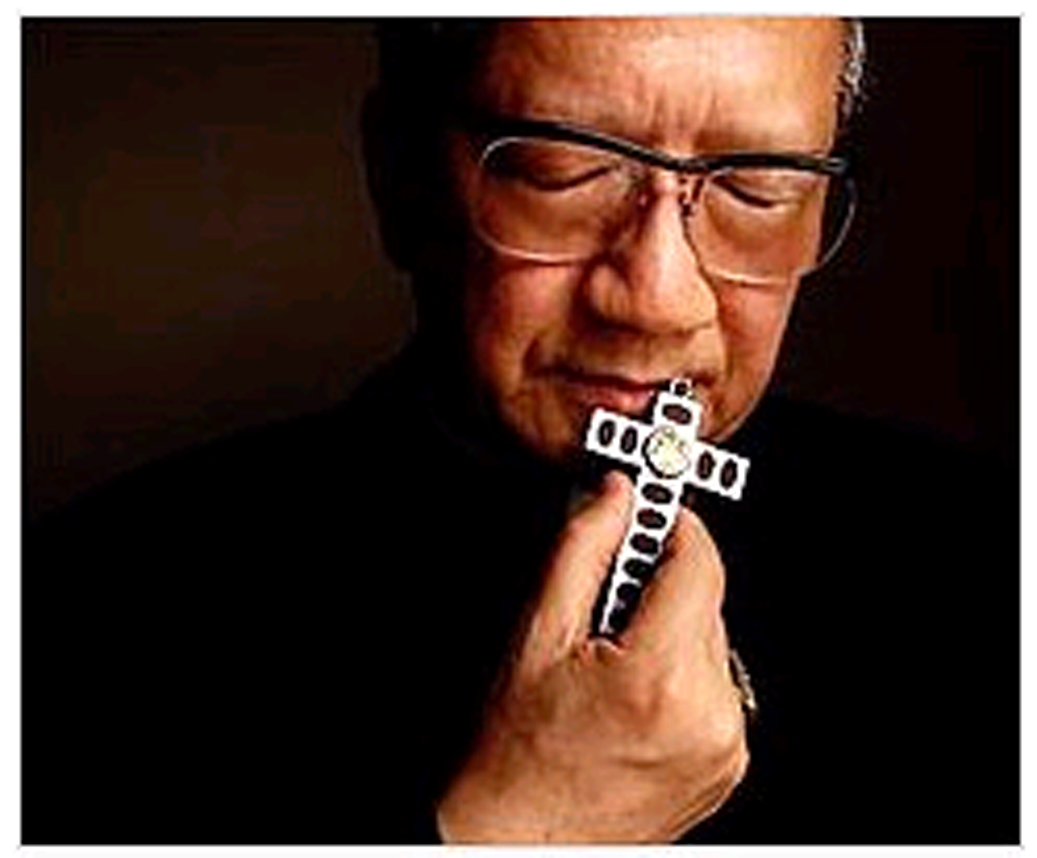
Up to the moment of his death, Bishop Van Thuan wore a memento of this period around his neck: a pectoral wooden cross on a fuse-wire chain which he fashioned in secret and hid for many years in a bar of soap. He wrote: “It is not beautiful but for me it is a symbol, a reminder always to love, and forgive and reconcile.”
This is how he describes the origin of that cross: “One day, while I was in the prison of Vinh Quang, I asked a guard to be allowed to cut a small piece of wood in the shape of a cross. Without hesitating, the guard agreed. In another circumstance, in a different prison, I asked a guard for a piece of electric wire. The guard was suspicious and scared because he thought I wanted to kill myself. But I reassured him explaining that I only wanted to make a kind of little chain for my wooden cross so that I could wear it around my neck. The guard not only got me the wire but also a pair of pliers and, together, we made the little chain.”
He could not take a Bible with him to prison. He then decided to collect all the scraps of paper and joined them together. He wrote in them 300 sentences from the Gospel that he remembered by heart. This makeshift Bible, together with the Eucharist, was his source of strength, the daily treasure from which he used to draw his energies of resistance.
He was later returned to solitary confinement, guarded by two policemen who were changed every two weeks to avoid contamination. His strategy was to love them, smile, talk to them, teach them foreign languages and answer their questions about the Church… He also wrote a book of more than one thousand exhortations to his people that were smuggled out on sheets of paper torn from a diary, copied by a child into a school exercise book to escape detection, and taken out of the country by one of the boat people. The Road to Hope has been translated in more than ten languages.
DESCENDANT OF MARTYRS
Cardinal Francis-Xavier Nguyen Van Thuan was born in Hue, Vietnam, on April 17 1928. He descended from a family profoundly Christian that counted among its elders numerous martyrs: in 1885 all the inhabitants of his mother’s village were burned inside the parish church, with the exception of his grandfather who, at that time, was studying in Malaysia. Also, some of his ancestors underwent fierce persecution and fell victims to it between the years 1698 and 1885.
His grandmother was illiterate but every night she used to recite the rosary for priests. His mother Elizabeth, at the time of his death, was more than 100 years old and living in Australia. She used to teach him the stories of the Bible and give him an account of the witness of the martyrs, especially his ancestors. She used to speak to him also about Saint Therese of the Child Jesus.
On June 11, 1953, he was ordained a priest. In 1959, he obtained a doctorate in Canon Law from the Pontifical Urban University. On his return to Vietnam, he was the rector of the seminary and vicar general. He was appointed bishop of Nha Trang in 1967. He soon threw himself into pastoral activity. He increased the number of seminarians from 42 to 147, developed lay movements and youth groups, built schools and promoted pastoral councils. He always described himself as a man of action, which made his suffering in confinement, when it came, so much greater.
When he was released from prison, the Communist authorities remained suspicious of his family connections and prevented him from taking up his appointment as auxiliary bishop of Hanoi. He was placed under house arrest at the Hanoi residence of the Archbishop, Cardinal Joseph Marie Trinh Van Can. In 1991, he escaped from Vietnam, after a threat to his life from a Vietnamese government official.
Since he was forced into exile away from his country, John Paul II welcomed him to the Roman Curia and in 1998 made him president of the Pontifical Council for Justice and Peace. He was made a cardinal in 2001. In March 2000, Cardinal Van Thuan preached the Lenten retreat for the Holy Father and the members of the Roman Curia. He would recall with pleasure the Holy Father’s invitation: “In the first year of the Third Millennium, a Vietnamese will preach the spiritual exercises to the Pope,” he remarked. And when the Pope asked him if he had a topic in mind, he answered: “Holy Father, I will speak about hope…”
JESUS’ MATHEMATICS
In the spiritual exercises, he described how he told his non-Catholic fellow prisoners, who were curious to know how he could go on hoping: “I left everything to follow Jesus because I love the defects of Jesus.” He explained: “On the cross, during his agony, Jesus heard the voice of the thief crucified on his right, ‘Jesus, remember me when you come into Your Kingdom.’ If I had been Jesus, I would have told him: “I certainly will not forget you, but your crimes have to be expiated with at least twenty years in purgatory.
Instead Jesus tells him: ‘Today you will be with Me in paradise.’ He forgets all the man’s sins. He does exactly the same with the sinful woman who has anointed His feet with perfume. Jesus doesn’t ask her anything about her scandalous past. He simply says: ‘Her many sins have been forgiven because she loved much.’ Jesus doesn’t have a memory like mine. He not only pardons, and pardons every person, he even forgets that He has pardoned.”
On another occasion he said: “If Jesus would have had to take a mathematics exam, He might have failed. He indicated this in the parable of the lost sheep… One of the sheep becomes lost and, without delay, He sets out in search of it, leaving the other ninety-nine in the wilderness. Finding it, He puts the poor creature on His shoulders and returns to the fold. For Jesus, one is equal to ninety-nine − and perhaps more.”
THE AUTHORITY OF SUFFERING
During the same retreat, the Cardinal also emphasized the need to love one’s neighbor. “One day, in prison, I was asked by a guard: ‘Do you love us?’ I answered: ‘Yes, I love you.’ ‘But we have kept you in prison for so many years, without a trial, without a sentence, and you love us? That’s impossible! Perhaps it is not true!’ I reminded him: ‘I have been with you many years, you have seen it’s true’ ‘When you are free, won’t you send your faithful to burn our homes, to kill our families?’ ‘No! Even if you want to kill me, I love you’. ‘But why?’ ‘Because Jesus has taught me to love everyone, even my enemies. If I don’t, I am no longer worthy to be called a Christian.’ The guard said: ‘It’s very beautiful, but very hard to understand.’”
The secret of Cardinal Van Thuan was his indomitable trust in God, nourished by prayer and suffering, accepted with love. The Eucharist changed the prison into his cathedral. The Body of Christ was his “medicine.” He recounted with great feeling: “Each time I celebrated the Mass, I had the opportunity to extend my hands and nail myself to the cross with Jesus, to drink with Him the bitter chalice. Everyday, in reciting the words of consecration, I confirmed with all my heart and soul a new pact, an eternal pact between Jesus and me, through His blood mixed with mine.”
Cardinal Francis-Xavier Nguyen Van Thuan died on September 16, 2002, in Rome, aged 74, after a battle with cancer over several months. During the last, long sickness, he kept his serenity, even joy… In the last days, when he was already unable to speak, his gaze remained on the crucifix that was in front of him, praying in silence, while he was consuming his supreme sacrifice, crowning an existence marked by his heroic configuration to Christ on the cross.
No one questions the moral authority his sufferings gave him: “Believe in one sole strength: the Eucharist,” he wrote from prison. “Keep precious one sole secret: prayer… One sole food: the will of the Father.” “This way,” he told his readers, “you will accomplish a revolution, to renew the world.”