
The roots of Satyagraha can be traced to Gandhi’s 1893 trip to South Africa where he had accepted a contract from an Indian firm (see biography). In this country, he saw firsthand the terrible reality of thousands of Indian immigrants living under racial segregation. The indignation he felt over the racial discrimination inflicted on his fellow Indians (and himself) by the British authorities led him to political action.
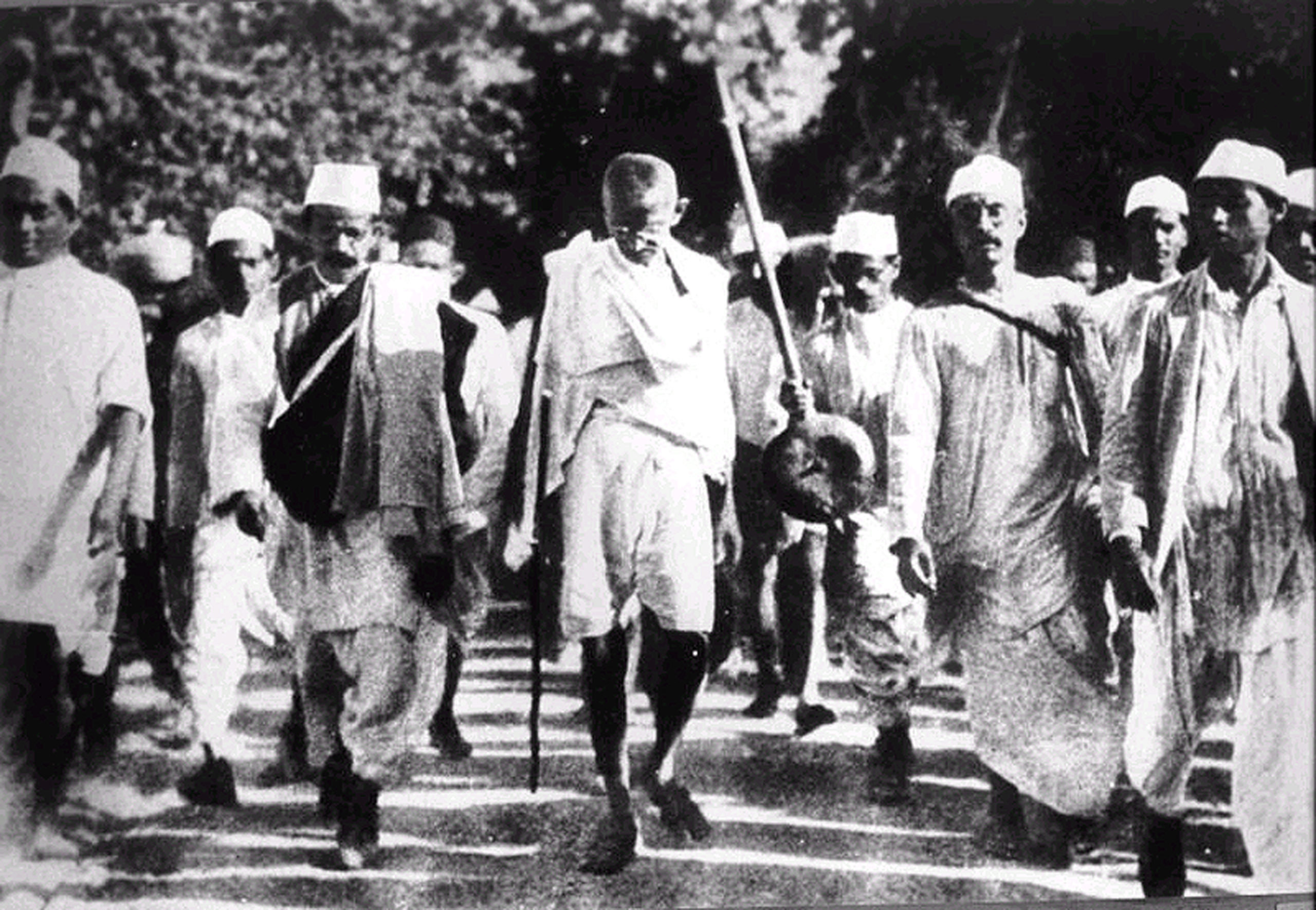
The Mahatma (Great Soul) became involved in the fight for his compatriots’ rights and on September 11, 1906, he launched a campaign based on a nonviolent resistance — Satyagraha — a total refusal to collaborate with the British authorities that made use of mass pressure. Thanks to Gandhi, peaceful rebellion and marches become the hallmark of the struggle for social and political equality.
Satya is Sanskrit for Truth, and Agraha is used to describe an effort, endeavor. Truth (Satya) implies love and firmness (Agraha) serves as a synonym for force. Satyagraha may thus be construed a ‘true force’, ‘the force of love’, or “the firmness of truth. It conveys the notion of ahimsa — avoidance of himsa, or injury.
THE APOSTLE OF PEACE
Archbishop Oswald Gracias, chairman of the Catholic Bishops’ Conference of India, said that “Gandhi was the apostle of nonviolence, peace and harmony. He had an inner strength and this, along with other virtues, helped him reach his goals. He had a huge following because people of every faith, caste and creed witnessed his spiritual strength, not to mention his political action.”
“The Mahatma’s message of nonviolence is important today more than ever, for India and the world,” the prelate said. “In today’s India, some segments of society have come under the sway of globalization and are leading the country away from the basic principles of peace, harmony and mutual co-existence for which Gandhi fought hard and upon which our beloved nation was founded.”
“The Mahatma loved India and his inner strength helped him overcome obstacles that lay on its path to freedom and independence. This love made him a much admired and beloved leader, an example followed by leaders like Martin Luther King and Nelson Mandela.”
“Today’s world is divided by hatred, violence and intolerance,” Archbishop Gracias noted. “And we should instead turn to this apostle of nonviolence who’s encouraged us to improve ourselves and move on the path of peace. Satyagraha’s centennial is a call to action for the international community to come together and overcome wars and terrorism.”
THE CORRECT PATH
Jesuit Fr. Cedric Prakash, director of the Prashant Human Rights Centre, said that “Satyagraha in the world we live in is, without doubt, the best way to achieve peace. When Gandhi launched his campaign for truth in South Africa exactly a century ago, he didn’t clearly foresee what this powerful weapon could bring about. It was successful in achieving Indian independence. For Satyagraha to be meaningful, we must ensure that our society becomes more open and transparent and that everyone’s rights are protected. Terrorism in any form must always be condemned. People around the world must condemn such actions without any appeal.”
“We are conscious that the world could become a different place if the world’s superpowers met the legitimate rights and aspirations of peoples and nations, and if we were serious about disarmament and dismantling the industry that encourages war and violence. Satyagraha and nonviolence are the only path to correctly deal with fundamental problems that today cause violence.”
A FOLLOWER OF JESUS
For Fr. Augustine Kanjamala, a well-known theologian and director of the Institute of Indian Culture, the “Mahatma Gandhi was one of the most complex personalities of the 20th century. He interacted with complex situations and people, first in South Africa where he clashed with injustice and social inequalities, and later in India where he fought for freedom from the powerful colonial oppressor. But his weapons were nonviolence and Satyagraha.”
“By his own admission, in his protracted struggle for justice, Gandhi was kept sound of mind by his spirituality. The Hindi concept of spirituality in the Bhagavad Gita [“the Song of the Divine One,” a poem comparable to the Gospels] and the Christian one embodied in the Sermon on the Mountain gradually became in him a single harmonious concept. He was always in touch with the social and political realities of his country and in dialogue with Hindus, Christians, Muslims and believers of other religions.”
“For me,” Father Kanjamala added, “Gandhi is an example that inspires dialogue. In the current context of clashes between civilizations, sectarian violence and corruption in public life, the Gandhian spirit, although difficult, is all the more relevant. In the last few years, the Church has redefined its mission giving preference to inter-faith dialogue, education and caring for the poor. Gandhi’s message and example will be of great assistance in rediscovering the meaning and relevance of Jesus, whom he always admired and followed.” Nirmala Carvalho; AsiaNews