
A Living Hell

INTRODUCTION

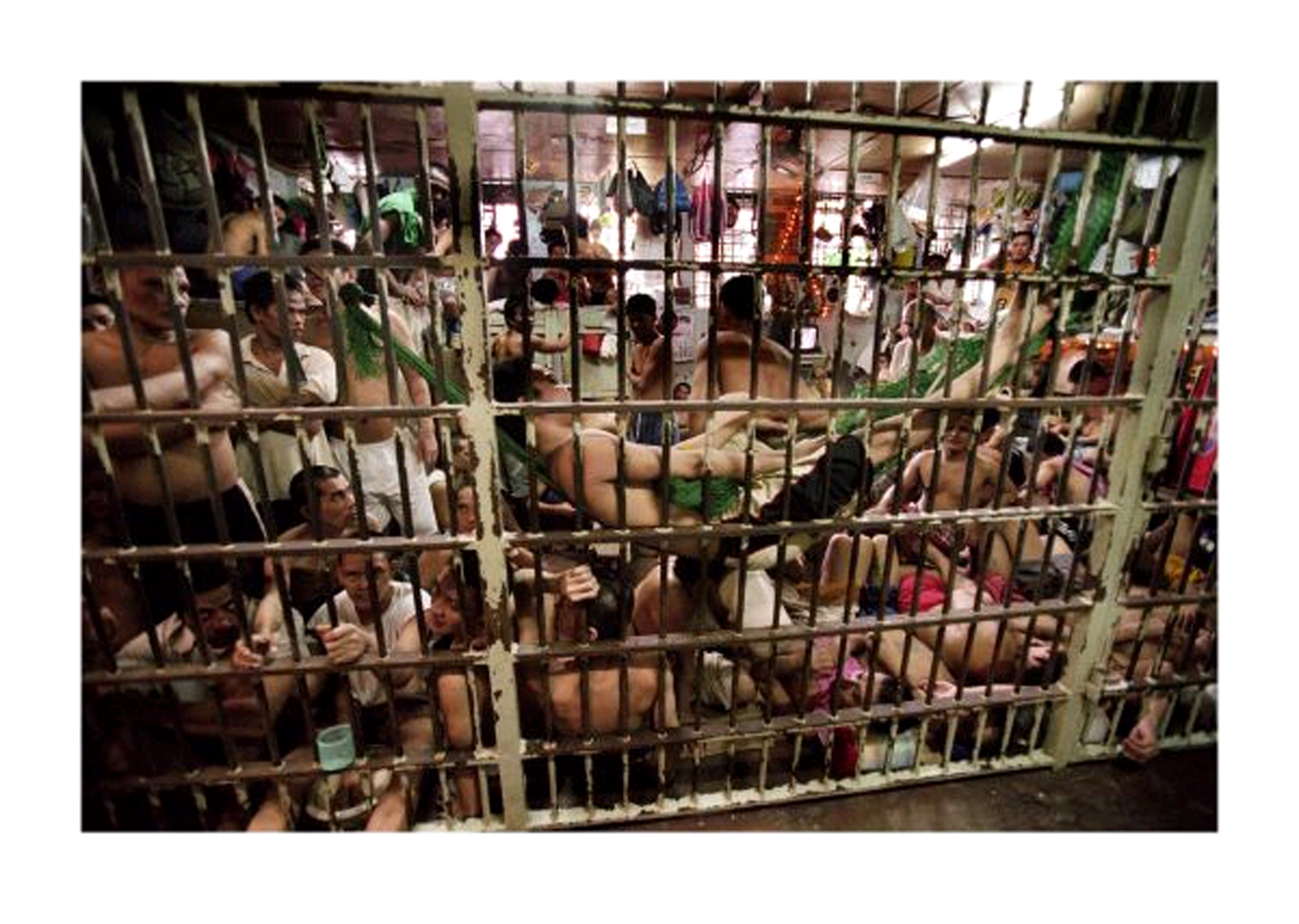
The Philippine prison system is described in a recent book as a living hell, more in tune with the 19th century than the modern age. Due to overcrowding, many inmates sleep standing up; the toilets run like rivers; disease and death are the only way to “rehabilitation.”

WRITTEN BY

SHARE THE WORD

PUBLISHED ON

Raymund Narag spent nearly seven years in Metro Manila’s notorious Quezon City jail for a crime he did not commit. Three years after he was released from his living hell, he published a book about his experience called “Freedom and Death: Inside the Jail.” Published in 2005, it paints a harrowing picture of a prison system more in tune with the 19th century than the modern age.

Narag lays out in graphic detail the subhuman existence inmates are forced to endure: the stench, the overcrowding, the toilets that run like rivers through the cells, disease and death. Built in the 1950s, Quezon City jail was only supposed to house 236 inmates. Today, it is home to more than 3,000 — packed in so tight that many inmates sleep standing up. It is a scene repeated around the country in a prison system grossly undermanned, poorly funded and neglected by the country’s economic planners.

According to Chief Superintendent Antonio Cruz, head of the Bureau of Jail Management and Penology and the largest cog in a fragmented penal service, the system is near to breaking point. “Overcrowding is our most pressing problem,” he said. Cruz’s bureau, which is an arm of the Interior Department, runs 1,100 prisons with a total cell area of just over 56,000 square metres and a population, at the end of 2006, of more than 60,000 inmates; most are awaiting trial while a small percentage are serving sentences for minor crimes like theft, and illegal drug use. Another 200 prisons are run by the police forces of smaller provincial towns, as Cruz’s bureau, with just 7,000 personnel, cannot cope. Ideally, he said, the system needs another 35,000 guards and support staff. About 17,000 other inmates convicted of more serious crimes like murder, kidnapping and drug dealing are housed in slightly better facilities at the National Penitentiary compound in southern Manila.

200 IN A CELL FOR 20
The UN Standard of the Minimum Treatment of Prisoners, to which the Philippine government is a signatory, gives clear guidelines on how prisoners should be treated, including bedding and food, and states: “It is not desirable to have two prisoners in a cell or room.” In the Quezon City jail, a 30-square-metre cell, with a holding capacity for 20, houses 180 to 200 inmates. Nearly a thousand death row inmates contributed to the overcrowding at the maximum security section of the National Penitentiary after Congress abolished the death penalty last year.

“Conditions are a bit better here,” says inmate Rodolfo Fernandez. “Back at the provincial jail, there would be 100 of us in a cell built for 40. Even the spaces beneath the beds were occupied.” (Fernandez was jailed for life, while seeking work abroad, for swindling neighbors of their life savings.) Still, of the 185 inmates at his new quarters, only 80 have beds while 105 use their own mats to sleep on the floor. Policing packed jails with a handful of men is “very difficult,” Cruz said. The rotting jail facilities themselves “become a rich source for improvising deadly weapons” such as rusted iron bars.

The US State Department, in a human rights report on the Philippines two years ago, said the country’s prison conditions were “rudimentary and sometimes harsh,” were “overcrowded, lacked basic infrastructure, and provided prisoners with an inadequate diet.” It said the “slow judicial process exacerbated the problem of overcrowding. Some inmates took turns sleeping, and others slept on their feet.” The study also cited “widespread corruption” among guards as well as “reports that guards abused prisoners,” including women who were “particularly vulnerable to sexual and physical assault by police and prison guards.”

60% ARE DRUG OFFENDERS
Cruz admits congestion exposes inmates to “diseases, contamination,” and warns the problem will probably get worse before it gets better. But he denies prisoners are physically or sexually abused. He estimates the prison population will rise by about 13 percent a year over the next eight years mainly due to case overload within the undermanned judicial system, as well as higher bail bonds imposed on drug offenders who make up 60 percent of the national prison population.

Manila-based business consultant Peter Wallace said recently there are about a million cases pending for 1,470 judges across the country because a third of the country’s courts are without a judge. “For a salary of 20,000 pesos (about 409 dollars), there’s little question as to why that’s so,” he said. Less than one percent of the national budget goes to the judiciary.

With an annual budget of just 2.8 billion pesos (57 million dollars), “we don’t have enough financial support to construct new jails,” Cruz said. “Realistically,” he added, “under these conditions, rehabilitation — the fundamental objective of the penal system — just does not take place. You just go back and forth in the system, committing the same offense. In the Manila city jail, for example, if we release 100 prisoners today, there will be another 300 (offenses) committed,” he said.

Share Your Thoughts

All comments are moderated

From The Same Issue

The articles and content about this issue

From The Same Issue

The articles and content about this issue

From This Topic

The articles and content about this topic

From This Topic

The articles and content about this topic

Frontline

Jesus wept!

Explore Other Topics

Browse other coverage

Explore Other Topics

Browse other coverage

WM SPECIAL

Presents, discusses and draws readers to reflect on issues of outmost relevance to the world today.


FRONTIERS

Very often, mission is carried out in frontier situations around the world. Those who embrace these situations have much to share.


UNITY IN DIVERSITY

Writer Ilsa Reyes will be exploring the richness of Pope Francis’s latest encyclical Fratelli Tutti with a view of helping our readers to get a grasp of the this beautiful papal document.


FRONTLINE

Puts to the front committed and inspiring people around the world who embrace humanitarian and religious causes with altruism and passion.


IN FOCUS

Focus on a given theme of interest touching upon social, economic and religious issues.


FAITH@50

As the Philippines prepares to celebrate 500 years of the arrival of Christianity. Fr. James Kroeger leads us in this series into a discovery journey of the landmark events in the history of faith in the Philippine archipelago.


INSIGHT

Aims to nurture and inspire our hearts and minds while pondering upon timely themes.


FILIPINO FOCUS

The large archipelago of the Philippines, in its richness of peoples and cultures, offers varied and challenging situations for mission.


FOLLOW ME

Reflections and vocation stories that shape up the lives of young people.


MISSION IS FUN

As humor and goodness of heart are qualities of Christian and missionary life, the new column “Mission is fun” will be publishing some anecdotes and stories that have happened in a missionary context to lighten up the spirits and trigger a smile in our faces.


LIVING COMMUNION

To help readers of World Mission live this year dedicated to Ecumenism, Interreligious Dialogue and Indigenous Peoples, Tita Puangco, writer and lecturer, shares in this section insights on the spirituality of communion.


WINDS OF THE SPIRIT

A historic view of the Catholic movements that emerged from the grassroots as an inspiration by the Holy Spirit.


BRIDGE BUILDERS

On the Year of Ecumenism, Interreligious Dialogue and Indigenous Peoples, radio host and communicator Ilsa Reyes, in her monthly column, encourages Christians and people of good will to be one with their fellow people of other sects, religions and tribes.


INTERVIEW

Questions to a personality of the Church or secular world on matters of interest that touch upon the lives of people.


WORLD TOUCH

News from the Church, the missionary world and environment that inform and form the consciences.


CARE OF THE EARTH

A feature on environmental issues that are affecting the whole world with the view of raising awareness and prompting action.


EDITORIAL

The editor gives his personal take on a given topic related to the life of the Church, the society or the world.


YOUNG HEART

A monthly column on themes touching the lives of young people in the Year of the Youth in the Philippines by radio host and communicator I lsa Reyes.


SCROLL

A missionary living in the Chinese world shares his life-experiences made up of challenges and joyous encounters with common people.


EXTRAORDINARY PEOPLE

Life stories of people who deserve to be known for who they were, what they did and what they stood for in their journey on earth.


ONE BY ONE

Stories of people whom a missionary met in his life and who were touched by Jesus in mysterious ways.


INCREASE OUR FAITH

Critical reflection from a Christian perspective on current issues.


SPECIAL MOMENTS

Comboni missionary Fr. Lorenzo Carraro makes a journey through history pinpointing landmark events that changed the course of humanity.


PROFILE

A biographical sketch of a public person, known for his/her influence in the society and in the Church, showing an exemplary commitment to the service of others.


WM REPORTS

Gives fresh, truthful, and comprehensive information on issues that are of concern to all.


LIFE'S ESSENTIALS

A column aimed at helping the readers live their Christian mission by focusing on what is essential in life and what it entails.


ASIAN FOCUS

Peoples, events, religion, culture and the society of Asia in focus.


THE SEARCHER'S PATH

The human heart always searches for greatness in God’s eyes, treading the path to the fullness of life - no matter what it takes.


INDIAN FOCUS

The subcontinent of India with its richness and variety of cultures and religions is given center stage.


AFRICAN FOCUS

The African continent in focus where Christianity is growing the fastest in the world.


JOURNEY MOMENTS

Well-known writer and public speaker, Fr. Jerry Orbos, accompanies our journey of life and faith with moments of wit and inspiration based on the biblical and human wisdom.


IGNATIUS STEPS

On the year dedicated to St. Ignatius of Loyala, Fr. Lorenzo Carraro walks us through the main themes of the Ignatian spirituality.


THE SEVEN LAST WORDS OF JESUS

Fr. John Taneburgo helps us to meditate every month on each of the Seven Last Words that Jesus uttered from the cross.


INSIDE THE HOLY BOOK

In this section, Fr. Lorenzo delves into the secrets and depths of the Sacred Scriptures opening for us the treasures of the Sacred Book so that the reader may delight in the knowledge of the Word of God.


CONVERSATIONS

Reflections about the synodal journey on a conversational and informal style to trigger reflection and sharing about the synodal path the Church has embarked upon.


VATICAN II

This 'mini-course' series provides a comprehensive exploration of Vatican II, tracing its origins, key moments, and transformative impact on the Catholic Church.


COMBONIS IN ASIA

This series offers an in-depth look at the Comboni Missionaries in Asia, highlighting their communities, apostolates, and the unique priorities guiding their mission. The articles provide insights into the challenges, triumphs, and the enduring values that define the Comboni presence in Asia.


BEYOND THE SYNOD

Following the Synod on Synodality, this series examines how dioceses, parishes, and lay organizations in the Philippines are interpreting and applying the principles of the synod, the challenges encountered, and the diverse voices shaping the synodal journey toward a renewed Church.


A TASTE OF TRADITION

This series introduces the Fathers of the Church, featuring the most prominent figures from the early centuries of Christianity. Each article explores the lives, teachings, and enduring influence of these foundational thinkers, highlighting their contributions the spiritual heritage of the Church.


A YEAR OF PRAYER

In preparation for the 2025 Jubilee Year under the theme “Pilgrims of Hope,” 2024 has been designated a Year of Prayer. World Mission (courtesy of Aleteia) publishes every month a prayer by a saint to help our readers grow in the spirit of prayer in preparation for the Jubilee Year.


OUR WORLD

In Our World, the author explores the main trends shaping contemporary humanity from a critical and ethical perspective. Each article examines pressing issues such as technological advancement, environmental crises, social justice, and shifting cultural values, inviting readers to reflect on the moral implications and challenges of our rapidly changing world.


CATHOLIC SOCIAL DOCTRINE

This series unpacks the principles of Catholic Social Doctrine, offering a deep dive into the Church's teachings on social justice, human dignity, and the common good.


HOPEFUL LIVING

Hopeful Living’ is the new section for 2026, authored by Fr. James Kroeger, who dedicated most of his missionary life to the Philippines. In this monthly contribution, he will explore various aspects of the virtue of hope. His aim is to help readers align their Christian lives more closely with a hopeful outlook.


PHILIPPINE CROSSROADS

Filipino Catholic scholar Jose Bautista writes each month about how the Philippines is at a crossroads, considering the recent flood control issues and other corruption scandals that have engulfed the nation. He incorporates the Church’s response and its moral perspective regarding these social challenges.


BIBLE QUIZ

Test your knowledge and deepen your understanding with our Bible Quiz! Each quiz offers fun and challenging questions that explore key stories, themes, and figures from both the Old and New Testaments.


Shopping Cart