

How did you discover your painting vocation?
It happened two years ago (in 2005). I was afflicted with a serious illness. My left kidney had to be removed and I underwent a major operation. Recovering at home, my life changed: from an active lifestyle in the business arena where I was very successful − I was always moving around and making things happen − I became weak and dependent on people. I lost track of my direction and I thought it was already the end line. Suddenly, I felt an urge to create figures of what I experienced during my stay at the hospital. So, I started scribbling, dabbling, sketching… but everything was so crude, because I didn’t know how to draw, to paint…
Have you tried to paint before?
Yes, I tried when I was a child. But it was not my cup of tea, so to speak. I felt it was a waste of time. I preferred outdoor activities. I loved to play basketball, soccer, moving around. Then, when I was in business, I underestimated artists. I considered them just artisans, not real artists. Since the majority of the artists here in the Philippines are just struggling for survival, some are starving because they cannot find their place in the art circle. Suddenly, what I was not attracted to became my strength. I held on to that when I was depressed. I tried to keep myself busy and productive and I realized that gradually − day by day − I couldn’t only make figures, but I was able to put dimensions and volume in my work. I asked somebody to buy me canvasses, paintbrushes, paints… I started buying and reading a lot of books and researching in the Internet on the correct way to come up with a real portrait. So, I studied very well the techniques used by the old masters like Da Vinci and Rembrandt… I looked for a school which could teach me that process − the lasing process, which proceeds layer by layer − but there was no school, only two or three known professors: one was in Hong Kong; and the other two were living quite far in the province. Later on, I learned that one of them, Norman Sustiguer, had transferred to our neighborhood. He had just retired from teaching fine arts at the University of the Philippines. I was lucky to find him and be welcomed and taught in his atelier. Then I started painting the portraits of my wife, my children, anything I could do… Our house became a gallery.
But, initially, you were a self-made painter…
I could execute. But it was quite forcing through. It was more of a trial and error. Finding Professor Norman Sustiguer, I discovered there’s an easier way to do that. For example, there are a thousand ways of making shades. I found his process − the process of the old painters − the best one because, being in layers, the painting could last for many years.
A LESSON TO THE KIDS
How have you decided to paint the Last Supper?
After six months of studying painting, I realized that our dining room was quite bare. Initially, I wanted to paint fruits and vegetables − still life − because they are appropriate for the dining place and because we wanted our children to eat more vegetables. But I didn’t feel challenged enough. On the other hand, my kids, at times, were complaining about the food and being choosy. They just liked fast food from Jollibee and McDonalds… I felt tired of constantly advising them. I was a father with a life-threatening illness. The values I would like to share with them in the next 20 years, I should compress in a few months or weeks. I thought of providing them with a visual reminder − strong and challenging enough − for them to be reminded of their blessings in life and to appreciate what was on the table. Therefore, I planned to paint the standard Last Supper like the one of Leonardo Da Vinci or of Salvador Dali.
What was the result?
The painting became very effective! It reminded them and it also reminded me of my duties towards society. I was complaining more than them. I was more choosy because of my previous complicated lifestyle. It became a reminder of my social responsibilities, especially to those who are in need.
To paint it, you had to look for models…
Yes, because I don’t paint from imagination. I am a beginner, I have to copy. Therefore, I went to different squatter areas of Metro Manila − under the bridge, to the North Cemetery where people live − to find models. It wasn’t so difficult because there are a lot of impoverished, neglected and abused children around. Those who wanted to come along, we rode them in a van to the area where we would make the photos for my reference. I didn’t ask them to pose; I just fed them with noodles and juice. And I gave them some money. They didn’t know that I had a camera. I just clicked three times when they were eating. That’s why they appeared so natural, some turning their backs and not looking at Jesus. They were busy eating. Everything was hurriedly done because it was getting dusk already. So, three shots… after that we parted ways.
A SPIRITUAL JOURNEY
Have you met them personally before?
Not, exactly. I got around 20 kids and I chose the more hungry-looking ones. I had the pictures developed 8×10, 10×12, 11×14 inches. Each face I had it developed 8×10 to have the details, the shadows and the lights. I was challenged because I had been painting only for six months. It took me only one and a half months to paint the 4 x 8 ft mural. That was relatively fast for a beginner!
Then did you use it to teach your kids?
I didn’t have to talk anymore. The painting talked to them. Once it was placed in our dining room, it was as if they were there eating with us. I was surprised myself. At times, I had the impression they were real persons. The sizes of their faces are patterned to that of the children so that they can relate. They can look at Jesus and the other people there as part of our history. It shows what God is all about.
Did your children ask about their names and identity?
Yes, they asked but I had no answer. I didn’t know what to tell them because I just used these children as models. I didn’t know them personally. They were functional. I don’t know if, on their part, they also encountered me that way but as far as we are concerned, they were able to have a feast on the Lucky Me! noodles I gave them.
But then, you got close to them…
Later, I got to know them because I was already consumed by the painting. I was embarked in a spiritual journey. I was surprised. It was an accident. I never expected that it would happen this way. As I said, it was meant for my children but it turned out that it was meant for me. It also became intriguing to people who came to our house. Then, it was exposed, incidentally, unveiled in public before a big crowd and people started taking pictures. I was amazed at their reactions.
Who was behind the disclosure of the painting?
When I was still in the process of painting it, my wife went to Msgr. Romulo Rañada to collect some money because we had done business with him. He asked why I was not with her. She answered that I was at home painting. He was surprised. “What is he painting? Is he painting the wall, the roof?” Nobody knew me as a painter. My wife explained: “No, Father, he is painting on a canvass.” He was surprised: “You mean he is a painter? What is he painting about?” “He is painting the Last Supper. Instead of the apostles, he is using street children,” my wife replied. “What? Can I go to your place now? Can I go to his studio?” he excitedly asked. My wife replied I had no studio, but he insisted on going with her. They came. I was painting. Monsignor Romulo was stunned and had a bright idea. “Why don’t we unveil this on the closure of the National Eucharistic Year; in the Cathedral of Manila. So I agreed. We had it unveiled there. I was so excited. For a non-painter like me, it was amazing. I was teary-eyed when it was shown, because people were really flocking to it and taking pictures, videos and so it spread in the Internet. That was on December 9, 2005.
HELPING STREET CHILDREN
Then it was printed…
One Sunday, the manager of the St. Paul Publications, Fr. Paul Intig, came to have lunch with us. He knew I was painting. Therefore, he asked me to paint the cover of his book, The Holy Trinity. At that time, I was still searching how to execute a good professional painting. While eating lunch, he saw The Last Supper, the Hapag ng Pag-asa. He proposed: “Joey, why don’t you print it to help street children.” I complied. We had it printed and sold for a very cheap price. I didn’t receive royalty for that because it was meant to help street children. It spread like that. Since my name was there, many people, especially the clergy, were inviting me to explain why I had painted it and who the children were. Being the shy type of person − although I was a businessman − I was not used to speaking in public or before a big crowd. It was overwhelming for me, so I would always beg off. But afterwards, I thought my journey had to be presented whenever I was invited. I started believing that I had to flow where the Spirit leads me.
The image has been widely used…
That’s correct. It has been used by many foundations − orphanages, street children foundations, even Caritas − for their own apostolate in raising funds for poor children, because that is how they view it. This painting belongs to everyone so they can use it according to their approach as long as they help children. Personally, I do not use it for raising funds. It is not my idea. My idea is for people to react to it in their own way − not only of charity, because it goes beyond charity.
It is meant to lead people to get involved, to do voluntary work, to give their time and skills… that is more difficult than to give money.
Yes, that’s right.
THEY BECAME MISSIONARIES
But you didn’t paint it to be divulged…
I didn’t paint it for the public, just for the house. I was not planning to have it in print − it happened when I was still in the state of amazement. It struck me when I had started being proud or self-conceited of what I had done as a person who was just learning how to paint and was able to do such a big mural. I would look at it every morning, at five o’clock, while sipping coffee alone, when everybody was still sleeping and ask: “How did I start this? Did I really do this?” I had forgotten already how I had finished it, I had forgotten the process. That’s why I cannot teach. The knowledge is there. I just mixed the colors according to what I had been taught, but I don’t really know the exact amounts. So when I was looking at the painting I was feeling proud that I had become a painter, an artist. People liked my painting; they liked the beauty, the realistic aspect of it. Little by little, I came to realize that the painting was more than that, more than what I could do and more than what it could do to me. I was no longer the one looking at it: the painting was looking at me. I was no longer observing; the subjects of my painting were observing me and I could no longer escape them. For one full year, every morning, I would look at the painting and the figures kept haunting me. I would look at the small child under the table and I could feel something, someone so dear to me, so close to me like my own child. I didn’t know the fate of each one. I could see myself in each one of them: the different stages of my life − my woundedness, my brokenness, my experiences before, how I viewed God as a punishing and angry God. I no longer knew what was happening within me. I didn’t know if it was a curse. I was confused, bothered.
What did you do?
I had no choice anymore but to search for my models. Those pictures which I had developed (8×10) became my guide to retrieve the children. I had to recall what cemetery it was, what squatter area it was, what bridge and so on. I searched for each one of them and it was only then that I knew who they were and in going back to them, I was able to go back to myself and my God. Things like these before were just like benchwarmers in my life. I took them for granted because they might be a hindrance to my success in life − as a person, and financially as a businessman. So when I went back to them, I thought they were the ones who were lost only to find out that I was the one who was actually lost. That was the time I knew who they were, their parents, what they were doing everyday, their ambitions in life, things like that but more than that, I learned many things which I never learned in school like the nobility of character, courage, bravery… I thought I was being charitable because I was feeding them. They became missionaries to me. They brought me to a journey of spiritual conversion. Then, I was able to answer my children when they were asking me who Itok was, who were Nene, Joyce, Tinay, Emong, Onse, Buknoy, Michael, Dodoy, Jun, Roselle and “Sudan.” Before they were anonymous; but now they have become specific people.
THE HEALING PROCESS
Why did you depict “Sudan,” the little girl under the table?
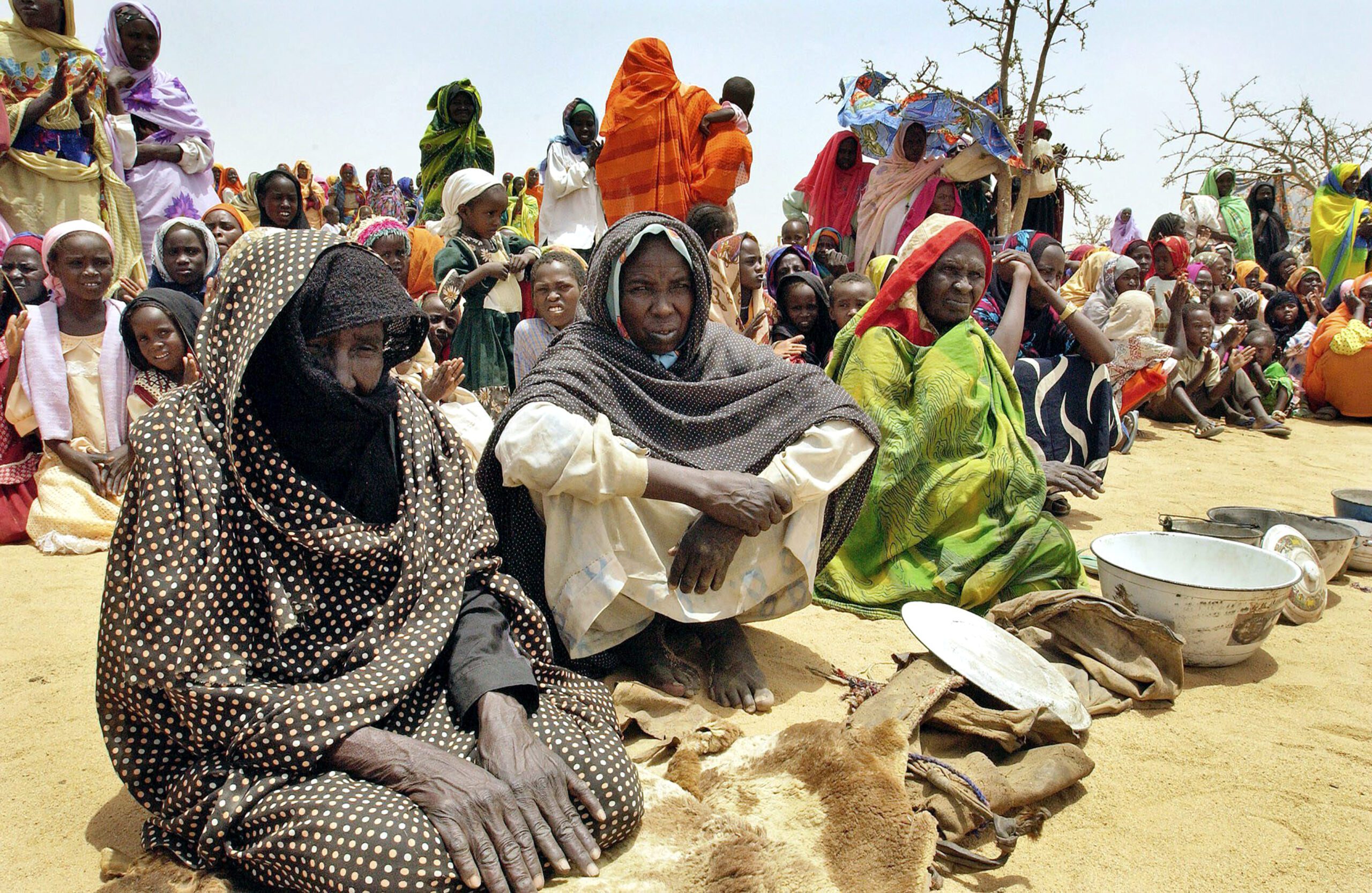
In 1994, I saw the famous photograph of a girl on the National Geographic magazine. I was already struck to the very core by famine all over the world when I saw that. It flashbacked when I was doing the painting. When I was in the process of composing the scene, more people were suffering; but more than that Sudan became my own symbol. I included her in the painting because in reality it was me. I was crawling and I was trying to get some light and the light in that painting is none other than the one in the center, Jesus. And so, Sudan there would symbolize myself. Other viewers have other interpretations. For me that child is myself trying to find the way out of the mess and finally getting the light. And Jesus gave me light, brought me to a new life by reaching out to me through the paintbrush!
The healing process you started consists exactly of what?
Healing of my concept of God, healing of the life I had been leading. Business is actually good. Entrepreneurship is positive. But, at times, there is an element of worldliness, ego-centeredness and shrewdness in order to really catapult yourself to a certain height. This painting has also led me to a lot of doctors, good doctors, and it has led me to a lot of spiritual healers − priests, nuns, laypeople who are instruments of healing and my life became deeper and deeper. Stronger roots hold my life now.
What image of God is connected to this worldview?
I thought God was an investigative God, who would always scrutinize me. That was how I was raised up in the fear of God. I thought he had a strong fist to hold and punish me. Therefore, I had to do good things in order to be loved by God. In this painting, with my encounter with the children, I realized that God is not a far God, but is a near God − Somebody who is beside us and is offering His love for free. We don’t have to be good-looking for Him to love us. If you notice, the children on the painting are looking far. They are not looking at Jesus; they are not paying attention to Him. Later, as I was reflecting, I realized that Jesus does not pay attention only to those who pay attention to Him, but He cares even for those who do not bother with Him. I did not pay attention to Him for a very long time, but He paid attention to me because of His unconditional love.
IT IS A WORK OF GOD
It seems there is a new way of looking at your personal weakness and fragility…
Yes. There is always the bright side of hope. I never knew that an artwork could transform someone. Actually, an artist is the one who transforms his work but, in this case, it happened the other way around. The obra, the artwork transformed the artist.
It became a turning point in your life and in the life of other people…
Yes, it spread and I started receiving testimonies of how it touched people’s lives. But they are just confirmations that this is not my own work. Somebody else painted it. The paintbrush moved by itself.
Do you think it was supernatural phenomenon?
Definitely. I was just a brush because I couldn’t do it. The professional artists would hear my name and ask: “Who is this Joey Velasco? Why is he being talked about? Why is he in the papers?” They are wondering where I came from. Some are thinking maliciously that somebody else has painted that, not me. They think these paintings I do could not be done by a beginner, someone who has been painting for just a little more than 2 years. And I made the Last Supper when I had only been painting for six months!
Was it a kind of mystique experience?
I suppose so. There is a point that, whenever I am painting, I don’t feel about it anymore. Are you familiar with the runner’s high? When one gets to a particular point, one doesn’t feel like he/she is running anymore but floating even though one feels the friction; the momentum gets so strong. In the same way, I feel like I am brought to another world, to another state. In faith, I believe it is the work of God, especially so because never did I imagine myself being a painter, never did I imagine myself painting a work which would touch the core of people’s lives. I am not an exemplary Christian, but my painting radiates some good to people. When unknown people e-mail or call me from abroad, saying that my work has touched their lives, I smile and think: How can my painting do that? This painting touches different people differently − calling them to get involved in fighting poverty or strengthening and confirming those who are doing so. It is more attractive to those in service − priests, nuns, those who really love doing apostolate − because it is challenging but not accusatory.
It promotes people’s solidarity.
I have started receiving e-mails from people expressing their intention to donate to these children. They are so much touched that they would like to give money. That’s the kind of charity they want to do. That was not my idea. I did not plan to raise money. My plan was just a faith journey − how I would go inside myself − but these people have other views, different from mine and other insights better than my own and so I allowed them to do that but I told them that I don’t have a foundation and I am not intending to have one. So, I ask people to send their donations to Gawad Kalinga.
BUILDING HOUSES
How did you enter in partnership with Gawad Kalinga?
Gawad Kalinga’s founder, Tony Meloto, saw a replica of Hapag in a big billboard along EDSA. He was wondering who painted that and he was also able to relate that to what they are doing − their poverty alleviation program. They made a research and they invited me to have lunch with them in their office. We talked and I was also attracted to what they are doing. It is a massive work of empowerment and raising the dignity of people. There, we agreed to course all the help to them and to build houses for the children who are now all at school. The budget for that is already complete. Someone donated the land. Right now, seven families are already building their homes and the rest will be transferred to their villages.
Why do you keep on painting?
Just to express myself. Not to sell − except when the one who likes to buy my painting has become a part and parcel of my spiritual journey. Anyway, Hapag ng Pag-asa is not really for sale because I cannot find any action of selling and buying that can be included there in my own journey with these children. I don’t paint in order to be famous or to be known as a painter. I just paint whenever there is a strong encounter − with a sick person, a prisoner, an ex-convict, a security guard…. If there is no experience involved, I don’t paint. When the story I hear is so powerful that it keeps on haunting me, I have to execute it on canvass to have peace. The models I use are just incidental because the intensity of the painting is based on a particular experience. The day I started painting, it was the moment I started living my life.”