
The Martyrdom Of Marching Monks

INTRODUCTION

The monks and Burmese marchers teach us a thing or two about how to resist tyranny, what the spiritual life looks like, and for Christians, how to follow the nonviolent Jesus.

WRITTEN BY

SHARE THE WORD

PUBLISHED ON

Imagine this: thousands of priests, nuns, monks, deacons, bishops and cardinals dropping everything and taking to the streets. Around the White House they march, week after week, and then off they head to the Capitol and the Pentagon. They walk with a sharp demand. Stop the war on Iraq. End the occupation of Palestine. Abolish all electric chairs and nuclear weapons. And turn over the vast sums, earmarked for death, to the world’s poor and hungry.

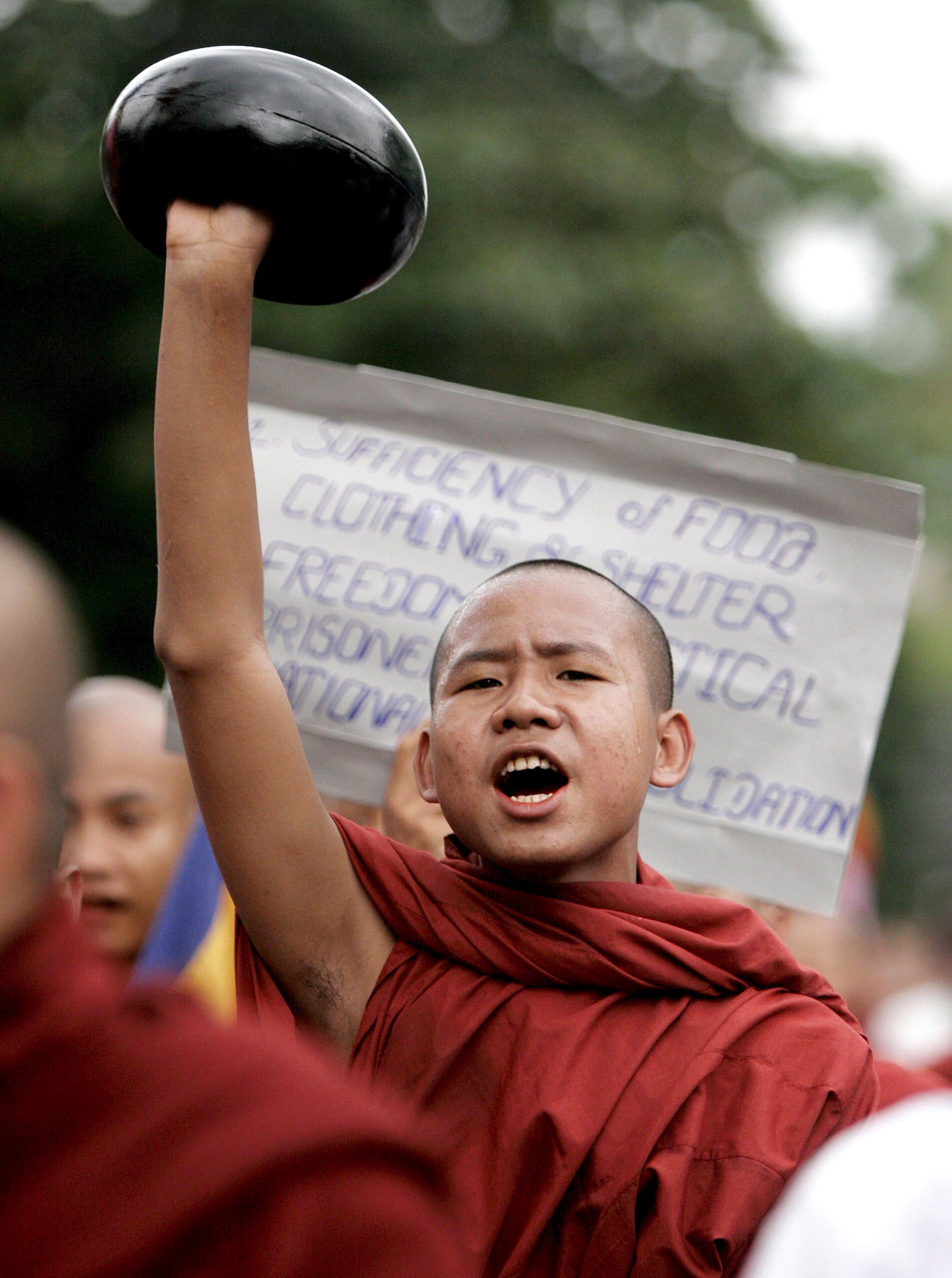
Alas, here, such a scenario is a fantasy, but not in Burma. Since mid-August something rare has arisen – a historic and magnificent display of creative nonviolence. Buddhist monks stopping the nation’s unjust business as usual, taking to the streets, and facing off with Burma’s brutal dictatorship. They’re in the midst of a dazzling act of resistance and hope for which many have given their lives. They’ve forced the world to look at their reality.

Things began when the government, in August, ruinously raised gas prices by 500%. In response, there were a few small demonstrations. The dictatorship, in turn, cracked down − at which point the monks began to organize.

Burma is home to some 54 million, 90% of whom are Buddhist, and monks there command enormous respect. So much so that the dictatorship adopted a policy of trying to buy them off. Public funds have gone toward pagodas and temples during the last 17 years while, for the people, tax burdens have skyrocketed and civil rights vanished.

But it turns out, the monks can’t be bought. They’ve formed a national coalition called the All Burma Monks Alliance. And from this alliance, the marches sprang. They began modestly, 2,000 monks at first, all of them with their begging bowls turned upside-down.

THE OVERTURNED BOWL
Here is a symbolic gesture against the junta and soldiers the power of which eludes American minds. It is akin to a union of Catholic priests denying communion to any U.S. soldier, any federal employee, or any weapon manufacturer. It is akin to workers at Los Alamos (LANL is one of the two laboratories in the United States in which nuclear weapons are designed − Editor’s note) being turned away from Catholic altars.

Exponentially, the marches in Burma swelled. By late September, the number of marchers had grown to hundreds of thousands − tens of thousands of monks plus 10 times that were civilians. And in two major cities, Yangon and Mandalay, there gathered in the streets, according to some reports, up to 100,000 monks, with a fervid, silent demand for democracy and justice.

As the days unfolded, I presume, the junta decided to let the leaders emerge. They permitted some 500 monks onto the blockaded street of political prisoner and internationally known peacemaker and hero, 61-year-old Aung San Suu Kyi − the new Mandela, one of our times’ great figures of justice and peace. She stood before the monks, tears in her eyes, her first public appearance in more than four years.

Then the junta cracked down. It appears that the gesture, and the light touch during the first few days, afforded them time for surveillance.

Seems the junta let matters take their course in order to document the organizers and their supporters. Then once soundings had been taken, the killings began. Two hundred have died, say various Asian reports. British reports put the figure at 2,000. And they say thousands more find themselves in jail, having been dragged from their homes. Moreover, many monasteries have been raided and ransacked. And communication has been cut off, including the Internet, so the repression goes on, as it were, in the cover of darkness. The brutality goes on.

NOT EVEN WORDS
Similar marches erupted in 1988, which the military used as a pretext to take control. The melee caused the deaths of some 3,000 and, when the dust had settled, the junta renamed the country Myanmar. Aung San Suu Kyi quickly found herself under house arrest, the threat of execution hanging over her head. So far, her global fame has kept the executioner away − that, and the love and reverence of the people.

They voted her head of state in a 1990 election, but the junta threw out the results and imprisoned members of her party. Then in 1991, she was awarded the Nobel Peace Prize. This, to the junta, was an inconvenient turn of events, but they refused to be moved. And to this day, uttering her name is risky business. (People dart their eyes and lower their voices, and speak only of “the Lady.”) Riskier yet is to display her photo or own her writings or recite her words. “Please use your liberty to promote ours,” she tells the world.

One caught transgressing this ban is likely to be trundled off to a Burmese dungeon, more often than not, a one-way trip. My friend Richard Deats of the Fellowship of Reconciliation traveled to Burma in mid-September just before the drama began to unfold. Off he went to lead a series of secret trainings on nonviolence. The junta forbids gatherings of more than five, so Richard hustled from living rooms to out of the way restaurants. And along with seething unrest, he found broad interest in the way of nonviolence. They were especially eager to hear the story of the People Power movement in the Philippines, and how it nonviolently toppled the Marcos regime.

(On Richard’s return, not coincidentally, authorities at the Newark airport singled him out for special attention. He endured a thorough search and inspection, and as he cooled his heels in a remote office, a close reading of every sentence of his notes on nonviolence.)

LIKE GANDHI OR JESUS
The monks’ marching resembles epic movements of the last century. In particular, Gandhi’s salt march and Dr. King’s civil rights movement and the nonviolent campaigns in Lithuania and South Africa. And the Burmese crackdown smells of the massacre of Tiananmen Square. But in all their travail, the monks and Burmese marchers teach us a thing or two about how to resist tyranny, what the spiritual life looks like, and for Christians, how to follow the nonviolent Jesus.

Jesus Himself formed a procession into Jerusalem − atop a donkey, a display of street theater that struck a public nerve and mocked imperial power. And then He gave His life nonviolently resisting the occupying empire on behalf of the poor.

The monks are doing the same. Their example calls to us. We, too, must take a stand, march for peace, and put our spirituality into public action. That, too, is risky business, but transformation is sure to follow − social, economic and political. What bears fruit in distant corners of the world will bear fruit in our own imperial regime.

And so what to do? Surely, pray for the Burmese monks and civilians behind prison walls. Pray for Burma’s liberation and for the return of the noble Aung San Suu Kyi. More, join the growing chorus to pressure China, host of the next Olympics. Demand that China work for an end to Burma’s repression. Call for sanctions against U.S. oil companies operating in Burma, beginning with Chevron. Study the situation (see www.irrawaddy.org and www.buddhistnews.tv. Support solidarity groups (see www.uscampaignforburma.org and www.burmacampaign.org.uk).

Most of all, take to the streets. March for peace. Put your spirituality of peace on display. Emulate the marching monks and practice creative nonviolence down Main Street, America, and say, like them: No to occupation, No to injustice, No to war. And fund the peace movement, not the war machine. Then turn your begging bowl upside down. As “the Lady” pleads, let’s use our liberty to promote theirs. National Catholic Reporter Conversation Café: www. ncrcafe.org

Share Your Thoughts

All comments are moderated

From The Same Issue

The articles and content about this issue

From The Same Issue

The articles and content about this issue

From This Topic

The articles and content about this topic

From This Topic

The articles and content about this topic

Explore Other Topics

Browse other coverage

Explore Other Topics

Browse other coverage

WM SPECIAL

Presents, discusses and draws readers to reflect on issues of outmost relevance to the world today.


FRONTIERS

Very often, mission is carried out in frontier situations around the world. Those who embrace these situations have much to share.


UNITY IN DIVERSITY

Writer Ilsa Reyes will be exploring the richness of Pope Francis’s latest encyclical Fratelli Tutti with a view of helping our readers to get a grasp of the this beautiful papal document.


FRONTLINE

Puts to the front committed and inspiring people around the world who embrace humanitarian and religious causes with altruism and passion.


IN FOCUS

Focus on a given theme of interest touching upon social, economic and religious issues.


FAITH@50

As the Philippines prepares to celebrate 500 years of the arrival of Christianity. Fr. James Kroeger leads us in this series into a discovery journey of the landmark events in the history of faith in the Philippine archipelago.


INSIGHT

Aims to nurture and inspire our hearts and minds while pondering upon timely themes.


FILIPINO FOCUS

The large archipelago of the Philippines, in its richness of peoples and cultures, offers varied and challenging situations for mission.


FOLLOW ME

Reflections and vocation stories that shape up the lives of young people.


MISSION IS FUN

As humor and goodness of heart are qualities of Christian and missionary life, the new column “Mission is fun” will be publishing some anecdotes and stories that have happened in a missionary context to lighten up the spirits and trigger a smile in our faces.


LIVING COMMUNION

To help readers of World Mission live this year dedicated to Ecumenism, Interreligious Dialogue and Indigenous Peoples, Tita Puangco, writer and lecturer, shares in this section insights on the spirituality of communion.


WINDS OF THE SPIRIT

A historic view of the Catholic movements that emerged from the grassroots as an inspiration by the Holy Spirit.


BRIDGE BUILDERS

On the Year of Ecumenism, Interreligious Dialogue and Indigenous Peoples, radio host and communicator Ilsa Reyes, in her monthly column, encourages Christians and people of good will to be one with their fellow people of other sects, religions and tribes.


INTERVIEW

Questions to a personality of the Church or secular world on matters of interest that touch upon the lives of people.


WORLD TOUCH

News from the Church, the missionary world and environment that inform and form the consciences.


CARE OF THE EARTH

A feature on environmental issues that are affecting the whole world with the view of raising awareness and prompting action.


EDITORIAL

The editor gives his personal take on a given topic related to the life of the Church, the society or the world.


YOUNG HEART

A monthly column on themes touching the lives of young people in the Year of the Youth in the Philippines by radio host and communicator I lsa Reyes.


SCROLL

A missionary living in the Chinese world shares his life-experiences made up of challenges and joyous encounters with common people.


EXTRAORDINARY PEOPLE

Life stories of people who deserve to be known for who they were, what they did and what they stood for in their journey on earth.


ONE BY ONE

Stories of people whom a missionary met in his life and who were touched by Jesus in mysterious ways.


INCREASE OUR FAITH

Critical reflection from a Christian perspective on current issues.


SPECIAL MOMENTS

Comboni missionary Fr. Lorenzo Carraro makes a journey through history pinpointing landmark events that changed the course of humanity.


PROFILE

A biographical sketch of a public person, known for his/her influence in the society and in the Church, showing an exemplary commitment to the service of others.


WM REPORTS

Gives fresh, truthful, and comprehensive information on issues that are of concern to all.


LIFE'S ESSENTIALS

A column aimed at helping the readers live their Christian mission by focusing on what is essential in life and what it entails.


ASIAN FOCUS

Peoples, events, religion, culture and the society of Asia in focus.


THE SEARCHER'S PATH

The human heart always searches for greatness in God’s eyes, treading the path to the fullness of life - no matter what it takes.


INDIAN FOCUS

The subcontinent of India with its richness and variety of cultures and religions is given center stage.


AFRICAN FOCUS

The African continent in focus where Christianity is growing the fastest in the world.


JOURNEY MOMENTS

Well-known writer and public speaker, Fr. Jerry Orbos, accompanies our journey of life and faith with moments of wit and inspiration based on the biblical and human wisdom.


IGNATIUS STEPS

On the year dedicated to St. Ignatius of Loyala, Fr. Lorenzo Carraro walks us through the main themes of the Ignatian spirituality.


THE SEVEN LAST WORDS OF JESUS

Fr. John Taneburgo helps us to meditate every month on each of the Seven Last Words that Jesus uttered from the cross.


INSIDE THE HOLY BOOK

In this section, Fr. Lorenzo delves into the secrets and depths of the Sacred Scriptures opening for us the treasures of the Sacred Book so that the reader may delight in the knowledge of the Word of God.


CONVERSATIONS

Reflections about the synodal journey on a conversational and informal style to trigger reflection and sharing about the synodal path the Church has embarked upon.


VATICAN II

This 'mini-course' series provides a comprehensive exploration of Vatican II, tracing its origins, key moments, and transformative impact on the Catholic Church.


COMBONIS IN ASIA

This series offers an in-depth look at the Comboni Missionaries in Asia, highlighting their communities, apostolates, and the unique priorities guiding their mission. The articles provide insights into the challenges, triumphs, and the enduring values that define the Comboni presence in Asia.


BEYOND THE SYNOD

Following the Synod on Synodality, this series examines how dioceses, parishes, and lay organizations in the Philippines are interpreting and applying the principles of the synod, the challenges encountered, and the diverse voices shaping the synodal journey toward a renewed Church.


A TASTE OF TRADITION

This series introduces the Fathers of the Church, featuring the most prominent figures from the early centuries of Christianity. Each article explores the lives, teachings, and enduring influence of these foundational thinkers, highlighting their contributions the spiritual heritage of the Church.


A YEAR OF PRAYER

In preparation for the 2025 Jubilee Year under the theme “Pilgrims of Hope,” 2024 has been designated a Year of Prayer. World Mission (courtesy of Aleteia) publishes every month a prayer by a saint to help our readers grow in the spirit of prayer in preparation for the Jubilee Year.


OUR WORLD

In Our World, the author explores the main trends shaping contemporary humanity from a critical and ethical perspective. Each article examines pressing issues such as technological advancement, environmental crises, social justice, and shifting cultural values, inviting readers to reflect on the moral implications and challenges of our rapidly changing world.


CATHOLIC SOCIAL DOCTRINE

This series unpacks the principles of Catholic Social Doctrine, offering a deep dive into the Church's teachings on social justice, human dignity, and the common good.


HOPEFUL LIVING

Hopeful Living’ is the new section for 2026, authored by Fr. James Kroeger, who dedicated most of his missionary life to the Philippines. In this monthly contribution, he will explore various aspects of the virtue of hope. His aim is to help readers align their Christian lives more closely with a hopeful outlook.


PHILIPPINE CROSSROADS

Filipino Catholic scholar Jose Bautista writes each month about how the Philippines is at a crossroads, considering the recent flood control issues and other corruption scandals that have engulfed the nation. He incorporates the Church’s response and its moral perspective regarding these social challenges.


BIBLE QUIZ

Test your knowledge and deepen your understanding with our Bible Quiz! Each quiz offers fun and challenging questions that explore key stories, themes, and figures from both the Old and New Testaments.


Shopping Cart