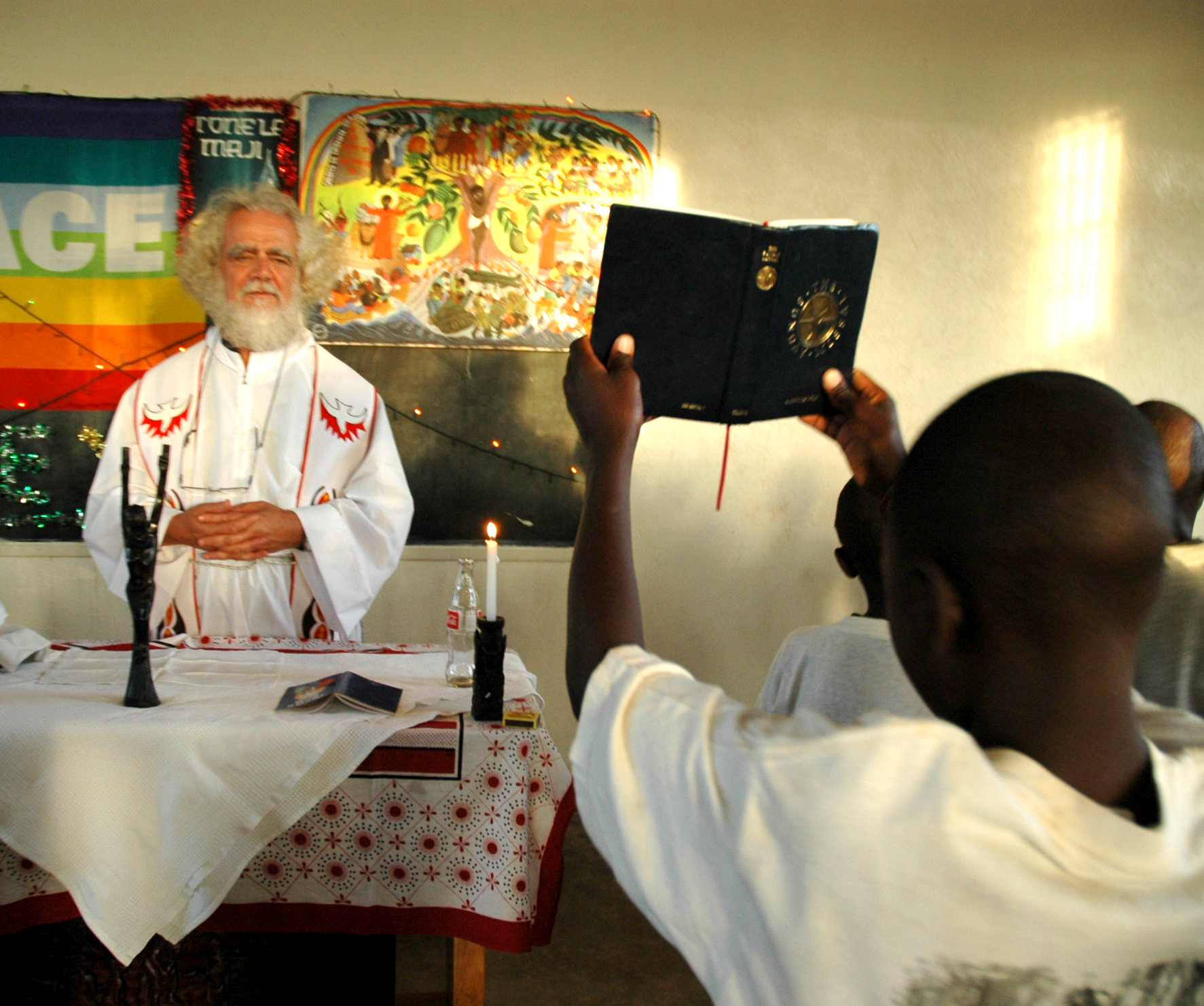
I arrived in Zambia thirty years ago, in mid-September 1977. After my priestly ordination in 1970, I worked for our Italian magazine, Nigrizia, and traveled many times to Africa to collect written materials and photos. Then, at last, the time came for me to set out for Africa − to stay there for good. Certainly, in the mind of some of my superiors, it was a removal, perhaps a punishment, because I had been too close to the liberation movements in the then Portuguese colonies. The visit to the Guinea-Bissau rebels, and the book that ensued, had not been accepted by everybody. At least at the outset. Later, after the carnations’ revolution and the fall of Caetano, the same superiors, in a press conference, had boasted of the book, saying: “We, Comboni missionaries, have been farsighted and, for years, we have been opposing the Portuguese colonialism as Fr. Kizito’s book witnesses…” About all this, however, and how other people were seeing things I couldn’t care less. I was setting out for Africa at last!
The then Father General had asked me what was my option. Was I willing to go to Ghana, where the Comboni missionaries had arrived recently and were in need of young blood? Or to Kenya, where some of our missionaries had taken refuge, after their expulsion from Amin’s Uganda? South Africa, which I had visited a couple of years before, was appealing to me, but I was frightened by the massive presence of a group of elderly missionaries, almost all of them German. I was afraid because we may not be on the same wavelength. Then Fr. Agostoni, the General, added: “We would like also to open new missions in Zambia, if you feel up to it…You would be the first Comboni missionary to reach that country.” Fr. Agostoni had in mind a great strategy: the Comboni missionaries had been in Mozambique then for a few years, and had also arrived recently in Malawi. Taking some missions in the Eastern corner of Zambia, wedged between Mozambique and Malawi, a zone of Comboni presence in three different countries, with practically the same local language being spoken, would have been established. In this way, an exchange of personnel in times of political instability could be possible. But, as it often happens when men of the cloth try to be strategists, nothing of the sort happened. If I recall correctly, only once did Comboni missionaries moved from Mozambique to Malawi, following the refugees, in the eighties. Anyway, I accepted the offer right there, in the staircase of our generalate in Rome.
WITNESSING A DELIVERY
After a few weeks, armed with introduction letters for the Bishop of Chipata, I left Italy. I made a stopover at Abidjan, in Ivory Coast, where the prestigious magazine of the black intellectuals Presence Africaine had organized a conference on the theme “Africa and the Church.” Thus, I arrived in Zambia with the charge of taking over the mission of Chaniza, in the Diocese of Chipata, from the White Fathers who had started feeling the crisis of vocations that would affect the Comboni missionaries only a few years later. My heart was full of the vision of an African Council that was officially proposed, for the first time, at Abidjan.
At Lusaka were the Comboni Sisters who still called themselves Pious Mothers of the Africans and whom I had visited two years previously − during a very long journey that took me to almost all the countries of Southern Africa. From the time of my arrival at Lusaka, in mid-September 1977, I lived in the house of the White Fathers who had offered to be my hosts until the following April. That was also the residence of Fr. Jean Vermeullen, who would teach me Chinyanja, the local language. The following day, I went to greet the Pious Mothers, in the parish of New Kanyama, a very vast popular settlement in the outskirts of Lusaka. Sister Clara, a midwife in the largest public hospital of Zambia, suggested to me: “What better way of starting your life in Zambia than to witness a delivery?” I had a diploma for general nursing which I earned from Gallarate Hospital, where I had watched a few deliveries, even if it was not in the syllabus, because the doctor in charge had a romantic vision that a missionary ought to be able to do everything! I accepted Sr. Clara’s invitation and in the morning of my third day in Lusaka, at around nine, I was present during the delivery of a baby boy. No complications were expected, and the delivery took place on the bed of the ward, behind drawn curtains. The mother glowed immediately after hearing the baby’s first cry; she wanted him in her arms. When I went back to that same bed, after a couple of hours touring the hospital, there was already another mother there suffering the pangs of giving birth. The mother and the baby I had seen earlier were already discharged.
I have often thought about that child. By now, if everything went well with him and he did not become a number in the statistics of victims of infant mortality because of malaria, tuberculosis and AIDS, he must be a thirty-year-old man.
THIRTY YEARS OF CHANGE
There have been thirty years of changes in the African society and the Church. The Church, even if providentially has now African bishops and leaders, on the whole it is still marked with European features, and finds it difficult to keep pace of the changes in the continent. On the other hand, the process of appropriating the Gospel can only be long and hard. As a missionary, I have committed myself to walk according to the pace of my brothers and sisters in the local community, trying not to create obstacles. I have never regretted it. Africa has given me back not one hundred but one thousand times more of what I have left behind.
In Africa, I have learned the Christian sense of life. I have learned that failures are more important than successes. Without failures − recognized, and I would say, savored, and loved − the Church would run the risk of becoming an efficient multinational charitable institution. Failures and our crosses help us to live our faith.
I have learned that the virtue that gives a sweet taste to everything, even to failures, to betrayals by those we thought were our friends, is goodness. It is the simple, old-fashioned goodness, of an affectionate and respectful gesture, a hand or a gift, given from the heart. It is the virtue that makes God’s presence visible in us. God is good and in the heart of each person there is some goodness. Many a time, in a difficult and hostile environment, the possibility of communication and dialogue begins with a gesture of goodness − even by one person alone.
Finally, among many things, Africa has taught me that my personal human adventure does not have sense and value if seen by itself; it must be able to assimilate into the context of the community. Only together, we are able to move towards God’s horizons.