
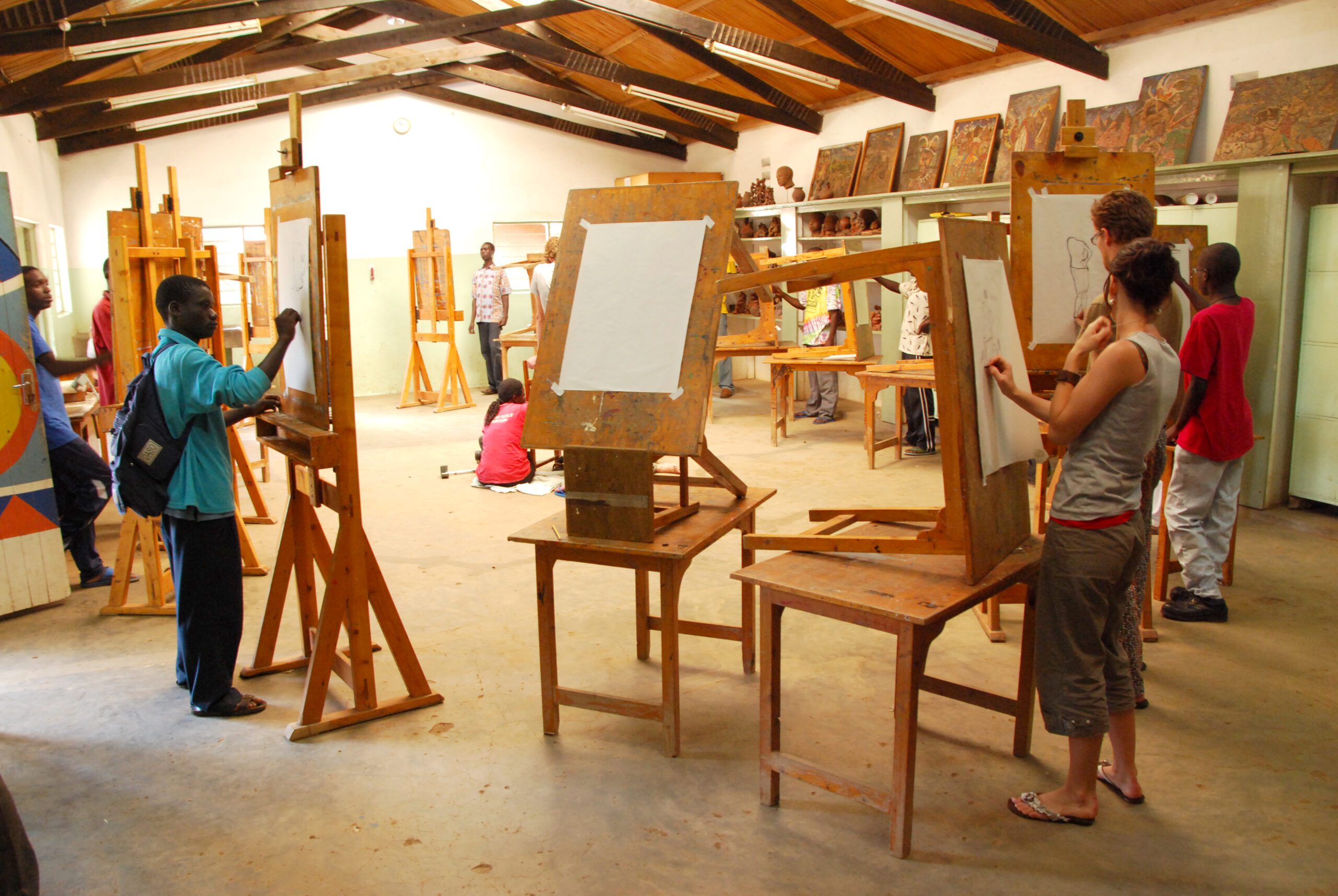
For a long time, I have felt that the existence of a centre of artistic learning aiming at fostering creativity and a sense of beauty among young talent from the slums surrounding the Kenyan lakeside town of Kisumu is a story crying out to be told. The Mwangaza Art School, as it has come to be called, is situated at Nyalenda, smack in the middle of the semi-circle of shanties holding the city centre of Kisumu in a tight embrace. It is an unusual component, to say the least, of the much larger Kisumu Urban Apostolate Program (KUAP) on integral slum development. This includes, among other activities, a community-based health care project. It provides opportunities for formal and informal education, and runs a street children rehabilitation centre.
“Here, in Kenya, this Art School is unique in more than one way,” Dan Ouma, one of the school’s teachers, explains to me when I meet him on a visit intended to satisfy my personal curiosity at this intriguing − by its location and its catchment area − slum-based artistic centre. “There is, of course, an Academy for Fine Arts in Nairobi and there are several other art schools, drawing their students mostly from the well-to-do. Engaging in art is generally seen as a luxury only the better-off can afford. Conditions for entry are often put very high. But an institution like this one, drawing the bulk of its students from the deprived shanties, one will find nowhere else, maybe in the whole of Africa,” he adds with a broad smile.
His own story is illustrative of the flourishing of talent from what would seem an unlikely background made possible by this school. Himself, originally from the disadvantaged perimeter of Kisumu, he moved to Nairobi in search of education and suitable employment. This he found, at first, as a semi-professional football player. But his heart was elsewhere. A German artist friend of an uncle of his, who lectured at Nairobi, spotted his natural talent for drawing and took him under his wings. But a bad injury, sustained when playing football, forced him to return to his home in Kisumu. To pass away the time while recovering, he started painting. This was way back in 1987. While in Kisumu, a friend told him about Sr. Janet Mullen, SND who, together with Fr. Hans Burgman, MHM, the now septuagenarian originator of KUAP project, were exploring the totally novel idea of starting an art school in the slums as part of an integral development program. He took up contact with her and never looked back notwithstanding strong pressure from his family to develop his football career. Eventually, he became a teacher at what later became the Mwangaza Art School.
THE IMPORTANCE OF SPIRITUALITY
Coming from the squalor and social deprivation of an African urban slum, one may be disadvantaged educationally and in many other ways, but there is no reason why such a background should prevent one from possessing some hidden artistic talent. Fledgling Picassos or Van Goghs may lie dormant in the alleyways of Nairobi’s Kibera slum! All it takes is opportunity and someone to call forth the talent that lies hidden among the shacks and hovels of the shanty towns.
Such, in brief, is the philosophy behind this extraordinary initiative. And it has worked! Naturally, in such circumstances, the level of education ranks second as a condition for entry after natural talents at this art school-not-like-any-other. Some are primary school leavers, others join after secondary education or from teacher training colleges. The school gets no government support and has to shoulder the students’ fees through friends’ gifts.
Nominal low fees may be waived when obvious talent is in evidence. Three months into the three-year long course covering drawing, watercolor painting, oil painting, acrylics, graphic design and clay modeling, a first test is conducted to separate artistic talent from those otherwise gifted. But some may need longer to begin to show signs of future promise.
Dan Ouma narrates: “Over my 20 years as a teacher at this school, I have learnt to identify with others. Right from the start, Sr. Janet taught me the importance of spirituality. To work from one’s inner strength and depth. This transfers to the students. Some students are from very deprived backgrounds. They come to school on an empty stomach. That, of course, influences their performance. And artistically inclined people often are special; they can be difficult. You have to learn how to deal with them, sense their moods, call forth the talent that is in them. It is a slow process! Teachers sometimes visit the homes of students who have migrated from the rural areas to assess their circumstances back in the country. ‘Take for example this boy from Dunga,’ he explains with obvious empathy, ‘he clearly had talent but it took a lot of coaxing to bring it to the fore. His level of education was a mere primary standard four. Father Hans told me: ‘Dan, you go and see.’ He was living with his grandmother in abject poverty. We waived his fees. Now he is doing wonders painting, and modeling clay. Doing really well.”
EMBELLISHING CHURCHES
“Over the past twenty years, graduates from Mwangaza Art School have taken up printing, design, advertising; some are making a living as free lance artists, others paint murals, become arts teachers or specialize in letter writing and designing logos. Others again may not have made arts the prime focus of their careers but the aesthetic interest once awakened shows itself in the embellishment of their personal environment,” Father Hans explains with a twinkle in his eyes. A striking example of this are the sculptures which welcome the visitor at the entrance of the slum-based Pandipieri Catholic Centre which continues to be the headquarters of the entire project.
Over the years, teams of budding artists have been invited to embellish churches and other significant spaces in Western Kenya and beyond. I recently visited the beautifully decorated church at Kiptere with its striking mural depicting an African Last Supper scene.
Over time, the school has acquired some distinguished friends and sympathizers. Fr. Hans speaks with legitimate pride of a surprise appearance at the school of Prince William Alexander, Crown Prince of the Netherlands, who, on a private visit to Kenya, popped in at the Art School and showed great interest in what they are trying to achieve. Artist friends from Europe and elsewhere have come in on a short-term basis as volunteers to give master classes sharing their knowledge and skills with the students. The day I visited, I found a group of six young Dutch volunteers from the street children program who joined in at the model drawing class given every Friday by Fr. Hans himself.
Training in creativity obviously expands not only personal and artistic horizons; it also fosters better understanding among humans.