
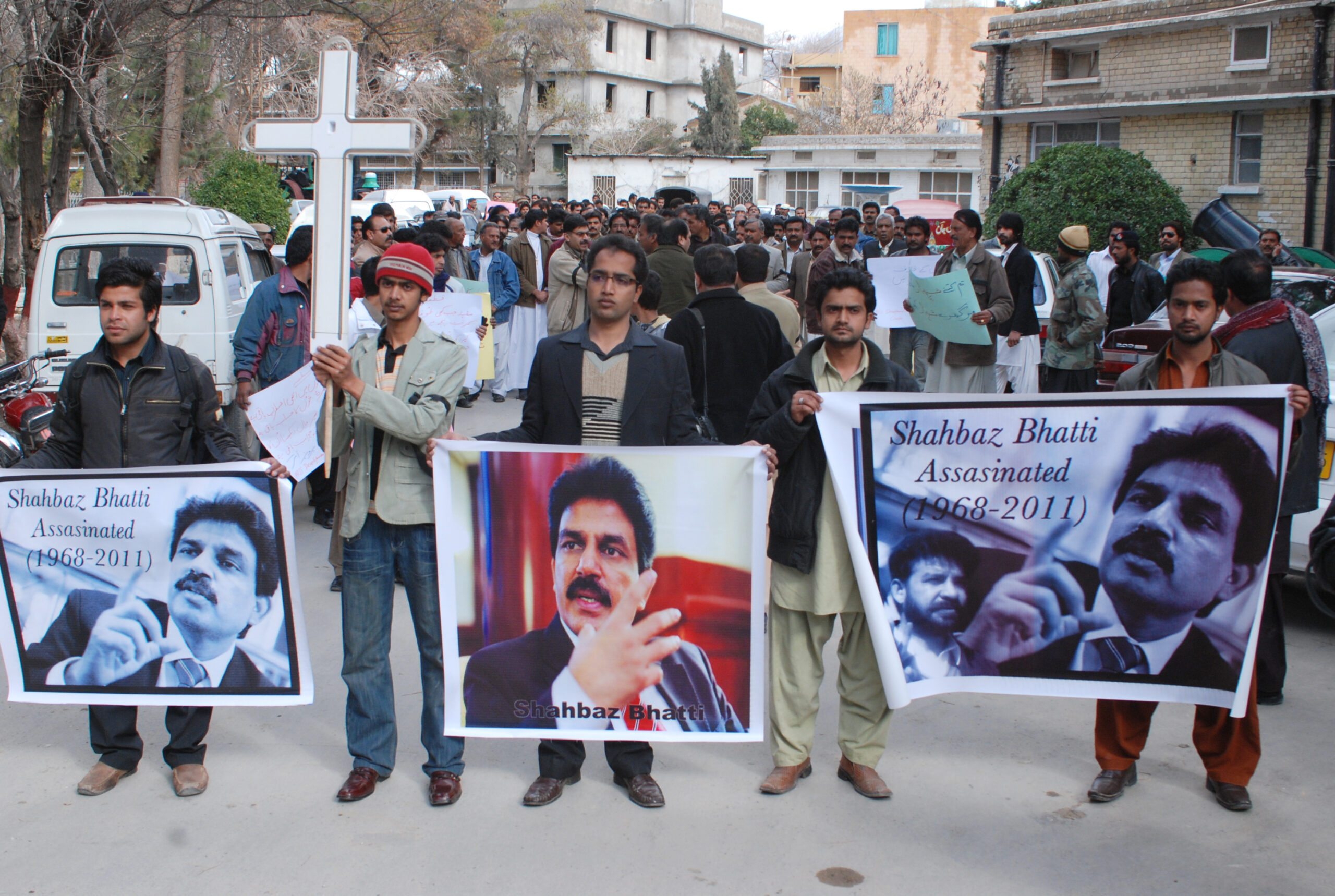
Jacob Bhatti was of fundamental importance in his son’s life. One testimony of this appeared in newspapers in Pakistan at the time of Jacob’s death describing him thus: “He was a brave man and was the main source of strength for his son. He encouraged him and helped him to deal with the most risky and precarious of situations.”
Shahbaz Bhatti was appointed Federal Minister for Religious Minorities in 2008. He boldly defended Asia Bibi, a Christian sentenced to death for blasphemy on the basis of false accusations.
He belonged to the Pakistan People’s Party (PPP), the progressive party in government. After the killing of Salman Taseer, a Muslim who Islamic fundamentalists blamed for also having defended Asia Bibi, Bhatti had become the radicals “top target.” His main goal was the abolition of the infamous blasphemy law, which allows this kind of persecution.
According to the 2009-2010 Report by the Episcopal Commission for Justice and Peace in Pakistan, currently, “the trend of violent acts against religious minorities is growing”; the blasphemy law is Damocles’ sword against minorities; freedom of religion “is reduced to a myth,” and “in the face of the Government’s apathy, urgent action is needed to protect human rights.” Between 1987 (since it has been in force) and 2009, 1,032 people have been unjustly affected by the blasphemy law. Religious freedom has been gradually eroded: from 2005 to 2009; there were 622 registered cases – just the tip of the iceberg – of forced conversion from Christianity to Islam.
The Minister was born in the village of Khushpur near Faisalabad, in Punjab, known as “the Vatican of Pakistan,” as it is a village founded by the Dominican friars, which has brought forth many Pakistani priests, sisters and men and women religious. After completing his studies, he started his political career in the most progressive political group for the reform of the nation. He was quickly noted by party executives, and especially Benazir Bhutto, with whom he worked closely until the charismatic leader was assassinated.
Bhatti always paid special attention to the situation of the country’s most discriminated against. He was chairman of the APM (All Pakistan Minorities Alliance). This is a representative organization of marginalized communities and religious minorities in Pakistan, working on several fronts in support of the needy, the poor and the persecuted. Speaking of the reason for his commitment, he would simply say: “I just want a place at the feet of Jesus. I want my life, my character, my actions to speak for me and say that I am following Jesus Christ.”
A Christian source, anonymous for security reasons, said that there is a “state within the state,” made up of fundamentalist elements “who commit crimes and act with total impunity.” The source explained: “There are elements working inside the government. There is a state within the state, that is more powerful, moved by an extremist ideology. By contrast, ordinary citizens, civil society, moderate Muslims, i.e., the majority, want to live peacefully, but they are powerless vis-à-vis fanatical and fundamentalist movements.” In the end, such a “deplorable incident” takes away “courage and hope from religious minorities and civil society.”
Of the population in Pakistan of 185 million inhabitants, 96% are Muslims, and 2% are Christians. Among these, Catholics are slightly more than one million. Christians, with Hindus and Sikhs (the remaining 2% of the population) live in a state of daily discrimination and social marginalization.
Even before the partition between India and Pakistan (1947) – which gave birth to the nation – there were so-called “Dalits,” those outside the caste system according to the rigid social classification that exists in India. Their condition of subordination has not changed in the Republic of Pakistan. Religious minorities are discriminated upon today in access to education, employment, and public office. www.asianews.it / www.fides.org