
An amusing story is told that, one Easter, Saint Peter noticed that many Filipinos were absent from heaven. Upon inquiry, he discovered that they all had returned to earth to celebrate the salubong, the Philippine Resurrection ritual, in their own hometowns. This humorous tale captures the magnetic quality of the Easter ritual, known locally as the “meeting” (encuentro); it dramatizes the encounter of the Risen Christ and His mother on Easter morning. It is a popular ritual countrywide; each region has its own terminology to describe the event: salubong (Tagalog), pagsugat (Cebuano), sabet (Ilocano), tonton (Bicolano), and abet-abet (Pangasinan).
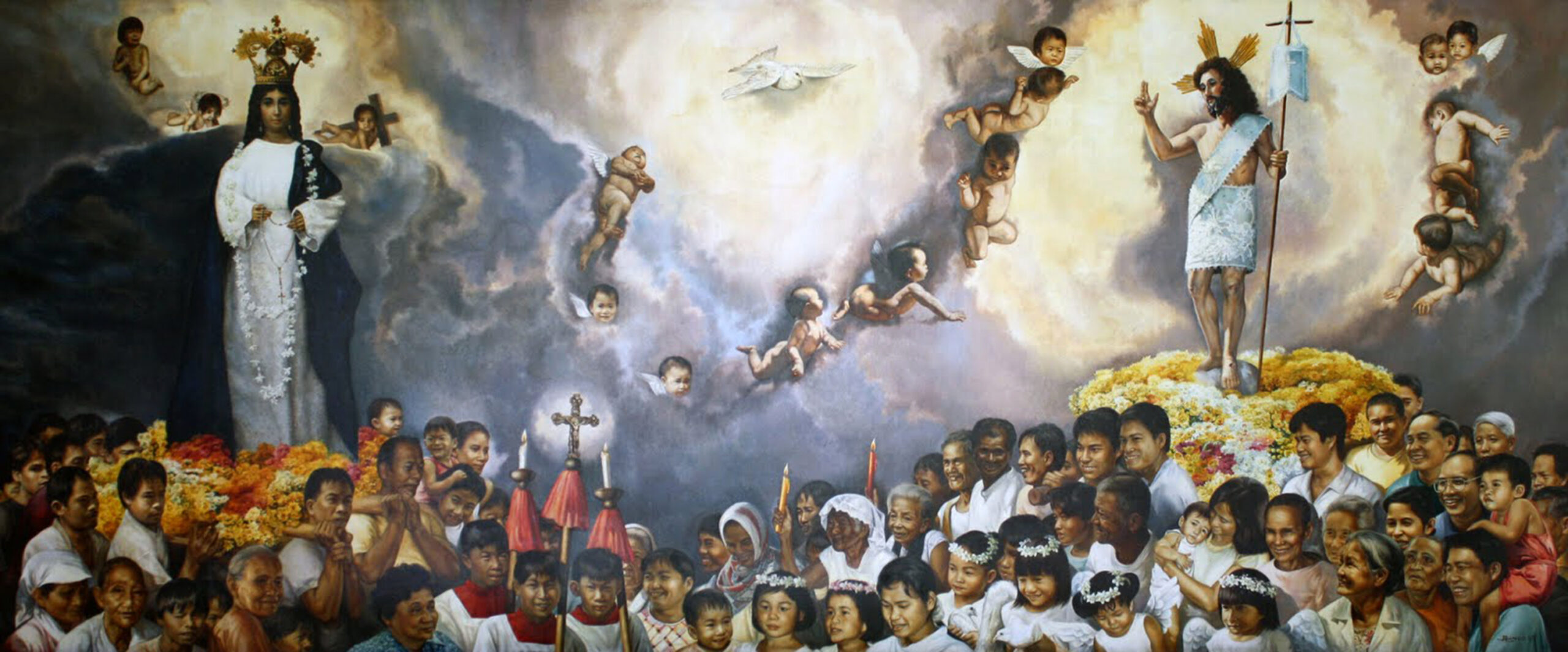
In the early morning darkness before the crack of dawn, two processions begin wending their way through the streets of the town. Literally, several hundreds join in the activities which begin around 4:00 a.m. One procession is composed of the townsmen. This all-male group follows the statue of the Risen Christ, clad in gold-embroidered white silk and holding his victory standard. The statue is borne aloft by young men who consider it a unique privilege to be chosen to carry the Risen Jesus. Another procession, composed of the women of the town, follows the statue of the Sorrowful Mother (Mater Dolorosa). She is in mourning, her face covered by a black veil; her hands are clasped in sorrow. The somber mood of Good Friday dominates the two processions.
Both groups, praying and singing as they follow their separate routes, emerge into the town square where additional crowds are waiting. With coordinated movements, they simultaneously approach the arch of “meeting.” The first light of dawn is breaking; the little male and female angels are positioned around the arch; flowers and decorations abound. A white-clad angel is lowered ever so carefully from the pulleys inside the arch.
She intones the Regina Caeli Laetare, Alleluia (Queen of Heaven Rejoice, Alleluia). Then, to the accompaniment of the band, all the choirs of angels on the arch break into their Easter chants. At the end of their singing, the lead angel slips her finger through a ring atop the Virgin Mother’s black veil. As the angel is slowly raised up on the arch, she removes the veil and reveals the gleaming ivory face of the joyous Virgin. Mary meets her Risen Son – to the wild, yet prayerful, enthusiasm of the expectant crowd. The band strikes up a rousing anthem and the faithful enter the church to continue celebrating, in Word and Sacrament, the Easter liturgy. The faithful hear the Gospel proclamation to become, like the first disciples, witnesses of the Risen Lord. Christ is truly risen!
TRUE PROCLAMATION
The foregoing scene of Resurrection encounter – meeting the Risen Jesus – is true proclamation in pageantry, drama, and song. It is eminently faithful to the Gospel narratives of the Resurrection, which themselves can be understood as “faith dramas.” A survey of the appearances of the Risen Jesus reveals a rich variety in the different scriptural accounts by the evangelists; they were addressing different communities with unique theological interests and purposes. Despite divergences in the details of appearances to Peter, Mary Magdalene, Thomas, and groups of disciples, each Gospel writer seeks to communicate the same fundamental experience: the Crucified One is risen and alive! Surely, this was also the Virgin Mary’s experience.
R
espected Catholic New Testament exegetes detect the presence of a pattern in most Resurrection encounters. The Gospels are perceived to include five paradigmatic elements in their narratives:
There is a mood of sadness, confusion, fear, disappointment, despondency; Jesus’ followers are in darkness and their minds are clouded. For example, Mary Magdalene is in the garden weeping; the Emmaus disciples are returning home disappointed (Lk 24:21; Jn 20:11; 20:19; Mk 16:3).
The initiative for the encounter comes from Jesus; He accompanies the disciples wandering in their confusion. Jesus comes to Mary, but she thinks He is only the gardener; Jesus “the stranger” walks with the Emmaus disciples (Lk 24:15; Jn 20:19; 21:4; Mt 28:9; 28:18).
There is a word or greeting of peace and reconciliation. Jesus says to His disciples: “Peace be with you.” He personally calls Mary Magdalene by her name (Jn 20:19; 20:26; Mt 28:9; Lk 24:36).
The climactic high point comes in the experience of recognition. The Emmaus disciples recognize Christ in the breaking of the bread; Mary addresses Jesus as “Rabbuni” (Teacher); John exclaims to Peter: “It is the Lord!” (Jn 20:16; 20:20; 20:28; 21:7; 21:12; Lk 24:31; Mt 28:9; 28:17).
A mission command from Jesus concludes the encounter: “Go out to the whole world; proclaim the Good News to all creation.” “Go, make disciples of all nations” (Mt 28:18-20; 28:10; Mk 16:15; Lk 24:48; Jn 20:17; 20:21; 21:15 ff.).
A retracing of this biblical-liturgical-catechetical paradigm of the Resurrection is now possible in tandem with the dramatic “meeting” / “encounter” (salubong) that Filipino popular religiosity celebrates early on Easter morn. In fact, the parallelism is almost self-evident:
Darkness reigns as the drama begins to unfold before dawn; it appears that the gloom and hopelessness of death have been victorious. The Virgin Mary is weeping, her head covered with a black veil.
Jesus draws near to His friends wandering through the streets of town; the dual processions present Jesus looking for His sorrowful mother.
Jesus’ word of greeting is placed on the lips of the interpreting angel: “Rejoice, O Queen of Heaven, Alleluia.”
The climactic moment of recognition is the central focus; Mary’s black veil of sadness is removed to reveal her joyful face carved from polished ivory; her facial expression proclaims: “It is the Lord!”
The crowds move into the church to hear the Scriptures proclaim their mandate to be witnesses of the Resurrection; the Sacrament of the Eucharist empowers the faithful for their mission.
THE PEOPLE’S INSIGHT
Reflection further reveals that the biblical pattern of Resurrection encounter, so poignantly dramatized in the inculturated Easter pageantry found throughout the Philippines, is an authentic paradigm of our own Christian experience. We so often walk in darkness, failing to recognize the reality of Christ among us. Jesus calls us personally by name to acknowledge His living presence. We need Word and Sacrament to heal our blindness. When we recognize that Jesus the Christ is alive, we are impelled into mission to announce the Good News to all creation.
Commenting on the religious dramatization that surrounds Easter in the Philippines, Filipino author, Nicanor G. Tiongson, has correctly noted that the Easter Encounter is “the very crown of the Filipino’s Semana Santa (Holy Week).” This is a compliment to ordinary people’s valid intuitions and insight into scriptural faith; for them, as for Saint Paul, meeting and recognizing the Risen Lord is central: “If Christ has not been raised, then our preaching is useless and your believing it is also in vain” (I Cor 15:14).
Taking their cue from each local Church’s genius (the Philippine expression serves only as one example), catechists, evangelizers, pastors and theologians must continue searching for more effective tools of exegesis and inculturated proclamation to announce Christ’s living presence. Creative cultural expressions found in popular rituals and piety can serve to address the need of every generation to be “re-evangelized” in its attitudes, motivations, and values. Indigenous proclamation seeks to overcome the split between faith and culture that challenges all societies – be they in first, second, or third world countries. The need of a “renewed evangelization” is a constant challenge for the Church – missionary by its very nature and identity.
In a word, then, the renewed examination of the role of dramatics, art, song, dance, pageantry, and festivity can certainly be a unique key to making the faith truly alive in people’s hearts, imagination, and daily experiences. These tools can rescue proclamation from the heavily verbal mode (which often dominates in parish catechesis and liturgy). Such creative evangelization effectively reaches a wide audience of diverse ages and backgrounds.
On Easter Sunday, ask any Filipino – even a four-year-old child – and you will hear: “Jesus is alive! I saw Him meet His mother; Mary is happy and smiling!” Without doubt, here is living liturgy and genuine biblical proclamation! Here is authentic inculturation of the faith!
* Fr. James H. Kroeger is professor of Theology and Mission Studies at the Loyola School of Theology and at the Mother of Life Catechetical Center in Metro Manila.