
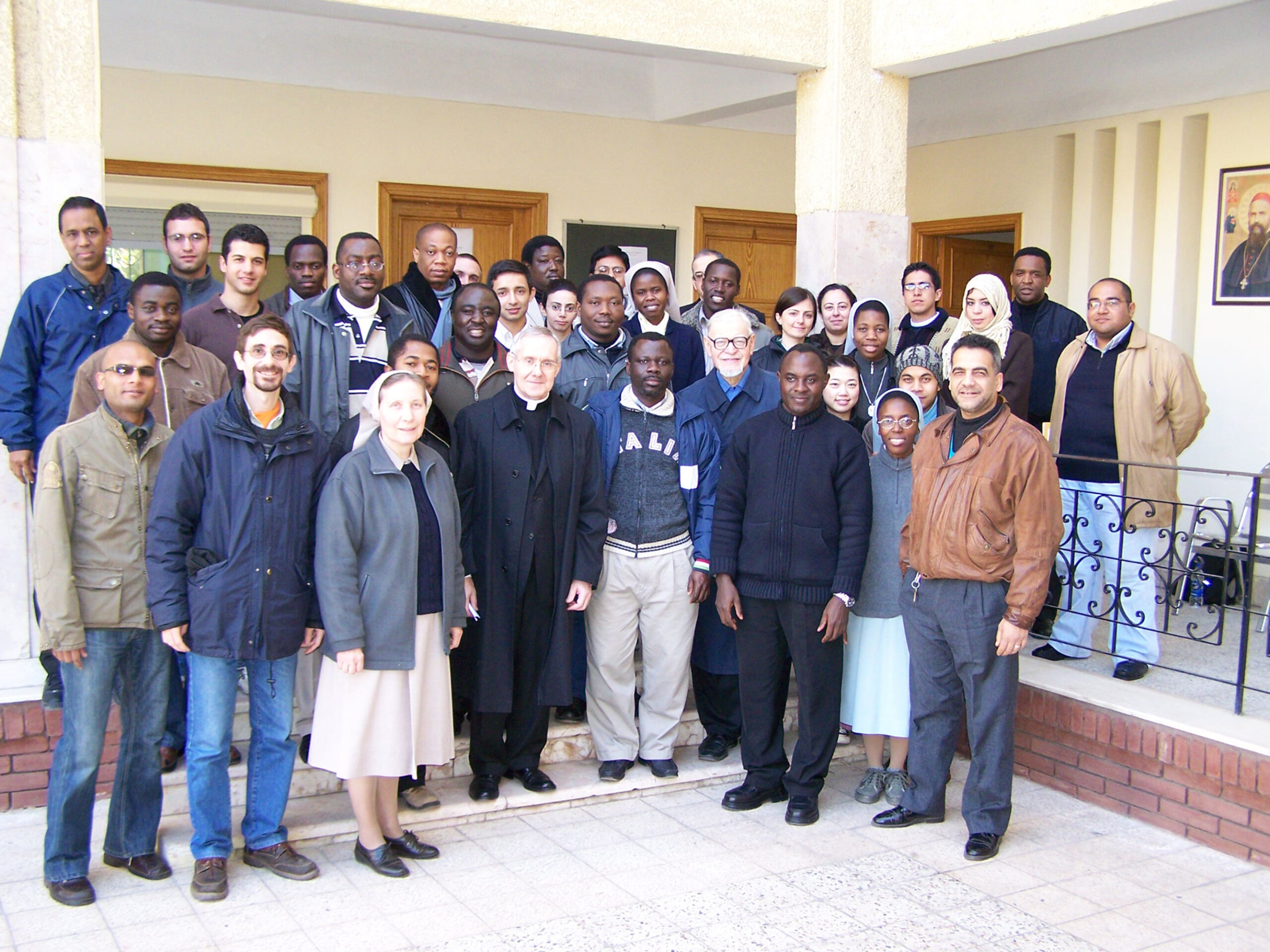
In February 2008, Cardinal Jean-Louis Pierre Tauran, President of the Pontifical Council for Interreligious Dialogue, visited Egypt. He started by giving a conference at the Nile Hall in St. Joseph’s Church on the role of the believers, Christians and Muslims, in today’s society. His Eminence also spoke about the meeting he had with the Shaikh of Al-Azhar University, Abd al-Fattah Muhammad Alamm, President of the Committee for Dialogue of Al-Azhar. The kernel of their conversation was the link between the love of God and the love of neighbor. The following year, the meeting was held in Rome. It was the beginning of a dialogue that still continues.
Also in August 2008, sixteen Italian university students belonging to “Comunione e Liberazione,” fascinated by the perspective of the encounter of different civilizations, religions and cultures, after a full year of private study, travelled to Egypt for an intense course of the Arabic language at the prestigious Dar Comboni Institute at Cairo, and a full immersion in the Arabic world in order to approach a way of thinking and living that immigration and globalization had made increasingly close to their lives. In November of the same year, they were received by Cardinal Tauran who encouraged them, telling them that the basic motivation of every knowledge is love, that true dialogue between people of different faith can occur only if they are steeped and rooted in their own faith. He also told them that such trips encourage the local Christians, often a discriminated and persecuted minority.
THE DOOR OF AFRICA
Considered the door of Africa, Egypt has always been, for the Comboni Missionaries, a kind of ante-room to the “Black Pearl,” the Sudan. Here, Daniel Comboni, the founder of the institute, opened the first religious communities in 1867 – a presence which was meant not only for the purpose of acclimatization but, above all, for learning Arabic. Even nowadays, Dar Comboni is one of the best centers for the study of the Arabic language and culture.
The origin of Dar Comboni is linked to the need the Comboni family felt to train its members, assigned to Egypt, Sudan or the Middle East, in the Arabic language. The Institute was initially opened in Lebanon but, due to the escalation of the civil war, it was transferred to the Sakakini site in Cairo. In the meantime, several Institutes asked to join the Comboni Missionaries in the preparation of their members who had the same objectives. At the end of the school year 1993-1994, Dar Comboni moved from the Sakakini site to Zamalek, Cairo where the community of Comboni Missionaries and the Institute reside at present. It is situated in the island/quarter of Zamalek, close to the Comboni parish which is one of the most active in the whole of Cairo.
The writer of this article is very proud to acknowledge that the president of Dar Comboni, Fr. John Richard Kyankaaga Ssendawula, doctor in Islamology, is a Ugandan whom he recruited together with his colleague at the institute, Fr. Achilles Kiwanuka Kasozi, way back in the eighties. They were both eager young men in the schools of Masaka, Uganda, when he was roaming the country along the dangerous routes of the post-Amin period. They are now the embodiment of Comboni’s dream to save Africa with Africa.
Dar Comboni offers language courses to missionaries and religious of both sexes and priests from all over the world, as well as lay people who want to seriously deepen the study of Arabic. Courses last for one or two years, with a compulsory attendance of 5 to 6 hours a day. Besides much grammar, other subjects like translation, conversation, written composition, newspapers’ reading, Islamic studies and reading of the Christian Arabic texts are proposed.
In light of Vatican II, the center fosters relations through dialogue with Muslims, giving, at the same time, a background preparation for Church personnel and committed lay people who will be working among Christian communities living in an Islamic environment. These aims are achieved by an intensive course in the Arabic language so as to have a good mastering of the contemporary standard Arabic and an introduction to Islamic culture to foster mutual understanding between Christians and Muslims and Interreligious dialogue.
ISLAM’S FOUNDING TEXTS
Some years ago, a telephone call from the Iranian Embassy in Rome warned the librarian of the PISAI (Pontifical Institute for Arabic and Islamic Studies) of the impending visit of a scholar of Islamic studies. The librarian was entrusted with the task of accompanying him to the library. The visit was long and detailed. On the shelves of the big room, more than 32,000 volumes are displayed. On the guest’s face, there was surprise when he discovered that the majority of the texts were not only in Arabic (a compulsory subject for the religious studies), but also the volumes were well known to him: one or the other, he had used for his studies. He picked up some and opened them in silence.
While he was going out, his eyes fell on the Iranian Encyclopedia in Arabic that was proudly displayed in front of the entrance. His face lit up with a smile. Then, turning to the secretary of the Iranian Embassy who was accompanying him, he exclaimed: “These people are better than us. We do not have Christian texts in our library in Teheran, whereas, here, they study Islam in the founding texts: the Kur’an, commentaries to the Kur’an, theology, law…”
If Cardinal Charles Lavigerie who founded the White Fathers in 1886 were present, he would have been very pleased by that admission. When, defying the French authorities, he started to get interested in the Arabs of the colonies, he realized that to get them open to a different religious sensitivity would be a long-time effort. It was necessary to understand first the historical heritage dwelling in their mind and heart, to study the language of the Koran, to deepen the knowledge of their religion and culture.
Lavigerie died in 1892. His guidelines remained alive in the Society of the White Fathers, but it required time and patience to see them traduced into practice. Only in 1926, at Tunis, the Institute of Arabic Literature (IBLA) was opened in order to foster the encounter with the local intellectuals and to prepare missionaries for Northern Africa. The Institute kept growing. Other men and women religious and lay people joined since they themselves were assigned to live and work in the Muslim world. For the Tunisian public, the Institute founded a magazine with the same name, IBLA, that is still in existence, and opened a library that remains one of the best and more frequented in the city.
The White Fathers perceived the necessity of giving their initiative a more universal dimension and took the Institute to Rome (1964). Pope Paul VI was convinced of the service the institute could render to the post-conciliar Church, by then, launched into dialogue with the world. He, therefore, welcomed it with satisfaction and qualified it to confer university degrees like licentiate and doctorate. Its acronym became PISAI (Pontifical Institute for Arabic and Islamic Studies). The new institute contributed already during the second part of Vatican Council II. The Declaration Nostra Aetate, the text which, among other things, gives the Church’s new view of Islam, was practically composed by Fr. Robert Caspar, one of the first professors of the Institute.
A WORK OF THE CHURCH
Nowadays, PISAI has its residence in Rome, in Viale Trastevere, in a palace that was the former center of the Brothers of Christian Instruction. Essential changes took place since the PISAI came to Rome. Born in Northern Africa, the Institute was naturally oriented towards the Islam of the Arabs. But the Arabic Muslims, from Morocco to the Middle East, represent only 20% of the whole Islamic world, even if they remain the most influential group. Nowadays, the most numerous communities are to be found in Asia (Iran, Pakistan, India, Indonesia, Malaysia), without mentioning the Sub-Saharian Africa where one person out of three is a Muslim. “Islam,” writes the Malian philosopher Amadou Hampaté Ba,” is like a river. It takes its color from the land it crosses.” It was, therefore, necessary for the PISAI to broaden its view to the whole vast world of the faithful of the Kur’an and take into account their different colors and sensitivities.
The teaching staff was made up only of White Fathers who, however, used to ask the help of outside collaborators of different intellectual horizons: teachers of Arabic as mother tongue, Muslim intellectuals, specialists of universities placed both in Italy and abroad. Also, in this field, there was the need of enlarging the scope. In this way, nowadays, the White Fathers are joined systematically by the Comboni Missionaries who themselves enjoy a rich experience of the Muslim world. Also, an Italian diocesan priest is integrated in the staff.
There is now an organic union with Dar Comboni, not only because of the exchange of lecturers, but especially because the students start their first year with the study of the Arabic language in Egypt, with the Comboni Missionaries. The administration of the Institute has been assumed by the Vatican: this assures its financial survival and, above all, is a sign of how much the Church has the PISAI at heart. The Missionaries of Africa (White Fathers) still have a moral responsibility role, given the fact that they are the founders.
The rector, Fr. Miguel Angel Ayuso, a Comboni missionary, from the time he took charge of the institute (2006) has witnessed the prestige the PISAI enjoys among the institutions and people who are involved in Muslim-Christian dialogue. “We have very good relationships with the Islamic Cultural Center of the Rome Mosque,” he says. “The Muslim embassies to the Holy See are close to us, as well as other Italian-Muslim organizations.” He himself is a consultant of the Pontifical Council for Interreligious Dialogue. He was called by the Vatican to contribute to the reflection on the “138 Muslim Intellectuals’ Message to the Pope” (2008).
As for academics, it is the duty of PISAI to prepare its students to a serious and deep knowledge of the Arabic language and an objective study of Islam’s foundational texts. This approach is not an end in itself. “The institute is a work of the Church, stresses Fr. Ayuso, a unique enterprise. It studies Islam from within. The program fosters a fundamental aspect in the interreligious relationship, i.e., the knowledge of the other religions as they are in themselves.”