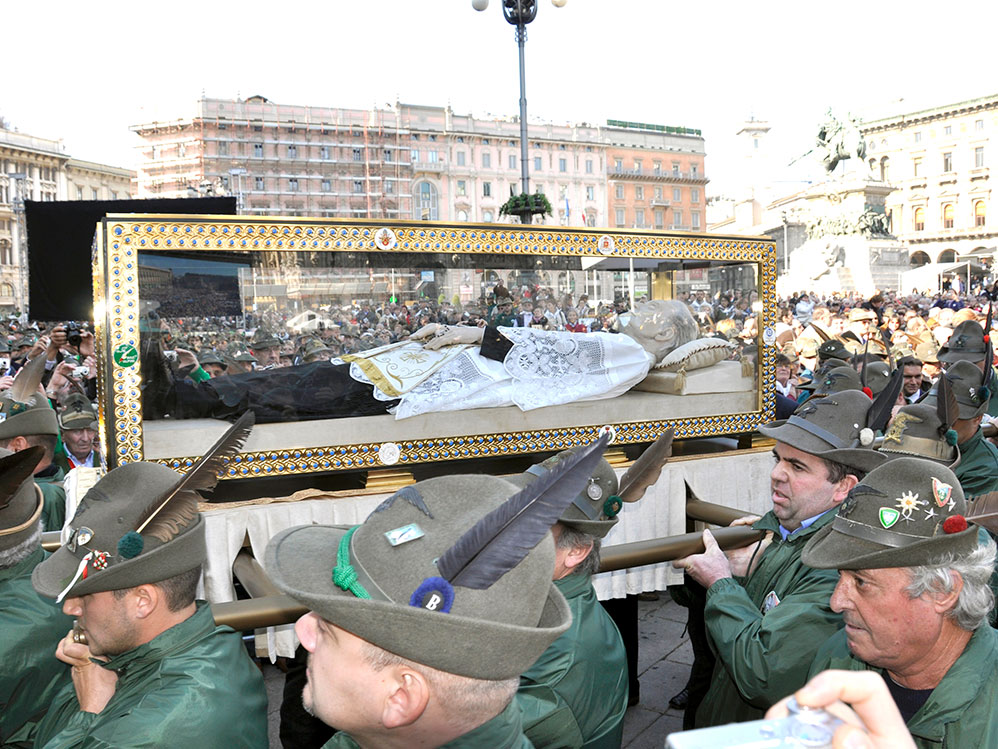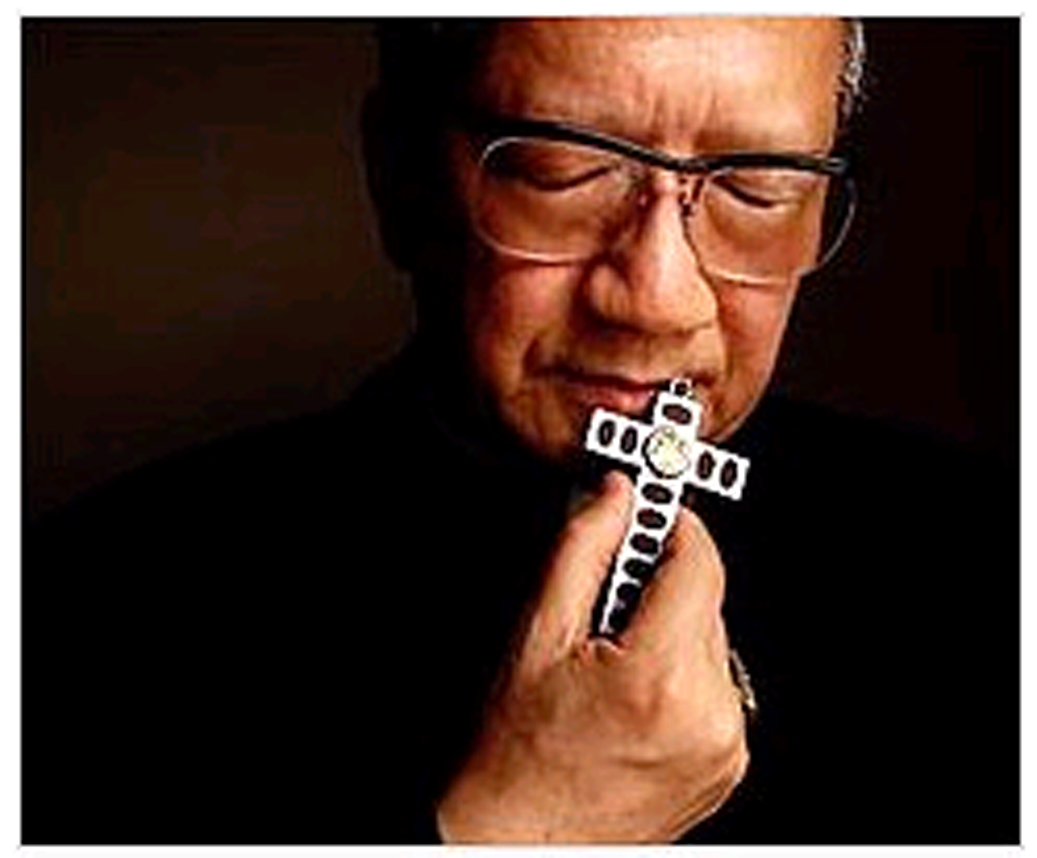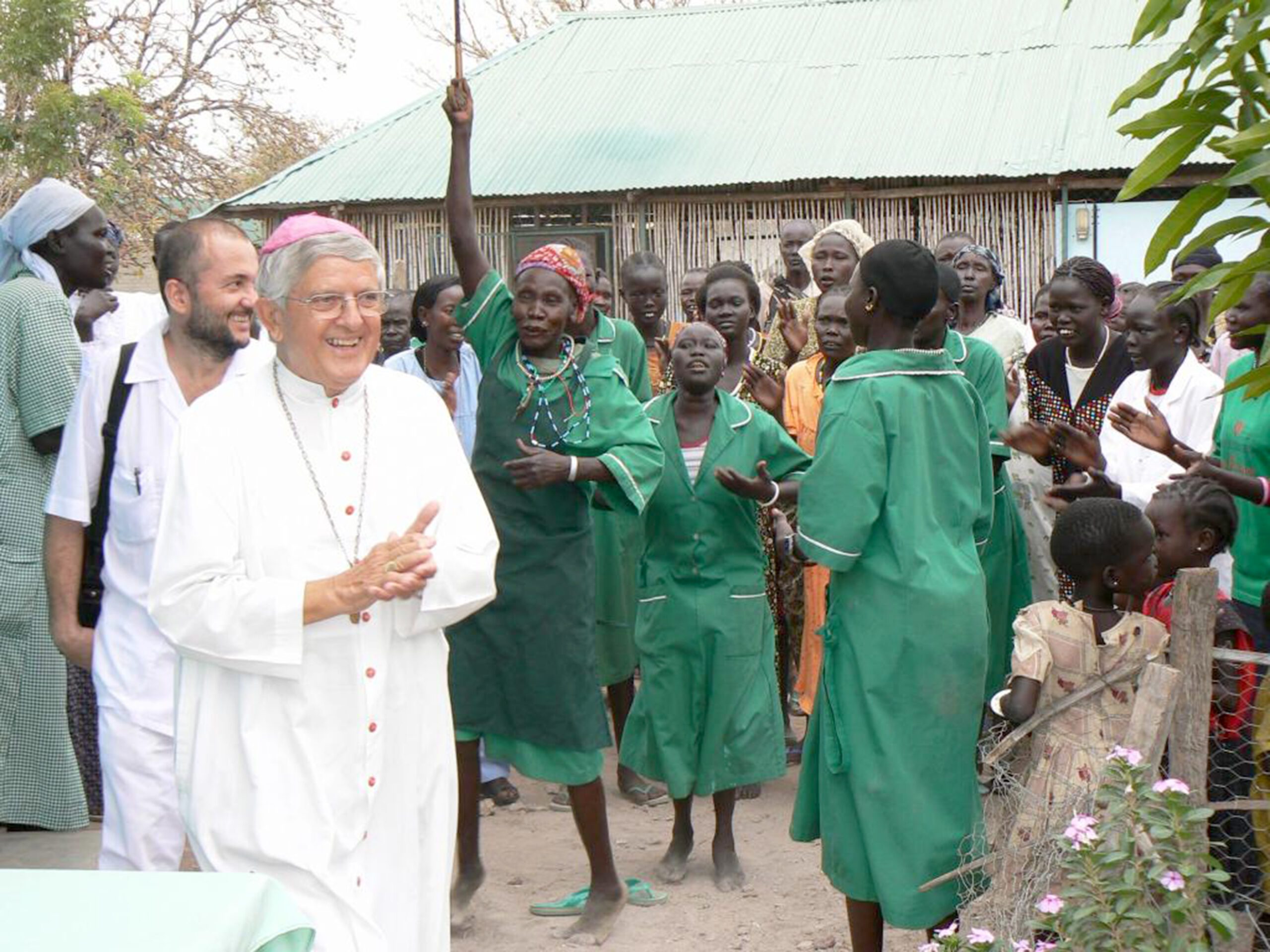
On Saturday, July 9, 2011, in the Freedom Square of the little town of Rumbek, in Southern Sudan, the local bishop, Msgr. Caesar Mazzolari of the Comboni Missionaries, presided over the official opening prayer during the Independence Day celebration, which made South Sudan the newest nation of Africa. Exactly one week later, on July 16, Bishop Caesar died. His death came about unexpectedly as he was celebrating Mass: at the beginning of the Consecration, he felt unwell; he was rushed to the hospital but found to be already dead on arrival. The burial took place at Rumbek on Monday, July 18, earlier than planned, due to the extremely hot weather. Msgr. Caesar had always expressed the desire to be buried in Africa, the land for which he gave so much of himself, for which he suffered much and which he loved immensely.
On September 26, the Permanent Council of the Italian Episcopal Conference (CEI) met in Rome. During his opening address, Cardinal Angelo Bagnasco, its president, said: “In Africa, as it is now well known, the 154th nation, South Sudan, was born, to which all our empathy and friendship goes. Primary protagonist of this independence has been one of our missionaries, Msgr. Caesar Mazzolari. His sudden death has contributed to give even more prominence to the work and achievements of this extraordinary servant of the Gospel, who, because of his intelligence and dedication, deserves to be numbered among the greatest missionaries of all times.” This was possibly the highest praise for Bishop Mazzolari in the large resonance that his sudden death had in the media.
A BROTHER, A FRIEND AND A CONSOLER
Msgr. Caesar Mazzolari was born at Brescia on February 9, 1937. His home was close to the house of the Comboni Missionaries and Caesar was still young when he first showed his desire to become one of them. After high school, Caesar entered the novitiate in 1953, but the following year, he was sent to Monroe, Michigan, in the United States, to complete his formation in view of religious profession and to study English. He was then eighteen years old. He took his first vows at Monroe on September 9, 1955. He then continued with his theological studies at Cincinnati and San Diego, in California. He was ordained priest at San Diego on March 17, 1962.
Fr. Caesar stayed in the United States until 1981 working in different capacities: as spiritual director of the Cincinnati seminary; in pastoral work in Los Angeles, and in a parish of Mexicans. Back in the seminary staff in Cincinnati, he worked among the Appalachians (mountain people) around Cincinnati and among the blacks of the city. During those years, Fr. Caesar realized how much poverty and suffering there existed even in the richest country of the world. For many of the poor, marginalized and unemployed, he was a brother, a friend and a consoler.
In 1981, he was assigned to Africa and South Sudan, first as curate in the town of Nzara, in the diocese of Tombura-Yambio. His first missionary experience took place, therefore, in the land of the Zande, a fertile area already evangelized by two generations of Comboni Missionaries. Fr. Caesar worked as assistant at the Diocesan Catechetical Center and as spiritual director at the minor seminary of the same diocese. In 1984, he was elected provincial superior of the Comboni Missionaries and, at the same time, was president of the Association of Major Religious Superiors up to the end of 1989 and superior general of the indigenous Sisters of the Sacred Heart.
On December 31, 1989, towards the end of his mandate as provincial, Fr. Caesar was appointed Apostolic Administrator of Rumbek. He accepted the post and for ten years followed the tragic vicissitudes of his people, moving his residence first to Arua-Ediofe in Uganda and then to Nairobi in Kenya, due to the war that was raging in South Sudan.
On January 6, 1999, Fr. Caesar was consecrated bishop of the diocese of Rumbek by Pope John Paul II in Rome. His diocese was bigger than the whole of Luzon, with just two diocesan priests and five missionaries. Political difficulties actually prevented him, for a long period, from taking possession of his see, and endangered the lives of his collaborators, both priests and laity. However, at the Cathedral of the Holy Family – built, destroyed and rebuilt more than once during the civil war – Bishop Caesar proclaimed the Good News, never once admitting compromise.
THE VOICE OF THE VOICELESS
During his numerous trips to Italy, especially to his friends in his home town of Brescia and the surrounding area, he spared no effort in giving ‘a voice to the voiceless,’ successfully moving public opinion. South Sudan was the poorest country in Africa where the good of the people took second place to 40 years of civil and tribal warfare whose only aim was to gain power and control over resources such as oil, water and gold to be found there in great quantities. He always asked everyone “not to forget, as the people of Sudan need a just peace that respects human rights.”
The Sudanese people were torn to shreds by tribalism, as well as being worn out by hunger and violence caused by a war which started as far back as 1955, a year before the Sudan became independent from Britain, and which flared up again in 1983. The victims of the war amounted to a million and a half, with five million refugees. “One of my tasks,” wrote Msgr. Caesar, “will be again to spiritually and humanly motivate a people whose moral fiber has been completely destroyed.” And again: “What disturbs me most is the despair felt by the people. For miles and miles, the scene is always the same: an endless crowd of women, old people and children trying to flee the scourge of a war which seems to have no end. In the villages, where there have been incursions by government troops, abandoned human bodies and burned out military vehicles are to be seen.”
In 1994, Msgr. Caesar himself was captured and held hostage for 24 hours by a group of guerrillas of the Sudanese People’s Liberation Army, the armed group fighting for independence against the government of Khartoum. On that occasion, he was seriously threatened simply because he wanted to make peace between two guerrilla factions fighting among themselves. In an interview, Msgr. Caesar explained how the Islamic fundamentalist government of Khartoum had launched a fierce religious persecution against Christians. Those who did not accept the Kur’an could not find work, a home or medical help and could not go to school.
Whenever Christians built a shelter to gather and pray, the government soldiers would come and burn everything. In this situation, Msgr. Caesar still kept in contact with the people and the priests who lived the lives of fugitives. It was extremely dangerous to travel from one part of the diocese to another. Traveling by light aircraft incurred the risk of being shot down while travel by road ran the danger of mines and military roadblocks. Furthermore, the fleeing people could not cultivate the land, sow or harvest. The villages were burned and the men forced to join the army. Women, the elderly and children wandered like specters in a scene of horror.
A GIGANTIC EXPERIENCE
“In a country whose population is 85% illiterate, the first challenge is definitely education. Not merely teaching people reading, writing, and arithmetic, but building a personal identity, the shape of a people, a nation looking at the future.” Bishop Caesar explained it recently to a journalist who interviewed him in the course of a journey by jeep. The bishop was at the wheel despite his 74 years of age and the roads of South Sudan – little more than tracks in the savannah. “One of the problems that the missionaries have to confront every day is the subjection of women in a culture of polygamy. The thing that will put an end to polygamy is education, so that women will understand that they are destined for something better than to be the 20th or 30th wife of the rich old man of the village,” argued Bishop Caesar with conviction.
“Even though modernity is making its timid inroads into an impenetrable society like that of South Sudan, the young are still completely chained to their culture by a sort of system: polygamy, the obligation of vendetta, and other negative situations. People are victims of this vicious circle. They will need tremendously strong Christian convictions to escape from all that,” explains the prelate from Brescia. In addition to the critique of polygamy – a practice that represents a defeat for the dignity of woman and for the value of love itself – education, understood in a Christian sense, is bringing into the ancient Nigritia another very important human and social value: forgiveness.
“As a Church, we have reconciled the Nuer and the Dinka through our diocesan association dedicated to Saint Monica: we have brought about meetings between tribes at one time in conflict with one another. Dinka families have gone to find the Nuer and the Nuer have visited the homes of the Dinka. This has been happening over the last 7-8 years while the war was still raging. When individuals forget about vendetta, peace comes.” What Bishop Mazzolari and others like him have tried to do is to heal the wounds suffered among the people through 20 years of battles and confrontations – in such a way as to overcome the very term ‘enemy.’
The Bishop gave an example: “In the area on the border between the North and the South, many young people managed to escape from the tented camps where they had been collected as slaves of the baghar, the Arab slave traders. So, we set up schools in Gordhim and in Marial Lou, two of our missions, where an education has been offered to these lads who were formerly slaves. Our schools have not just been schools but real refuges for these kids. They were places where kids who had come from the North, were (very reluctantly on their part) mixed in with the ones from the South.”
“Our centers have been able to bring about a real reconciliation and integration. We have been in a position to offer a future to hundreds of kids who were formerly slaves. One day, they will say: ‘If it had not been for the Church, we would still be abandoned and ignorant.’ I have sent some of the kids who were ex-slaves to university.
One girl, Suzanne, even went to Oxford. Now, she is in charge of public relations for the government of South Sudan. Education here serves as bread for the hungry and water for those who are thirsty.”
Bishop Caesar did not hide his enthusiasm also when speaking of his first Christians: “In the first years of mission among the Azande, I was personally responsible for the preparation for baptism. Then, as bishop, in one single evening, I baptized a good 1,200 youngsters in Niam Liel alone. The following morning, I confirmed 900. There are moments – when we become instruments of sanctification – when we ourselves are sanctified, too. We must not forget how much God works in the hearts of people. And when you become His minister, well, it’s wonderful! A gigantic experience!”
HIS SPIRITUAL HERITAGE WILL LIVE
The official burial ceremony took place on Thursday, July 21. The president of South Sudan, Salva Kiir Mayardit, sent a message in memory of Msgr. Caesar. Part of it reads: “He was a man of deep faith, humble and sincere, who dedicated his life to the service of the Catholic Church in Sudan and who will be remembered for his heroic commitment in the struggle for liberty, justice and human dignity, a man who always worked to reconcile opposing parties.” Only a week earlier, Msgr. Caesar took part in the celebration of the independence of South Sudan. In this context, Fr. Giulio Albanese wrote: “I believe he celebrated that event in faith, in the knowledge that, one way or another, good will always triumph over evil.”
Much could be said about Msgr. Caesar’s commitment to education. We may make a brief reference to the moving comment of Maker Mayek Riak, a holder of degrees in both humanistic disciplines and in law, who, in his message of condolence, speaks of the beginnings of the school at Mapuordit, built of reeds and bamboo, with a grass roof, of which he was one of the first pupils. “Today,” says this academic, “Lakes State may boast of the largest number of educated youth in the whole country: degree holders, economists, lawyers, doctors, engineers, etc.” He ends by saying: “His spiritual heritage will forever live in me and in those he helped to be what we are.”
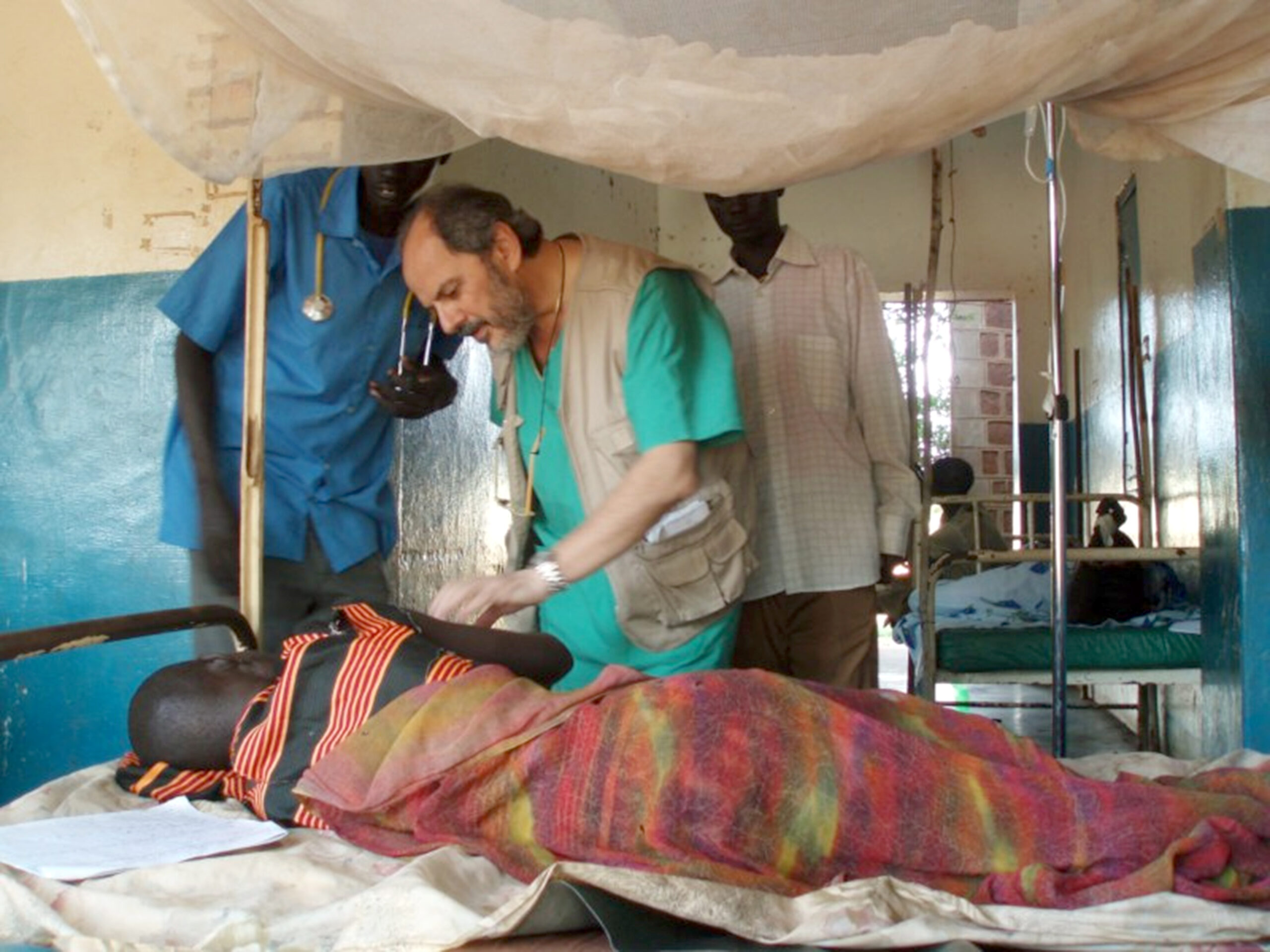
Fr. Fernando Colombo, the Comboni missionary who is keeping Rumbek diocese at present, writes of the secret strength of Msgr. Caesar: “We all knew of his ability to work ceaselessly, of his cordial welcome and, at the same time, of his poor health which obliged him to take a number of tablets every day as he lived with a bad heart, diabetes, changes in blood pressure, rheumatic pains and asthma. Nevertheless, he was not only the first in church in the morning, but those of us who lived close to him often saw him already at work at his desk at four in the morning. To this, we must add his untiring care for the good of the diocese and for peace and development in Sudan. How could such a weak body support such great faith, hope and unceasing charitable work? The answer is to be found in his deep communion of life with Jesus our Lord, nourished by Him in his many personal initiatives. Msgr. Caesar showed he had a ‘Presence’ within himself that he kept alive and burning like a flame.”