
The Angelic Painter

INTRODUCTION

Born in Tuscany, Italy, in 1387, the Dominican friar Giovanni da Fiesole remains widely known as Fra Angelico (Angelic Brother), because, only some years after his death in Rome, in 1455, Italians called him Blessed: He was known by the mystic beauty of his paintings, but also by his piety and good deeds. Purity of form and space characterize his art; purity of soul, his life. After so many centuries, he remains one of the most loved holy painters. In 1982, he was beatified by John Paul II. As if that was not enough, in 1984 the Pope declared him patron of Catholic artists.

WRITTEN BY

SHARE THE WORD

PUBLISHED ON

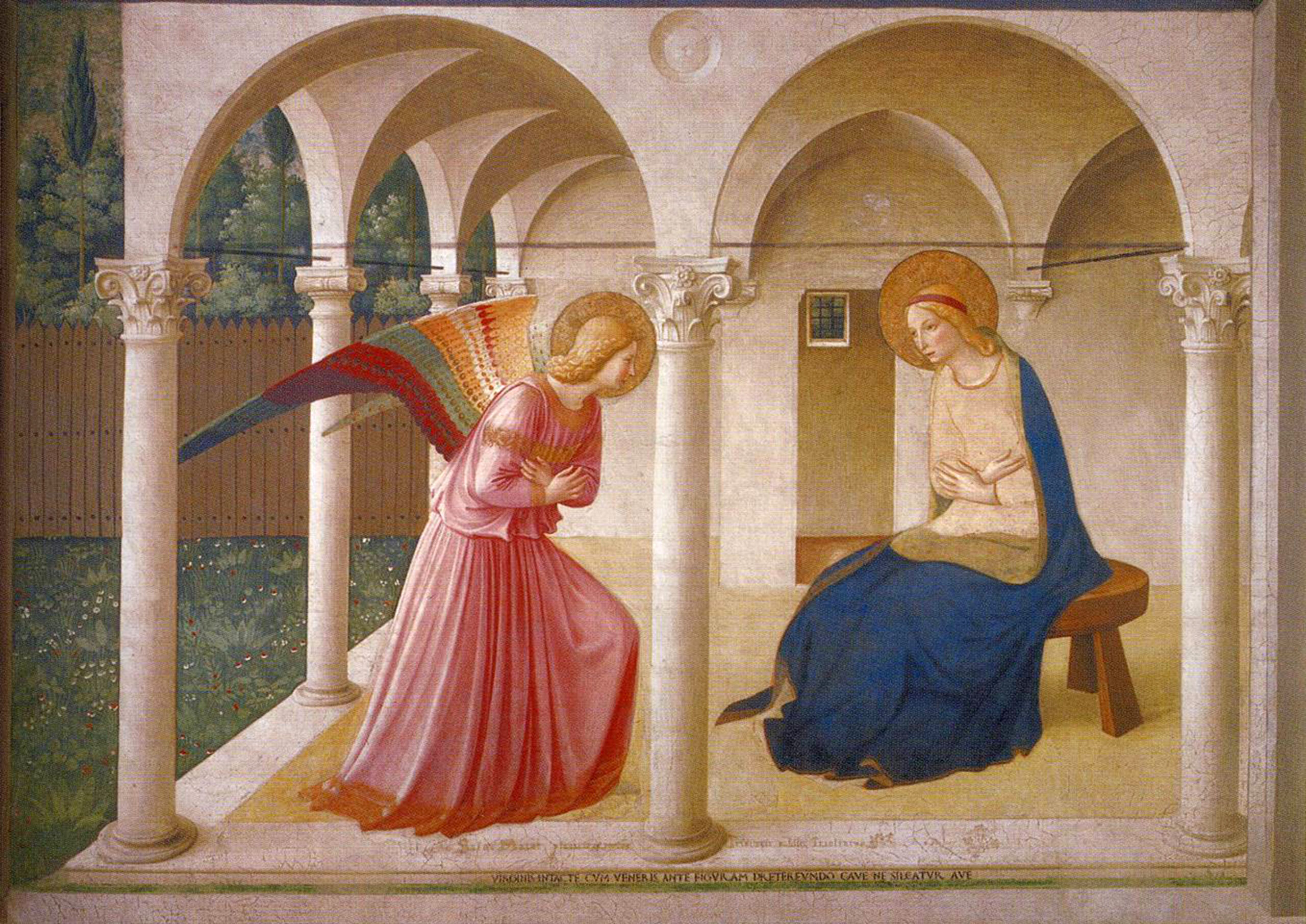
A painting haunts me since my childhood. I first saw it during family meals at a cousin’s house. A very good reproduction on the wall facing the table presided at our meetings. It was many, many years ago. But, if I close my eyes, I still can see it. Some can argue that I was just a small boy and that it was the first great art work I’ve met. But there was, even if then I didn’t know anything about painting or painters, a kind of aura. Something so peaceful and beautiful that I kept looking and looking at it, even when the desserts came! Somehow, it was like taking a glimpse at a hidden paradise, an inner and unknown reality.

Only much later I discovered that I had fallen in love with, perhaps, the most sublime depiction of the Annunciation. During the last decades, I kept looking at it, trying to decipher the secret of such a powerful spell, but I couldn’t. I have just a few clues. Of course, as a Catholic, I realize that it represents the greatest moment in the history of Christianity. Suddenly, an angel sent by God enters a young virgin’s home and tells her that she is going to give birth to the Savior of all humankind. She is, of course, incredulous, amazed, concerned, maybe even frightened. But, in a leap of the most blind and enlightened faith, she answers: “Be it done unto me according to Thy Word.”

The scene is so fundamental to Christianity that has been represented uncountable times in sacred art along the centuries. However, it is this particular Annunciation that still moves me the most. I will mention some clues. I don’t know if they will explain anything. I will just try to translate, in my own words, its deep power. Just to be brief: the time is the transition from the late Gothic to the Renaissance, so the setting is a typical Renaissance church, but bare of any kind of ornament; the plain white building, however, represents a home, with a small grilled window at the back. The angel seems to be the main protagonist, since those who look are attracted by the wings, painted with all the colors of the rainbow and is at the foreground. However, even if they share the same respectful salute, the eyes are led to the center where a smaller figure stands (even the mysterious black iron railing above that creates perspective, contributes to fix the viewer’s attention). While the profile of the angel has no expression, there’s an indescribable mix of emotions expressed on the maiden’s face. Outside, there is a fenced garden, filled with grass and wild flowers; beyond the common wood fence, a dense mass of cypresses does not distract onlookers.

The cypresses, so typical of Tuscany (Italy) landscape, are a sort of signature. It was there, more exactly in the province of Mugello, where Guido di Pietro was born, in 1387. This name, however, was unknown. When Guido became a Dominican friar at Fiesole, he changed his name to Giovanni and was named, thereafter, Fra Giovanni da Fiesole. Italians called him Beato (“Blessed One”). But the name by which we know him now was given him as a tribute fourteen years after his death. In 1450, Fra Giovanni da Fiesole became Fra Angelico, “angelic brother.” Unlike many friars, he took his vows seriously. Purity of form and space characterize his art; purity of soul, his life.

SIMPLICITY AND SERENITY
Vasari, the great source for Italian artists of this period, wrote of Fra Angelico: “But it is impossible to bestow too much praise on this holy father, who was so humble and modest in all that he did and said and whose pictures were painted with such facility and piety.” Facility is a feeble term. What seems simple is no easy at all. In fact, simplicity is quite hard to achieve, in art as in life. Even for Fra Angelico. Some years earlier, he had painted another Annunciation, quite similar but miles away from this masterpiece of balance and denouement. The second is a fresco in a corridor of the San Marco in Florence. He spent most of his life in the convent. He and his assistants decorated the walls between 1438 and 1450. For the frescoes in the monks’ cells, they used less expressive colors as pigments were quite expensive at the time, especially those reserved for the most holy figures.

To someone lucky enough to have seen illuminated manuscripts, one of the highest forms of art during the middle ages, it is quite easy to trace the lineage. The attention to detail, the purity of forms, the richness of color, the thin but expressive coat of paint, the lack of shadows or other dramatic effects are a mark of the great illuminators. And we know that, when Fra Giovanni, together with his younger brother, Fra Benedetto, joined the Order of Preachers in 1407, the brothers began their art careers as illustrators. Fra Benedetto, who had considerable talent as an illuminator and miniaturist, was supposed to have assisted his more celebrated brother in his famous frescoes in the convent of San Marco in Florence; he was superior at San Domenico at Fiesole for some years before his death in 1448. The Pope, it is said, wanted to make Angelico archbishop of Florence, but the unworldly priest declined the offer. According to an account which may be apocryphal, he was elected prior of Fiesole in 1449 and served three years, after which he returned to Rome to paint more pictures.

Even if illuminators are the true “reporters” of medieval costumes, court and popular scenes and also the first naturalists – they decorate the manuscripts with animals, butterflies and beautiful flowers they see around them – there is a great jump from a small format to the depiction of a big scene. Fra Angelico had the opportunity to watch the great frescoes that Giotto had painted in the St. Francis Basilica in Assisi. But, if Giotto is justly considered the first in a line of great artists who contributed to the Italian Renaissance, what a deep contrast! We just have to look at a big scene, like the Crucifixion, to realize that it portrays a sort of cosmic drama, where even the angels in the sky are contorted and tormented. If afterwards we look at Fra Angelico’s, the Maestà (Madonna enthroned), we see, in a quite earthly setting, Mary presenting the smiling Child Jesus to a group composed of Saints Cosmas and Damian, Saint Mark and Saint John, Saint Lawrence and three Dominicans: Saint Dominic, Saint Thomas Aquinas and Saint Peter Martyr. All of them are serene, as they just had met in the street, and they seem to be in a conversational mood. This kind of “normality” would be copied in the future by many other artists.

TO STAY WITH CHRIST
What really distinguishes the art of Fra Angelico is a kind of mystic insight that cannot be copied or repeated. In this case, this is not an interpretation, but a reality that transcends genius and artistic skills. In fact, there were attempts to rediscover the “formula.” In the 19th century, the Pre-Raphaelite tried to return to this source of purity. The renowned art critic, William Michael Rossetti, brother of the group’s greatest painter, Dante Gabriel Rossetti, wrote: “He led the devout and ascetic life of a Dominican friar, and never rose above that rank; he followed the dictates of the Order in caring for the poor; he was always good-humored. All of his many paintings were of divine subjects, and it seems that he never altered or retouched them, perhaps from a religious conviction that, because his paintings were divinely inspired, they should retain their original form. He was wont to say that he who illustrates the acts of Christ should be with Christ. It is averred that he never handled a brush without fervent prayer and he wept when he painted the Crucifixion.” Even if other painters admired him, they could not compete with him. Their paintings are more marked by a decorative sentimentality.

His piety was fully recognized during his life. But only on October 3, 1982, was he beatified by John Paul II. As if that was not enough, in 1984, the Pope declared him patron of Catholic artists. In his homage, he said: “Angelico was reported to say: ‘He who does Christ’s work must stay with Christ always.'” This motto earned him the epithet “Blessed Angelico,” because of the perfect integrity of his life and the almost divine beauty of the images he painted, to a superlative extent, those of the Blessed Virgin Mary.” He stayed with Christ all his life. He worked relentlessly. Wherever he resided – Cortona, Fiesole, San Marco – he left frescoes and paintings. When the decayed monastery at San Marco in Florence was restored by the Dominicans, he and his pupils painted fifty frescoes in its rooms as aids to contemplation. His most famous works are there.

He died in Rome on March 18, 1455, where he lies in the church of Santa Maria sopra Minerva. The epitaph engraved on his tomb tells all: “When singing my praise, don’t liken my talents to those of Apelles (the renowned painter of ancient Greece). Say, rather, that, in the name of Christ, I gave all I had to the poor. The deeds that count on Earth are not the ones that count in Heaven. I, Giovanni, am the flower of Tuscany.”

Share Your Thoughts

All comments are moderated

From The Same Issue

The articles and content about this issue

From The Same Issue

The articles and content about this issue

From This Topic

The articles and content about this topic

From This Topic

The articles and content about this topic

Missionary Vocation

Mystic Fire

Explore Other Topics

Browse other coverage

Explore Other Topics

Browse other coverage

WM SPECIAL

Presents, discusses and draws readers to reflect on issues of outmost relevance to the world today.


FRONTIERS

Very often, mission is carried out in frontier situations around the world. Those who embrace these situations have much to share.


UNITY IN DIVERSITY

Writer Ilsa Reyes will be exploring the richness of Pope Francis’s latest encyclical Fratelli Tutti with a view of helping our readers to get a grasp of the this beautiful papal document.


FRONTLINE

Puts to the front committed and inspiring people around the world who embrace humanitarian and religious causes with altruism and passion.


IN FOCUS

Focus on a given theme of interest touching upon social, economic and religious issues.


FAITH@50

As the Philippines prepares to celebrate 500 years of the arrival of Christianity. Fr. James Kroeger leads us in this series into a discovery journey of the landmark events in the history of faith in the Philippine archipelago.


INSIGHT

Aims to nurture and inspire our hearts and minds while pondering upon timely themes.


FILIPINO FOCUS

The large archipelago of the Philippines, in its richness of peoples and cultures, offers varied and challenging situations for mission.


FOLLOW ME

Reflections and vocation stories that shape up the lives of young people.


MISSION IS FUN

As humor and goodness of heart are qualities of Christian and missionary life, the new column “Mission is fun” will be publishing some anecdotes and stories that have happened in a missionary context to lighten up the spirits and trigger a smile in our faces.


LIVING COMMUNION

To help readers of World Mission live this year dedicated to Ecumenism, Interreligious Dialogue and Indigenous Peoples, Tita Puangco, writer and lecturer, shares in this section insights on the spirituality of communion.


WINDS OF THE SPIRIT

A historic view of the Catholic movements that emerged from the grassroots as an inspiration by the Holy Spirit.


BRIDGE BUILDERS

On the Year of Ecumenism, Interreligious Dialogue and Indigenous Peoples, radio host and communicator Ilsa Reyes, in her monthly column, encourages Christians and people of good will to be one with their fellow people of other sects, religions and tribes.


INTERVIEW

Questions to a personality of the Church or secular world on matters of interest that touch upon the lives of people.


WORLD TOUCH

News from the Church, the missionary world and environment that inform and form the consciences.


CARE OF THE EARTH

A feature on environmental issues that are affecting the whole world with the view of raising awareness and prompting action.


EDITORIAL

The editor gives his personal take on a given topic related to the life of the Church, the society or the world.


YOUNG HEART

A monthly column on themes touching the lives of young people in the Year of the Youth in the Philippines by radio host and communicator I lsa Reyes.


SCROLL

A missionary living in the Chinese world shares his life-experiences made up of challenges and joyous encounters with common people.


EXTRAORDINARY PEOPLE

Life stories of people who deserve to be known for who they were, what they did and what they stood for in their journey on earth.


ONE BY ONE

Stories of people whom a missionary met in his life and who were touched by Jesus in mysterious ways.


INCREASE OUR FAITH

Critical reflection from a Christian perspective on current issues.


SPECIAL MOMENTS

Comboni missionary Fr. Lorenzo Carraro makes a journey through history pinpointing landmark events that changed the course of humanity.


PROFILE

A biographical sketch of a public person, known for his/her influence in the society and in the Church, showing an exemplary commitment to the service of others.


WM REPORTS

Gives fresh, truthful, and comprehensive information on issues that are of concern to all.


LIFE'S ESSENTIALS

A column aimed at helping the readers live their Christian mission by focusing on what is essential in life and what it entails.


ASIAN FOCUS

Peoples, events, religion, culture and the society of Asia in focus.


THE SEARCHER'S PATH

The human heart always searches for greatness in God’s eyes, treading the path to the fullness of life - no matter what it takes.


INDIAN FOCUS

The subcontinent of India with its richness and variety of cultures and religions is given center stage.


AFRICAN FOCUS

The African continent in focus where Christianity is growing the fastest in the world.


JOURNEY MOMENTS

Well-known writer and public speaker, Fr. Jerry Orbos, accompanies our journey of life and faith with moments of wit and inspiration based on the biblical and human wisdom.


IGNATIUS STEPS

On the year dedicated to St. Ignatius of Loyala, Fr. Lorenzo Carraro walks us through the main themes of the Ignatian spirituality.


THE SEVEN LAST WORDS OF JESUS

Fr. John Taneburgo helps us to meditate every month on each of the Seven Last Words that Jesus uttered from the cross.


INSIDE THE HOLY BOOK

In this section, Fr. Lorenzo delves into the secrets and depths of the Sacred Scriptures opening for us the treasures of the Sacred Book so that the reader may delight in the knowledge of the Word of God.


CONVERSATIONS

Reflections about the synodal journey on a conversational and informal style to trigger reflection and sharing about the synodal path the Church has embarked upon.


VATICAN II

This 'mini-course' series provides a comprehensive exploration of Vatican II, tracing its origins, key moments, and transformative impact on the Catholic Church.


COMBONIS IN ASIA

This series offers an in-depth look at the Comboni Missionaries in Asia, highlighting their communities, apostolates, and the unique priorities guiding their mission. The articles provide insights into the challenges, triumphs, and the enduring values that define the Comboni presence in Asia.


BEYOND THE SYNOD

Following the Synod on Synodality, this series examines how dioceses, parishes, and lay organizations in the Philippines are interpreting and applying the principles of the synod, the challenges encountered, and the diverse voices shaping the synodal journey toward a renewed Church.


A TASTE OF TRADITION

This series introduces the Fathers of the Church, featuring the most prominent figures from the early centuries of Christianity. Each article explores the lives, teachings, and enduring influence of these foundational thinkers, highlighting their contributions the spiritual heritage of the Church.


A YEAR OF PRAYER

In preparation for the 2025 Jubilee Year under the theme “Pilgrims of Hope,” 2024 has been designated a Year of Prayer. World Mission (courtesy of Aleteia) publishes every month a prayer by a saint to help our readers grow in the spirit of prayer in preparation for the Jubilee Year.


OUR WORLD

In Our World, the author explores the main trends shaping contemporary humanity from a critical and ethical perspective. Each article examines pressing issues such as technological advancement, environmental crises, social justice, and shifting cultural values, inviting readers to reflect on the moral implications and challenges of our rapidly changing world.


CATHOLIC SOCIAL DOCTRINE

This series unpacks the principles of Catholic Social Doctrine, offering a deep dive into the Church's teachings on social justice, human dignity, and the common good.


HOPEFUL LIVING

Hopeful Living’ is the new section for 2026, authored by Fr. James Kroeger, who dedicated most of his missionary life to the Philippines. In this monthly contribution, he will explore various aspects of the virtue of hope. His aim is to help readers align their Christian lives more closely with a hopeful outlook.


PHILIPPINE CROSSROADS

Filipino Catholic scholar Jose Bautista writes each month about how the Philippines is at a crossroads, considering the recent flood control issues and other corruption scandals that have engulfed the nation. He incorporates the Church’s response and its moral perspective regarding these social challenges.


BIBLE QUIZ

Test your knowledge and deepen your understanding with our Bible Quiz! Each quiz offers fun and challenging questions that explore key stories, themes, and figures from both the Old and New Testaments.


Shopping Cart