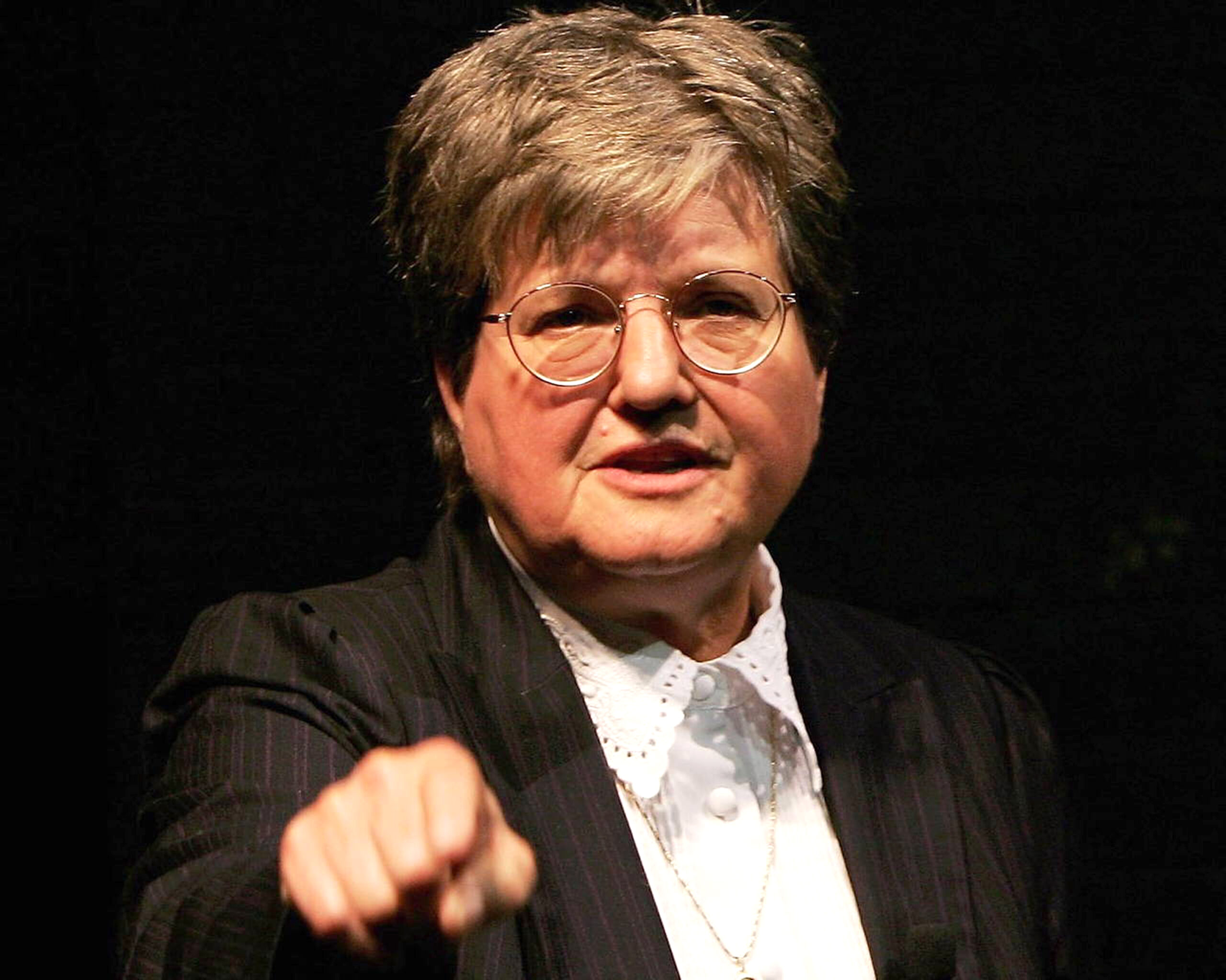
This is how Sr. Helen Prejean describes the first time she witnessed an execution, a defining moment in her life and vocation: “I was scared out of my mind. I went into the women’s room, the only private place in the death house, and put my head against the tile wall and grabbed the crucifix around my neck. I said, “Oh, Jesus God, help me. Don’t let him fall apart. If he falls apart, I fall apart.” I had never watched anybody killed before my eyes!
All I had agreed to in the beginning was to be a pen pal to this man on Louisiana’s death row. Sure, I said, I could write letters. But the man was all alone; he had no one to visit him. The next thing I knew I was saying, “OK, sure, I’ll come visit you.”
He had suggested that, on the prison application form for visitors, I fill in “spiritual advisor,” and I said, “Sure.” He was Catholic, and I’m a Catholic nun, so I didn’t hesitate as it only seemed right. But I had no idea that at the end, on the evening of the execution, everybody must leave the death house, everybody but the spiritual advisor. The spiritual advisor stays to the end and witnesses the execution.
Patrick had tried to protect me from watching him die. He told me he’d be OK. I didn’t have to come with him into the execution chamber. “The electric chair is not a pretty sight, it could scare you,” he told me, trying to be brave. But I said, “No, no, Pat, if they kill you, I’ll be there.” Then I remembered the women at the foot of Jesus’ Cross, and I said to him, “You look at my face. Look at me, and I will be the face of Christ for you.” I couldn’t bear that he would die alone. I said, “Don’t you worry. God will help me.”
“There in the women’s room, God and I met, just a few hours before the execution, and I felt some strength like a circle of light around me. When I think ahead of what would happen at midnight I was unraveled, and at the moment, I could hold myself together and be strong.”
A WAKE-UP CALL
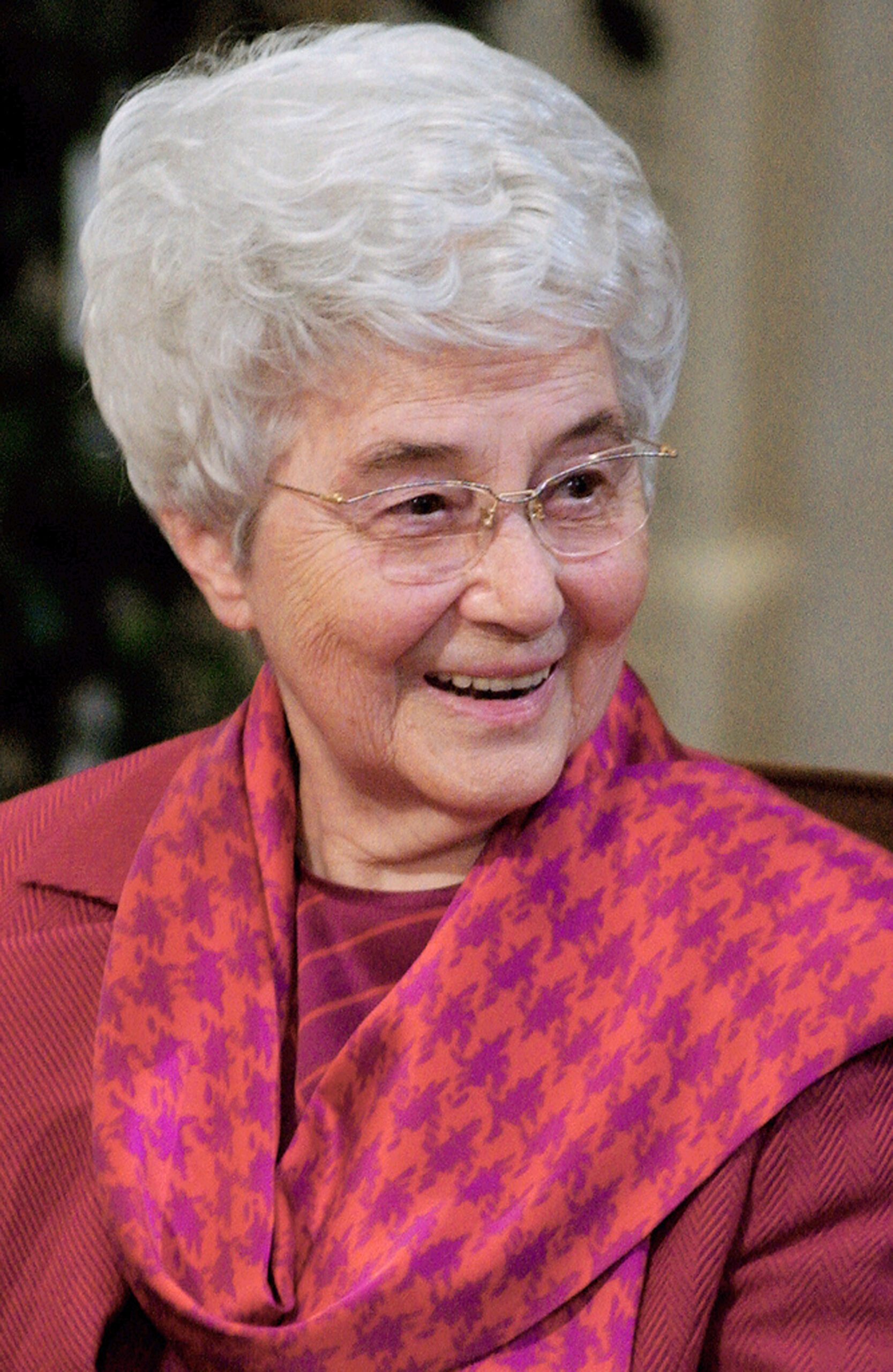
Sister Helen Prejean was born on April 21, 1939, in Baton Rouge, Louisiana. She joined the Sisters of St. Joseph of Medaille in 1957 (now known as the Congregation of St. Joseph) and received a B.A. in English and Education from St. Mary’s Dominican College, New Orleans, in 1962. In 1973, she earned an M.A. in Religious Education from St. Paul’s University in Ottawa, Canada. She has been the Religious Education Director at St. Frances Cabrini Parish in New Orleans, the Formation Director for her religious community, and has taught junior and senior high school students. That seemed to be her destiny: education.
She was already 42 when she had a wake-up call, a kind of vocation within a vocation, to go and share the life of the poor and that made her, eventually, the apostle of the death row. This is how she speaks about it: “Here’s the real reason why I got involved with death-row inmates. At first my involvement was with the poor people in general. It took me a while to respond to the call of the social gospel of Jesus. Other members of my religious community did so before me, and we had fierce debates on what our mission should be.
In 1980, when my religious community, the Sisters of St. Joseph of Medaille, made a commitment to “stand on the side of the poor,” I assented, but reluctantly. I resisted this recasting of the faith of my childhood, when what had counted were personal relationship with God, inner peace, kindness to others, and heaven when this life was done. I didn’t want to struggle with politics and economics. We were nuns, after all, not social workers.
But later that year, I began to realize that my spiritual life had been too ethereal, too disconnected. To follow Jesus and to be close to Jesus meant that I needed to seek out the company of the poor and struggling people. So, in June 1981, I drove a little brown truck into St. Thomas, a black, inner-city housing project.
Growing up as a Southern white girl on the upper class, I had only known black people as my servants. Now it was my turn to serve them. It didn’t take long for me to see that for poor people, especially the black, there was a greased track to prison and death row. As one Mama in St. Thomas put it: “Our boys here leave in a police car or in a hearse.”
DEAD MAN WALKING
Sr. Helen came out of the execution chamber that night, having sadly watched a man die in front of her eyes, a man whose last words were words of love. She held his Bible, thumbworn and underlined. She found that, on the front page of the Bible, were recorded births, marriages, and deaths. In his own handwriting, he had written the date of his own death.
She wrote: “Out of this experience came a fire that has galvanized me and stayed on in me. In the Catholic Church, when we receive sacraments, we say that an indelible mark is left on our souls. Being present at Pat’s death did that to me also. I think of it as a kind of second baptism in my life, for it committed me to pursue the gospel as it relates to the poor and to the quest for justice.
“This made me speak out about the death penalty, and I will continue to do so to my dying day. I could not have told this story and proclaimed the gospel message had I not understood it that night. And it was this experience that led me to write the book Dead Man Walking: An Eyewitness’ Account of the Death Penalty in the Unites States (1993). I had made a promise to Patrick before he died: “Patrick, I will tell your story across this land.” I didn’t know what I was saying. “Perhaps then your death can be redemptive for other people.”
The title of the book refers to the sentence uttered by the warden with the strap-down team when they came for the convict, to take him to the death chamber. “Please, God, hold up my legs!,” was Pat’s prayer on that day. It was the last piece of dignity he could muster. He wanted to walk. Sr. Helen too, walked with him. God heard his prayer. She wrote: “I saw this dignity in him, and I have seen it, myself, in the other men I have accompanied to their deaths. I wonder how I would hold myself if I were walking across a room where people were waiting to kill me.”
Sister Helen’s book was nominated for a 1993 Pulitzer Prize and was number one on the New York Times best seller list for 31 weeks. It also was an international best seller and has been translated into ten different languages. In January 1996, the book was developed into a major motion picture starring Susan Sarandon as Sister Helen and Sean Penn as the death row inmate.
The film was directed by Tim Robbins who was also its script writter. Susan Sarandon won the award for Best Actress. Sister Helen and Dead Man Walking have been the subject of numerous media stories and reviews in the U.S., Canada, Spain, Holland, England, Scotland, France and Australia.
Almost 20 years after beginning her crusade, the Roman Catholic Sister has witnessed five executions in Louisiana and today educates the public by lecturing about the death penalty, organizing seminars and by writing. As the founder of “Survive,” a victim’s advocacy group in New Orleans, she continues to counsel not only inmates on death row, but families of murder victims, as well.
To add to the innumerable honors, awards and commendations that have since then come her way, she is also a member of Amnesty International. On December 18, 2000, she presented Kofi Annan, Secretary General of the U.N., 2.5 million signatures from people all over the world who are calling for a moratorium on the death penalty.
Prejean’s second book, The Death of Innocents: An Eyewitness’ Account of Wrongful Executions was published in December 2004. In it, she tells the story of two men, Dobie Gillis Williams and Joseph O’Dell, whom she accompanied to their executions. She believes that both men were innocent. The book also examines the recent history of death penalty decisions by the Supreme Court of the United States.
In 1998, Prejean was given the Pacem in Terris Award, named after a 1963 encyclical letter by Pope John XXIII that calls on all people of goodwill to secure peace among all nations. Pacem in Terris is Latin for “Peace on Earth.”
RACISM, POVERTY AND VIOLENCE
Sr. Helen doesn’t see capital punishment as a peripheral issue about some criminals at the edge of society that people want executed. She sees that death penalty is connected to the three deepest wounds of the American society: racism, poverty, and violence. She wrote: “In this country, first there was the hangman’s noose, then the electric chair, and now the lethal-injection, all of which have been almost exclusively reserved for those who kill white people. In regard to this first and deepest of America’s wounds, racism, we have to change the whole soul of this country so that the criminal-justice system would not to be administered in a racially biased manner.
“The second wound is poverty. Who pays the ultimate penalty for crimes? The poor. Who gets the death penalty? The poor. After all the rhetoric that goes on in legislative assemblies, in the end, when the net is cast out, it is the poor who are marked to die in this country. Finally, the third wound is our penchant for trying to solve our problems with violence. Jesus Christ, whose way of life I try to follow, refused to meet hate with hate and violence with violence. I pray for the strength to be like Him.”
She has found strength in the victims of violence and their families who have been healed by God’s grace and been able to overcome their desire for revenge. “They are incredible human beings with great courage and, to me, they are living witnesses of the gospel and the incredible healing power of Jesus in the midst of violence.” Sr. Helen Prejean is now firmly in the place of all the champions of absolute non-violence: Saint Francis of Assisi, Gandhi, Martin Luther King and she would like to take with her there the Christian community and the whole of humanity.
RECKONINGS AND THE PLACE OF THE CHURCH
The U.N. Universal Declaration on Human Rights states that there are two essential human rights that every human being has: the right not to be tortured and the right not to be killed. Pope John Paul II, however, in his encyclical, “The Gospel of Life” still upholds the right of governments to kill criminals, even though he restricts it to cases of “absolute necessity” and says that, because of improvements in modern penal systems, such cases are “very rare, if not practically nonexistent.”
Likewise, the U.S. Catholic bishops in their 1980 “Statement on Capital Punishment,” strongly condemn the death penalty where it is imposed unfairly and in a discriminatory manner, for its continuance of the “cycle of violence,” and for its fundamental disregard for human dignity, but affirm in principle, the right of the state to kill in self defense.
Sr. Prejean has no doubt that, in the future, death penalty in America will be abolished. She believes that one day all the death instruments – electric chairs, gas chambers, and lethal-injection needles – will be housed in museums. She has worked very hard for a moratorium of all the executions and she will continue doing so until the death penalty is abolished everywhere in the world. She also believes that we cannot wait for the Church leadership to act. We have to put our trust in the Church as the people of God; things have to come up from the grassroots.
The dilemma, however, remains. In the Philippines, some years ago, the then President Gloria Macapagal Arroyo, on the occasion of her visit to the pope, suspended all executions and that still stands. In the meantime, extra-judicial killings have grown exponentially and innocents are executed daily by criminals. Then there is also the case in Mexico where the narcotraficking has claimed tens of thousands of lives in a short time. How about the victims of terrorism?…
The absolute abolition of the death penalty is a noble ideal, but the increasing crimes committed in our societies make it a distant goal. Many people still believe that, ultimately, it will not be beneficial to society as a whole.