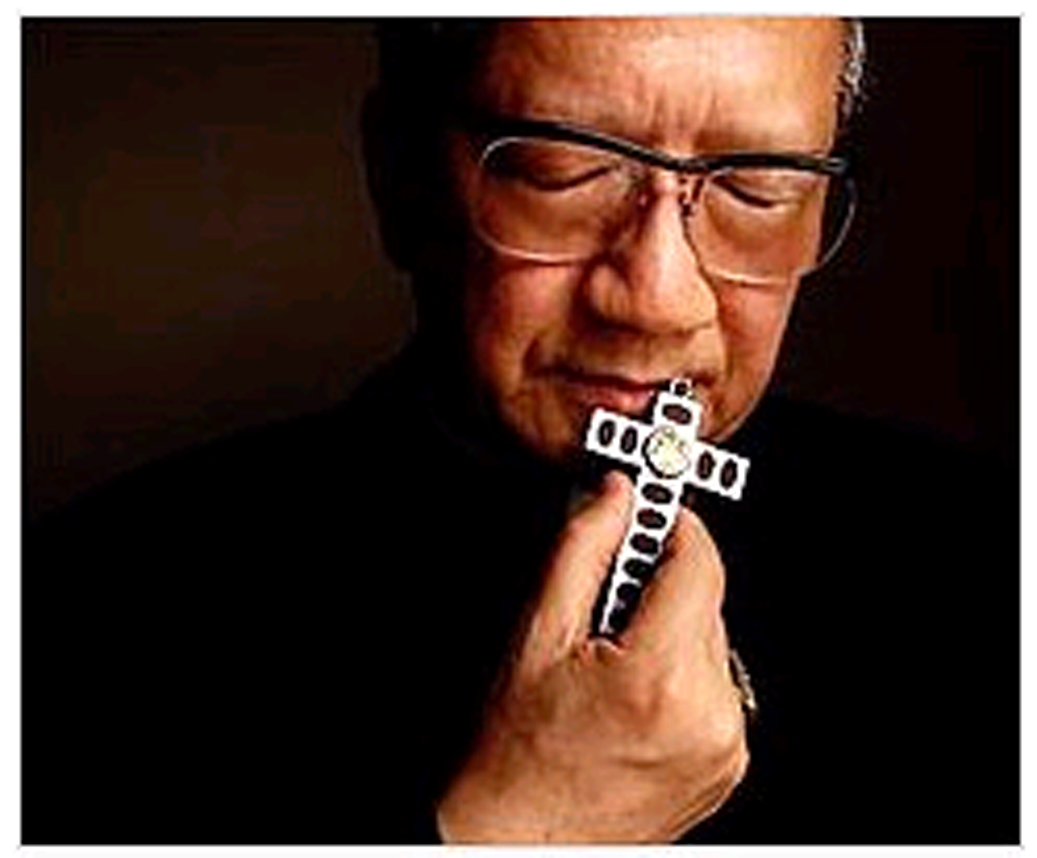
John de Brito was born of Portuguese aristocracy in 1647. His father, Salvador Pereira De Brito, was the governor of Brazil and died there when John was still very young. John became a member of the royal court at age nine and a companion to the young prince later to become King Peter II. When De Brito was young, he almost died of a sudden illness and his mother vowed he would wear a Jesuit cassock for a year if he were spared. He regained his health and walked around court like a miniature Jesuit, but there was nothing small about his heart or the desire that grew to actually become a Jesuit.
Despite pressure from the prince and the king, he entered the Jesuit novitiate in Lisbon on December 17, 1662 when he was only 15 years old. His mother, woman of great faith, supported him in his decision. He studied classics, with an interruption because of health problems, then philosophy. He wrote to the Superior General in 1668 asking to be sent to the Far East as a missionary, but had to finish theology first. He was ordained in February, 1673. Despite his demonstrated talent for academic excellence, his great devotion to St. Francis Xavier urged him to apply to serve in the Mission of India.
His request was granted, despite the strong and sometimes underhanded opposition of his family. He left Lisbon for Goa in mid-March, arriving the following September. He studied more theology in Goa and was again asked to remain as a teacher but he desired to be a missionary. He, therefore, proceeded for the mission of Madura in the state of Tamil Nadu. That was the place that had seen the enlightened apostolate of Fr. Roberto De Nobili whose example Fr. De Brito was determined to follow.
PIONEERS OF INCULTURATION
The Age of Discovery inaugurated a new era in Christian mission. As Spanish and Portuguese explorers and conquerors encircled the globe, they were accompanied by Christian missionaries eager to implant the Gospel in fields afar. There is no doubting the faith and courage that mark their heroic efforts. But most were oblivious of the extent to which their message was compromised with the association with colonial power and wealth. Even those who defended the native populations were generally blind to the tendency to confuse the Gospel with the supposed superiority of European culture.
The early Jesuit mission to Japan and China represented a remarkably prophetic chapter in the history of the Church because of the different policy and outlook. The essential architect of this strategy was the Jesuit visitor for Asia, Alessandro Valignano. At that time, a papal decree had granted the Portuguese and Spanish crowns authority for establishing and administering the church in their territories.
The Far East was predominantly in the Portuguese sphere of influence. Valignano, however, was determined to disengage the Jesuit missions from Portuguese control. He believed that the conquest model of evangelization would be absolutely fruitless in penetrating the ancient civilizations of Japan and China and that it was essential that the Church assimilate itself to Japanese and Chinese culture.
THE CHRISTIAN SANNYASI
The ethnocentric colonial tendency was markedly present in the Church in Southern India, established under Portuguese authority. Converts were forced to adopt Western customs that effectively alienated them from their own culture and their communities. One missionary who attempted to forge a different path was precisely the Jesuit Roberto De Nobili. Like his confrere in China, Matteo Ricci, De Nobili adapted his lifestyle and his method of evangelization to the local mentality and culture. He was thus implementing Valignano’s guidelines and became one of the pioneers of what more recently was termed “inculturation.”
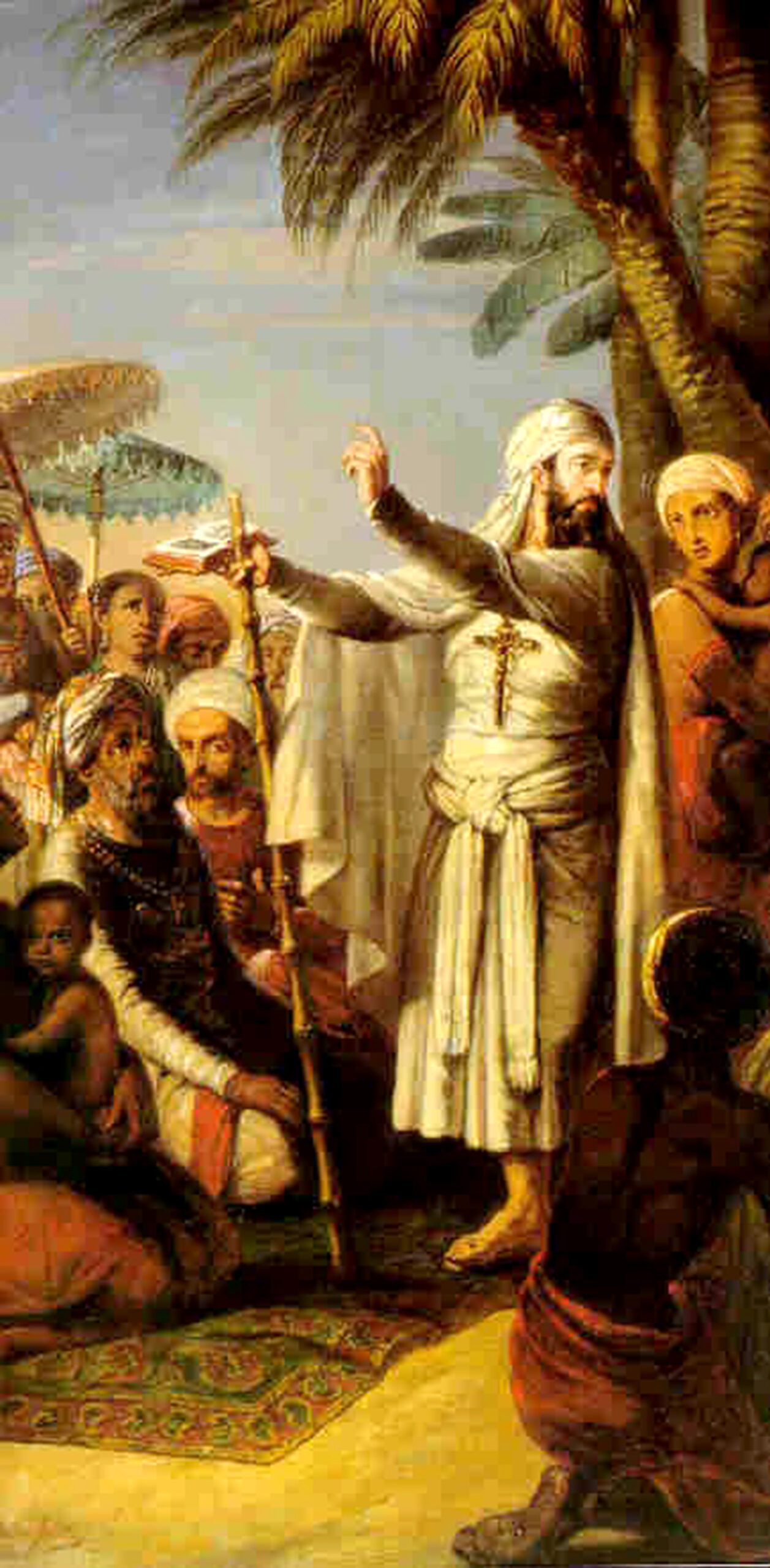
Father de Brito worked in Madura, in the regions of Kolei and Tattuvanchery and very soon showed that he was more committed to the singlemindedness of the enlightened Italian confreres than to any nationalistic loyalty. He studied the India caste system because he thought that members of the higher caste would also have to be converted to Christianity to have a future. He became an Indian ascetic, a pandaraswami since they were permitted to approach individuals of all castes. He changed his life-style, eating just a bit of rice each day and sleeping on a mat, dressing in a red cloak and turban. He established a small retreat in the wilderness and was in time accepted as a sannyasi. As he became well-known, the number of conversions greatly increased.
Together with his catechists, De Brito was extremely careful in the preparation of catechumens and the nurturing of neophytes, hoping that his work would soon bring about an Indian Church with Indian clergy. All of this was accomplished despite strong and sometimes violent opposition from both native rulers, on one side, and conservative Catholic elements, both in the Society and elsewhere, that clung to a European model of Church, on the other.
MIRACULOUS RED SAND
He was made superior in Madura after 11 years on the mission, but he also became the object of hostility from Brahmins, members of the highest caste, who resented his work and wanted to kill him. He and some catechists were captured by soldiers in 1686 and bound in heavy chains. When the soldiers threatened to kill the Jesuit, he simply offered his neck, but they did not act. After spending a month in prison, the Jesuit captive was released.
When he got back to Madura, he was ordered to return to Portugal to report on the status of the mission in India. When he reached Lisbon ten months later, he was received like a hero. He toured the universities and colleges describing the adventurous life of an Indian missionary. His boyhood mate and now-king, Peter II, noticed how thin, worn out and tired his friend looked; he asked him to remain at home to tutor his two sons, but De Brito placed the needs in India above the comfort of the Portuguese court.
De Brito sailed again for Goa and returned to the mission in Madura where he arrived in November 1690. He came back despite a death threat that the raja of Marava had made four years earlier. The Jesuit missionary traveled at night from station to station so he could celebrate Mass and baptize converts.
His success in converting Prince Tadaya Theva indirectly led to his death. The prince was interested in Christianity even before the prayers of a catechist helped him recover from a serious illness. De Brito insisted that the prince should keep only one of his several wives after his baptism; he agreed to this condition, but one of the rejected wives complained to her uncle, the raja of Marava who sent soldiers, on January 28 1690, to arrest the missionary. Two days later, the raja exiled de Brito to Oriyur, a neighboring province his brother governed. The raja instructed his brother to execute the troublesome Jesuit who was taken from prison on February 4 and led to a knoll overlooking a river where an executioner decapitated him with a scimitar.
There is great affection for Saint John De Brito among the people of Tamil Nadu, where he is known as Arulananda, the name he took as a “Roman sannyasi.” His place of martyrdom remains a popular place of pilgrimage for Christians, Hindus and Muslims. Red sand from the spot of his beheading is thought to possess miraculous powers. He is esteemed in the Society of Jesus for his boldness of service and his efforts to build a fully-indigenized Church in south India.
While today the practice of inculturation or indigenization has wide official support, this was not so in the 17th century. Valignano and Ricci were accused of promoting “syncretism.” The Jesuit strategy of cultural “accommodation” was officially suppressed by the Vatican in the early 18th century. It was again centuries before Valignano’s insights were properly appreciated by the Church.
The efforts of many heroic missionaries neither left stronger Christian communities nor did they always attract approval or empathy from the representatives of the cultures evangelized. Persecution is raging even now in India and China.