Why Truth Matters

INTRODUCTION

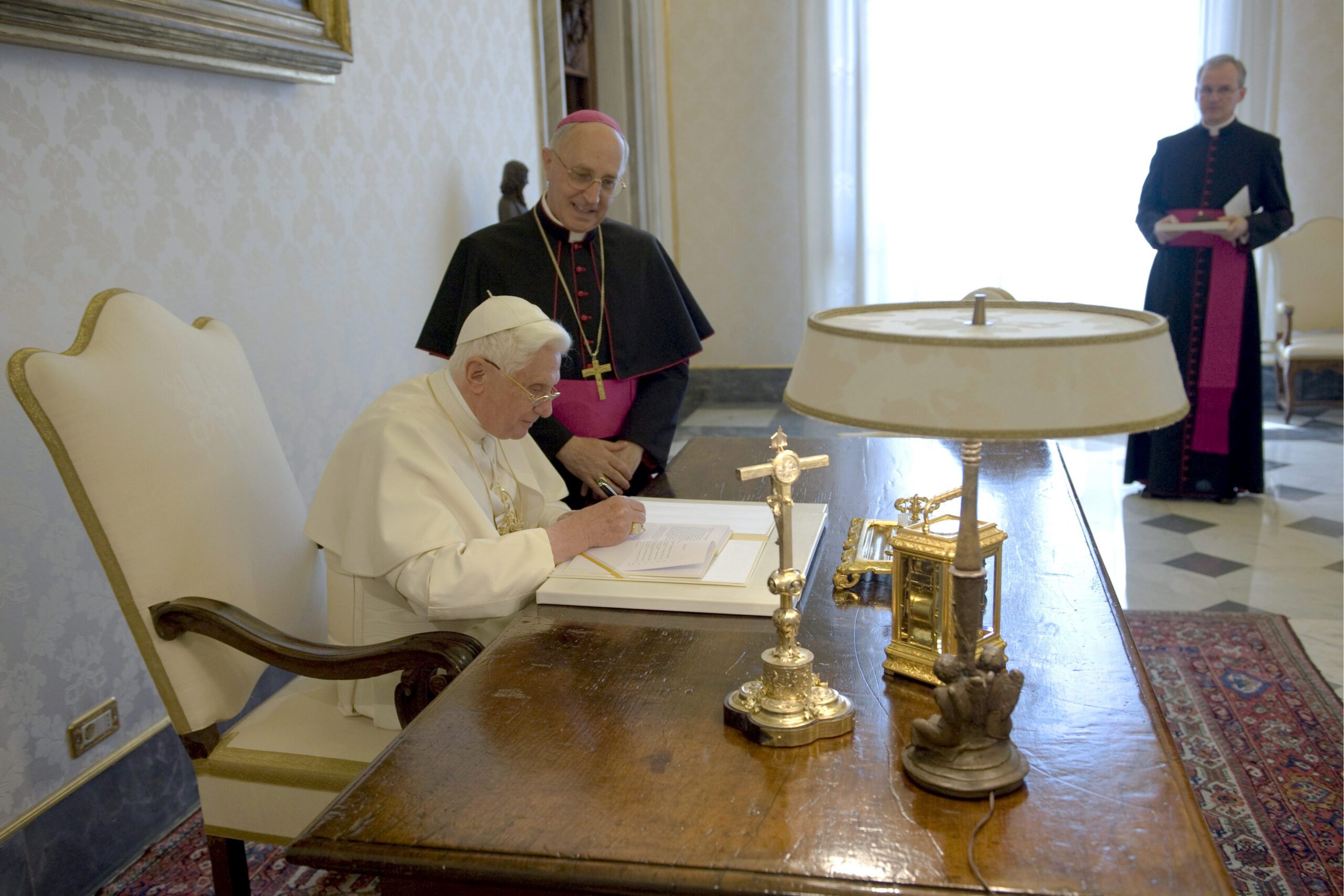
Relativists beware. Whether you like it or not, truth matters – even in the economy. That’s the core message of Pope Benedict XVI’s new encyclical Caritas in Veritate (Charity in Truth).

WRITTEN BY

SHARE THE WORD

PUBLISHED ON

For 2000 years, the Catholic Church has hammered home a trio of presently-unpopular ideas into the humus of human civilization: that there is truth; that it is not simply of the scientific variety; that it is knowable through faith and reason; and that it is not whatever you want or “feel” it to be. Throughout his entire life, Benedict XVI has underscored these themes, precisely because much of the world, including many Christians, has lost sight of their importance.

Perhaps Caritas in Veritate’s most important truth-claim about economic life is that the market economy cannot be based on just any value-system. Against all relativists on the left and the right, Benedict maintains that market economies must be underpinned by commitments to particular basic moral goods and a certain vision of the human person if it is to serve rather than undermine humanity’s common good: “The economy needs ethics in order to function correctly – not any ethics whatsoever, but an ethics which is people-centered” (CV No. 45).

“Without internal forms of solidarity and mutual trust,” the Pope writes, “the market cannot completely fulfill its proper economic function” (CV No. 35). This surely has been amply confirmed by the recent financial crisis.

America’s subprime-mortgage market collapse was at least partly attributable to the fact that, literally, thousands of people lied on their mortgage application forms. Should we be surprised that mass violation of the moral prohibition against lying has devastating economic consequences? “The economic sphere,” the Pope reminds us, “is neither ethically neutral, nor inherently inhuman and opposed to society. It is part and parcel of human activity and precisely because it is human, it must be structured and governed in an ethical manner” (CV No. 36).

Contrary to the pre-encyclical hype of certain American commentators and the ever-unreliable British press, predictions of papal anathemas against “global capitalism” have – as usual – been found wanting. In economic terms, the Pope describes as “erroneous” the tired notion that the developed countries’ wealth is predicated on poor nations’ poverty (CV No. 35) that one hears customarily from the likes of Hugo Chavez and whatever is left of the dwindling band of aging liberation theologians. That’s a pontifical body-blow to a central working assumption of many professional social justice “activists.”

Nor will they be happy with the pope’s concerns about the ways in which foreign aid can produce situations of dependency (CV No. 58), not to mention Benedict’s strictures against protectionism (CV No. 42) as well as his stress that no amount of structural change can possibly compensate for people freely choosing the good: “Integral human development presupposes the responsible freedom of the individual and of peoples: no structure can guarantee this development over and above human responsibility” (CV No. 17).

Nor does Benedict regard the market as morally problematic in itself. “In and of itself,” the Pope states, “the market is not the place where the strong subdue the weak. Society does not have to protect itself from the market, as if the development of the latter were ipso facto to entail the death of authentically human relations” (CV No. 36). What matters, Benedict claims, is the moral culture in which market exists.

At the heart of the economy are human persons. People whose minds are dominated by crassly hedonistic cultures will make crassly hedonistic economic choices. “Therefore,” Benedict comments, “it is not the instrument that must be called to account, but individuals” (CV No. 36).

The implications of truth for economic life do not, however, stop here. For Benedict, it is a lens through which to assess ideas such as “business ethics,” “ethical investing” and “corporate social responsibility.” The notion that investment and business choices have a moral dimension is hardly new. What matters for Benedict is the understanding of morality underlying these schemes. Merely labeling an investment scheme as “ethical,” Benedict notes, hardly tells us whether it is moral (CV No. 45).

A second major truth underscored by Benedict is the indispensability of a strong civil society for both undergirding and limiting the market and the state. By this, he does not mean a plethora of government-funded NGOs, many of whom Benedict identifies as intent upon imposing some of the very worst aspects of Western lifestyle-libertarianism upon developing nations (CV No. 28). Certainly, Benedict believes, there is a need to re-evaluate (CV No. 24) how the state regulates different parts of the economy. Ultimately, however, Benedict stresses that the virtue of solidarity is about people concretely loving their neighbor; it “cannot therefore be merely delegated to the State” (CV No. 38). This is reminiscent of Alexis de Tocqueville’s attention to the manner in which the habit of free association limits the size of government and discourages people from retreating into their own little bubbles.

The economist John Maynard Keynes is famous for many things, including the saying that “in the long run, we’re all dead.” The horizon of Benedict XVI’s perspective on economic life is rather different. The Pope asks people to live their economic lives in the short, medium, and long-term as if living in the truth is eternally important, not to mention eternally relevant to their soul’s salvation.
That’s change we can all believe in.

*The Acton Institute for the Study of Religion and Liberty is an ecumenical think-tank dedicated to the study of free-market economics informed by religious faith and moral absolutes. It is named after the great English historian Lord John Acton (1834-1902), best known for his famous remark: “Power tends to corrupt, and absolute power corrupts absolutely.” www.acton.org

Share Your Thoughts

All comments are moderated

From The Same Issue

The articles and content about this issue

From The Same Issue

The articles and content about this issue

From This Topic

The articles and content about this topic

From This Topic

The articles and content about this topic

Explore Other Topics

Browse other coverage

Explore Other Topics

Browse other coverage

WM SPECIAL

Presents, discusses and draws readers to reflect on issues of outmost relevance to the world today.


FRONTIERS

Very often, mission is carried out in frontier situations around the world. Those who embrace these situations have much to share.


UNITY IN DIVERSITY

Writer Ilsa Reyes will be exploring the richness of Pope Francis’s latest encyclical Fratelli Tutti with a view of helping our readers to get a grasp of the this beautiful papal document.


FRONTLINE

Puts to the front committed and inspiring people around the world who embrace humanitarian and religious causes with altruism and passion.


IN FOCUS

Focus on a given theme of interest touching upon social, economic and religious issues.


FAITH@50

As the Philippines prepares to celebrate 500 years of the arrival of Christianity. Fr. James Kroeger leads us in this series into a discovery journey of the landmark events in the history of faith in the Philippine archipelago.


INSIGHT

Aims to nurture and inspire our hearts and minds while pondering upon timely themes.


FILIPINO FOCUS

The large archipelago of the Philippines, in its richness of peoples and cultures, offers varied and challenging situations for mission.


FOLLOW ME

Reflections and vocation stories that shape up the lives of young people.


MISSION IS FUN

As humor and goodness of heart are qualities of Christian and missionary life, the new column “Mission is fun” will be publishing some anecdotes and stories that have happened in a missionary context to lighten up the spirits and trigger a smile in our faces.


LIVING COMMUNION

To help readers of World Mission live this year dedicated to Ecumenism, Interreligious Dialogue and Indigenous Peoples, Tita Puangco, writer and lecturer, shares in this section insights on the spirituality of communion.


WINDS OF THE SPIRIT

A historic view of the Catholic movements that emerged from the grassroots as an inspiration by the Holy Spirit.


BRIDGE BUILDERS

On the Year of Ecumenism, Interreligious Dialogue and Indigenous Peoples, radio host and communicator Ilsa Reyes, in her monthly column, encourages Christians and people of good will to be one with their fellow people of other sects, religions and tribes.


INTERVIEW

Questions to a personality of the Church or secular world on matters of interest that touch upon the lives of people.


WORLD TOUCH

News from the Church, the missionary world and environment that inform and form the consciences.


CARE OF THE EARTH

A feature on environmental issues that are affecting the whole world with the view of raising awareness and prompting action.


EDITORIAL

The editor gives his personal take on a given topic related to the life of the Church, the society or the world.


YOUNG HEART

A monthly column on themes touching the lives of young people in the Year of the Youth in the Philippines by radio host and communicator I lsa Reyes.


SCROLL

A missionary living in the Chinese world shares his life-experiences made up of challenges and joyous encounters with common people.


EXTRAORDINARY PEOPLE

Life stories of people who deserve to be known for who they were, what they did and what they stood for in their journey on earth.


ONE BY ONE

Stories of people whom a missionary met in his life and who were touched by Jesus in mysterious ways.


INCREASE OUR FAITH

Critical reflection from a Christian perspective on current issues.


SPECIAL MOMENTS

Comboni missionary Fr. Lorenzo Carraro makes a journey through history pinpointing landmark events that changed the course of humanity.


PROFILE

A biographical sketch of a public person, known for his/her influence in the society and in the Church, showing an exemplary commitment to the service of others.


WM REPORTS

Gives fresh, truthful, and comprehensive information on issues that are of concern to all.


LIFE'S ESSENTIALS

A column aimed at helping the readers live their Christian mission by focusing on what is essential in life and what it entails.


ASIAN FOCUS

Peoples, events, religion, culture and the society of Asia in focus.


THE SEARCHER'S PATH

The human heart always searches for greatness in God’s eyes, treading the path to the fullness of life - no matter what it takes.


INDIAN FOCUS

The subcontinent of India with its richness and variety of cultures and religions is given center stage.


AFRICAN FOCUS

The African continent in focus where Christianity is growing the fastest in the world.


JOURNEY MOMENTS

Well-known writer and public speaker, Fr. Jerry Orbos, accompanies our journey of life and faith with moments of wit and inspiration based on the biblical and human wisdom.


IGNATIUS STEPS

On the year dedicated to St. Ignatius of Loyala, Fr. Lorenzo Carraro walks us through the main themes of the Ignatian spirituality.


THE SEVEN LAST WORDS OF JESUS

Fr. John Taneburgo helps us to meditate every month on each of the Seven Last Words that Jesus uttered from the cross.


INSIDE THE HOLY BOOK

In this section, Fr. Lorenzo delves into the secrets and depths of the Sacred Scriptures opening for us the treasures of the Sacred Book so that the reader may delight in the knowledge of the Word of God.


CONVERSATIONS

Reflections about the synodal journey on a conversational and informal style to trigger reflection and sharing about the synodal path the Church has embarked upon.


VATICAN II

This 'mini-course' series provides a comprehensive exploration of Vatican II, tracing its origins, key moments, and transformative impact on the Catholic Church.


COMBONIS IN ASIA

This series offers an in-depth look at the Comboni Missionaries in Asia, highlighting their communities, apostolates, and the unique priorities guiding their mission. The articles provide insights into the challenges, triumphs, and the enduring values that define the Comboni presence in Asia.


BEYOND THE SYNOD

Following the Synod on Synodality, this series examines how dioceses, parishes, and lay organizations in the Philippines are interpreting and applying the principles of the synod, the challenges encountered, and the diverse voices shaping the synodal journey toward a renewed Church.


A TASTE OF TRADITION

This series introduces the Fathers of the Church, featuring the most prominent figures from the early centuries of Christianity. Each article explores the lives, teachings, and enduring influence of these foundational thinkers, highlighting their contributions the spiritual heritage of the Church.


A YEAR OF PRAYER

In preparation for the 2025 Jubilee Year under the theme “Pilgrims of Hope,” 2024 has been designated a Year of Prayer. World Mission (courtesy of Aleteia) publishes every month a prayer by a saint to help our readers grow in the spirit of prayer in preparation for the Jubilee Year.


OUR WORLD

In Our World, the author explores the main trends shaping contemporary humanity from a critical and ethical perspective. Each article examines pressing issues such as technological advancement, environmental crises, social justice, and shifting cultural values, inviting readers to reflect on the moral implications and challenges of our rapidly changing world.


CATHOLIC SOCIAL DOCTRINE

This series unpacks the principles of Catholic Social Doctrine, offering a deep dive into the Church's teachings on social justice, human dignity, and the common good.


HOPEFUL LIVING

Hopeful Living’ is the new section for 2026, authored by Fr. James Kroeger, who dedicated most of his missionary life to the Philippines. In this monthly contribution, he will explore various aspects of the virtue of hope. His aim is to help readers align their Christian lives more closely with a hopeful outlook.


PHILIPPINE CROSSROADS

Filipino Catholic scholar Jose Bautista writes each month about how the Philippines is at a crossroads, considering the recent flood control issues and other corruption scandals that have engulfed the nation. He incorporates the Church’s response and its moral perspective regarding these social challenges.


BIBLE QUIZ

Test your knowledge and deepen your understanding with our Bible Quiz! Each quiz offers fun and challenging questions that explore key stories, themes, and figures from both the Old and New Testaments.


Shopping Cart