

Profit-Motive vs. Asian Religiosity. The pity today is that these are the very areas that have been drawn into the realm of commercial exploitation. The globalization of business has locked communities into a type of relationships that they keep borrowing from each other cultural elements of the least worth. Profit-making and self-interest provide the strongest motives. The result is the situation that we see: one of violence, corruption, damage to environment, and bad governance dominating the scene. People become incapable of taking a long-term view of life and of human affairs, all too eager to acquire the trinkets and trivialities that the commercial world offers. And yet, a recent study in Delhi revealed that 90% of the Indians were religious, and that 40% were ‘very religious.’ Religiosity is part of the Asian cultural heritage. But how far does the religious sentiment in Asian society come to assist individuals and communities in their decisions with regard to their personal choices, social obligations, moral options, and collective goal-setting?
The Gospel and the Temporal Order. Pope Paul VI in Evangelii Nuntiandi said that evangelization is concerned with bringing the Gospel to the way people think and make judgments, values they hold and the manner they live.
A convinced believer has a wonderful opportunity to encounter individuals and communities in these very areas of reflection and offer them a meaningful message. In this way, they give themselves to their mission of “evangelization and sanctification of men and to the penetrating and perfecting of the temporal order through the spirit of the Gospel,” witnessing to Christ and acting as leaven in the world (AA 2, 5).
It is true that modern society is tired of all types of ‘pious’ preachings and moralizing homiletics. But everyone questions himself/herself seriously when a tsunami has razed his/her home to shambles and has carried away his/her loved ones. If a neighbor who shares the same condition, anxiety and pain, invites him/her to reflection at such serious moments, drawing inspiration from their own cultural resources and proposing a relevant message from the Gospel, he/she is most likely to listen. Such contexts for reflection can be created in other situations too in order to bring the power of God’s Word to life’s uncertainties and agonies. When the message is interpreted in categories that are intelligible and acceptable within their own cultural world of meanings, light begins to shine again in their minds and hearts.
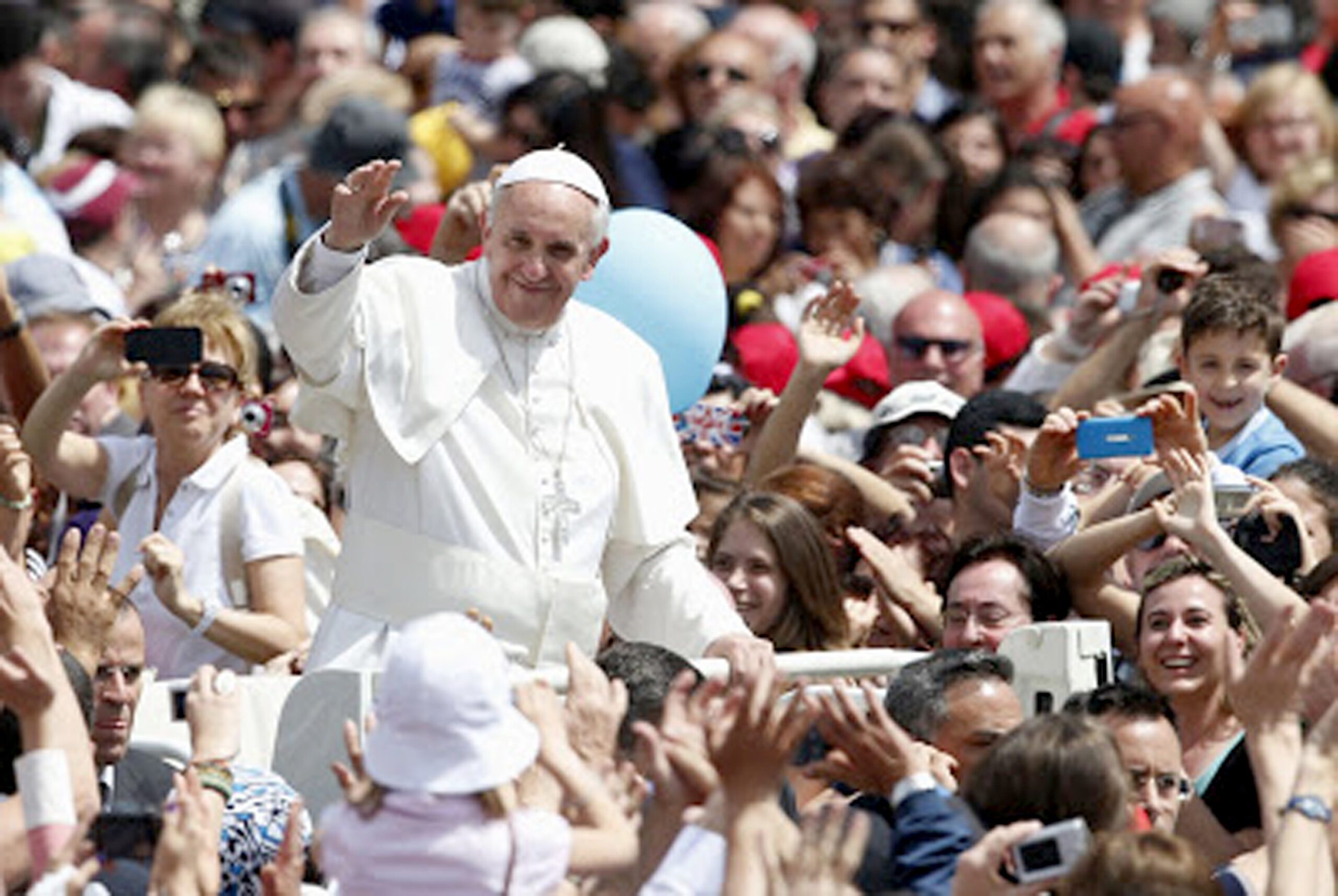
To the Outskirts of Human Existence. If then, this is the challenge that the Church places before the laity in our times, we will readily understand the anxiety that Pope Francis has expressed about ‘ecclesiastical narcissism.’ He wants us to widen our interests and not to imprison ourselves in our own internal concerns.
“When the Church does not come out of itself to evangelize,” he said, “it becomes self-referential and then gets sick.” An inward-looking Church, which does not look at Christ, does not reflect Him; she becomes incapable of offering His light and His love for those walking in darkness. Soon enough, she succumbs to the greatest of evils, which the Pope calls, a “spiritual worldliness … living in itself, of itself, for itself.” He wants the Church to move out of herself and go to those “on the outskirts of human existence.” That sort of pilgrimage is the fundamental conversion that the Church needs today; and, on this pilgrimage, he wants to lead us, not only priests and curial officials, but laypeople as well.
Don’t Clericalize the Laity. “It’s key that we Catholics, both clergy and laity, go out to meet the people,” he stressed in a 2010 interview with El Jesuita. This is “not only because the Church’s mission is to announce the Gospel, but because failing to do so harms us. … A Church that limits herself to administering parish work, that lives enclosed within a community, experiences what someone in prison does: physical and mental atrophy.” A Church that merely protects its small flock, that gives all or most of its attention to its faithful clientele, he believes, “is a Church that is sick.” In a 2011 interview with an Argentinian Catholic news agency, he said this contagious spiritual sickness comes from a clericalism that passes from clergy to laypeople.
“We priests tend to clericalize the laity. We do not realize it, but it is as if we infect them with our own disease. And the laity – not all, but many – ask us on their knees to clericalize them, because it is more comfortable to be an altar server than the protagonist of a lay path. We cannot fall into that trap – it is a sinful complicity.”
Clericalization means focusing fundamentally on the things of the clergy and, more specifically, the sanctuary, rather than on bringing the Gospel to the world. Clericalism ails the clergy when they become too self-referential rather than missionary. But it afflicts laypeople worse, when they begin to believe that the fundamental service God is asking of them is to become greeters, lectors or extraordinary ministers of Holy Communion at Church rather than to live and spread the faith in their families, workplaces, schools, neighborhoods and beyond.
The layperson is a layperson and has to live as a layperson, with the power of baptism, which enables him to be a leaven of the love of God in society itself, to create and sow hope, to proclaim the faith, not from a pulpit but from his everyday life. And, like all of us, the layperson is called to carry his daily cross – the cross of the layperson, not of the priest.”
Keep Clear of Hypercriticism. One of the wild grapes that flows from the vine of clericalism, the Pope said in El Jesuita, is a hypercritical spirit that leads some Catholic priests and faithful to expend most of their energy censuring others inside and outside the Church rather than seeking to live and share the joy of the Christian faith.
“This is a problem not only for priests,” he said, “but also for laypeople. One isn’t a good Catholic when he is looking only for the negative, for what separates us. This isn’t what Jesus wants.” Such unredeemed behavior “mutilates the message” of the Christian faith and scares people away from it, he said. Firing vitriolic criticism at those with whom one disagrees is not the path of the reform of the laity and the Church. The reform of the laity must involve reforming them to become “missionary disciples in communion.” Those four words define the lay vocation: converted followers of Jesus who, together with others, share Jesus’ life and faithfully seek to spread their joy, life and love to those who have not yet come into that twofold communion. Vatican II says: “Common human values not infrequently call for cooperation between Christians pursuing apostolic aims and those who do not profess Christ’s Name but acknowledge these values” (AA 27).
Transform Politics, Society, Neighborhood. It is a community of believers trained and inspired to go out to transform politics, society, education, neighborhoods, family and marriages that transforms the world. It is a brotherhood of Good Samaritans drawing near to neighbors with love and mercy that will give life to human society. It is the faithful who are the salt of the earth and not just salty critics of the Church that will fill the world with joy. It is a body of torchbearers radiating Christ’s light rather than hiding it within the bushel basket of self-referential, spiritually worldly and ultimately “sick” parochial or diocesan structures that will evangelize the world. Pope Francis has set in motion this pilgrimage leading to this reform, taking us by example to the outskirts of human existence. The real work, however, still needs to take place in hearts, homes, parishes, movements and schools across the Catholic world.
Secular Spirituality and Good Human Relations. If this be the mission of the laity, their apostolic formation, says Apostolicam Actuositatem 29, should especially be characterized by the distinctively secular and particular quality of the lay state and its own form of spiritual life. It should be a well-rounded formation. Lay leaders should be well-informed about the modern world and perfectly at home within their community and with their culture. They should be perceptive of the movement of the Holy Spirit in the world. The courses they do will vary according to the nature of the service they intend to offer in community: theological, spiritual, practical, technical. In conveying the message, they should adapt it to the age, status and competence of the listeners. Most of all, they should know how “to cultivate good human relations; truly human values must be fostered, especially the art of living fraternally and cooperating with others and striking up friendly conversation with them.” It demands maturity of the human person, and “harmony and balance” must be safeguarded (AA 29).
Prevent Erosion of Cultures and Values. Such reflections have acquired enormous importance in the context of the ‘erosion of cultures’ and of ethical values that is taking place right round the globe today. Every religious tradition is under threat. Globalization has led to large-scale de-traditionalization and de-institutionalization, weakening family bonds, community cohesion and parish togetherness that used to communicate values and provide answers to perennial questions about the meaning of life and nature of truth (Instrumentum Laboris 47).
If the Church is eager to come to the rescue of people in their economic and social disabilities, even more does she need to come to the aid of communities whose religious beliefs and values stand threatened. There are people who reduce religion to psychological assistance, therapy, or self-motivation exercises. When faith is weak in those who communicate it, life remains untouched. Meantime, some evangelical preacher with deep conviction carries away the flock. Laypeople, with deep Christian convictions, turn out to be powerful witnesses in married life, in the field of education of children, in guiding the choice of vocation, defending the indissolubility and sacredness of marriage, in promoting prayerlife, offering hospitality, assisting migrants, affirming the rights of the weaker sections to have a share in the expanding economy (AA 11).
Strengthening the Role of Catechists. Speaking to the Episcopal Conferences of the Pacific and New Zealand, Pope Benedict XVI said sometime ago: “I understand from your report that your task of spreading the Gospel often depends on the assistance of lay missionaries and catechists. Continue to ensure that a sound and ongoing formation be afforded them, especially within the context of their associations. In doing so, you will equip them for every good work in the building up of the body of Christ (2 Tim. 3:17; Eph. 4:12). Their zeal for the faith under your continued leadership and support will surely bear much fruit in the vineyard of the Lord.” This precisely is my own experience in the mission during half a century. More depends on the generous work of the laypeople, especially the catechists, than can easily be described. They pioneer into difficult areas, stand opposition, work out their own solution to problems, explain Christian teaching in the most creative way, and continue to break new grounds year after year. Aside from the service of teaching, there are times when they help in the administration of temporalities of the Church. They have the courage and creativity to approach immigrants and bring together people of different cultural background in the parish and the diocese. They foster a universal outlook and promote keen interest in the missions (AA 10).
Risking Lives for Christ. About such courageous Christian workers, the Council says (AA 17), they teach Christian doctrine where there is no freedom with risk to their lives, and manifest “heroic fortitude in the midst of persecutions.” During the recent harassment of Christians in Orissa (India), there were generous catechists who gave their lives for their faith. Lay apostles show amazing courage in areas “where Catholics are few in number and widely dispersed.” They “gather in smaller groups for serious conversation…giving spiritual help to one another through friendship and the communicating of the benefit of their experience,” and overcoming isolation (AA 17). They have no difficulty in cooperating with fellow citizens of other faiths in discussing social problems in the light of higher principles and working for justice of God’s Kingdom and engaging themselves in Christian social action (AA 7). That is how they infuse a Christian spirit into the mentality, customs, laws, and structures of the community in which they live (AA 13).
Acting in the Secular Space. The secular space offers opportunities for believers and non-believers to meet on equal terms, and listen and interpret the ‘many voices of our age’ (Instrumentum Laboris 129). The public opinion that emerges is like the people’s parliament, towards the shaping of which everyone has the possibility to contribute in order to build a society that is built on justice and peace (Instrumentum Laboris 73). Intelligent Christian leaders can propose, in the light of their faith, loftier motives of action in their family, professional, cultural and social life and make them known to others when the occasion arises (AA 16).
Be Close to Thinking People. Duc in altum (Lk. 5:4), we hear today: meet people at their depths, be close to ‘thinking people’ in every community, reflect with them on the future of society, humanity. Our prophetic mission is not at its best in denouncing and humiliating those who think differently from us, but inviting them to reflect, and to change when required. God has a plan for Asia. We need to open ourselves to that plan operating mysteriously in the diverse heritages of this continent, so that we can present our own heritage of faith in all its richness (Instrumentum Laboris 67). A ‘depth’ dimension of reflection and a ‘sense of responsibility’ linked with it, can be brought to every sphere of human life: to the market, to the digital world, scenes of ethnic tensions, areas of corruption, damaged environment and slums, and contexts where life is undervalued. And the in-depth search for the Absolute, that is evident in the Asian spirit of inquiry, can help Christians, floundering in faith, to deepen their own and share it with others.