
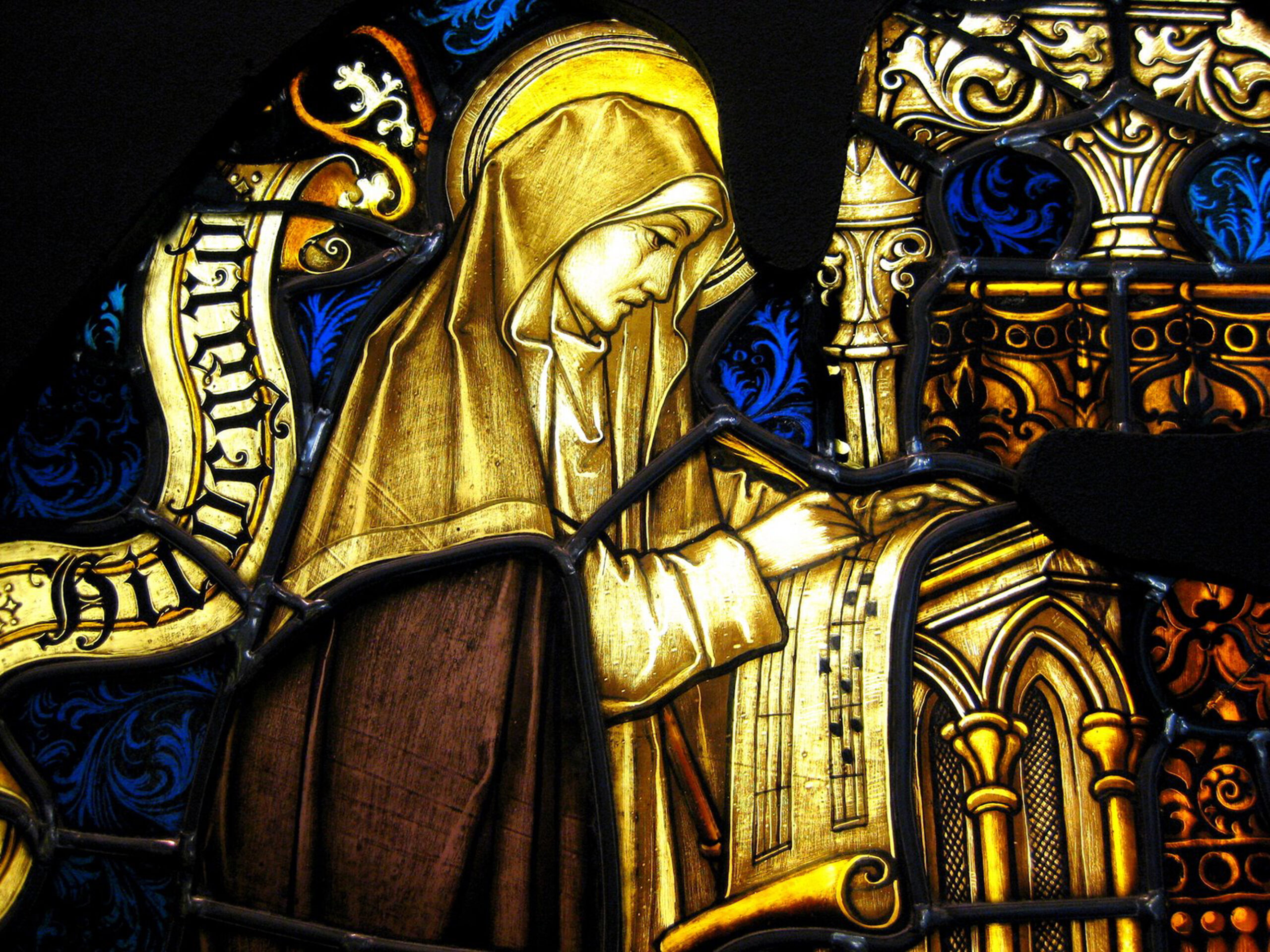
Hildegard of Bingen (1098-1179) was a remarkable woman, a “first” in many fields. At a time when few women wrote, Hildegard, known as “Sybil of the Rhine,” produced major works of theology and visionary writings. When few women were accorded respect, she was consulted by and advised bishops, popes, and kings. She used the curative powers of natural objects for healing, and wrote treatises about natural history and medicinal uses of plants, animals, trees and stones. She is the first composer whose biography is known. She founded a vibrant convent, where her musical plays were performed. Revival of interest in this extraordinary woman of the Middle Ages was initiated by musicologists and historians of science and religion. Her story is important to all students of medieval history and culture and an inspirational account of an irresistible spirit and vibrant intellect overcoming social, physical, cultural, gender barriers to achieve timeless transcendence.
Hildegard is considered the patron saint of environmentalists, at the same level as St. Benedict or St. Francis. She provides a sense of the earth in its sacred relationship with the divine as its source of fertility. She saw the divine in the greening of the earth and spoke of the “kiss of the Earth” that produced all. Fr. Thomas Berry asserted: “It was a kind of wedding relationship between Heaven Father/Earth Mother – a thing of union that she spoke of in erotic terms and she understood in a very profound way. I think we need to understand and accept more her earth creation concept today.”
Modern feminists also claimed she is an inspiring figure. The thought of the time was based in Greek philosophy, which was not kind towards women. Plato wrote: “It is only males who are created directly by the gods and are given souls.” Aristotle considered “women are defective by nature” because “they cannot reproduce semen which contains a full human being.” Now, look at what Hildegard wrote: “When God looked upon the human countenance, God was exceedingly pleased. For had not God created humanity according to the divine image and likeness? Human beings were to announce all God’s wondrous works by means of their tongues that were endowed with reason. For humanity is God’s complete work…. Man and woman are in this way so involved with each other that one of them is the work of the other. Without woman, man could not be called man; without man, woman could not be named woman. Thus, woman is the work of man, while man is a sight full of consolation for a woman. Neither of them could, henceforth, live without the other. Man is, in this connection, an indication of the Godhead while woman is an indication of the humanity of God’s Son.”
ILL HEALTH AND INNER LIFE
Hildegard was born as the “10”th child (a tithe) to a noble family. As it was customary for the tenth child, the family could not count her in for feeding. She was dedicated at birth to the Church. The girl started to have visions of luminous objects at the age of three, but soon realized she was unique in this ability and hid this gift for many years. She kept having the visions. Left much to herself on account of her ill health, she led an interior life, trying to make use of everything for her own sanctification. She says of herself: “Up to my fifteenth year, I saw much, and related some of the things seen to others, who would inquire with astonishment, whence such things might come. I also wondered and during my sickness I asked one of my nurses whether she also saw similar things. When she answered no, a great fear befell me. Frequently, in my conversation, I would relate future events, which I saw as if present, but, noting the amazement of my listeners, I became more reticent.”
At age 8, the family sent this strange girl to an anchoress named Jutta to receive a religious education. Jutta was born into a wealthy and prominent family, and by all accounts was a young woman of great beauty. She spurned all worldly temptations and decided to dedicate her life to God. Instead of entering a convent, Jutta followed a harsher route and became an anchoress. Anchors of both sexes, though from most accounts, they seem to be largely women, led an ascetic life, shut off from the world inside a small room, usually built adjacent to a church so that they could follow the services, with only a small window acting as their link to the rest of humanity. Food would be passed through this window and refuse taken out. Most of the time would be spent in prayer, contemplation, or solitary handworking activities, like stitching and embroidering. Because they would become essentially dead to the world, anchors would receive their last rights from the bishop before their confinement in the anchorage. This macabre ceremony was a complete burial ceremony with the anchor laid out on a bier.
ABSORBING KNOWLEDGE
Jutta’s cell was a typical anchorage, except that there was a door through which Hildegard entered, as well as about a dozen of girls from noble families who were attracted there by Jutta’s fame in later years. What kind of education did Hildegard receive from Jutta? It was of the most rudimentary form, and Hildegard could never escape the feelings of inadequacy and lack of education.
She learned to read the Psalter in Latin. Though her grasp of the grammatical intricacies of the language was never complete – she always had secretaries to help her write down her visions – she had a good intuitive feel for the intricacies of the language itself, constructing complicated sentences fraught with meanings on many levels, that are still a challenge to students of her writings. The proximity of the anchorage to the church of the Benedictine monastery at Disibodenberg (it was attached physically to the church), undoubtedly, exposed young Hildegard to musical religious services and were the bases for her own musical compositions. After Jutta’s death, when Hildegard was 38 years of age, she was elected head of the budding convent within the cramped walls of the anchorage.
During all these years, Hildegard confided her visions only to Jutta and another monk, named Volmar, who was to become her life-long secretary. However, in 1141, Hildegard had a vision that changed the course of her life. A vision of God gave her instant understanding of the meaning of the religious texts, and commanded her to write down everything she would observe in her visions: “And it came to pass … when I was 42 years and 7 months old, the heavens were opened and a blinding light of exceptional brilliance flowed through my entire brain. And so it kindled my whole heart and breast like a flame, not burning but warming. And suddenly I understood the meaning of expositions of the books.”
HUMILITY AND OBEDIENCE
Yet Hildegard was also overwhelmed by feelings of inadequacy and hesitated to act: “But although I heard and saw these things, because of doubt and low opinion of myself and because of diverse sayings of men, I refused, for a long time, the call to write, not out of stubbornness but out of humility, until weighed down by a scourge of God, I fell onto a bed of sickness.”
The 12th century was also the time of schisms and religious foment, when someone preaching any outlandish doctrine could instantly attract a large following. Hildegard was critical of schismatics; indeed, her whole life she preached against them, especially the Cathars. She wanted her visions to be sanctioned, approved by the Catholic Church, though she herself never doubted the divine origins of her luminous visions. She wrote to St. Bernard, seeking his blessings. Though his answer to her was rather perfunctory, he did bring it to the attention of Pope Eugenius (1145-53), a rather enlightened individual who exhorted Hildegard to finish her writings. With papal imprimatur, Hildegard was able to finish her first visionary work Scivias (“Know the Ways of the Lord”) and her fame began to spread through Germany and beyond.
ENCYCLOPEDIC WORKS
Around 1150, Hildegard moved her growing convent from Disibodenberg, where the nuns lived alongside the monks, to Bingen about 30 km north, on the banks of the Rhine. She later founded another convent, Eibingen, across the river from Bingen. Her remaining years were very productive. She left behind over 100 letters, 72 songs, 70 poems, and 9 books. Her scientific views were derived from the ancient Greek cosmology.
Hildegard’s writings are also unique for their generally positive view of sexual relations and her description of pleasure from the point of view of a woman. They might also contain the first description of the female orgasm: “When a woman is making love with a man, a sense of heat in her brain, which brings with it sensual delight, communicates the taste of that delight during the act and summons forth the emission of the man’s seed. And when the seed has fallen into its place, that vehement heat descending from her brain draws the seed to itself and holds it, and soon the woman’s sexual organs contract, and all the parts that are ready to open up during the time of menstruation now close, in the same way as a strong man can hold something enclosed in his fist.”
THE MUSIC OF THE ANGELS
Between 70 and 80 compositions have survived, which is one of the largest repertoires among medieval composers. Music was extremely important to Hildegard. She describes it as the means of recapturing the original joy and beauty of paradise. According to her, before the fall, Adam had a pure voice and joined angels in singing praises to God. After the fall, music was invented and musical instruments made in order to worship god appropriately. Perhaps this explains why her music most often sounds like what we imagine to be like angels singing.
Hildegard wrote hymns and sequences in honor of saints, virgins and Mary. She wrote in the plainchant tradition of a single vocal melodic line, a tradition common in liturgical singing of her time. Her music is undergoing a revival and enjoying huge public success. One group, Sequentia, recorded all of Hildegard’s musical output in time for the 900th anniversary of her birth in 1998. Their latest recording, Canticles of Ecstasy, is superb. Be sure to read the translations of the Latin text of the songs which provide a good example of Hildegard’s metaphorical writing, and are imbued with vibrant descriptions of color and light that also occur in her visionary writings.
A FIGHTER FOR REFORM
Such a fragile person, so deeply oriented towards her inner life and so careful to respect the Church’s teachings, had nevertheless a strong and independent character. The acceptance of public preaching by a woman, even a well-connected abbess and acknowledged prophet does not fit the usual stereotype of that time. She conducted four preaching tours throughout Germany, speaking to both clergy and laity in chapter houses and in public, mainly denouncing clerical corruption and calling for reform.
Before Hildegard’s death, a problem arose within the clergy of Mainz. A man buried in Rupertsburg had died after excommunication from the Church. Therefore, the clergy wanted to remove his body from the sacred ground. Hildegard did not accept this idea, replying that it was a sin and that the man had been reconciled to the Church at the time of his death. On 17 September 1179, when Hildegard died, her sisters claimed they saw two streams of light appear in the skies and cross over the room where she was dying.
Hildegard was one of the first persons for whom the canonization process was officially applied, but the process took so long that four attempts at canonization were not completed, and she remained at the level of her beatification. Numerous popes have referred to Hildegard as a saint, including Pope John Paul II and Pope Benedict XVI.
Few received the honor to be remembered in the skies. Hildegard is one of them: Asteroid 898 was named after her.
* Responsible for editing the text. The main sources are available in: http://www.fordham.edu/halsall/med/hildegarde.asp; en.wikipedia.org/wiki/Hildegard_of_Bingen; and in the site of Catholic Encyclopedia: www.newadvent.org/cathen/07351a.htm