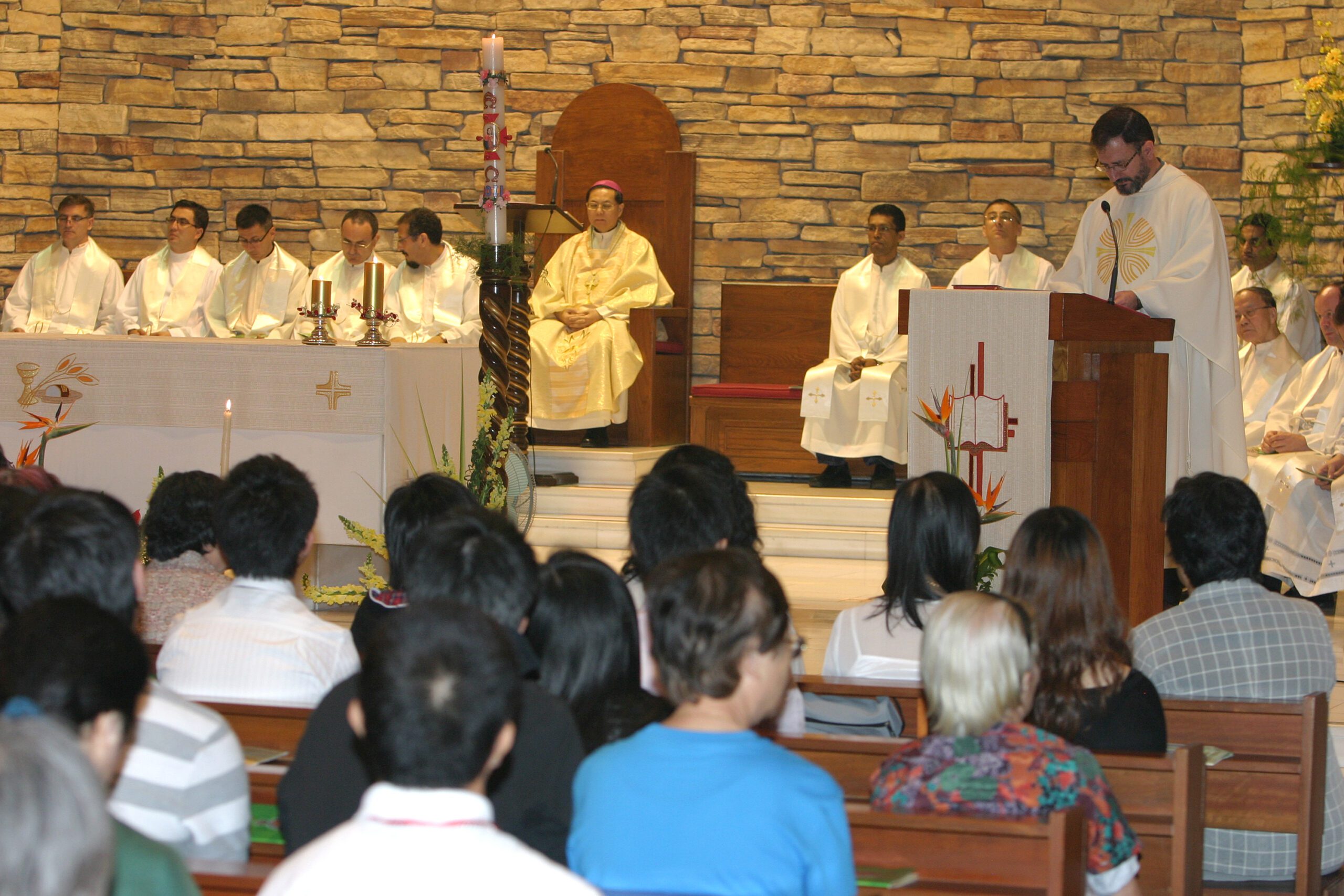
The Comboni Missionaries arrived in China in 1991. The 20th anniversary of the arrival was celebrated in Macau at the Parish of Saint Joseph the Worker which they have been running since its beginning. It took place on May 1, feast of the patron saint of that Christian community. The bishop of Macau, Msgr. José Lai, presided over the solemn Eucharistic celebration in Cantonese, participated by some clergymen and many parishioners and guests. Among them were the General Superior of the Institute, Fr. Enrique Sanchez, and his councilor, Bro. Daniele Giusti.
In his address to the participants, who filled the 11-year old church to its full capacity, Fr. Enrique Sánchez, said: “This is a significant moment for us who, as missionaries, came, 20 years ago to this continent where we knew the majority of humanity lives and where Christ was almost unknown – the same Christ, whom we would like to become witness of, in your midst.”
Even though small – it consists of only a dozen members in three communities (two in Macau and one in Taiwan, the country-island that China keeps reclaiming) – the Comboni presence is meaningful for the Institute: “Through these years,” Fr. Enrique stated, “a new page has been written in the history of the mission of the Comboni Missionaries.” Then, he explained: “The experience of the past years has brought us to discover a new way of living our missionary vocation and has taught us that what is important is not so much what we can accomplish with our own strength, but what the Lord can do when we allow Him to work through our weakness and frailty.”
THE GATEWAY TO CHINA
Macau, which was a tiny territory under Portuguese administration 20 years ago, had been chosen as the spearhead of the Comboni efforts to expand their evangelizing presence to China. The first missionary to arrive was Fr. Manuel António Machado (Portuguese). Two confrères joined him a few months later: Fr. Daniel Cerezo (Spaniard) and Fr. Conrado de Robertis (Italian). After learning Cantonese in Hong Kong, they settled in Macau, each one in a parish, so that they could practice the language, inculturate and get involved in the pastoral work.
They came to live together as a community in 1996. They bought an apartment on the North side of Macau – not far from the border with China known as Portas do Cerco – where they started working. The Parish of St. Joseph the Worker was opened in 1998. They took up residence in its premises in November after a simple blessing officiated by the diocese’s Vicar General. The solemn blessing and inauguration, with the presence of the bishop, the governor, and who would be the chief executive, happened in 1999, the year of the handover of Macau to China.
After these years, Macau became a cosmopolitan city. Its gambling industry, which attracts millions of tourists weekly and has overcome that of Las Vegas, is at the origin of the territory’s construction boom and development. Macau has doubled its original 14 sq. kilometers by reclaiming sea areas. Even though its importance has been increasing, it continues being a suitable gateway to Mainland China – at least, while there is still no religious freedom in the latter. The reason is: The Portuguese left after agreeing with the Chinese authorities that a special status would be accorded to the territory, similar to the one that was earlier applied to Hong Kong.
Mission in that context is difficult and with scarce gratifications. After working hard preparing catechism class and homilies – a daunting task for foreigners – the missionaries hardly see the fruits of their labor. For instance, after finishing the one-year-and-a-half period of catechumenate (the journey proposed to those who want to join the Christian community) not all the candidates wish to be baptized – an amazing experience which underlies the mystery of faith and conversion! This year, however, in St. Joseph the Worker Parish, the fruits were more visible and abundant: “We had 44 baptisms of which around 30 were adults,” asserts its parish priest, Fr. Manuel Machado.
Learning Cantonese is a long and slow process which requires a lot of time and effort. Therefore, to become proficient in the language and deepen the understanding of the culture continues to be the missionaries’ main challenge. Another, is to prepare more lay persons to give catechism classes and for evangelization to assist the missionaries in reaching out to more people – including in Mainland China.
The Church in Macau has been in a transition period. Vocations are minimal. The majority of the clergy are old and sick. Religious are not many, either. Thus, Fr. Manuel Machado suggests: “Since the Church has to rely more on lay people, they should be given a chance to prepare themselves, be trusted upon and given more responsibilities. We are in a good position to do this because we assert that we are not protagonists ourselves.”
Thinking at the Institute’s level, Fr. Manuel underlines the need to have missionaries with academic credentials prepared for interreligious dialogue and formation of the pastoral agents in China. He concludes: “We have laid the foundations and people have come to know us. Now is the time to move on and add value to our presence.”
IT’S A MIRACLE!
In 1997, three Comboni missionaries were sent to Taipei (Taiwan) to study Mandarin, China’s most widely-spoken language. In March 2002, they were entrusted with the care of Jen Ai Parish in the city. They handed it back in November 2010 to assume a poorer parish in the suburbs, in the area of Wugu, among factory workers and aborigines.
Fr. Paolo Consonni has been there since the beginning and he is satisfied with their accomplishments, especially with the way they have been able to enter into people’s lives. He says: “In spite of the language and cultural barriers, people count on us to listen to them when they are sick and fear death. We are the reference point in moments of need, grief and darkness. And they think of us in special moments of joy. We have wonderful stories how we became the reference point in some of the painful and meaningful events in the life of the people. They look for us in such moments, expecting us to help and accompany them – even if we are foreigners.” And adds: “After 13 years in that cultural milieu, I am amazed at this capability of a missionary, in spite of all the limitations, to enter into a person’s life. It’s a miracle!”
The community has to draw a pastoral plan and start its evangelizing work almost from scratch. But, during the Easter Vigil, they already baptized four people. Fr. Paolo explains the situation they face: “People are very pragmatic and they have their own answers to the great questions – of life, death, after death, moral values, etc. The Buddhist philosophy is very rich and comprehensive in answering peoples’ quests. The issue is: are those answers really updated for the Chinese people? Not for those coming out of the traditional family networks who find that they need something else. It is when our presence gains meaning – offering them something they do not find in traditional religion. The challenge is to be there and let the answer emerge through our presence and our community life…”
WORK OF HUMILITY
The project Fen Xiang (meaning, sharing), as an outreach to Mainland China, was established in 1998. Macau became its logistic base in 2000. Its first aim is to provide formation to pastoral agents, especially seminarians, priests and Sisters – to help the Church to grow. The director of the project, Fr. Víctor Mejía (Mexican), who has been going to China to give talks and retreats, says: “They are very thirsty for the Word of God and for a new vision of Church, especially in the rural areas.” Since the beginning, they have helped both the underground Church and the open Church. The latter is not synonymous to the organization called Patriotic Association which should disappear because it has been a stumbling block in the process of reconciliation.
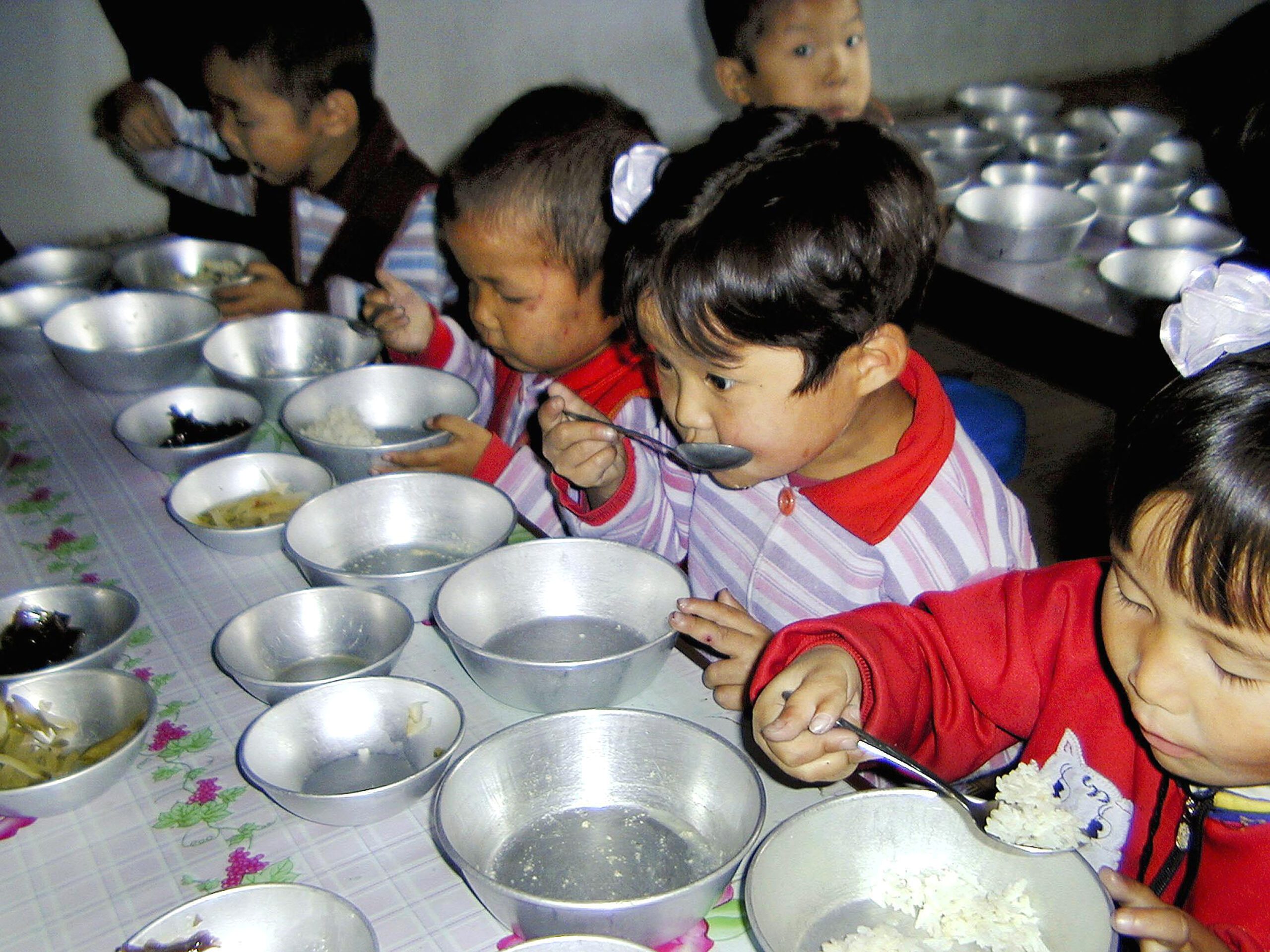
The second aim of Fen Xiang is human promotion. With the assistance of overseas agencies and benefactors, it helps orphanages, handicapped children and very poor students from rural areas who are likely to be illiterate. Why should they provide aid to a country which has become the world’s second economic power and is even bailing out some Western economies? The administrator of Fen Xiang, Fr. Víctor Aguilar from Costa Rica, argues: “There’s a lot of inequality inside China. We help not the China shown on television, the China of the big cities like Beijing or Shanghai, but the poor China of the rural areas. In the country, there are many poor, especially children and disabled, who are neglected by the government.”
In 2000, Fen Xiang started a bulletin, published in different languages, to exchange news and experiences with donors and benefactors. It is also a bridge to China. And a way of avoiding some of the restrictions of movements China imposes. For instance, Fen Xiang people can cross its borders only with a student or a tourist visa. Overall, this is a work of humility. We give a little contribution to a huge country and to a people who are very proud by character and find it difficult to say “thanks!” for a service they receive.
NEW STYLE OF MISSION
General Assistant Bro. Daniele Giusti explains the presence of the Comboni Missionaries in this continent from the perspective of a physician, his profession: “It takes time for some of our genes to become evident. In Comboni’s vocation, Asia was present as a fascination, after reading the story of the martyrs of Japan. It took 150 years at the Institute, which is the continuation of Comboni in history, for this gene to become evident.”
He claims it is a necessary presence for the Institute: “Our presence in Asia, especially in the Chinese world, forces us to understand what kind of missionaries we are called to be nowadays – moving away from the idea of protagonism, from being the bosses.” He explains: “It is undeniable that, in Africa, we have been the founders and the spearhead of the mission. Here, we are called to be much more humble. We have to learn that the mission is not ours; it is the mission of the Holy Trinity and we are just collaborators and companions of people.”
Father General stresses the idea that this presence is enriching as it helps the Institute to acquire a new style of mission: “This is an experience in which we can discover ourselves not as protagonists, but collaborators, disciples of the mission. In Africa, we invested a lot in development projects and human promotion which are still needed. But, today, mission is passing a lot through other channels – of listening, dialogue, discovering God’s presence in the other, of walking at the pace of the people with whom we want to share the Gospel, not taking for granted that we have the truth and are its exclusive dispensers. We have the Good News we are called to share, but God is waiting for us in all the people we meet in our mission.”
He adds: “Ours is an almost insignificant presence, but we are beneficiaries of a great gift God is granting us – of having the opportunity to witness to His presence, fidelity, love and His trust in the humanity that lives here. Our task is not to convert more than a billion Chinese people, but to be witnesses and to walk with this little flock of people who are opening to the Gospel, seeks answers and finds in Jesus the answer to their expectations of enjoying the plenitude of life.”
For Fr. Enrique, this presence is in line with the Comboni charism, because Comboni’s vision of mission, when closely looked at, is one where nobody should feel like a protagonist or owner of the mission. He tries to involve all the forces available in the mission he conceives as Catholic, i.e., is open to all and tries to reach out and meet those the Lord reveals to him as the recipients of the Good News.
Then, the Superior General observes: “We want our presence here to be the expression of the need of the Gospel to reach the least, the frontiers of humanity because it is the Good News God wants to sow in the heart of every human being. It shows a desire of going out, sharing, learning and being enriched by the richness of the Gospel which waits for us in this culture, in this reality.”
He concludes with a wish: “We wish that our small missionary presence here, as Comboni Missionaries, may continue to be like a bit of yeast which ferments the dough – the Christian community – to help its members grow and be witnesses of the beauty of having a Christian life.”