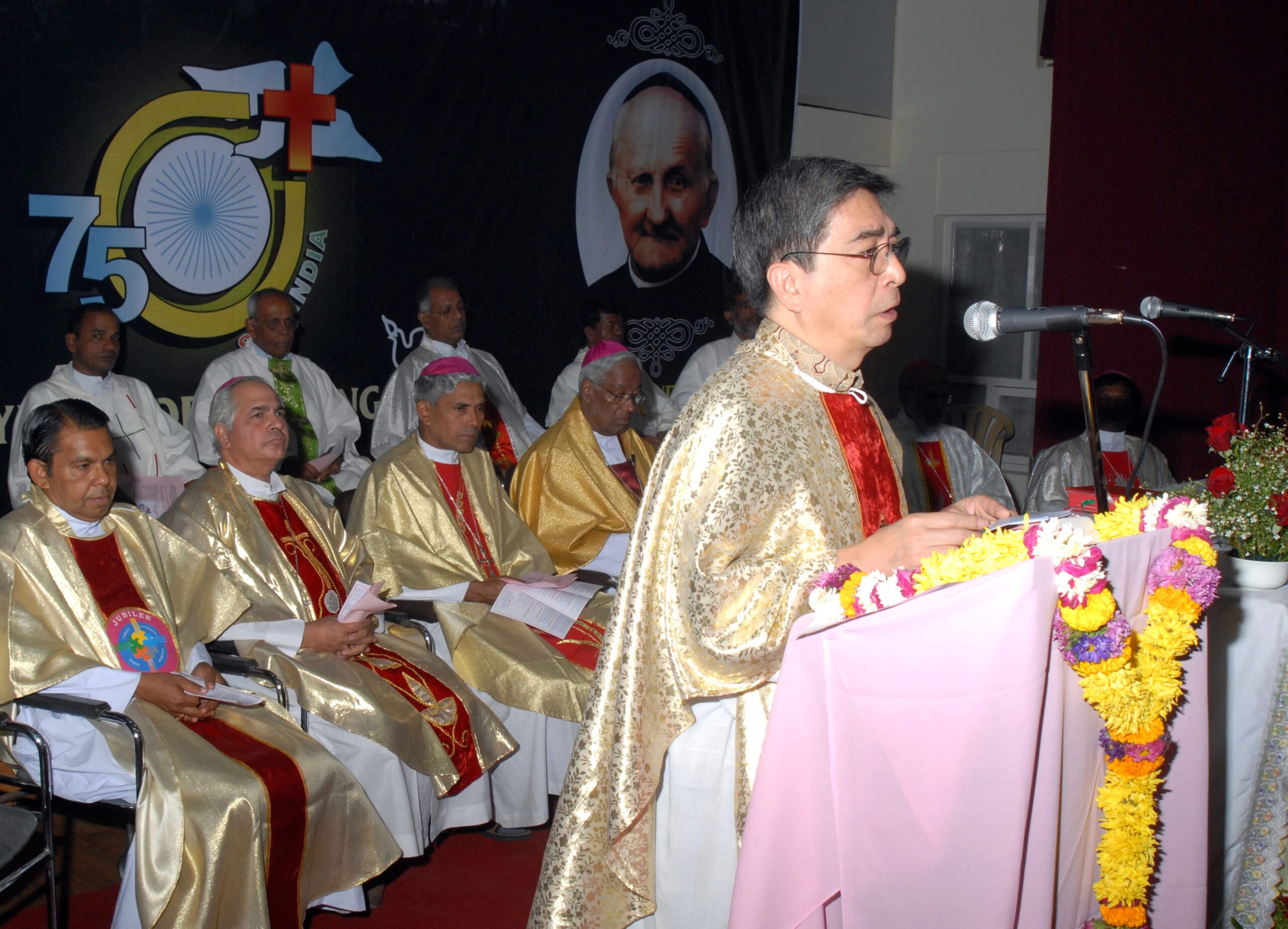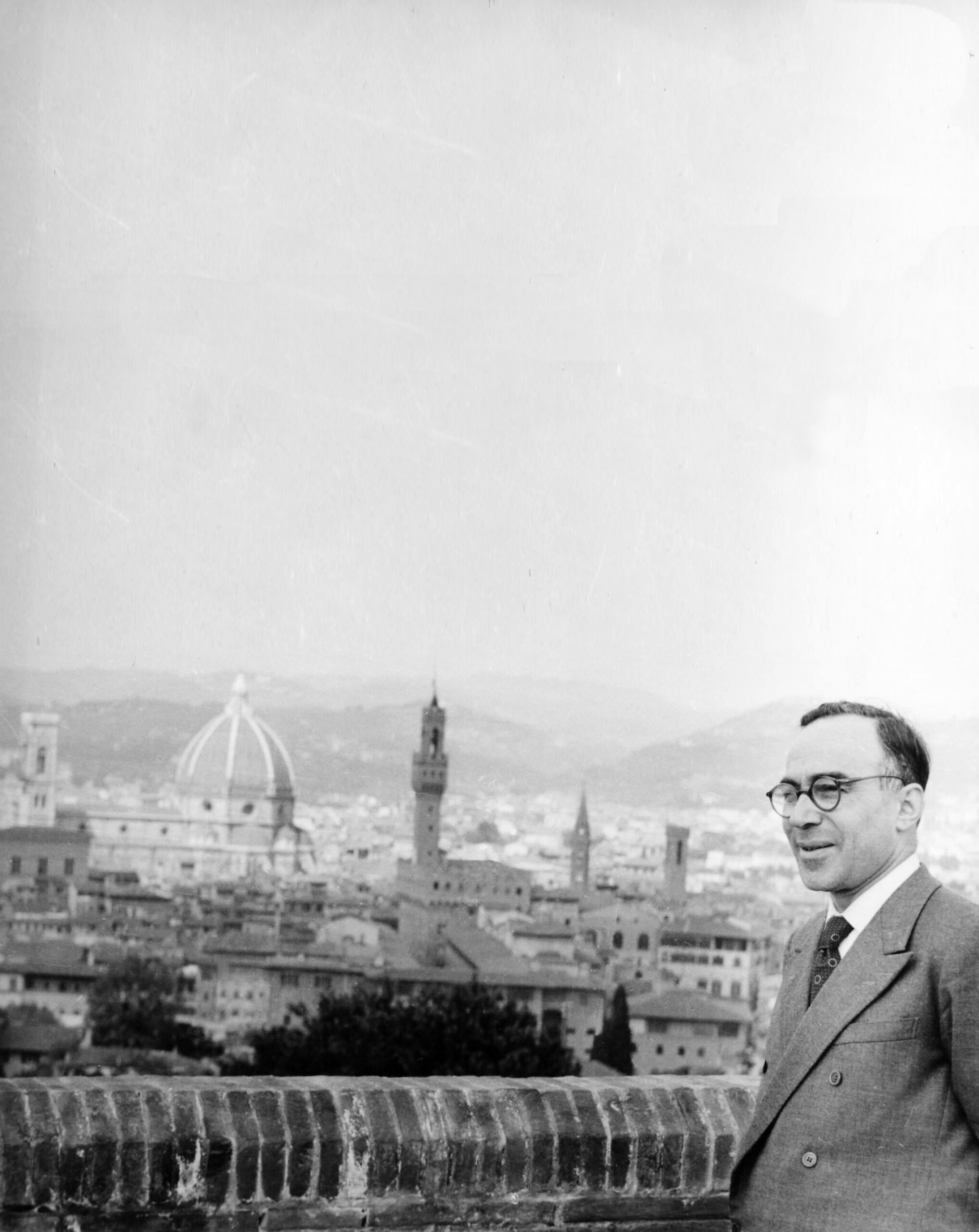
Not long ago, with a solemn Mass, His Eminence Cardinal Ennio Antonelli, archbishop of Florence, Italy, concluded the diocesan process of beatification of Giorgio La Pira, university professor, former mayor of Florence, congressman and prophet of peace. It started in 1986 and it was meant to “inquire about the heroic nature of the virtues and the fame of holiness of the person in question.” On that occasion, the documentation collected at diocesan level was sealed and sent to Rome, to the Congregation of the Causes of the Saints. It is a monumental work comprising the 35 volumes of La Pira’s published works, the interviews with more than 200 witnesses and tens of thousands of letters that the Servant of God exchanged with many of the most important characters of the time (only the correspondence with Fr. John Baptist Montini, who later became pope with the name of Paul VI, comprises more than 1200 letters).
A CHRISTIAN DEMOCRACY
Giorgio La Pira was born at Ragusa, in Sicily, Italy, on January 9, 1904 to a poor family. Because of his outstanding intelligence and at the price of innumerable sacrifices, he managed to finish a law degree and was given the chair of Roman Law at the University of Florence. He turned out to be an esteemed scholar who aimed at putting Christian foundations to true democracy. For this purpose, he started a law magazine, Principles that very soon was targeted by the fascist government and suppressed.
It was the crucial time, after World War II, when the Italian people were changing form of government, moving from monarchy to republic. A new constitution was needed. La Pira’s ambition was to make it according to the
Christian inspiration as he stated to a gathering of Catholic social activists in 1945: “The Christian inspiration essentially depends on this fact that the object of the Constitution, its aim and purpose is the human person as shown and defined by the Catholic doctrine. Therefore, the constitutional setup of economy, politics, the family, education and religion should conform to the nature and dignity of the human person. Only in this way, may we consider a Constitution to be inspired by Christianity.”
In 1946, La Pira was elected to the Constituent Assembly and within the very commission of the 75 members that contributed to formulate the principles of the Constitution of the new republic. With him were other Catholic leaders called “the young professors” like Giuseppe Dossetti who, later on, became a priest and founder of religious orders, and Aldo Moro who was Prime Minister, member of the European Parliament and was subsequently kidnapped and killed by the Red Brigades.
THE “SAINTLY MAYOR”
The moments when Giorgio La Pira was showing himself more spontaneously were the ones of meeting with the poor. Since 1934, the community of the poor used to gather around him for Sunday Mass, first in the little church of Saint Procolo, and then, from 1942, in the more spacious church of Badia del Proconsole in Florence. He was then a young university professor; later, he would be the mayor and an internationally reknown figure. For forty years, the poor communities were the place in which he verified the validity of his choices, his observation point of the world, even the world of politics.
He entered active politics coming from there: not the silent atmosphere of a convent or library: it was the underground of the city where those who are unable to make a living gather, those on whom the eyes of the sociologist or of the journalist do not focus. It is exactly from there that it is possible to see the other side of history. He was looking at the world of wealth and power with the eyes of the poor, adding his deep sense of compassion and the awareness of the temptation of inhumanity that wealth and power almost fatally produce.
Because of this attitude, the Democratic Party made him head-list candidate at Florence in 1951. He was the only person capable of snatching the mayorship of the city from the Communists who considered it as their own monopoly because he could attract to his person the votes of the poorest strata of the populace who were inclined naturally to the left. He accepted the candidacy because he wanted to give voice to those in the city who had been voiceless, certainly not because he was a party man. He used to say: “My only party card is my baptism card.”
He was called: “Il sindaco santo” (“the saintly mayor”). His tenure of that post, that defines him better than any other, was exemplary. He was the mayor of the lower sector of the citizenry − committed to a courageous program of housing for the working class and loyal to the workers to the point of joining their strikes and agonizing with their struggle for a just salary and in defense of their jobs. These uncompromising positions did not spare him bitter criticism on the part of government agents as well as industrialists and even some Catholic prominent people. Answering the government representatives who were inviting him to change his position in favor of the 1,750 workers who had been laid off by the Pignone Factory, he said: “Be you the ones to change the law, I cannot change the Gospel!”
La Pira had no doubts when he was dealing with whatever ensured the basic rights of each person: “the house to live in, the workshop to find a job, the school to educate, the hospital to heal, the church to pray, the public administration building to promote relationship among the citizens” as he wrote in his book, The Mayor of the Poor.
His tenure as mayor of Florence was always concerned with serving everybody, but with a particular attention the poor. He himself was poor and loved to be so for Jesus’ sake and like Jesus, so much so that he didn’t even own an official suit of value. The episode of the time he gave away his new coat that he had just received as a present from his friends is well known. “I met with a helpless destitute who needed a coat… I couldn’t possibly give him this one of mine, which is so old and worn out!” he said.
“He died poor as he had lived poor” they wrote in the papers when he died and this was judged to witness not only his moral stature but also his political greatness. Today, more than any other time, we understand the exceptional nature of a public figure that never took advantage of his position for his selfish advantage but served the community without sparing his energies.
PEACE AND THE CITY
He was mayor of Florence from 1951 to 1957 and then again from 1960 to 1964. Almost immediately after the first nomination, he also started the International Peace Encounters, the twining with other great cities of the world and his first trips as peace messenger. He continued in the second period. Florence became the “city on the mountain,” the meeting point of world leaders in search of peace like Leopold S. Senghor, representative of the new African States or U Thant, UNO secretary, who organized there an East-West round table on disarmament.
La Pira convened the “Mediterranean Colloquies,” international gatherings aimed at fostering peace and co-existence between Christians, Muslims and Jews. He was the first to anticipate the importance of creating a state for the Palestinians and the Israelis. In 1965, he traveled to Hanoi and met with Ho Chi Minh. He came back with a concrete peace proposal and organized a Symposium for Peace in Vietnam. His trips took him to Jerusalem, Rabat, Cairo, Amman and Moscow. His letters to Nikita Kruschev are famous for their Christian daring as was his speech in front of the Supreme Soviet. La Pira was a trailblazer and a prophet.
Especially in the last period of his life, he was an untiring peace activist. He felt that, in front of the atomic threat, the “utopia of disarmament” was the only realistic way. In the peak of the cold war era, he managed to bring together the mayors of London, New York and those of Moscow and Beijing to represent the peoples who were often silently rejecting the policies of their governments and the tragic choices done over their heads. When he ceased to be mayor of Florence, he dedicated himself to travel on behalf of the peace cause, giving innumerable talks on the topic of peace and good governance of the city and he strenuously defended the right to life against the abortion law.
Peace and the city are the pivotal tenets of the thought of the “saintly mayor:” a peace that is linked inseparably to the freedom of the person, especially religious freedom, and the city, as center of culture for the people. The role of the city between historical roots and challenges of the future is a continuous topic of his teaching and commitment. Politics is, for La Pira, action for the common good of the community. He died on November 5, 1977.
THE “ESSENTIAL MAN”
La Pira had no interest in the opinion of the world. His other worldly attitude is shown not only by the fact that he was always absorbed in God, but also by his spontaneous siding with those who are not touched by the noise of history, like the time he was seen greeting a child who was passing on the opposite side of the road, by just briefly lifting his hat.
His house was a few-square-meter room, too small even for a monk, and one day he decided to free it even of his books. He was absolutely loyal to the Catholic dogmas, and yet his faith was showing a remarkable degree of freedom. He didn’t aim at converting anybody: for him all people were already moving in God the Fathers’ kingdom. This is why, notwithstanding his loyalty, his party members or the institution representatives always perceived him as an alien. He really belonged to the dimension of holiness.
He constitutes an example for all the Catholics committed in politics. He remains, to the people who knew him, the image of a small man who dared to force history like the man of faith he was: he couldn’t help creating the premises of a change in history in order to make possible the coming of the kingdom of God.
La Pira is a challenging model for the people of our time, especially the youth. He was a man capable of great vision, because of his large knowledge and especially because he was a man of faith. He defined the 21st century as the century of peace, in this way, showing that he was a man of hope. He is certainly a demanding, even upsetting or disturbing model. He has embodied two apparently contradictory virtues: consistency in principles and capacity for dialogue. He was an “essential” man: almost hermitical in his personal life, heroic in his poverty, a person of prayer, a saint.
La Pira was an authentic Christian, in love with the Church and extremely faithful to the Magisterium, capable of uniting action and contemplation, ready to read the signs of the times, especially the tension towards peace and the unity of the human family, the seeds of the kingdom of God that is preparing to burst open.