The Image of Filipino Faith

INTRODUCTION

The devotion to the Black Nazarene is regarded as the most popular Filipino devotion and the most powerful image of Filipino’s traditional faith. There are some aspects that do not please the Church, but the people have been able to impose their practices and beliefs.

WRITTEN BY

SHARE THE WORD

PUBLISHED ON

Most of the devotees attest to the miracles they have received through the Black Nazarene. And out of thanksgiving, they make a promise (panata) to continue their devotion. An old man standing by the Quiapo bridge during the procession was asked about his devotion to Hesus Nazareno. He told about his only daughter who had breast cancer. He said that the Black Nazarene appeared to him in a dream, accompanied him into his daughter’s bedroom and spent some moments with her. He kept some portion of the rope, used for the procession, in the previous year. He claimed that the rope he kept aided his prayer for his daughter. His daughter’s cancer was cured after some weeks. These experiences changed his life and helped him to stay away from gambling.

BLACKENED BY FIRE
In 1606, in a galleon, the Spanish Augustinian Recollect friars brought the statue to Manila from Mexico, then also a Spanish colony. That the ship caught fire explains why the image is black. It was put in the Recollect’s church in Bagumbayan, which is now a part of Rizal Park. In 1787, the archbishop of Manila ordered the image to be transferred to the church in Quiapo. This happened more than a century after Pope Innocent X canonically established the Cofradia de Jesus Nazareno. In the nineteenth century, Pope Pius VII granted indulgence to those who piously pray before the image.

Plaza Miranda, a place often dedicated to political rallies, is in front of the church: Quiapo is the heart of Manila. But during the 400th anniversary of the arrival of the Nazarene, the statue stayed overnight at the Quirino Grandstand at Rizal Park where the people held an overnight vigil. The following day, January 9, 2007, the procession started from Rizal Park to Quiapo. In the procession, Pinky Webb, TV anchor woman, braved the crowd and managed − with the help of some men − to touch the Nazarene. One seminarian, who came as an observer, had to remove his shoes and joined the men in pulling the rope used in the procession.

A “MACHO” DEVOTION
The devotees can identify with the statue in its half-kneeling position − carrying the cross with one hand free − on the road to His crucifixion. Men find it “macho” and the devotion has a huge male following. The devotees wear maroon T-shirts, which is also the color of the Nazarene’s robe.

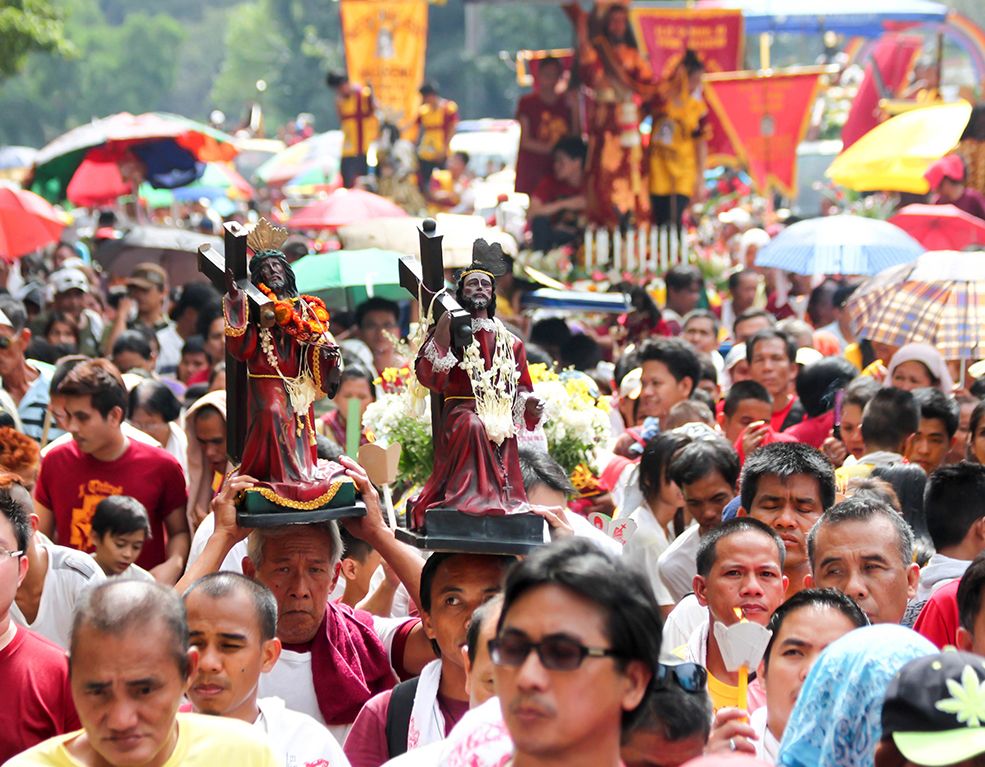
Every Friday is dedicated to the Nazarene where the devotees flock for the Holy Mass and novena. But the greatest events are when the statue is brought out of the church for a procession: on January 9, which is the feast of the parish, and every Good Friday. In the procession, devotees also carry their own statues of the Nazarene. Various chapters display their standards.

AN ORGANIZED CHAOS
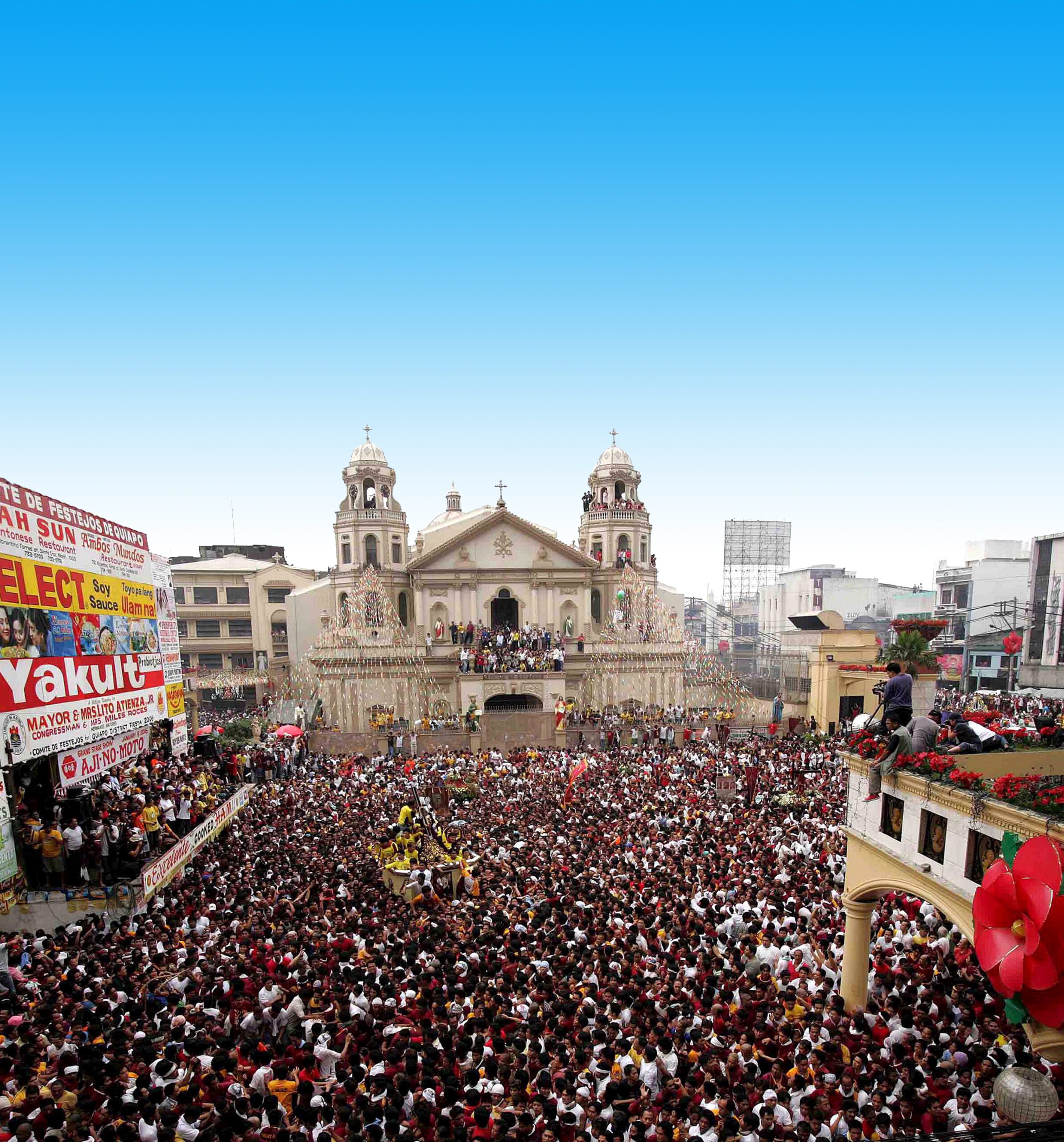
To outsiders the procession looks like an organized chaos where men shout and vie for the privilege of holding the two long ropes that pull the carroza that carries the statue and of having their towels wiped on the statue. Because hands or necks can get entangled in the rope, somebody riding on the carriage tries to foresee possible dangers. When he sees one, he shouts, “Eight!” That means the procession has to stop to check the rope that is getting looped and needing to be pulled taut before anybody gets hurt. During such stops, some women in pants and T-shirts do manage to worm into the crowd and are able to touch the statue.

Devotees go barefoot as a sign of humility, love and respect for the Lord. But there is another reason; besides removing their shoes, participants remove watches, rings and other sharp objects that may hurt the next devotee in this body-to-body procession.

THE EXAMPLE OF ST. PAUL
While Church authorities have not been able to stem practices of the procession, the people have been able to impose their practices and beliefs − this is analogous to the Church authorities’ negative stand against the live crucifixions in Pampanga, a practice that continues. After every Black Nazarene procession, devotees mention their sense of release, that having passed the “struggle” gives them a sense of pleasure.

One aspect of the devotion is to have their towels touch the statue. This is based on the belief that divine power lies immanent in the statue. Like the woman who was cured of hemorrhage in the Gospel (Lk. 8:43-48) by touching the hem of Christ’s robe, devotees attribute cures to touching the icon with bare hands or with a towel. The same can be said of St. Paul: “God was performing unusual miracles through Paul. Even handkerchiefs and aprons he had used were taken to the sick and their diseases were driven away, and evil spirits would go out of them” (Acts 19:11-12).

A SOURCE OF FAITH
If Christ is the truth (Jn. 14:6), He did not primarily mean truth as propositions. He embodies the truth. For many saints like St. Thomas Aquinas, the best textbook is the crucifix. Likewise for the Filipino, meditating on the icon, feeling the Nazarene speaking to the devotees, arouse their faith and commitment.

As the procession winds through the narrow streets, thousands of devotees wait eagerly for its arrival. When the statue appears, the crowd roars and wave their handkerchiefs and towels in greeting. They speak of the Nazarene as alive; they say “dumating na ba Siya?” (meaning, “has He arrived?”). If there is transubstantiation in the Eucharist, perhaps this is the counterpart: the wooden image “becomes” a live person through the eyes of faith.

WITHOUT DISTINCTIONS
The followers come from all walks of life. Philippine Vice-President Noli de Castro, also a devotee, never misses to attend the yearly procession. The devotees come from a wide range of occupations, ages, educational backgrounds. They are street-sweepers or highly paid surgeons, school teachers or office workers, city people or people from the barrios. The devotion erases all social distinctions.

While devotees may have temporary commitments, there are more permanent communities in the circle of the confraternity (cofradia) members. Among them are the Hijos del Nazareno and Mga Devoto ng Nazareno. The members are presumed to have made their individual panata (vows) of serving the Nazareno. Applicants fill out a form and pay a small registration fee and monthly fee which guarantees them a health and death insurance. After giving sixty hours of service, which include running church-related activities, they become full-fledged members.

THE PEACEMAKER
In addition to observing the Ten Commandments and what the Church requires of them, members of confraternities pledge to wear their uniforms. They must not quarrel with each other. Differences between them are settled before their meetings end.

Drinking alcohol is also forbidden. But should they be constrained to drink with a group, they must first remove their uniform in order not to sully its reputation. Their duties include establishing order during masses inside the church, and more specially during the two annual processions. They attend their regular monthly meetings. They also have their regular formation, handled by the parish priest or his assistants.

When a seven-year-old boy was asked why he wore the maroon-colored T-shirt of the Black Nazarene, he said that when his mother got sick, he prayed to the Nazarene. His prayers were answered. Out of thanksgiving, he promised that he will always visit the Quiapo Church and continue his devotion to the Black Nazarene. And such popular piety will continue among Filipinos.

Share Your Thoughts

All comments are moderated

From The Same Issue

The articles and content about this issue

From The Same Issue

The articles and content about this issue

From This Topic

The articles and content about this topic

From This Topic

The articles and content about this topic

Explore Other Topics

Browse other coverage

Explore Other Topics

Browse other coverage

WM SPECIAL

Presents, discusses and draws readers to reflect on issues of outmost relevance to the world today.


FRONTIERS

Very often, mission is carried out in frontier situations around the world. Those who embrace these situations have much to share.


UNITY IN DIVERSITY

Writer Ilsa Reyes will be exploring the richness of Pope Francis’s latest encyclical Fratelli Tutti with a view of helping our readers to get a grasp of the this beautiful papal document.


FRONTLINE

Puts to the front committed and inspiring people around the world who embrace humanitarian and religious causes with altruism and passion.


IN FOCUS

Focus on a given theme of interest touching upon social, economic and religious issues.


FAITH@50

As the Philippines prepares to celebrate 500 years of the arrival of Christianity. Fr. James Kroeger leads us in this series into a discovery journey of the landmark events in the history of faith in the Philippine archipelago.


INSIGHT

Aims to nurture and inspire our hearts and minds while pondering upon timely themes.


FILIPINO FOCUS

The large archipelago of the Philippines, in its richness of peoples and cultures, offers varied and challenging situations for mission.


FOLLOW ME

Reflections and vocation stories that shape up the lives of young people.


MISSION IS FUN

As humor and goodness of heart are qualities of Christian and missionary life, the new column “Mission is fun” will be publishing some anecdotes and stories that have happened in a missionary context to lighten up the spirits and trigger a smile in our faces.


LIVING COMMUNION

To help readers of World Mission live this year dedicated to Ecumenism, Interreligious Dialogue and Indigenous Peoples, Tita Puangco, writer and lecturer, shares in this section insights on the spirituality of communion.


WINDS OF THE SPIRIT

A historic view of the Catholic movements that emerged from the grassroots as an inspiration by the Holy Spirit.


BRIDGE BUILDERS

On the Year of Ecumenism, Interreligious Dialogue and Indigenous Peoples, radio host and communicator Ilsa Reyes, in her monthly column, encourages Christians and people of good will to be one with their fellow people of other sects, religions and tribes.


INTERVIEW

Questions to a personality of the Church or secular world on matters of interest that touch upon the lives of people.


WORLD TOUCH

News from the Church, the missionary world and environment that inform and form the consciences.


CARE OF THE EARTH

A feature on environmental issues that are affecting the whole world with the view of raising awareness and prompting action.


EDITORIAL

The editor gives his personal take on a given topic related to the life of the Church, the society or the world.


YOUNG HEART

A monthly column on themes touching the lives of young people in the Year of the Youth in the Philippines by radio host and communicator I lsa Reyes.


SCROLL

A missionary living in the Chinese world shares his life-experiences made up of challenges and joyous encounters with common people.


EXTRAORDINARY PEOPLE

Life stories of people who deserve to be known for who they were, what they did and what they stood for in their journey on earth.


ONE BY ONE

Stories of people whom a missionary met in his life and who were touched by Jesus in mysterious ways.


INCREASE OUR FAITH

Critical reflection from a Christian perspective on current issues.


SPECIAL MOMENTS

Comboni missionary Fr. Lorenzo Carraro makes a journey through history pinpointing landmark events that changed the course of humanity.


PROFILE

A biographical sketch of a public person, known for his/her influence in the society and in the Church, showing an exemplary commitment to the service of others.


WM REPORTS

Gives fresh, truthful, and comprehensive information on issues that are of concern to all.


LIFE'S ESSENTIALS

A column aimed at helping the readers live their Christian mission by focusing on what is essential in life and what it entails.


ASIAN FOCUS

Peoples, events, religion, culture and the society of Asia in focus.


THE SEARCHER'S PATH

The human heart always searches for greatness in God’s eyes, treading the path to the fullness of life - no matter what it takes.


INDIAN FOCUS

The subcontinent of India with its richness and variety of cultures and religions is given center stage.


AFRICAN FOCUS

The African continent in focus where Christianity is growing the fastest in the world.


JOURNEY MOMENTS

Well-known writer and public speaker, Fr. Jerry Orbos, accompanies our journey of life and faith with moments of wit and inspiration based on the biblical and human wisdom.


IGNATIUS STEPS

On the year dedicated to St. Ignatius of Loyala, Fr. Lorenzo Carraro walks us through the main themes of the Ignatian spirituality.


THE SEVEN LAST WORDS OF JESUS

Fr. John Taneburgo helps us to meditate every month on each of the Seven Last Words that Jesus uttered from the cross.


INSIDE THE HOLY BOOK

In this section, Fr. Lorenzo delves into the secrets and depths of the Sacred Scriptures opening for us the treasures of the Sacred Book so that the reader may delight in the knowledge of the Word of God.


CONVERSATIONS

Reflections about the synodal journey on a conversational and informal style to trigger reflection and sharing about the synodal path the Church has embarked upon.


VATICAN II

This 'mini-course' series provides a comprehensive exploration of Vatican II, tracing its origins, key moments, and transformative impact on the Catholic Church.


COMBONIS IN ASIA

This series offers an in-depth look at the Comboni Missionaries in Asia, highlighting their communities, apostolates, and the unique priorities guiding their mission. The articles provide insights into the challenges, triumphs, and the enduring values that define the Comboni presence in Asia.


BEYOND THE SYNOD

Following the Synod on Synodality, this series examines how dioceses, parishes, and lay organizations in the Philippines are interpreting and applying the principles of the synod, the challenges encountered, and the diverse voices shaping the synodal journey toward a renewed Church.


A TASTE OF TRADITION

This series introduces the Fathers of the Church, featuring the most prominent figures from the early centuries of Christianity. Each article explores the lives, teachings, and enduring influence of these foundational thinkers, highlighting their contributions the spiritual heritage of the Church.


A YEAR OF PRAYER

In preparation for the 2025 Jubilee Year under the theme “Pilgrims of Hope,” 2024 has been designated a Year of Prayer. World Mission (courtesy of Aleteia) publishes every month a prayer by a saint to help our readers grow in the spirit of prayer in preparation for the Jubilee Year.


OUR WORLD

In Our World, the author explores the main trends shaping contemporary humanity from a critical and ethical perspective. Each article examines pressing issues such as technological advancement, environmental crises, social justice, and shifting cultural values, inviting readers to reflect on the moral implications and challenges of our rapidly changing world.


CATHOLIC SOCIAL DOCTRINE

This series unpacks the principles of Catholic Social Doctrine, offering a deep dive into the Church's teachings on social justice, human dignity, and the common good.


HOPEFUL LIVING

Hopeful Living’ is the new section for 2026, authored by Fr. James Kroeger, who dedicated most of his missionary life to the Philippines. In this monthly contribution, he will explore various aspects of the virtue of hope. His aim is to help readers align their Christian lives more closely with a hopeful outlook.


PHILIPPINE CROSSROADS

Filipino Catholic scholar Jose Bautista writes each month about how the Philippines is at a crossroads, considering the recent flood control issues and other corruption scandals that have engulfed the nation. He incorporates the Church’s response and its moral perspective regarding these social challenges.


BIBLE QUIZ

Test your knowledge and deepen your understanding with our Bible Quiz! Each quiz offers fun and challenging questions that explore key stories, themes, and figures from both the Old and New Testaments.


Shopping Cart