

Thomas Merton has been one of my teachers. When I entered the Jesuits, I was on fire with a desire to pursue the life of peace and justice. I started to study the writings of the great peacemakers, such as Gandhi, Martin Luther King, Dorothy Day, the Berrigans and, from day one, Thomas Merton. I’ve been reading Merton ever since. I think I’ve read everything he’s published, and I’m amazed how he still speaks to me. In contrast to the culture, to the TV, to the president, even the whole world, Merton remains a voice of sanity and reason and faith and clarity and hope, and I can’t put him down. The great theologian David Tracy recently said spontaneously, when asked what the future of theology in the U.S. would look like: “For the next 200 years, we’ll be trying to catch up with Merton.”
In 1989, I visited the Abbey of Gethsemani, for the first time, and became friends with Bro. Patrick Hart. Later, when I was in prison for nearly a year for a plowshares disarmament action, Brother Patrick wrote that Gethsemani wanted to support me, and he offered to let me stay for a while in Merton’s hermitage. It was one of the greatest blessings of my life to live and pray there. Over the years, Merton has helped me not only in my work for peace but in keeping me in religious life and the Church because whenever I get in trouble for working for peace and justice, or whenever I get discouraged about the Church or religious life, I recall how much trouble Merton was in for writing about war, racism, nuclear weapons and monasticism, how he stayed put, remained faithful, did what he could, said his prayers and carried on. I would like to share five simple callings that I have learned from Thomas Merton:
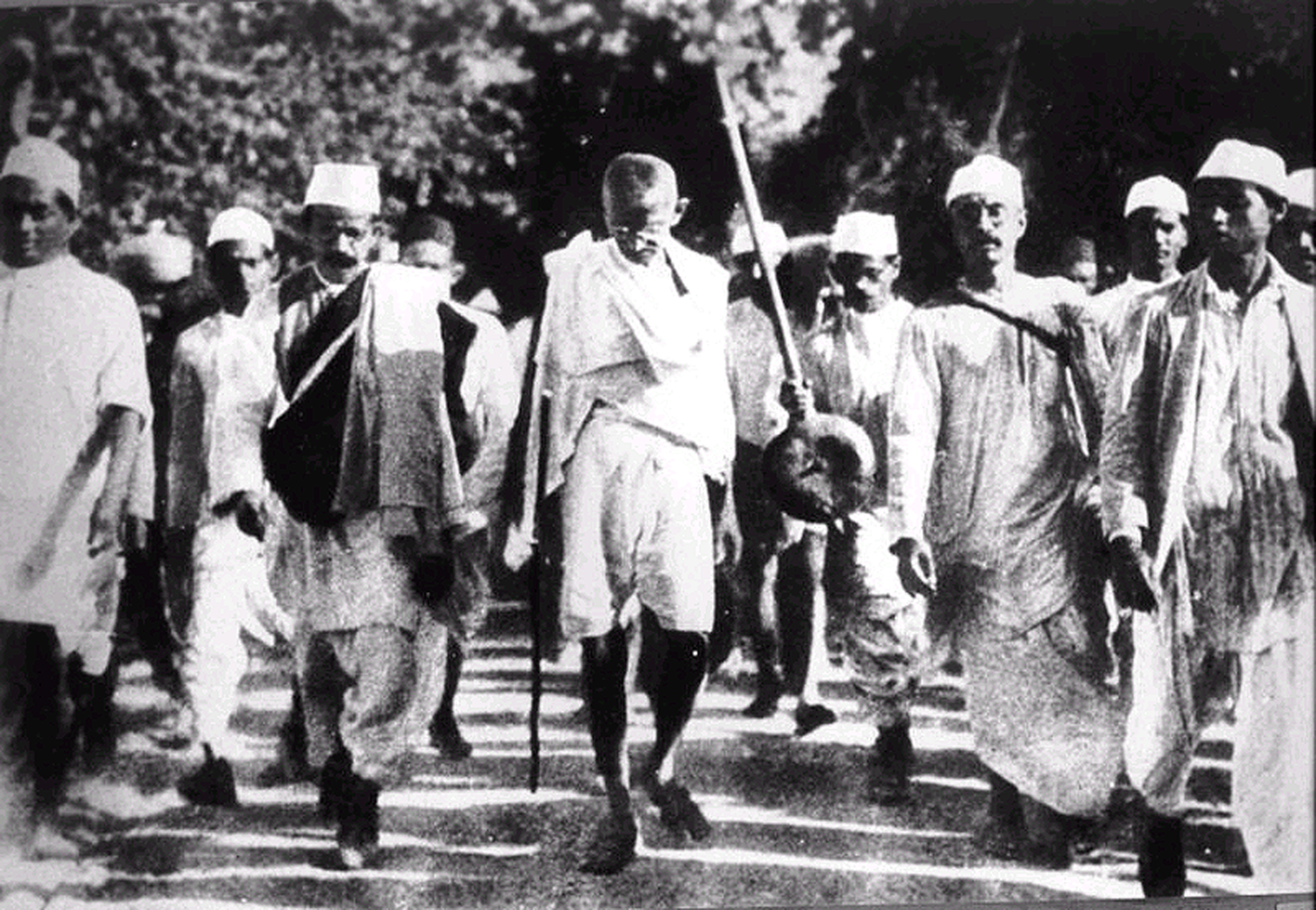
To become contemplatives, mystics, of nonviolence. Merton knew that prayer, contemplation, meditation, adoration and communion mean entering into the presence of the God of peace, dwelling in the nonviolence of Jesus, that, in other words, spiritual life begins with contemplative nonviolence, that every one of us is called to be a mystic of nonviolence. So in prayer, we turn to the God of peace, we enter the presence of the One who loves us and who disarms our hearts of our inner violence and transforms us into people of Gospel nonviolence and then sends us on a mission of disarming love and creative nonviolence. We learn to give God our inner violence and resentments, to grant clemency and forgiveness to everyone who hurts us; to move from anger and revenge and violence to compassion, mercy and nonviolence so that we radiate personally the peace we seek politically. In the end, as Merton knew, peace is a gift from God. “The chief difference between violence and nonviolence,” Merton writes, “is that violence depends entirely on its own calculations. Nonviolence depends entirely on God and God’s word.” When Jesus calls us to love our enemies, he said we should do so because God does so. God let’s the sun shine on the just and the unjust, and the rain fall on the good and the bad. God is compassionate to everyone, and we should be too. This is the heart of contemplative nonviolence. Then we are able to see everyone as a human being, and to see God and become like God. As we begin to imagine the peace and nonviolence of God, we learn to worship the God of peace and nonviolence; and in the process, become people of peace and nonviolence.” On his way to Asia, Merton told David Stendl-Rast that “the only way beyond the traps of Catholicism is Buddhism.” In other words, every Catholic has to become a good Buddhist, to become as compassionate as possible, he said. “I am going to become the best Buddhist I can, so I can become a good Catholic.” That is the wisdom of Merton’s contemplative life, to become like Buddhists, people of profound compassion, deep contemplative nonviolence. That is what he discovered when he wrote: “Everything is emptiness and everything is compassion.” This is what Merton meant when he wrote about Gandhi: “Gandhi’s nonviolence was not simply a political tactic which was supremely useful and efficacious in liberating his people. On the contrary, the spirit of nonviolence sprang from an inner realization of spiritual unity in himself. The whole Gandhian concept of nonviolent action and satyagraha is incomprehensible if it is thought to be a means of achieving unity rather than as the fruit of inner unity already achieved.”
To become students and teachers of nonviolence. Merton was not just a great teacher, but the eternal student. He was always studying, always learning, always searching for the truth. The lesson starts off with the basic truth: Violence doesn’t work. War doesn’t work. Violence, in response to violence, always leads to further violence. As Jesus said, “Those who live by the sword, will die by the sword.” Those who live by the bomb, the gun, the nuclear weapon, will die by bombs, guns and nuclear weapons. You reap what you sow. The means are the ends. What goes around comes around. War cannot stop terrorism because war is terrorism. War only sows the seeds for future wars. War can never lead to lasting peace or true security or a better world or overcome evil or teach us how to be human or as Merton insists, deepen the spiritual life. Underneath this culture of war and injustice is a sophisticated spirituality of violence, a spirituality of war, a spirituality of empire, a spirituality of injustice that has nothing to do with the living God or the Gospel of Jesus. In this false spirituality, we believe violence saves us, war brings peace, might makes right, nuclear weapons are our only security, God blesses wars, we seek not forgiveness and reconciliation but victory and domination, and the good news is not the love of enemies but the elimination of enemies. It’s heresy, blasphemy and idolatry. The empire always tries to instruct the church on sin and morality, telling us that certain personal behavior is sinful or immoral, while saying nothing about the murder of 130,000 Iraqis in recent years, as if that were not sinful or immoral. The empire wants the Church to be indifferent and passive; to be divided and fighting and silent, even to bless wars and injustice. “The God of peace is never glorified by human violence,” Merton wrote. In other words, peaceful means are the only way to a peaceful future and the God of peace. Merton concludes: “What is important in nonviolence is the contemplative truth that is not seen. The radical truth of reality is that we are all one.” Merton’s nonviolence begins with the vision of a reconciled humanity, the truth that all life is sacred, that we are all equal sisters and brothers, all children of the God of peace, already reconciled, all already united, and so, we could never hurt or kill another human being, much less remain silent while our country wages war, builds nuclear weapons, and allows others to starve. I learned, like Merton, that all the major religions are rooted in nonviolence. Islam means peace. Judaism upholds the magnificent vision of shalom, where people beat swords into plowshares and study war no more. Gandhi exemplified Hinduism as active nonviolence. Buddhism is all about compassion toward all living beings.
To become apostles of nonviolence. In Merton’s famous article for Dorothy Day and The Catholic Worker, he wrote: “The duty of the Christian in this time of crisis is to strive with all our power and intelligence, with our faith and hope in Christ, and love for God and humanity, to do the one task which God has imposed upon us in the world today. That task is to work for the total abolition of war. There can be no question that, unless war is abolished, the world will remain constantly in a state of madness and desperation in which, because of the immense destructive power of modern weapons, the danger of catastrophe will be imminent and probable at every moment everywhere. The Church must lead the way on the road to the nonviolent settlement of difficulties and toward the gradual abolition of war as the way of settling international or civil disputes. Christians must become active in every possible way, mobilizing all their resources for the fight against war. Peace is to be preached and nonviolence is to be explained and practiced. We may never succeed in this campaign but whether we succeed or not, the duty is evident.” Today, there are 35 wars currently being fought, with our country (USA) involved in every one of them. According to the United Nations, some 50,000 people die every day of starvation. Nearly two billion people suffer in poverty and misery. We live in the midst of structured, systemic, institutionalization of violence which kills people through war and poverty. From this global system comes a litany of violence — from executions, sexism, racism, violence against children, violence against women, guns, abortion, and the destruction of environment, including the ozone layer, the rain forests, and our oceans. Since 2003, we have killed over 135,000 Iraqis. But on August 6, 1945, we crossed the line in this addiction to violence and vaporized 130,000 people in Hiroshima and another 70,000 people, three days later in Nagasaki. Today, we have some 25,000 nuclear weapons with no movement toward dismantling them; instead, we increase our budget for killing and send nuclear weapons and radioactive materials into outer space. We put missile shields around the planet, and plan even greater nukes. On the first page of his book, Peace in the Post Christian Era, which was suppressed until its recently publication by Orbis Books, Merton writes: “Never was opposition to war more urgent and more necessary than now. Never was religious protest so badly needed.”
To become visionaries of nonviolence. One of the many casualties of the culture of war is the imagination. People can no longer imagine a world without war or nuclear weapons or violence or poverty. They can’t even imagine it, because the culture has robbed us of our imaginations. We live in a time of terrible blindness, moral blindness, spiritual blindness, the blindness that will lead us over the brink of global destruction. Our mission is to uphold the vision of nonviolence, like Merton, to point the way forward, the way out of our madness, to lift up the light, to lead us away from the brink. We need to be the community of faith and conscience and nonviolence that lifts up the vision of peace, to help others imagine a world without war or nuclear weapons, the vision that teaches us to resist our country’s wars and nuclear arsenal. Like Merton, we all need to become new abolitionists who imagine a world without war, poverty or nuclear weapons.
To become prophets of nonviolence. Here is one of my favorite Merton quotes: “It is my intention to make my entire life a rejection of, a protest against the crimes and injustices of war and political tyranny which threaten to destroy the whole human race and the whole world. By my monastic life and vows I am saying NO to all the concentration camps, the bombardments, the staged political trials, the murders, the racial injustices, the violence and nuclear weapons. If I say NO to all these forces, I also say YES to all that is good in the world and in humanity.” I think that just as Merton learned to make his life a rejection of war by speaking out for peace, we must do the same thing and make our entire lives a rejection, a protest against the crimes and injustices and wars and nuclear weapons of our country and so become prophets of nonviolence to the culture of violence. Merton teaches us to break through the culture of war and denounce the false spirituality of violence and speak the truth of peace. He wrote to Jean LeClerc that the work of the monastery is “not survival but prophecy,” in the biblical sense, to speak truth to power, to speak God’s word of peace to the world of war, to speak of God’s reign of nonviolence, to the anti-reign of violence. I think that’s our task too — not survival, but prophecy. And to Daniel Berrigan: “If one reads the prophets with ears and eyes open, then you cannot help recognizing our obligation to shout very loud about God’s will, God’s truth, and God’s justice.”
I’m sure Merton would have something to say about everything that is happening in the world today, in this whole culture of war. So like Merton the prophet, our job is to call for an end to war, starvation, violence and nuclear weapons, to say, bring the troops home, end the U.S. occupation of Iraq, cut off all military aid to the Middle East and help the U.N. pursue nonviolent alternatives to this crisis. If we cared about the possibility of Iraq having one part of a weapon of mass destruction, we would dismantle our 20,000 weapons of mass destruction. This war is all about the control of Iraq’s oil fields, at any price, to gain financial control of the world economy. We bombed every single major building in Baghdad except for the Ministry of Oil. We have an imperial economy based entirely on oil and weapons, and to maintain this empire, we have to wage war and wars require the blood of children, the blood of Christ.
You and I have to become, like Merton, the voice of the voiceless, the voice of sanity and peace. “I am on the side of the people who are being burned, bombed, cut to pieces, tortured, held as hostages, gassed, ruined and destroyed,” Merton wrote in the 1960s (protesting against war in Vietnam). “They are the victims of both sides. To take sides with massive power is to take sides against the innocent. The side I take is the side of the people who are sick of war and who want peace, who want to rebuild their lives and their countries and the world.” Like Merton, I think we too have to take sides. We have to side with the poor and the children, with the innocent, with our enemies, and be like Christ, who took sides when he said: “Whatever you do to the least of these, you do to me.” Merton concludes his great essay, Blessed are the Meek on the roots of Christian nonviolence, by talking about hope, saying our work for peace and justice is not based on the hope for results or the delusions of violence or the false security of this world, but in Christ. Our hope is in the God of peace, in the resurrection.
I looked up Merton’s concluding advice to Daniel Berrigan in one of his letters, and thought we could all take heart from Merton’s encouragement: “You are going to do a great deal of good simply stating facts quietly and telling the truth,” Merton wrote to Dan. “The real job is to lay the groundwork for a deep change of heart on the part of the whole nation so that one day it can really go through the metanoia (life conversion) we need for a peaceful world. So do not be discouraged. Do not let yourself get frustrated. The Holy Spirit is not asleep. Keep your chin up.” www.johndear.org
Excerpts from a 2005 conference on Thomas Merton, adapted and edited by World Mission.