The pastoral letter of Pope Benedict XVI to the Catholic Church in China, published on June 30, is remarkable and historic for its content and style. The Pope speaks like a father to the Chinese Catholics and with respect to Chinese authorities, and he puts forward clear principles to both of them. In carefully chosen words, he expresses his understanding of the sufferings of the “underground community,” which refuses to cooperate with the government, but also for the “official community” and for its decision to cooperate. He expresses some fundamental theological principles asking both communities to reconcile, and he calls on civil authorities to enter into dialogue beyond the misunderstandings of the past.
The letter is remarkable for its content because it gives a clear answer to the burning pastoral questions that have divided the Chinese Church internally for 20 years. Only Rome can clarify the confusing discussions of the past. I understand the meaning of the Pope’s letter as follows:
There is only one Chinese Catholic Church and it is faithful to the Holy See. Bishops and priests of both communities may concelebrate, but the Pope encourages them first to express among themselves their unity by a profession of faith. For the Church to live underground is not a normal situation. There is at present no longer any reason to keep an underground Church community going in China. The Pope, therefore, revokes all privileges that were conferred to China’s underground community in the past. Chinese faithful may also take part in the Eucharist of priests of the official Church community.
The Pope expresses these pastoral guidelines after he, in the first part of his 26-page text (English version), exposes at length some basic theological principles on the communion of particular Churches with the universal Church, reconciliation, and the need for dialogue and cooperation in charity and truth between Church and state, while giving to God and to Caesar, respectively, what belongs to each.
ONLY ONE CHURCH
The Pope promised in January that he would write a letter to the Catholic Church in China. Since then, they awaited this letter impatiently, and so did civil authorities. There was even some tension. All planned ordinations and other important Church activities were postponed “until after the letter of the Pope,” even if it was not said in just those words. The causes of this uncertainty in China were calls expressed outside the mainland for confrontation with Chinese authorities, as well as last year’s illicit episcopal ordinations in China at which Chinese bishops recognized by Rome had been forced to participate. Everybody wondered: will the Pope’s letter threaten to apply canonical sanctions for illicit ordinations that may happen in the future? Or will the letter, instead, be a friendly, though urgent, call for unity and dialogue?
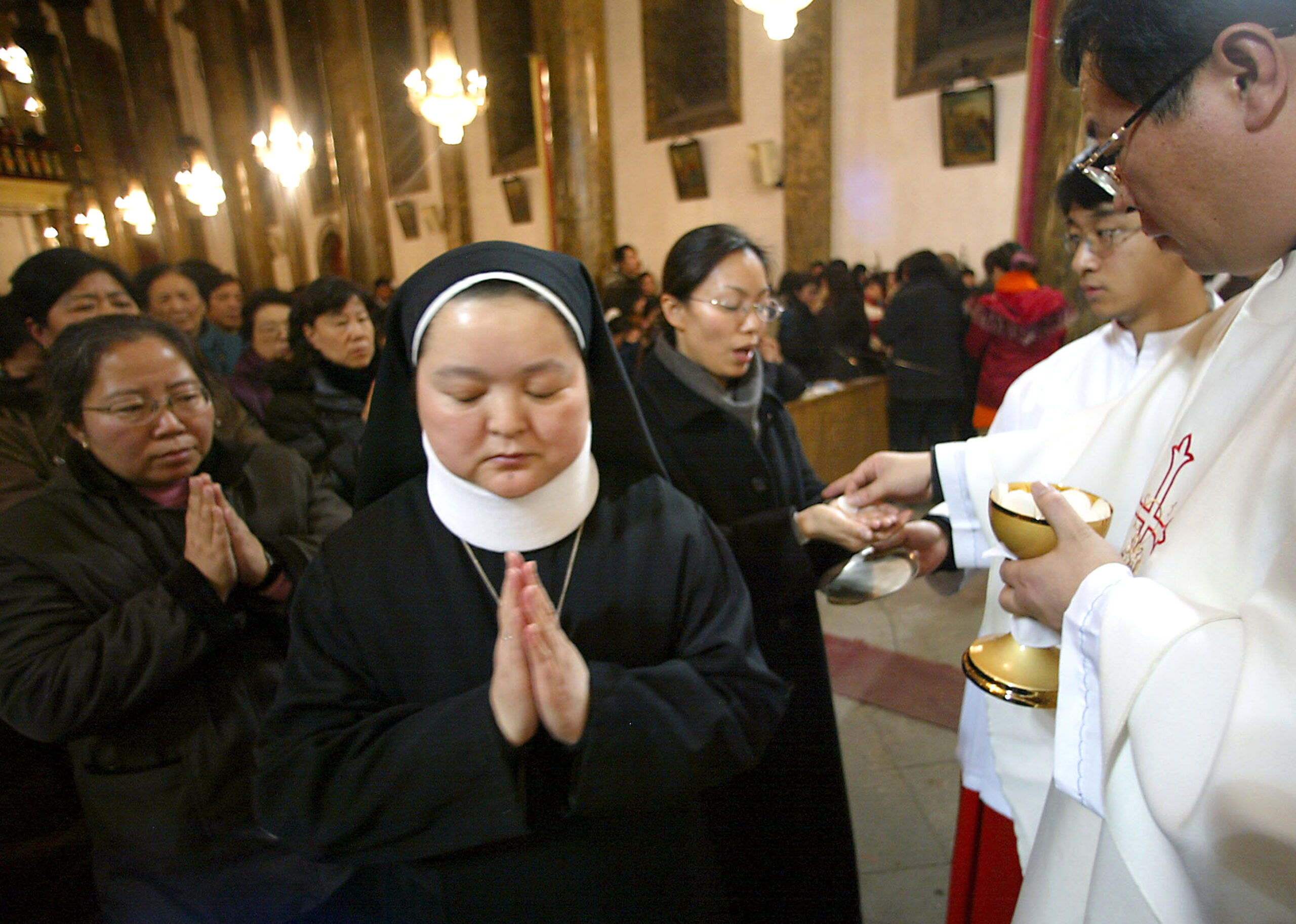
The large majority of Catholics in remote places in China’s countryside had other concerns. The vital question for them has existed for decades: yes or no, may we participate in the Eucharistic celebration of the “open” (official) Church communities? Do we commit a mortal sin if we do, as we were taught? So much confusion has been caused by what was said, preached and written about these questions that only the highest Church authority could give a clear answer. This is what happened in the pastoral letter. The Pope says there: only one Catholic Church exists in China. Let Chinese Catholics peacefully celebrate the Eucharist together.
ALL BISHOPS SHOULD UNITE
But there is more in the letter. The Pope admonishes the official bishops appointed by the Holy See to make their appointment public. They apparently did not make that sufficiently clear in the past. The Pope does not speak a warning language to bishops ordained without papal appointment, but he does ask them to clarify their relation to the successor of Peter now. Underground bishops are encouraged to apply for recognition by civil authorities. An underground Church “is not a normal feature of the Church’s life” for the Catholic Church, says the Pope. All bishops should now unite so that Rome can finally recognize officially the already existing Chinese Bishops’ Conference. This could not be done until now because the underground bishops are not members, while some other members of the conference are not appointed by Rome.
The pastoral letter touches here upon an extremely delicate point related to Church-state relations. It suggests that the present statutes of the Chinese Bishops’ Conference still need to be amended. In the present situation, one entity “desired by the State” − apparently referring to the Patriotic Association − stands above the bishops and makes important pastoral decisions, some even related to the appointment of bishops. Doing so, it in fact directs the Church. This situation takes the pastoral authority away from the bishops, which is against Catholic teaching: “Only a legitimate Episcopal Conference can formulate pastoral guidelines, valid for the entire Catholic community of the country concerned.”
TRUE RELIGIOUS FREEDOM
The pastoral letter contains more concrete pastoral guidelines than many of us may have anticipated. But they are all important, useful guidelines urgently needed in the Chinese local Church and they are included in Canon Law. Priests are reminded that they should be incardinated in one clearly defined diocese. Dioceses that have a limited number of priests and experience difficulty in finding a suitable candidate-bishop are encouraged to ask neighboring bishops to help find alternative candidates. Bishops are reminded to set up structures required in their dioceses to promote cooperation and dialogue in pastoral work, such as: diocesan curia, presbyteral council, college of consultors, diocesan pastoral council and financial commission. The letter even refers to the importance of registering Church properties in the name of the Church, not of individuals. It all shows how well the Holy See is informed about and concerned with the concrete needs of the Church in China.
The Pope pleads for the principle of separation between Church and state, a relation in charity and truth to be realized through open dialogue. However, he introduces some points that, from the side of the Church, are not discussable. The proposal to set up a Church independent from the Holy See is incompatible with Catholic doctrine. The principle that bishops must be appointed by the successor of Peter is crucial for the Church, since only appointments by the Pope assure the unity of the Church and the apostolic succession of bishops. These appointments have no political character at all. The Pope refers to internationally accepted documents that state the appointment of Catholic bishops by the Pope is part of true freedom of religion.
A NEW BEGINNING
For some readers, the letter may create the impression of being “too clear” and “too explicit,” leaving nothing to be discussed and clarified in the dialogue with diplomats. This is the opinion of some friends in China who stress that in China one should leave some things to be cleared up by private bargaining. But here, too, the problem is that years of discussion have created confusion around matters of principle that are crucial for the Church. Just as pastoral guidelines were urgently needed for the Chinese Church, so too is there need to make clear what is and is not discussable with regard to relations of the Church with the state.
Some people would have criticized the Pope if he did not clarify these points. But he repeatedly expresses his hope and trust that, through dialogue, all these questions can be clarified and agreed upon. As a concrete example, the Pope cites the new division of dioceses that civil authorities introduced over the past 50 years but never previously agreed upon with Rome. The Pope says this can be discussed whenever opportune and helpful.
This is the beginning of a new phase in the history of the Chinese Catholic Church. Together with the letter in which Pope John Paul II offered excuses for what happened in the 19th century, this pastoral letter is undoubtedly the most important and historical document ever written by Rome to the Chinese Church. The key words are: reconciliation, unity and dialogue. Nowhere in this letter does the Pope call for confrontation
Marked by reconciliation and unity inside the Church and dialogue with civil authorities on the basis of equality and mutual respect, it initiates a new phase in Chinese Catholic Church history.
* Member of the Congregation of the Immaculate Heart of Mary (CICM) and director of Ferdinand Verbiest Institute at Catholic University of Leuven in Belgium. This commentary was written at the request of UCA News.