
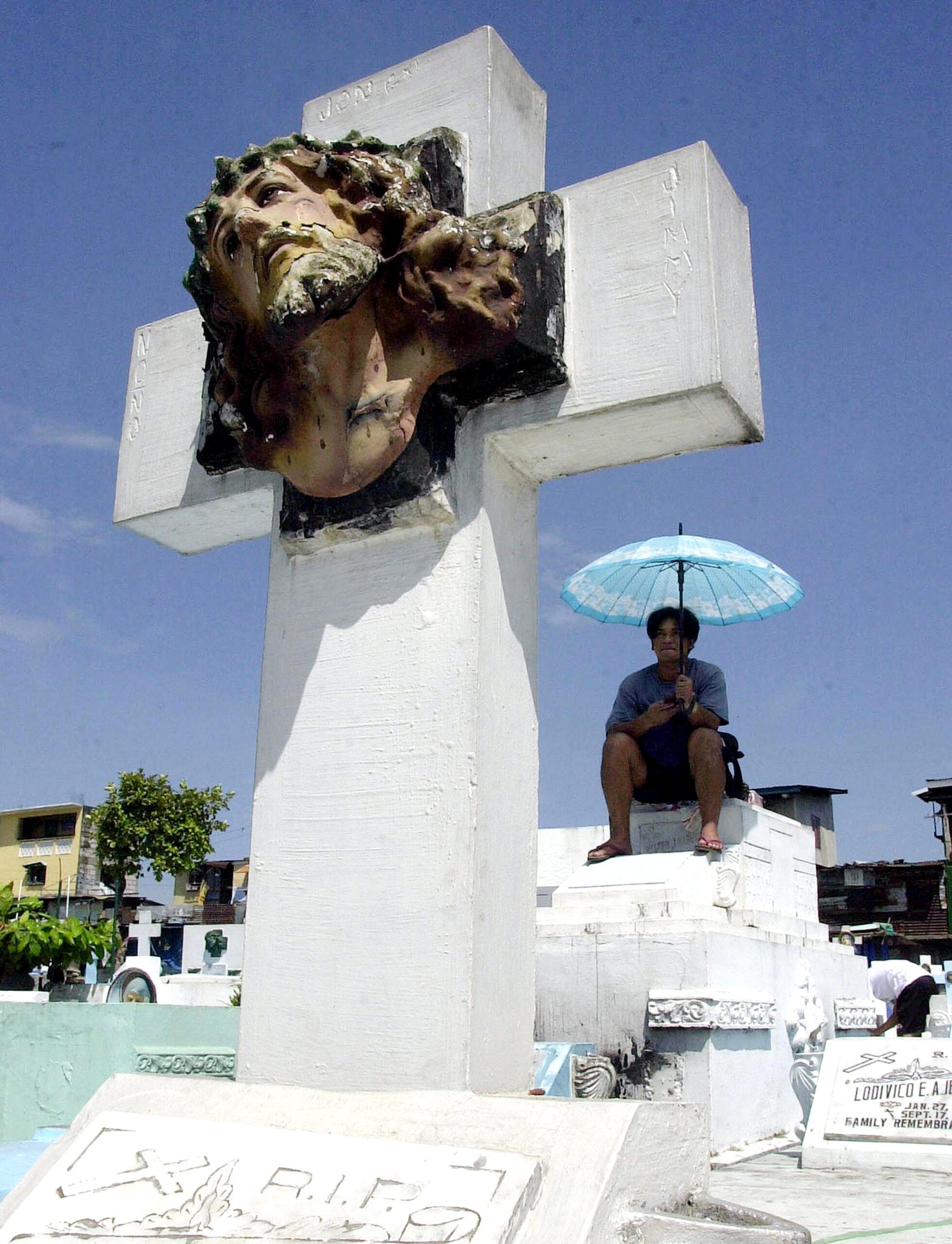
On November 1 or earlier, Filipinos throng to the cemeteries to visit their departed. The place is aglow with candles and electric lights and awash with flowers. The occasion becomes a picnic, complete with meals, even with the comforts of home such as radio and TV and taped music. Many of the relatives camp in the cemeteries and even spend the whole night to pray and to commune with the departed. The Fiesta ng mga Patay (Feast of the Dead) may strike non-Filipinos as odd. But we find similar practices in Mexico and Southeast Asian countries like China and Thailand and elsewhere in the world.
The Fiesta ng mga Patay is an extension of the wake. The wake is one of several occasions for family reunion. Why should struggling Overseas Contract Workers spend precious cash to attend the funeral of their loved ones at home? Is it not better to remit the money than to spend it in “useless” travel and the almost “obligatory” gifts (pasalubong)? This question often comes from non-Filipino observers who are amazed at the phenomenon. But wakes are like obligatory family reunions. Their values dictate it. That is why the wake has often to be extended in order to wait for relatives abroad to travel back home.
THE SPIRITS ARE REAL
When I attended my late brother’s wake in Richmond, Virginia, I could only see his body on the schedule allowed by the funeral parlor. But such is not the case in the Philippines where one can visit the body lying in state all around the clock. The mourners keep themselves awake by amusements like playing mahjongg and card games. Wakes are also accompanied with eating and drinking. In earlier times, they were likewise social occasions for single boys to meet girls.
Greek philosophy distinguishes the soul from the body, which corresponds to the split between the spiritual and the physical. The Filipino counterpart of the said distinction is the seen and the unseen. The unseen spirits for Filipinos are as real as the seen and therefore are “natural.” Because Filipinos believe that the unseen spirits can be hurt or even get wet. Filipinos say “tabi po” (please excuse me) before throwing anything outside the window — even if nobody is around.
The Filipino social philosophy of being group-oriented extends to the departed. Because the departed relatives and the living are one, the departed are like the saints who will intercede (lakad) their petitions to God. If Filipinos in real life ask more exalted persons to be their negotiators, the departed seem to have that role. The feast, therefore, illustrates the Communion of Saints.
ADVICE AND COMMUNICATION
Advice and tarot. A friend of mine, an engineer, told me that when he has problems that need decisions, he goes to the tomb of his departed parents in the cemetery in order to ask for their advice. He says that he often gets the right answers. Outside the Quiapo church in Manila, many people consult the departed through the psychics outside the church. The psychics often use tarot cards.
The medium’s accusation. In Metro Manila, on the night of June 29, 1991 six young men entered a house of an eighteen-year old girl, Carmela Vizconde, then raped and murdered her, together with her mother and her sister. The father, Lauro Vizconde, was at a loss on who did it, not until he consulted a medium who invoked the departed during a séance. The departed allegedly revealed the identity of the culprits, including a look-out girl. But such evidence could not be valid in court. After four years, the girl, Jessica Alfaro, who was conscience — stricken, came out to reveal the truth in court. Her testimony in December 1995 led to the conviction of the six young men: they were scions of prominent rich families and the head was the son of a former senator.
Food as flowers. Whenever I am asked to bless the dead during funerals or celebrate Mass during death anniversaries, especially of the poor and ordinary people, I invariably notice that a plate of food lies before the picture of the departed. The Ilocano word for it is atang, or alay in Tagalog and halad in Cebuano. Once when traveling in Ilocos Sur, I chanced to see a bamboo staked beside a deserted road. On top was a small square plywood which contained a full meal, including basi (rice wine), cigarettes and matches. Food offering for the dead is not only Filipino but also Asian. One finds food offerings — especially fruits — in Buddhist temples. This is equivalent to flower offerings in the West. If the spirits “smell” the flowers, they also “eat” the essence of food offerings.
ALL SAINTS’ DAY
If November 2 is All Souls’ Day, why do most Filipinos go all out on November 1, which is All Saints’ Day? We see the same pattern in other instances. During town fiestas, the eve or bisperas is more elaborately celebrated than the fiesta day itself. Unlike the official liturgical year which emphasizes Advent as the preparation to Christmas, the same does not seem to be the case in the Philippines. While Christmas liturgically begins on the midnight of December 24, Christmas in the Philippines is more celebrated during the nine-day early dawn Novena Masses (Simbang Gabi) before Christmas and the climax is Christmas Eve. Christmas Day itself seems anti — climatic when most people take it easy or even sleep. The excitement of Simbang Gabi seems to have worn itself out on Christmas Day.
The foregoing examples indicate the Filipino philosophy of time, that is, being now-oriented and less tomorrow-oriented. In eschatology, we speak of the tension between the already and the not-yet. It seems Filipino time points more to the already or to the now and the present. If November 1 is All Saints’ Day, this is also the day for the non-canonized saints — their departed relatives and friends.