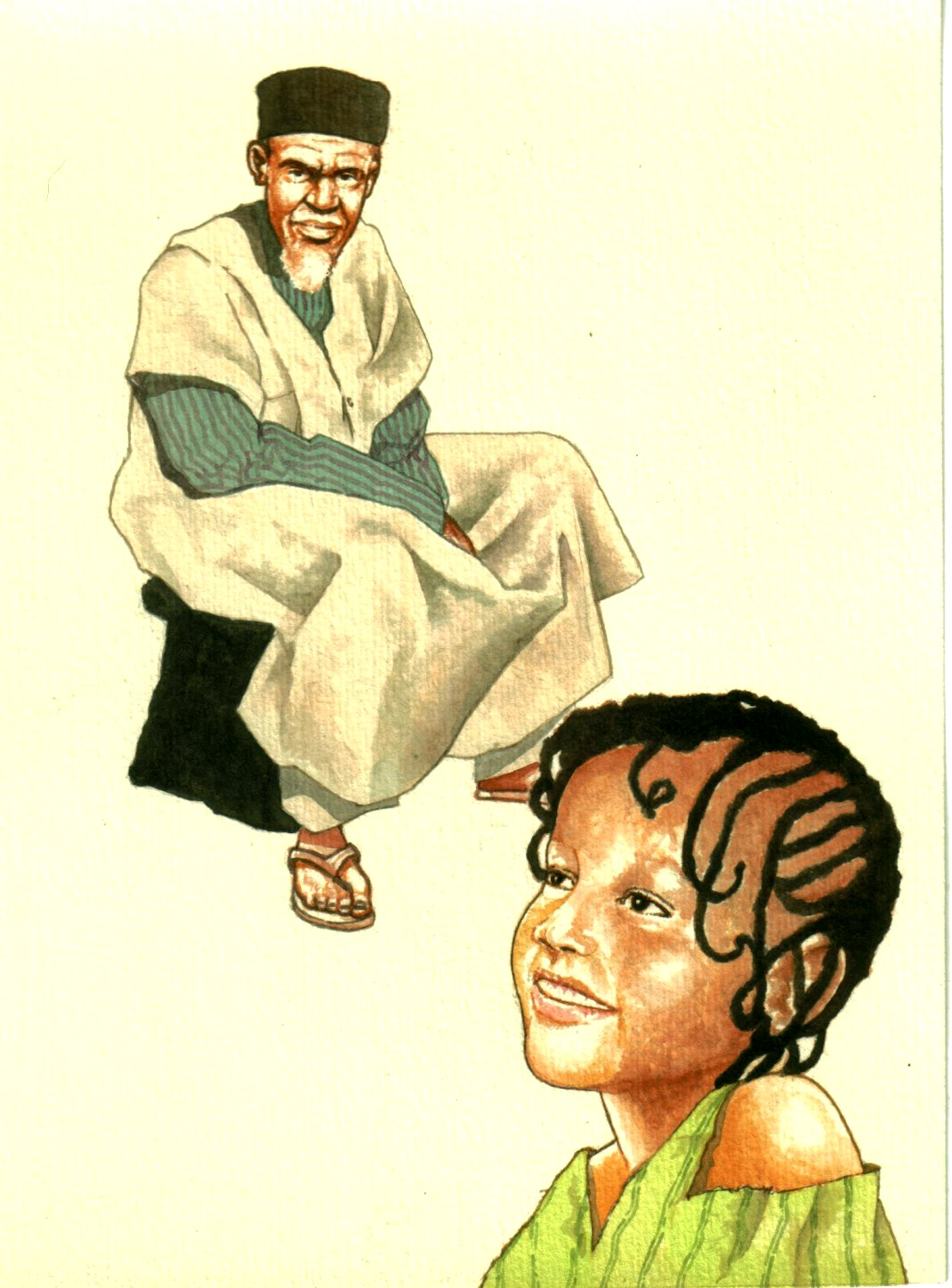
ABOUT YOUTH − One grows up only once (Kalenjin). You never know what a young man will be as an old man (Zande). Young people tend to be impatient. If the piglet asks its mother why her snout is so long, she will answer: “When you grow up, you will see that your snout will also be long (Ewé); An eagle cannot fly high if its wings are still frail (Oromo). This must be remembered when speaking of authority: Don’t give power to a young man (Zande). Life stages must be respected: Those who haven’t cut their teeth yet must be careful when coming to nuts (Banun); A hammer in the hands of a young man becomes a nut-cracker (Kongo); I shall not shout for joy before I have seen how you talk, what you do and how you hit (Somali). I shall put you to the test: The tree grows strong by holding out against the wind. Life is what you do when you are young: If you don’t sweat when young, you will beg when old (Ewé); The children you bore in your youth, the journeys you started early morning, will be your companions when night comes (Tigrigna); Go to the fields in the morning (Mondo). True, when the beard appears, youth disappears (Rwanda); Yet A wise old man is appreciated for his wisdom and not for his beard (Zande). When a young man says: Yesterday’s porridge is good for dogs (Popo), the generation war has started. Then The old woman you knew when young, ought to die when you grow up (Kiga), lest she reveals your youthful pranks. Youth must be lived: you cannot pretend the opposite. Whoever saw A monk dance and a young fellow stay at home? (Tigrigna). Where the girls are, the boys will go (Gbande). Youth and beauty go together, yet we cannot appreciate beauty if one misbehaves (Yoruba). Youth disappears: A tender leaf will not remain such for long (Ewé). What you do not do when you can, you will not do when you want; You don’t walk on four legs three times (Zulu): we are babies only once. We are all fools at the beginning, and then we grow wise with experience (Maasai). We cannot despise old people: Don’t soil the old spring: one day you will need it (Zande); Before starting to sing, the young bird will listen to the song of the old (Bechuana). To be really safe, Ask the advice of the old, and go to war with the young (Ethiopia).
ABOUT FRIENDS − If you have no friends, you are really poor (Somali). Friendship is spontaneous: Friendship is like mushrooms, you cannot force them (Luganda). Friendship is above every other human sentiment: A good company is better than a good meal (Luo). A friend would do the impossible: A real friend has tears for you, even if his eyes are lifeless (Rundi). Friendship is courteous: Don’t meet a friend without greeting him (Samburu). True friends must meet: To say “please, remember me to him” is not the same as meeting him (Rundi); Your feet will make you brothers (Ewé). Ties grow stronger when seeing each other: Friendship is like a track on the sand; it vanishes if not continuously re-done (Douala). Friendship is easier between people much alike: Rarely a weak person associates with a strong one (Luo); Rats and snakes do not agree (Ambede). How do we tell a true friend from a false one? Open your eyes! If you don’t choose your friends with care, you may be in for a big disappointment (Ewé): in fact, It may happen that the friend you cherish most, will make you sink (Logbara); Your killer is under your clothes (Swahili). We must learn to choose our friends: A devil you know is better than an angel you don’t know (Tigrigna); Pretend to be dead and see who will cry for you (Mongo); A friend is known in misfortune (Yoruba); Where food is free, many will come (Yoruba); Many friends may empty your pockets (Kikuyu). If you can, make some powerful friend: If you walk with an elephant, the dew will not bother you (Baoule). To kill a friend is easy, but to find another is a lot more difficult (Malinke). A sincere enemy is better than a false friend (Bambara). A friendship through the stomach will never die (Mongo), meaning that if you feed a hungry person, that person will never forget.
ABOUTH THIEVES − The weak point with robbers? They are never satisfied with their last robbery; they always hope to pull off a bigger one. The thief can lie and also kill (Gbande). There are more thieves than we believe to know, but The thief is the one who is caught (Sotho). Every thief has his lucky day (Swahili). But there is always a time when he makes the wrong move, and then he is caught: A monkey has missed the branch (Tonga); The goat has come back with a bruised foot (Bassari): it went to steal in a field and was caught in a trap. Bitter is somebody else’s wealth (Yaka); He who ate the hen, will sooner or later eat dung (Bemba). Yet it is not easy to discover a thief you don’t see in the face: There grows no grass on the thief’s nose (Ewé). A thief is like a mouse: you catch him with a trap (Ganda). Caught, the scoundrel tries to deny: “I am not eating Lokko’s corn, I am only smoking,” says the monkey (Oromo); If the thief is clever, how much more must be the one who has to discover him? (Kalenjin). A thief can detect the footmarks of another thief on a rock (Yoruba): use a thief to find a thief. A stealing dog must have a solid behind (Luyia): a thief must expect punishment. A town will have problems when the guard is the thieves’ leader (Yoruba). If you go on a robbing expedition, take a companion with you; later you may accuse him (Samburu). A thief does not speak ill of another thief (Oromo). Light is poison for the thieves (Logbara). Robbery does not make you an owner (Bemba): restitution! The mouse has been taken by the boa; it’s a forest affair (Kongo): the thieves have to work out their contentions among themselves. A whistle will not call back a dog that has escaped from the leash (Peul): it is not easy to catch a thief escaped from prison. It is known that where there are riches, thieves abound; if the riches are large, the thieves are as big: Where there are cows, the ibis will be plentiful (Kiga). The occasion makes the thief: Don’t tempt warriors with cows (Maasai), they will snatch them from you. The pig cannot resist before a cassava tuber (Ewondo). We point the finger at thieves: we ought to blame also those who plant yams on the road-side (Yoruba). God does not listen to the thief (Maasai); If you steal while you carry your son on your back, you teach him to steal (Rundi). Stay with a thief and you will become a thief (Kalenjin).
ABOUT JUSTICE − An important rule: It is the offender who forgets, not the offended (Zulu). Don’t hit me before talking to me (Maasai). When you want to cross a river, you swim, when you want to become a bandit, you make yourself a judge (Amhara). The remedy for fire is fire (Kalenjin). He who commits a serious crime deserves an adequate punishment. The spy comes back with a blind cow (Rundi): if you harm people, expect an equivalent punishment. You don’t beat the tam-tam on one side only (Douala): listen to both parties, before you judge. You can’t blame the flea for smelling foul when you crush it (Ovimbundu): if you injure somebody, expect a return. A thorn is removed with another thorn (Massango): offences must be repaid with a punishment. I am like the tongue in between the teeth (Shambala): the judge must be impartial. There is no court of justice without trials (Yaka): conflicts are a part of life. A lone judge cannot solve a case well (Yaka). A leopard’s marks must be seen, not only talked about (Yaka): you cannot testify to what you haven’t seen. You will be judged on what you say (Luyia). The eye can be a bad judge (Luo). The others are always the culprits (Tumbuka). Justice is like fire: if you try to cover it, it burns (Bambara). If a lion eats a bad fellow today and it is not killed, tomorrow it will eat a good one (Lozi): stop criminals! If the trial concerns the forest, don’t take a monkey as a judge (Kiga): no one is a judge of oneself. The crab pinches anybody, regardless (Pygmy): bad justice does not care who is hurt. I can help you set a trap: if you kill an animal, will you give me some meat? (Ganda): every service deserves a reward.
ABOUT LOVE − A never-ending topic. Where love is, night will never fall (Rundi). Love is like a serious illness (Mongo): very difficult to recover. Love consequences are far from the eyes but near the heart (Popo). Love is at the base of many things: Love generates praises, hate, and gossip (Mongo). At times, it ought not to be encouraged: To put out the fire of the heart, it is advisable to prevent it (Bemba); The heart is like a goat, it must be tied up (Sotho). How is it born? Often from very simple things: Love and hatred are born from the beer (Rundi). Love is the mainspring of extraordinary things: You cannot advise a man in love with a woman (Maasai); When the heart goes too hot, the brains rot. Love cuts distances: There are no thorns on the road that leads to your beloved (Douala); It is a short way in the forest, if you love the people you are going to visit (Mongo). Love is a precious thing and rare. That can lead to bitter considerations: Those who loved are dead, only the quarrelsome remain (Mongo); If you love, you will spit out liver and bile (Madagascan). Love unites people: The people sailing in the same boat share the goal (Wolof). Love demands more than just words (Madagascan); Sacrifice is the proof of love (Ewé); When there is no jealousy, five men can sleep on a hare skin (Rwanda); When people love each other, they do not hide their nakedness (Mongo): there are no secrets. Love may come to an end: Hot water does not remain hot for ever (Ntomba). I love you, but not more than I love myself (Maasai). Love asks to make up for any harm done: If you have hit your brother, ask him where you hurt him (Samburu).