
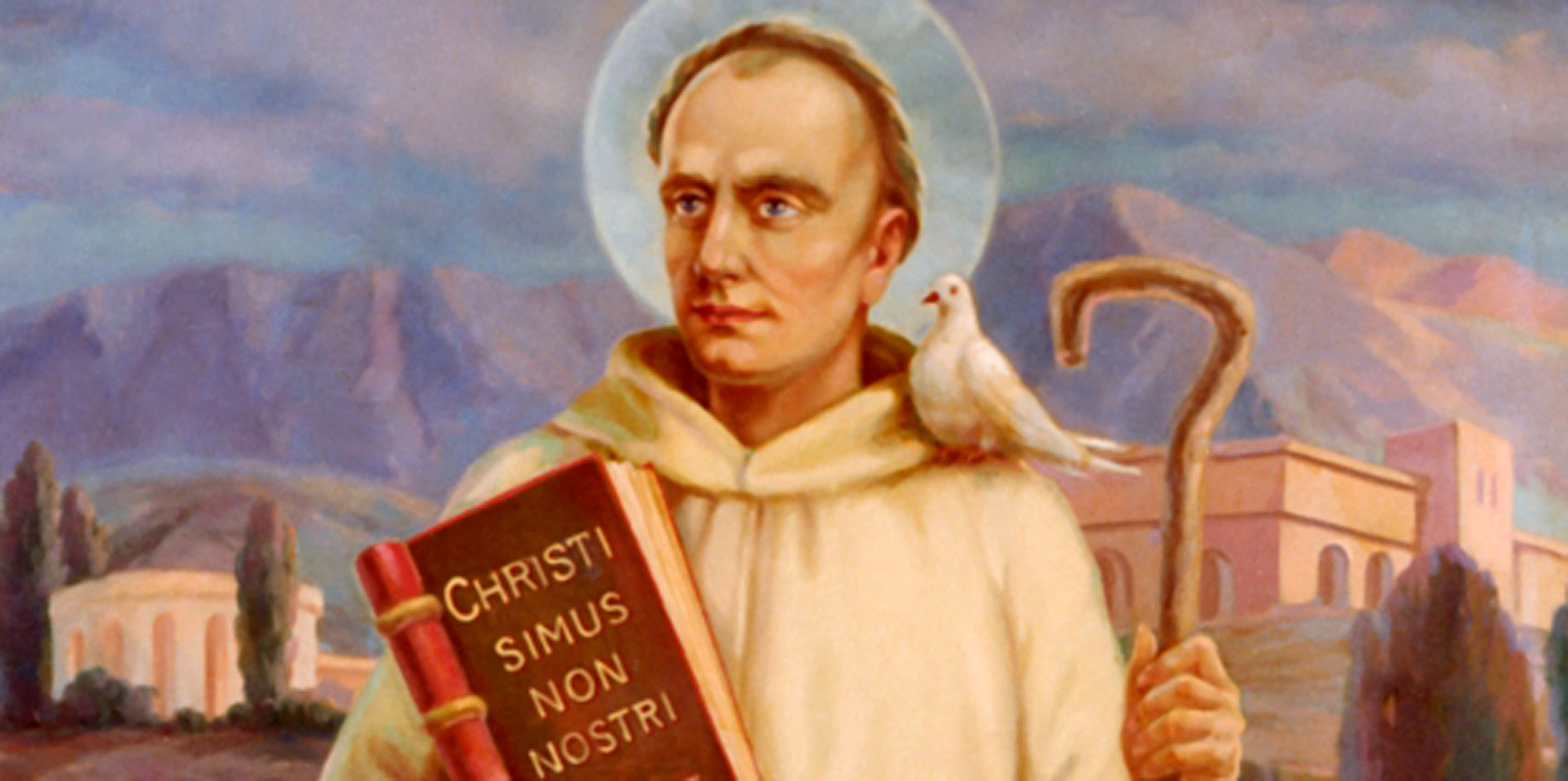
In his book, “St Columbanus, Pilgrim for Christ,” Fr. Aidan Larkin, SSC, gives a thumbnail biographical sketch: “The child would grow to manhood and become, first, a monk, then a priest, a distinguished Scripture teacher, a master of Latin prose style and rhetoric, a competent versifier, an abbot, a founder of monasteries and monastic lawgiver, notably in Annegray, Luxeuil and Fontaines, in Burgundy, France, from where he would be expelled, and then in Bregenz, Austria and, finally in Bobbio, northern Italy, where he would die in 615.” One could write at length on any one of these aspects of Columban’s life. Like many other early Irish saints, finding God in Creation came naturally to Columban. Many legends grew up around him in Luxeuil. Squirrels and doves were pictured playing in the folds of his cowl. Birds also approached him and nestled in the palms of his hands. Even wild beasts obeyed his commands. In his sermon “Concerning the Faith” he wrote, “Seek no further concerning God; for those who wish to know the great depth (of God) must first learn about Creation.” Further on, in the same sermon, he challenges us. He writes “if you wish to know God, learn about Creation.”
In popular Christianity, the key text for the common understanding of the place of humans in Creation is found in Gen.1:26. God said, “Let us make man in our own image and in the likeness of ourselves, and let them be masters of the fish of the sea, the birds of heaven, the cattle, all living beasts and all the reptiles that crawl on the Earth.”
From the above, we deduced that humans were special, made in the image of God, while all other creatures were put on the earth to be of service to humankind. If we had read the Noah’s story or the book of Job or the Wisdom literature, we might have gained more insight into God’s presence in other creatures as well.
St. Thomas Aquinas certainly did. In the Summa, Part 1, Question 47, Article 1, he wrote: “Hence we must say that the distinction and multitude of things comes from the intention of the first agent, who is God. For He brought things into being in order that His goodness might be communicated to creatures and be represented by them; and because His goodness could not be adequately represented by one creature alone, He produced many and diverse creatures so that, what was wanting to one in the manifestation of the divine goodness, might be supplied by another.” For goodness, which in God is simple and uniform, in creatures, is manifold and divided, and, hence, the whole universe together participates in the divine goodness more perfectly, and represents it better than any single creature whatsoever.
GOD’S PRESENCE IN AN EAGLE
So other species also reveal God in ways that humans do not. My own experience of this came many years ago when I worked among the T’boli people at Lake S’bu in the mountains of South Cotabato in the Philippines. One evening, a group of fishermen brought a Philippine eagle over to my house. What had happened was that a flock of hornbills forced this young eagle down on to Lake S’bu and its talon’s got caught in the fishermen’s nets. The fishermen didn’t kill the bird; instead, they brought it over to my house where we built a makeshift aviary. We sent for a vet from the Philippine Eagle Foundation because we thought the bird had injured its wing.
For the next few days, hundreds of T’bolis came from all over the mountain to view this magnificent creature. It stood more than three feet tall and had a wing span of more than 6 feet. Everything about this creature was stunning – it’s piercing eyes, its powerful beak and its beautiful front plumage. After the bird was treated by the vet, we released it back into the wild. I remember being struck by the power of its wings in flight. As a result of this experience, the metaphor in Exodus 19: 6, took on a totally new meaning for me. “You yourselves have seen how I carried you on eagle’s wings and brought you to myself.”
While marveling at the beauty of the eagle, I experienced incredible sadness at the thought we are the last generation of humans that will see the Philippine eagle in the wild. This is because its habitat has been destroyed through logging. On the wider global scale, we are living in the 6th largest extinction of life on earth since life began 3.8B years ago. If we continue in our destructive ways, we could lose between one third to a half of the species of the planet within the next 50 to 100 years.
Extinction is the permanent destruction of life on the planet and, tragically, the response from the religious world has been minimal. The Catholic Church claims to be a pro–life organization, but it would be more accurate to say it is against human abortion, which is laudable, but it has not cherished the lives of other species of God’s creation. In the large Compendium of the Social Teachings of the Church, only one paragraph (in No. 466) is devoted to protecting biodiversity. I believe that if the Catholic Church was seen to be in the forefront of protecting biodiversity around the world, its position on abortion would be much better understood.
INSIGHTS OF DUN SCOTUS
Blessed John Dun Scotus, probably the most significant Celtic theologian, also saw God in Creation in a more intense way even than Aquinas. He was a Franciscan who lived in the 13th and early 14th century (1266 – 1307). Scotus had no time for neo–Platonism which had a rather jaundiced view of Creation. Like Francis before him, Scotus’s love for all reality is grounded in his belief in the Incarnation, that God took human form and became part of Creation. For him, there is a direct link between Creation and the Incarnation. He takes his cue from those passages in both St. Paul and St. John where it seems that Creation is made for Christ. He is both the source and center of everything. In the prologue of John’s Gospel, we read: In the beginning was the Word and the Word was with God and the Word was God. He was with God in the beginning. Through Him all things came to be, not one thing had its being but through Him. All that came to be had life in Him and that life was the light of men, a light that shines in the dark, a light that darkness could not overpower.” (Jn. 1: 1–5).
When one takes the primacy of Christ in tandem with Scotus’ notion of ‘thisness’ or haeceitas, Jesus is seen as the model which God uses for every single dimension of Creation. This includes the sun, the stars, oak trees, dolphins, a blade of grass and humans. Everything in Creation becomes charged with divine meaning in and of its own unique being. Scotus’ view of Creation, transparent in Christ, appealed enormously to the Jesuit poet Gerard Manley Hopkins who was deeply influenced by Duns Scotus as is clear from his poem, “Duns Scotus’s Oxford:”
…Yet ah! This air I gather and I release/ He lived on; these weeds and water, these walls are what He haunted/ Who of all men most sways my spirit to peace.
Another one of Hopkin’s poems, “God’s Grandeur,” begins with the line, “The world is charged with the grandeur of God.” In the second verse Hopkin’s celebrates the role of the Holy Spirit in Creation: “Lord and Giver of Life.” Because the Holy Ghost over the bent/ World over the bent, world broods with warm breast and ah! Bright wings.”
In Scotus’s vision, each and every thing, no matter how small or seemingly insignificant, is of infinite value because it images God in its own unique way. In such a scheme of things, the more diversity there is in Creation, the greater the glory of God. This is far removed from an exclusively homocentric understanding of the Imago Dei which has informed, or should I say deformed, a lot of our God talk about Creation and our own place in Creation. Much of our articulation of our faith – in creedal statements or theological tomes – took place at a time when we believed that the earth was the center of the universe, that the universe was just over 6,000 years and that everything that grew on the earth, or flew through the sky, or swam in the oceans was put there by God for humankind’s benefit.
FINDING THE PLACE OF HUMANS
Modern science, on the other hand, describes how the universe emerged from the mysterious fireball 13.7B years ago. It tells how the elements were forged in the galactic cauldrons of the first generation of stars as they collapsed in the supernova explosions. It tells how these new elements seeded our solar system and gave rise to our sun, the planets and, especially, the Earth. The story goes on to tell how, over hundreds of millions of years, our Earth was formed in its physical dimensions. Finally, it tells how life arrived on earth in the oceans, first as a tentative flicker, and later in great profusion and diversity, culminating in emergence of a creature with reflective self–consciousness. This creature is called homo sapiens. This story helps us to discover our proper place in God’s Creation. It tells us that everything in the universe is linked and that we are literally cousins with every creature on the planet. It tells us that Creation is there primarily to give glory to God, not to be a quarry for humans to exploit.
If we take Columban, Aquinas and Scotus as our guides, we have a lot to learn from the story of the emergence of the cosmos. We are blessed in our time that we have the possibility to know, multiple times, more about the universe and life on earth than either Columban or Scotus. One of the instruments which has given us new eyes so that we can become more intimate with the “small” world of Creation is the microscope. With microscopes, we can now see things that Columban or Scotus in their wildest dreams could not even imagine.
SETTING UP A LABORATORY
To facilitate our encountering God in Creation, Peter O’Neill, our house manager, has agreed to set aside a room in the front of the house where there will be a number of microscopes, environmental charts and books such as John Feehan’s “The Wild Flowes of Offaly” and “The Grasses of Ireland.” There will be an ongoing educational program to help people familiarize themselves with the world around Dalgan. You will be able to bring flowers or grasses which you might collect during your walk in the grounds and be able to view them under a microscope. The focus here is experiencing God’s presence in nature.
The pioneering Swedish botanist, Carl Linneaus, put it well when he wrote in Latin: “Natura in Minimis Maxima Miranda” (Nature in its smallest is greatly to be admired). Admiration leads to wonder and praise – which is the beginning of prayer and contemplation. And as Christians in the 21st century, I think it is how we might respond to Columban’s challenge – “Intellige, si vis sciere Creatoram, creaturam,” (If you wish to know God, learn about Creation.)