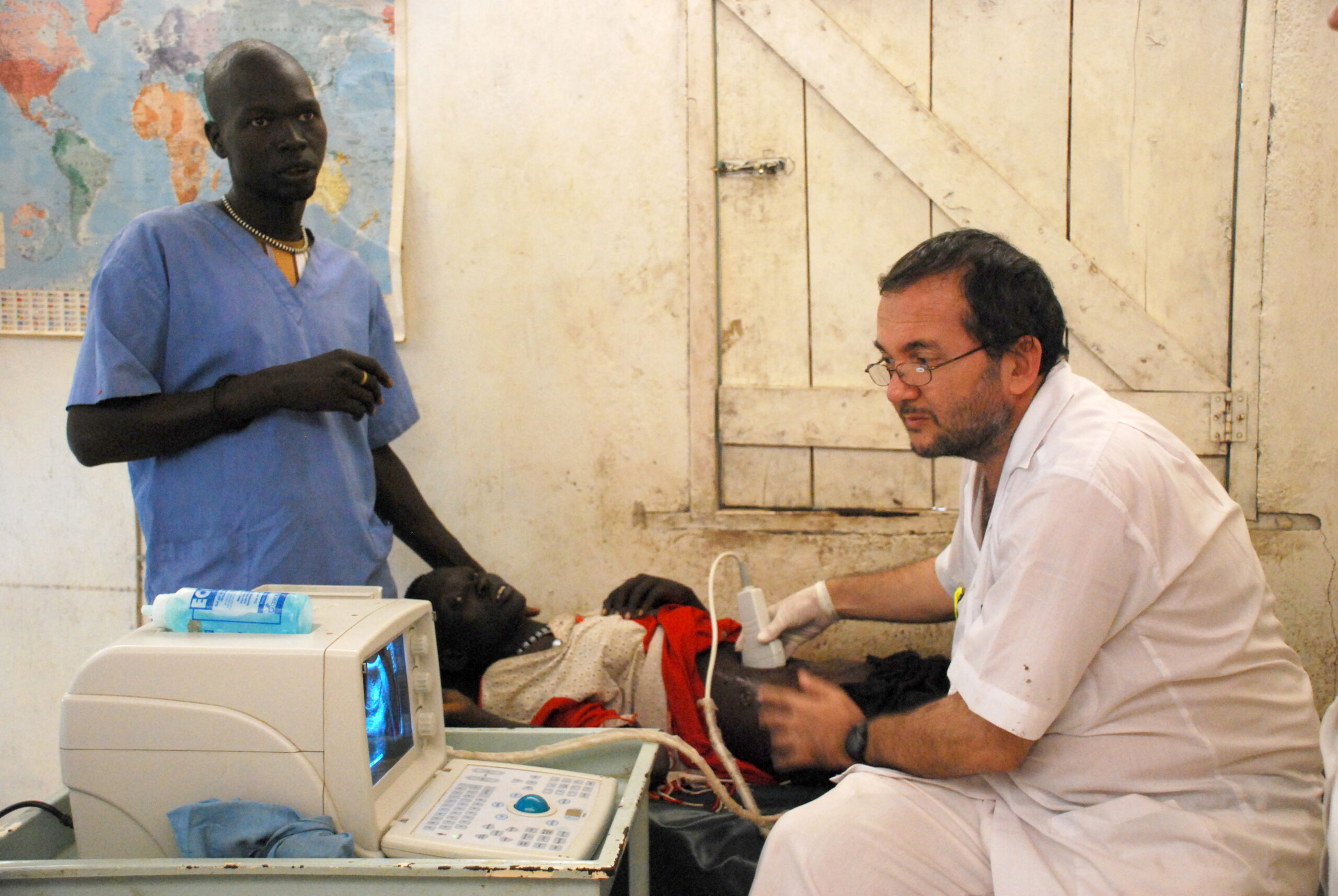
What made you become a Comboni Missionary?
ß Since I was very young, I have been feeling a strong inner call to live my Christian faith not only in a private, devotional way, but by actions. I was particularly touched by the text of Mt 25:40: “Whatever you did for one of these least brothers of mine, you did for me.” In my teen age, I have been involved in volunteer assistance to disabled children with the Caritas in Naples, my home town, at the parish and diocesan level; in this way, finding a confirmation to my vocation to be a doctor by profession which I felt since I was young.
At the same time, I was quite struck by what I perceived to be a warped world set up: on one side, a minority of rich nations and people living with excess food and goods; on the other, the majority of the nations and people living in poverty and lacking the essential food and goods. Statistics about the distribution of the medical doctors in the world used to leave me astonished: in my country, there’s one doctor for every 300 inhabitants; in Africa, there’s one for every 100,000. As a Christian, born by chance on the lucky side of the earth, I could not remain indifferent to this unjust situation: I would have spent my entire career as doctor in the so-called Third World, possibly in Africa. I remember this was for me, a quite natural decision. But it took me quite some time to discern if I was called to live as a lay volunteer missionary or as a religious missionary.
I was quite sure not to have the vocation to priesthood but, at the same time, I felt a radical call to dedicate myself to the service of God present in the least of my brothers and sisters. I came to know about the vocation of the missionary Brother rather late: I remember I was 19 and already a medical student when I met, for the first time, a Comboni Brother. After a short period, I came to the conclusion that that was the vocation being offered to me by God as a great gift to make myself and many others happy.
What has been your journey in Africa?
ß I left the Comboni Brother Center (a post-Novitiate formation house) of Nairobi in 1993 to study Arabic in Cairo for two years which, later on, were reduced to one year because I was urgently needed in Wau, South Sudan, to help an elderly Comboni father doctor whose health condition had been deteriorating. Anyway, in one year, I managed to pick up the basic structure of the Arabic language which helped me a lot then to fastly learn the simple broken Arabic dialect spoken in South Sudan as lingua franca, an extremely useful tool in a big town like Wau, where more than 10 different tribes live together.
I worked in Wau from 1995 to 1999, in a federal state hospital built by GLRA (German Leprosy Relief Association), which was supposed to be the National Leprosy Training Center but, in fact, due to the civil war and the poor functioning of Wau State Hospital, it had become a general hospital providing any kind of medical and surgical emergency services. The conditions of work were very hard. Wau was under the Islamic government of Khartoum, but was surrounded by the rebels of SPLA. The hospital was 10 km outside the town and, on the road, there were landmines. In August 1997, the hospital car itself fell on a landmine, killing on the spot two hospital mechanics and two leprosy patients.
The situation became worse in January 1998, when Kerubino Bol (one of the SPLA founders who had defected to the Islamic government) attacked Wau from within, betraying the government. The retaliation from the Islamic government was terrible: all the Dinka people (the same tribe of Kerubino), who had not escaped from the town in time, were killed as well as some of my nurses. The Dinka quarter and market were also completely burnt.
Most of my leprosy and TB patients were Dinka and used to come from outside the town to collect periodically their medicines. A time came when it was forbidden to cross the Jur River (the border between the two armies) but two leprosy patients tried to reach the hospital. They were killed while crossing the river, by the government soldiers. I reached the conclusion that it was not possible to work in those conditions anymore. Therefore, I requested my superiors for a transfer to the other side, in order to work among the Dinka in the liberated area under the SPLA.
THE HIGHEST MATERNAL MORTALITY
When did you come to Mapuordit?
ß In 2001, after having spent a sabbatical year in South Africa and a year of intensive surgical training in a Comboni Missionary Hospital in Uganda (Kalongo), I was assigned to the community of Mapuordit, in the Diocese of Rumbek, 300 km southeast of Wau. Mapuordit was a village built from scratch in 1993 by the Dinka displaced people who had escaped from Yirol when the Islamic Government of Khartoum had re-captured the town from the SPLA in 1991. There, I found a clinic made up of three huts, run by Sr. Moira, an old Australian, OLSH (Our Lady of Sacred Heart) Sister nurse, helped by a few local medical assistants and aid nurses.
When there was any surgical or obstetric emergency – for example, a pregnant mother in need of a Cesarean Section – Sr. Moira had to rush to the radio and call the Red Cross asking to send their airplane to collect the patient at the airstrip of Akot (25 km away from our mission traveling a terrible road) and to take her to the Red Cross Hospital of Lokichokio in Kenya, about 1,000 km away. Many times, the plane would come only after two days or it wouldn’t come at all. For this reason, the late Bishop Caesar Mazzolari (see pages 34-37) asked me to start a small surgical unit with the help of the Slovak Catholic University of Trnava, which sent an operation inflatable tent furnished with basic surgical equipment. They also sent 2 to 3 doctors in rotation every 3 months.
We started to operate in March 2002. In 3 years, we did more than 1,000 operations under the tent, till the new operation theater was inaugurated in December 2004. The coming of peace in 2005 allowed us to accelerate the program of constructions. Therefore, the hospital rapidly grew from the initial 40 beds (in 3 huts and one prefabricated shelter) to the present 112 beds (in 5 wards) built with permanent construction materials.
Indeed, a remarkable feat…
ß However, the biggest challenge has been to form local paramedical staff: nurses, laboratory technicians, operation theater nurses, etc. In South Sudan, all the nursing schools had been closed since 1985 due to the civil war. We employed expatriate qualified nurses, mostly recruited from the Ugandan missionary hospital of Matany, to train on the job our local staff, also through few theoretical lessons. Our dream to open a proper Nursing School for Certified Nurses became a reality in 2008 with the help of the Italian Cooperation and the Italian NGO CISP. On November 7, 2011, the first batch of 11 nurses graduated from the School, after two years and a half of intensive training.
Since we opened the hospital in 2002, so many volunteers and Comboni Brothers from all over the world (doctors, anesthetists, nurses, laboratorists, electricians) have come to help and to teach in the nursing school and in the hospital, creating a conducive environment for young South Sudanese coming from all over the new nation to learn to take up the nursing profession, as a real mission, to serve their own people from every tribe.
How badly people need medical care in South Sudan?
ß South Sudan has the highest maternal mortality in the world. The statistics are vague, but we estimate that about one mother in every 15 dies from complications related to pregnancy. UNICEF says that, in South Sudan, a girl has more chance of dying because of pregnancy than finishing her primary education – the illiteracy rate among women is above 80%. Less than 10% of women give birth in a health facility; the others deliver at home.
The two civil wars, lasting from 1956 up to 2005 – with only 11 years of interval between the two – have prevented the development of health services and, above all, the formation of South Sudanese qualified health staff. In our region, Lakes State – one of the 10 States forming the just born Federal Republic of South Sudan – with a surface of about 70,000 square kilometers and about one million inhabitants, has only 3 hospitals with a total of about 10 doctors, of whom only two are South Sudanese. The qualified midwives are about 15, of whom only 3 are natives.
The children mortality rate is very high – about 20% die before reaching 5 years of age, mainly, due to malaria, diarrhea and pneumonia. The prevalence of HIV/AIDS is rapidly increasing as prevention and treatment are extremely difficult due to the high illiteracy rate and lack of mass media outlets which could spread health education.
FIRST CONTACT WITH CHRISTIANITY
How effective are the traditional medicines in the country?
ß There are many traditional healers, but their role has become mainly to delay the going of the sick people to the few health centers. They do not have efficacious herbal remedies against the infectious diseases which are the main causes of death. This delay and the waste of resources used to pay for the traditional healers contribute very much to the high children and maternal mortality rate which could be prevented, because it is due to curable diseases. However, traditional healers have some good results in the treatment of simple fractures and hysteric disorders.
Do you feel fulfilled as a missionary serving as a medical doctor?
ß Yes, medicine is a great weapon to show the love of God for people, which is the basic element of the announcement of the Good News, especially in this area of first evangelization. Most of my patients are followers of traditional religions. Being admitted in the hospital is often for them the first chance to hear about the Christian faith. This is evident from their curious and astonished faces when, from afar, they observe us celebrating Mass every Sunday morning in the hospital.
To serve as a doctor is also an occasion to show to our Christians that God is present, in a special way, in the least of our brothers and sisters, such as the terminally ill patients affected by AIDS or cancer or the disabled and lepers rejected by the society.
What are the convictions that underlie your work as a missionary physician?
ß That God does not forget the poorest and most abandoned who also have the right to be cured and assisted.
Do people appreciate your work?
ß People appreciate very much my work, although they do not express it often by words, but I can sense it especially from their worry when I have to leave the hospital for a few days and from their happiness when I come back. They are aware that the hospital is a big gift from God for this remote area.
How do they look at you? For them are you, first and foremost, a missionary or a doctor?
ß They consider me a “missionary doctor“ quite different from the dozen of volunteers or employed doctors who have passed by and stayed for a short time, not only because I have been here now for 10 years but probably also because they see me fully involved and incarnated in this reality which is my real home. Most of my new patients call me doctor, but the old “clients” and, especially most of my staff, call me Brother, although I have never told them which of the two ways I prefer to be called.
SO MANY PEOPLE OF GOODWILL
Hospitals are places of great suffering. Don’t you feel your faith being challenged by the dramas you encounter?
ß Hospitals are places of suffering, but especially of healing. Most of our patients enter the hospital in poor conditions and leave it healed and happy enjoying again a healthy life. The sufferings of our brothers and sisters call us to show them solidarity and love, especially when the disease is not curable. Rarely my faith is questioned by the dramas. On the contrary, most of the time, it is reinforced by the answers to these dramas which God gives through so many people of goodwill.
What has been the most significant (or beautiful) experience of your missionary life?
ß The recent celebration of the Independence of South Sudan. When at midday on July 9, 2011, the new flag was raised up in the official ceremony at our small village of Mapuordit, I thought how privileged I have been, as a Comboni Missionary, to be sent to this land where Comboni is buried and to have taken a full part during the last 16 years in the struggle of its people for their liberation and regeneration. Like the women who, at that moment, were crying for their husbands and sons killed in the liberation war, I was remembering my staff killed in Wau and thanking God for sparing me from landmines and granting me the grace to witness the country’s Liberation Day. I felt great to have been truly a part of these people’s history, an amazing grace for a missionary!