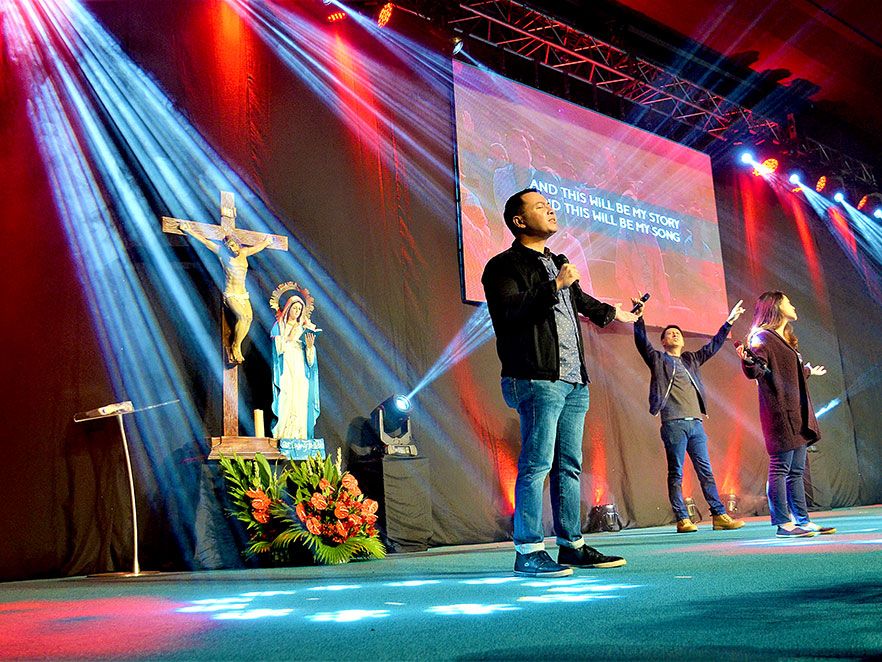

During Holy Week, from Holy Monday to Holy Thursday, Filipinos in Luzon chant the passion (pasyon) of Christ. In Metro Manila the chanting is usually done with a sound system and people gathered before an improvised altar with sacred images, candles and a crucifix.
Although the term is on reading (pabasa), the poetic text is sung or chanted. For the old people of Batangas, to read is not merely something passive; it also includes pronouncing the words and using tones as in chanting.
The extent of the pabasa tradition is more common in Tagalog-speaking areas, less among the Ilocanos and lesser still in Mindanao where there are Tagalog settlers.
Pabasa is a poetic version of the salvation history, from creation until St. Helena, the Constantine’s mother, finds the true cross in Calvary. Because the pabasa includes the pasyon, the two names are often interchanged as synonymous. The powerful image provides a portrait of Jesus they can identify with. For example: He is from Galilee,/ A man poor and lowly/ Who shelters in others’ roots./ Furthermore, his father/ Is just a simple carpenter/ Devoid of fame and wealth/ Living in poverty/ Without property of his own.
ILLITERATE CATECHISM
The pabasa, which began during the Spanish colonization of the Philippines, was a catechism tool for the mostly illiterate population. Fr. Juan Jose Delgado reports that the pasyon was already popular in 1740.
The Roman ritual encouraged, as salutary, that dying persons pronounce the name of Jesus. The thoughts of a dying person should be focused on the mercy of God as depicted in the story of The Passion. Now since the natives did not all like to live in the settlements in order to be nearer their fields, the distance posed a pastoral problem. The missionaries had two solutions. The first was the Magpa-Hesus ritual; the other was to bless the sick and read the Gospel whenever they were brought to town.
Concerning the Magpa-Hesus ritual, the Jesuit missionaries organized some Catholic laypersons belonging to the ruling class in towns in order to help their fellowmen grow in faith. These laymen were to care for the sick and the dying. The ritual also counter-checked the practice of calling the native priests/priestesses (babaylans) who chanted dirges during the wake.
The earliest communities then were those surrounding the death bed. From the devotion with the Magpa-Hesus, arose the primitive form of the pasyon. The Mahal na Pasyon served as a substitute for the rosary and the Magpa-Hesus rituals. Then it extended from the scene of the dying into a wider audience.
A SOCIAL EPIC
The first known pasyon was Gaspar Aquino de Belen’s Mahal na Pasiyon ni Hesukristong Panginoon Natin na Tula (printed in 1704). The most popular text is the Kasaysayan ng Pasyong Mahal ni Hesukristong Panginoon Natin (the Account of the Sacred Passion of our Lord Jesus Christ). It is called as Pasyong Pilapil because Fr. Mariano Pilapil edited, in 1814, a pasyon-text of unknown authorship which the people already used. It is also called Pasyong Henesis because it begins with creation and ends with the last judgment. Hence, the topic is not only the passion but the entire salvation history. From being a ritual for the dying, the pasyon became a Holy Week devotion for the masses.
INSPIRING FREEDOM
Although there are different versions of the Pasyon, most Tagalog-speaking places use the Kasaysayan ng Pasyong Mahal, or briefly, Pasyong Mahal. Of the many pabasa versions, one text from Ilocos Norte consists of 53 chapters, made up of 3,207 stanzas, each with five lines.
Since it was one of the few literary works available to the farming population, the text also functioned as a traditional social epic, which sank in or shaped the people’s consciousness. According to Reynaldo Ileto, the reading and dramatization of the passion of Jesus shaped the style of peasant brotherhood that led to the uprisings during the Spanish and American periods.
The farmers in rural communities introduced the pabasa into the Lenten traditions. Because Lent falls between the time of planting and harvest and farmers were practically idle, they had time for the pabasa.
As the pabasa became more popular, it was an occasion for socialization and drinking, for young men to meet young women, which led to a number of pregnancies.
SANCTIFYING PRACTICE
The text begins with a prayer to the Blessed Virgin Mary. The topic extends from creation (Genesis) and ends beyond the New Testament with a message to all concerning repentance and salvation. Besides using biblical sources, the pabasa also uses apocryphal or extra-biblical embellishments. For example, it mentions that the apple was the forbidden fruit, although the Bible only mentions the forbidden fruit. It describes how St. Anne gives birth to the Virgin Mary; that the three kings (Melchor, Gaspar and Baltazar) came, respectively, from Persia, Arabia and Saba; that Joseph died in the arms of Jesus and Mary; that the groom in the wedding at Cana was John the Evangelist who later left his wife to join Jesus; that when Jesus washed the feet of the apostles at the Last Supper, he foretold pope, bishops, and priests. It also mentions the death and assumption of Mary, that the Blessed Trinity crowned her, and that Empress Helena found the true cross.
Once started, the participants take turn in chanting the pabasa according to their own style. The participants believe that doing so will sanctify themselves and the community.
COMMUNAL MEAL
To have a pabasa may be motivated by somebody’s panata or vow. The said vow may be out of thanksgiving for a petition granted, or a wish to have a prayer answered.
The pabasa involves the community. Upper class families may serve as sponsors. More often, the pabasa was held in the houses of the middle class in order to become more accessible to the rest of the community. But it can also be done in a street corner with the bare essentials. The people involved are not only those who take part in the singing but also who prepare the food and ginger tea.
After the completion of the pabasa, a communal meal is shared by all. The meal aspect is essential because eating has a social function of cementing people and making them interact with each other.
Shouldering the meal is the role of the hermano/hermana mayor, the big brother/big sister. This inferior-superior relationship also strengthens the hierarchical nature of Philippine society. In the Holy Week of 2007, the mayor of Manila ordered his policemen to chant the pabasa in Plaza Miranda, Quiapo.
In short, the pabasa is one of the several devotions that is truly Filipino.