To appreciate where the Catholic Church in China is today, we must take a look at the recent past. After almost total annihilation between 1965 and 1975 during the course of the ten-year Cultural Revolution, the Church in China began to emerge from the catacombs. The country was opening up to the outside world, and the Church, if it followed the rules and regulations laid down by the government, would be allowed to exist openly once again. All religions had to operate under Party rules. Still, there was a significant change in the official line: the government now acknowledged that people with religious beliefs could make good citizens. This was something totally new. Marxism, of course, still operated under the belief that religion was socially backward and doomed to eventual extinction, but the point of view that had held that religion was the opium of the people was no longer popular.
The promulgation in 1982 of Document 19, the basic text on religious policy under Deng Xiaoping, had helped greatly to effect a change of attitude. This document, which has remained the guiding principle for all future documents, rules and regulations on religion hold that religion must be tolerated as part of the present reality. At that particular historical moment, what was all-important was “building a modernized powerful Socialist State.” That task required everyone’s cooperation. Chinese pragmatism worked in favor of religion. The same year, 1982, also marked the passage of Article 36 of the revised Constitution. This article guaranteed the freedom of religious belief to all citizens of the People’s Republic of China. This revision of Article 35 showed an evolution in the thinking of the Party and its leaders towards religion.
By 1985, some 700 Catholic churches had already reopened, not to mention about 2,000 Protestant churches and thousands of mosques. The Chinese government, however, still felt the need to maintain control over religion and religious activities. To do this, Chinese authorities resorted to the historically familiar policy of registration and monitoring − an old imperial device that had existed for many centuries.
The newly reopened legal places of worship, of course, were all required to register with the government. Religious groups that failed to register, and who met clandestinely were illegal, and subject to punitive action then and now.
OPTIMISTS AND PESSIMISTS
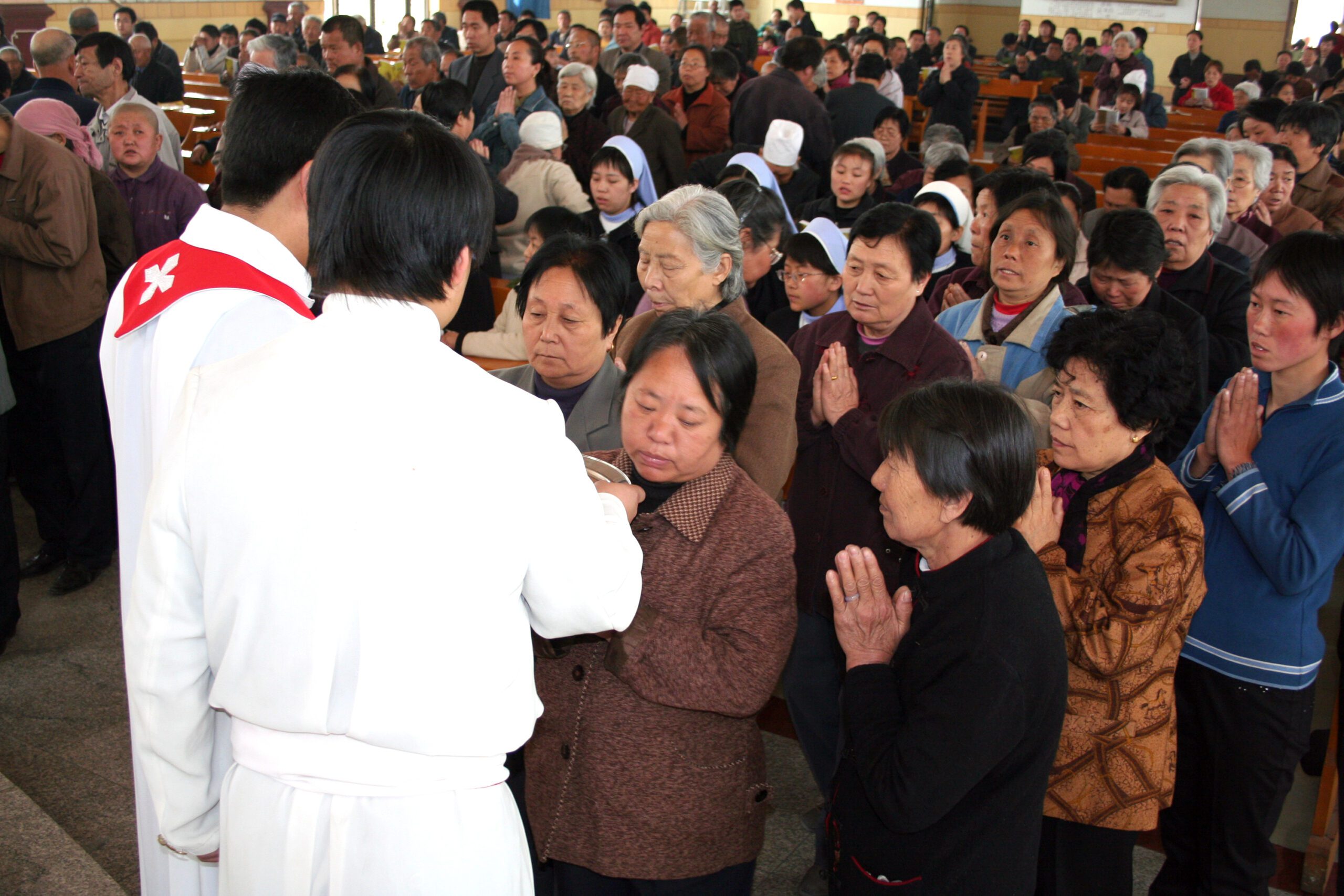
What is the situation of the Catholic Church in China today? Today, the Catholic population is estimated at approximately 12,000,000. Dioceses number 110 and Catholic churches number over 6,000. There are 114 active bishops and 22 inactive bishops. There are over 3,000 priests and more than 5,000 Sisters. Opinions on the present situation of the Church in China range from uncritical optimism to unmitigated pessimism. After quickly synthesizing the views at both ends of this spectrum, I will try to situate the Church somewhere in the middle of the two extremes.
In the school of optimism, I would put David Aikman. Some of you have no doubt read David Aikman’s book Jesus in Beijing in which he paints a glowing picture of Christianity in China. He is convinced that religion is already having a significant impact on politics, education and economics. He substantiates his argument with statistics. He compares the number of Catholics in 1949, which he gives as 4,000,000 to an estimated 12,000,000 today. He quotes an even more impressive increase in the number of Protestants with 1,000,000 in 1949 and the present estimate of some 70,000,000. From these figures, he extrapolates that within 30 years, China could become the largest Christian nation ever in the entire history of Christianity. He then conjures up the possibility that China’s leaders might embrace Christianity. This shift in mentality and ideology is nothing short of a genuine revolution of such major proportions that a new Christianity emerges and Christianity is now changed forever. The kinds of Christianity that Aikman mentions as thriving, however, are too fundamentalist even for most evangelicals, not to mention mainstream Christians. The types that Aikman speaks about in his book have virtually no place in Catholicism. His optimism leads him even further. Somewhere along the line the Muslims get on this bandwagon and many of them become Christians achieving what the Christian world has never been able to accomplish before.
Mr. Aikman’s optimism does not seem to me to be founded in reality. Catholics in China are still only about 1% of the population and they are, for the most part, poor and uneducated rural people. Aikman cannot be faulted for his enthusiasm, but short of a series of miracles, the journey of Christianity and especially Catholicism in China will continue, in my opinion, to be uphill in the foreseeable and even distant future.
Other scholars, such as Gianni Criveller, maintain that although the country is changing fast along economic and social lines, it has not changed for over 20 years along political lines, and therefore along religious lines.
Exponents of the less optimistic view maintain that the last significant changes along religious lines came under Deng Xiaoping, with Document 19, (March 31, 1982), and Article 36, (April 12, 1982) on the freedom of religious belief in the New Constitution. Even the three documents on codifying the Church in China of March 2003, and new “Regulations on Religious Affairs” (Decree No. 426) which came into effect on March 1, 2005, have signaled very little in the way of any new openness and change. Criveller holds that since Communism so far has failed to eradicate religion, religion must be tolerated as part of the present reality. This toleration is a political expediency. It does not change the long-term goal expressed in various ways in the speeches of Ye Xiaowen, Director of the State Administration of Religious Affairs (SARA) “to eliminate the impact of religion in China.” Furthermore, there are already signs indicating that the present Communist leadership under Hu Jintao is ready to crackdown on any dissent, including religion.
If you take the short view of the present situation of the Catholic Church in China, you might be tempted to agree with the less optimistic opinions of many scholars who find change coming very slowly, if at all. If you take the long view, you are likely to see that religion indeed has made progress along a variety of lines since the early 1980s.
But for the moment, I would like to take a different look at the Church in China, not as an entity tied to a government or an institution operating within a specific society, shackled under government rules, laws, and regulations, but the way you would look at any Catholic Church anywhere else in the world, as the People of God − the Church in China with its particular human face. I feel that often in assessing the situation of the Church in China as a particular local Church, the human face of the Church is lost. To assess where the Church is today, and where it may be heading, it is essential to concentrate on the human aspect of the Church as it is manifested in its bishops, priests, Sisters and laity.
THE YOUNG BISHOPS
Since the beginning of 2005, at least one elderly bishop in China has died each month. There are presently 66 bishops active in the open church and 48 active in the underground. Eighteen underground bishops are in some form of detention. These are mostly from Hebei Province. The bishops who have spent most of their adult life in prisons or labor camps will soon be a memory, a beloved memory of suffering, valiant men who gave their all for the Church of Christ. Their passing will bring to an end another dramatic and often traumatic period in the history of the Church in China. It will also usher in a period of unparalleled change, whose dimensions and outcome are not yet clear.
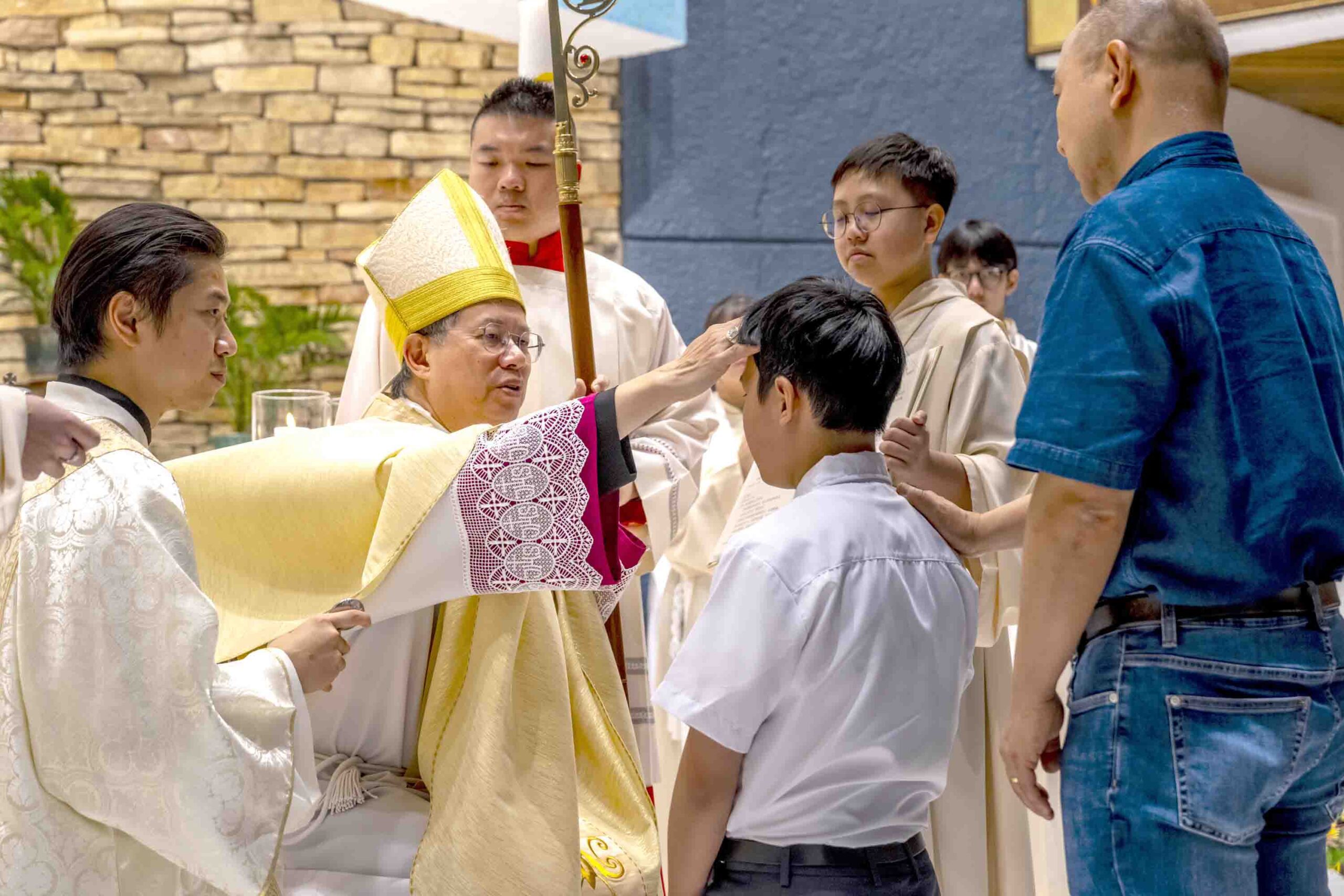
The youngest bishops in the world today are in China. Bishop Tong Changping of Weinan is currently 37 years old; he was ordained when he was 34. Bishop Joseph Han Zhihai of Lanzhou is presently 41. He was named administrator of the Lanzhou Diocese in 1999 when he was 35. (Since he is underground, the government refuses to acknowledge that he is the bishop and they call him Teacher Han although he never had any real formal schooling.) Of the five bishops ordained in 2004, four were in their 30s. Bishop Peter Feng Xinmao of Hengshui Diocese, Hebei Province was 39; Coadjutor Bishop Paul Ma Cunguo of Shuozhou Diocese, Shanxi Province, was 33; Coadjutor Bishop Zhang Xianwang of Jinan Diocese, Shandong Province, was 39. Only Su Yongda, Bishop of Zhanjiang, Guangdong Province, was 46. All of these new bishops are in union with Rome. The approval of Rome is extremely important for any new bishop to win the trust of the people. Not having Rome’s approval today weakens the authority of the young bishop in his diocese not only with the people, but also with his brother bishops. The people are extremely sensitive to this issue, contrary to some popular belief.
These young bishops are a sign of new life in the China Church. They are a sign of a new energy, and foreshadow changes to come. The older men, having suffered for long years for their religion have been cautious and prudent men. Younger men often found that difficult and hard to understand. They themselves, of course, have not suffered the same ordeal or imprisonment. The young men are more daring than their older mentors, more willing to risk, but certainly not foolhardy. These new young bishops, like the older ones, are poor and zealous and mostly in charge of extremely poor dioceses. The ones that I have met, are men filled with joy and easy laughter, men eager to bring the Church into the 21st century. A good number of them, educated in a more cosmopolitan atmosphere abroad, are also more tolerant of their counterparts in the underground church, and more ecumenical in outlook. Theirs is a challenging responsibility but the future of the Church in China is in their hands.
One issue that comes to mind which I have never heard addressed anywhere before is this: What are the implications for the future of the Church in China of having so many young bishops likely to hold their office for a very long time, perhaps as long as 50 years or more? That is something completely new in the history of the Church.
THE ROLE OF THE SISTERS
I would like to speak about the Sisters in China before speaking about the priests. Since 1991, I have routinely visited and spoken with Sisters from one end of China to the other. During this time, I have had many opportunities to observe the evolution of feminine religious life in the New China. In general, the Sisters are still very poor and live in straightened circumstances. Their accommodations are often nothing more than abandoned seminaries, the seminarians having taken up residence in newer structures. But, if it is true that much of the life of the Church depends on the Sisters, one way to assess the situation of the Church in China is to take a look at what has happened with the Sisters since China’s reopening. I vividly remember one of my first visits to a convent in South China.
The bishop was very friendly. I asked him if I might meet with the Sisters and ask them a few questions. He was delighted and accompanied me to the convent. I said, “May I ask them, Bishop, how they came to join the convent?” “What an interesting question,” he said, “it never occurred to me to ask.” So the superior gathered all the young novices and professed Sisters. They were an enthusiastic group reminiscent of the novices and young professed Sisters of the early 50s in the USA. I said to them, “Would anyone of you be willing to tell us how you came to join the religious life?” Hands shot up. They were delighted to tell their story. I pointed to one young woman who stood up and related the following: “One day,” she said, “I was walking in my village and I heard someone say xiu nu (Sister). I had never heard the word and so I asked, ‘What is a Sister?’ The person answered:
− “A Sister is a person who likes to do good for people.’”
− “I like to do good for people,” she said, “How can I become a Sister?”
− “You have to ask the bishop.”
− “Bishop?” she asked, “What is a bishop?”
− “A bishop is a man who can tell you how to become a Sister.”
− “Where is he?” she asked.
− “We don’t have one in this village,” the woman said.
− “Then where do I find him?”
The woman gave her the name of the place where the bishop lived. A few days later, the young woman left her village to go find the bishop. She knocked at the bishop’s door.
− “I want to be a Sister,” she said.
− “Fine,” said the Bishop, “We will go see Mother Superior,” and off they went. The Superior took in the young woman. No questions asked.
A few days later, the Superior, having observed the young woman’s behavior during the religious exercises, decided to ask a few questions.
− “Are you Catholic?” the Superior asked.
− “Catholic?” the young woman seemed completely perplexed.
− “What is Catholic?” she ventured. The Superior asked another question: “Are you baptized?”
− “Baptized?” the young woman was now truly baffled.
This young woman was neither Catholic nor baptized. This would never happen today. Procedures to be admitted to the religious life have changed considerably since the early 90s. But I want to add that when the young woman told this story, she could laugh about it and she had been in the convent four years. She was now indeed Catholic and baptized. I could not help but shake my head and think; “The Holy Spirit certainly had a hand in this.”
The Sisters in China have come a long way since then. Today, the Center for Religious Formation in Xi’an, Shaanxi Province, has a full contingent of young women every year taking a two-year course on various aspects of religious life, taught by well-qualified people. Promising young women are even encouraged to take courses in religious leadership. Another religious formation center has recently opened in Shanxi Province with similar aims and goals. Major superiors conferences have been set up in several areas of the country. Sisters from Hong Kong and Taiwan give retreats and workshops to the Sisters in the mainland. Members of Hong Kong’s catechetical office have offered them catechetical training. A number of Sisters come to Hong Kong every summer for special courses in various aspects of the religious life. As you are aware, a good number of young Sisters have studied or are studying in the United States, Germany, Italy, Ireland, France, etc. Some are with us here at this meeting. Many Sisters are now doctors taking care of clinics all over China. Hundreds of elderly are in the care of young Sisters who have discovered this social aspect of the Sisters’ ministries. Lepers are finding care and hope through the loving service of Sisters, and now a significant number have been trained, and others are in training, to minister to HIV/AIDS patients.
My impression is that there is great potential in the Church in China within the life and growth of feminine religious life. Many young superiors are ready, and fast replacing the older Sisters whose work is done.
So as not to present an unbalanced picture, I wish to add that many individual Sisters and congregations still have a long way to go. Many still need much better religious formation and academic training. This is especially important as young university students discover Christianity and seek answers to their search for meaning in life. Very few Sisters are trained along these lines. Few are spiritual directors, able to give retreats or workshops; few are liturgically minded or ecumenically competent, or able to deal on a par with their peers at the university level. And yet, all the signs are in place. In China, as everywhere else in the world, much of the hope of the Church lies with the Sisters.
BURDENED PRIESTS
Many young priests stop at our Centre on their way from or back to the Mainland. We also visit many of them during our trips. They are generally very open in sharing their hopes and dreams, their fears and frustrations with us. From these encounters, it is my opinion that the situation of the priests in China is more problematic than that of the Sisters. Young priests are given a great deal of responsibility, often immediately after ordination, and sometimes too much is expected of them.
Seminarians and young priests have generally been given many more advantages than the Sisters. Their education and educational facilities have been superior; they have been given many more opportunities to travel; many more young priests than Sisters have studied or are studying abroad. They are, however, under more pressure than the Sisters. Before entering the seminary they are under pressure from their families, especially if they are an only or elder son. Once in the seminary, they are under pressure to achieve academically. They must study hard, often without an adequate background or adequate resources in terms of faculty, books and materials. They are also under more political pressure from the government than the Sisters. Political correctness is extremely important to the Party. Often the spiritual aspects of the priesthood are neglected in favor of political indoctrination. The seminarians and their professors, however, on the whole, have shown more interest in orthodoxy than in political correctness. Once ordained, they are under pressure from the older people in the parishes who often measure the quality of this new generation of priests with those of former times. Naturally, the younger people are different. These are pressures stemming from the generation gap. Other pressures are the result of the priests’ assignments. Many young priests minister in very isolated rural areas. They travel many miles over unpaved roads to minister to their faithful, most of whom are very poor. They themselves often live very poor and lonely lives where they must often try to eke out a living from foreign Mass stipends.
In the early 1980s, vocations were really plentiful. Seminaries could not accommodate all the young men who wanted to enter. Today, some 20 years later (the first seminary to reopen, Sheshan, in Shanghai, opened in 1982.), China is already showing signs of crisis. There are indications that the large numbers of vocations to the priesthood are drying up. The “one child” policy is, of course, partly responsible for this. Furthermore, not so long ago, a young man entering the seminary and eventually being ordained a priest could expect to be better educated than most young men of his generation. But today, the rapid changes in China’s society are offering intelligent and ambitious young men very attractive educational opportunities, options and challenges. Economic development, modernization and globalization have created a culture of consumerism which, in turn, have accelerated secularization. Many succumb to these attractions and leave the priesthood.
The government also has a hand in this. The government’s emphasis on the importance of the Church being self-supporting keeps many of the young priests busy with business matters. Young priests must be vigilant to insure that the pastoral and spiritual aspects of their ministry and their own personal spiritual development are not neglected.
Young priests in China are entrusted quickly with positions of authority and responsibility unmatched anywhere else in the Church. They are early ordained bishops, appointed rectors of seminaries and administrators of dioceses. The great majority of the young priests show a deep loyalty to their Church, to the pope, to their people, and to their chosen vocation. Young priests are now the moving force behind the various developing social services operated by the Church throughout the nation, and behind the development of communications media and publications. If young Sisters are the hope of the Church, it is on the shoulders of the young priests that the future of the Church in China rests. And the prospects look very good.
A MORE BIBLICAL SPIRITUALITY
Most of the Catholics in China are concentrated in the rural areas. This is a historical fact since missionaries were much more plentiful and successful in making converts in the countryside than in the cities. Catholics are concentrated in two provinces: Hebei and Shaanxi Provinces. Hebei, as is well known, is also the seat of the underground church, and the location where most arrests of bishops and the faithful still take place. Hebei is the home of at least one quarter of the country’s Catholic population. Hebei boasts a number of so-called Catholic villages, that is, villages where most or all of the inhabitants are Catholics. There are similar villages also in other provinces, such as Shaanxi, Guizhou and Guangdong. Catholics in these Catholic villages tend to be very devout but in pre-Vatican II style. They are very clannish and find great solidarity in their common religious bond. In the village of Huangjia, in Shaanxi Province, for instance, the entire population, at 5:00 o’clock each morning, makes its way to the large parish church of Our Lady of the Rosary for morning prayer and Mass. The villagers are poor farmers who work in the fields all day and eke out very little in return. Most of the people are uneducated; they cannot read a newspaper or even write their name, but they have a staunch faith, which they endeavor to pass on to the next generation.
Attending an early morning Mass in one of these rural Catholic villages can be a very moving experience. The devotion and depth of faith of the people are nothing short of palpable. On one occasion, when I was traveling with two women from the German Office of Aid to the Church in Need, one became so overwhelmed that she could not stay to greet the people after the Mass. She went off alone and wept. Can such faith survive in a different milieu? People are already beginning to worry about the younger generation, those who leave this kind of rural setting to find work in the cities, or who become better educated and acquainted with a culture of consumerism and globalization, foreign within the confines of their small villages.
And what about the people in the cities? Is there a Catholic intelligentsia? The Christianity fever of the 1980s, with the phenomenon of culture Christians, never made a deep impact within the Catholic Church. The Catholic Church burdened with division, difficulties with Sino-Vatican relations, the imperative of rebuilding all its structures destroyed by the Cultural Revolution, and doing so with sparse finances, the need to educate its younger generation of priests and Sisters − to name only a few difficulties, have not yet allowed sufficient leisure to develop quality pastoral care to address the spiritual needs of the laity both in the countryside and in the cities.
There is still much work to be done to help the people rid themselves of superstitions and absorb the teachings of Vatican II beyond the externals of the vernacular at Mass. Very little has been done so far to help people replace their traditional pre-Vatican II pieties with a more biblical spirituality. The laity remains loyal, passive rather than active members in the Church. There is still much work to be done before the laity can rightfully take their place as envisioned by Vatican II, and develop a spirituality where they will see themselves truly as a priestly people, the People of God assuming their rightful place in the Church in China in these rapidly changing times.
JUST ONE CHURCH
The very mention of the Catholic Church in China conjures up an image of an open Church and an underground Church. The simplistic approach to this situation goes something like this: The open Church is a patriotic Church loyal to the government, and not in communion with the Holy Father or the Universal Church. The underground Church, on the other hand, is the loyal Church in communion with the Holy See and the Universal Church. This is far from the reality of the situation. The reality is extremely complicated historically, ecclesiastically and canonically. First of all, we must understand that there are not two Catholic Churches in China. There is only one Catholic Church in China. Pope John Paul II was always very careful about speaking of the Church in China as one. Second, China does not have a patriotic Catholic Church. There is a Chinese Catholic Patriotic Association, which is a political organization set up by the Party to monitor and direct the activities of the open Church. The Association operates under the United Front and the Religious Affairs Bureau at the local levels and the State Administration of Religious Affairs on the national level. I should add here that the Chinese Patriotic Association is not an organization reserved for the Catholic Church. Such an association monitors each of the five approved religions in China. Just how freely the Churches operate depends almost entirely on the quality of the individuals who serve in these associations, on their motivation and their knowledge of and respect for religion. The make up of these associations can sometimes be bizarre. I asked a bishop in the west of the country recently whether he had a cooperative Patriotic Association. “No problem at all,” he said, “The government put all Muslims on my Association and they are all religious men and understand.” That, of course, is not always the case. Many in these organizations are there because they see it as a good job with steady remuneration and with power. A third point to remember is that the division within the Catholic Church in China is political and not doctrinal.
The open and underground nomenclature is not accurate to describe the reality of the Church in China. Churches are either registered or unregistered. The registration of places of worship is mandatory. “Our aim,“ said Ye Xiaowen, Director of the State Administration of Religious Affairs (SARA), “is not registration for its own sake but … to tighten control over places of religious activities as well as of all religious activities themselves.” Open, official or government approved churches are all registered. China has always been suspicious of groups that can put any loyalty, including spiritual loyalty, such as to the Catholic Church, ahead of civic loyalty. China remains suspicious of religion and religious movements of any kind. No loyalty can compete with civic loyalty.
The underground churches are unregistered. Sites that refuse to register are illegal and subject to closure and persecution. Authorities in different places deal very differently with both the registered and unregistered groups. Some groups are relatively free in both the open and underground sectors to go their own way, while others, for example in Hebei Province, are arrested, detained, and subject to crackdowns.
The underground Church is not underground in the literal sense. In certain areas that I have visited recently, the church is large and beautiful. It is built in view of everyone and in the middle of the city. In some places, it is literally on the 7th floor! In other places, the so-called underground Church is the only Catholic Church; there are no official churches. In still other places, people meet for Mass or prayer in people’s homes. These are the communities more vulnerable to the surveillance of the Public Security Bureau. In a few places, both the open and the unregistered Church share the same building for services. In some seminaries, underground bishops may serve as professors. In other places, the two groups are at complete loggerheads.
I would like to give you a very concrete example of how confused the situation can sometimes be. One day a bishop from the north arrived at our office. He was a small man but obviously enterprising. He had received an invitation to visit Germany, and he had obtained his passport from the government. He arrived with a terrible cold so Bishop Tong asked one of our men to take him to St. Paul’s Hospital for treatment since there was no way for him to get on a plane in that condition. Within a few days, he had recuperated sufficiently, and set off for Germany. His permission did not extend beyond Germany. Nonetheless, once in Germany, he said, “This is so close to Rome, why don’t I drop in on the Holy Father?” Someone arranged for him to go to Rome to see the Holy Father. Somewhere along the way, he managed to obtain the entire bishop’s regalia. Anyone acquainted with Rome is aware that the most ubiquitous person in the world is the papal photographer! When our little bishop saw the photographs, he was ecstatic! So he got many of them and had some of them enlarged. When he returned to Hong Kong, we cautioned him that it might not be a good idea to display these publicly since he had no permission to go to Rome. But his enthusiasm got the better of him and he threw caution to the wind. When he got home, he framed the photos and put them in the vestibule where they were prominently visible to anyone. The authorities came in, took one look at the photos and asked: “Who made you a bishop?” Not willing to divulge the name of the bishop who had originally ordained him, he said, “The Holy Father!” They did not believe him, of course. This man that we knew as a bishop was, in reality, a bishop in the underground Church and a priest in the open Church!
We in the West, who like things neatly boxed in their individual categories, are not comfortable with this kind of ambiguity. Every year, I give an orientation on the situation of the Church in China to the AITECE teachers going to China to teach for the first time. I say to them, “If you can’t stand ambiguity, don’t get on the plane!”
*Excerpts from the article “The Catholic Church in China: Journey of Faith. An Update on the Catholic Church in China: 2005.”