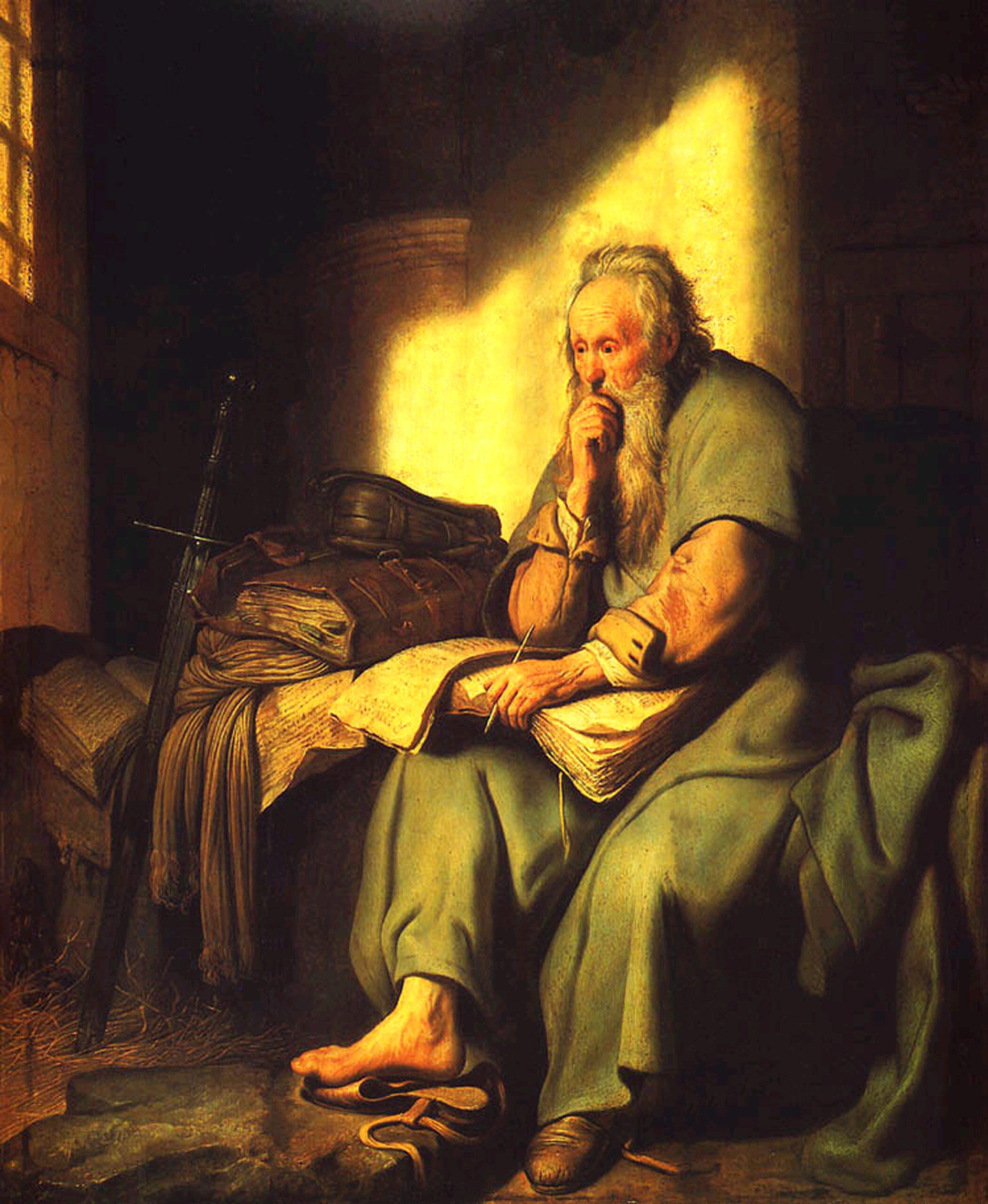
On June 28, 2007, during the celebration of the First Vespers of the Solemnity of the Holy Apostles Peter and Paul, Pope Benedict XVI announced that the Church would be dedicating a special Jubilee Year to the Apostle Paul from 28 June 2008 to 29 June 2009, on the occasion of the bi-millennium of his birth, which historians have placed between 7 and 10 A.D.
Much of the liturgical, cultural, and ecumenical events will be held in Rome, particularly at the Papal Basilica of St. Paul Outside-the-Walls. There will be pilgrimages to the remains of the Apostle Paul preserved beneath the Papal Altar of the Basilica.
The Holy Father has also called for the promotion of study conventions and special publications on Pauline texts in order to make ever more widely known the immense wealth they contain, a true patrimony of humanity redeemed by Christ. To implement initiatives for the Year of St. Paul are the dioceses in every part of the world. Also expected to be active are Religious and educational institutions and social assistance centers which are named after St. Paul or inspired by him and his teaching.
One particular aspect is to be given special attention during this Jubilee: the ecumenical dimension. Pope Benedict explains: “The Apostle to the Gentiles, who was especially committed to taking the Good News to all peoples, left no stones unturned for unity and harmony among all Christians.”
SEARCHING FOR ST. PAUL
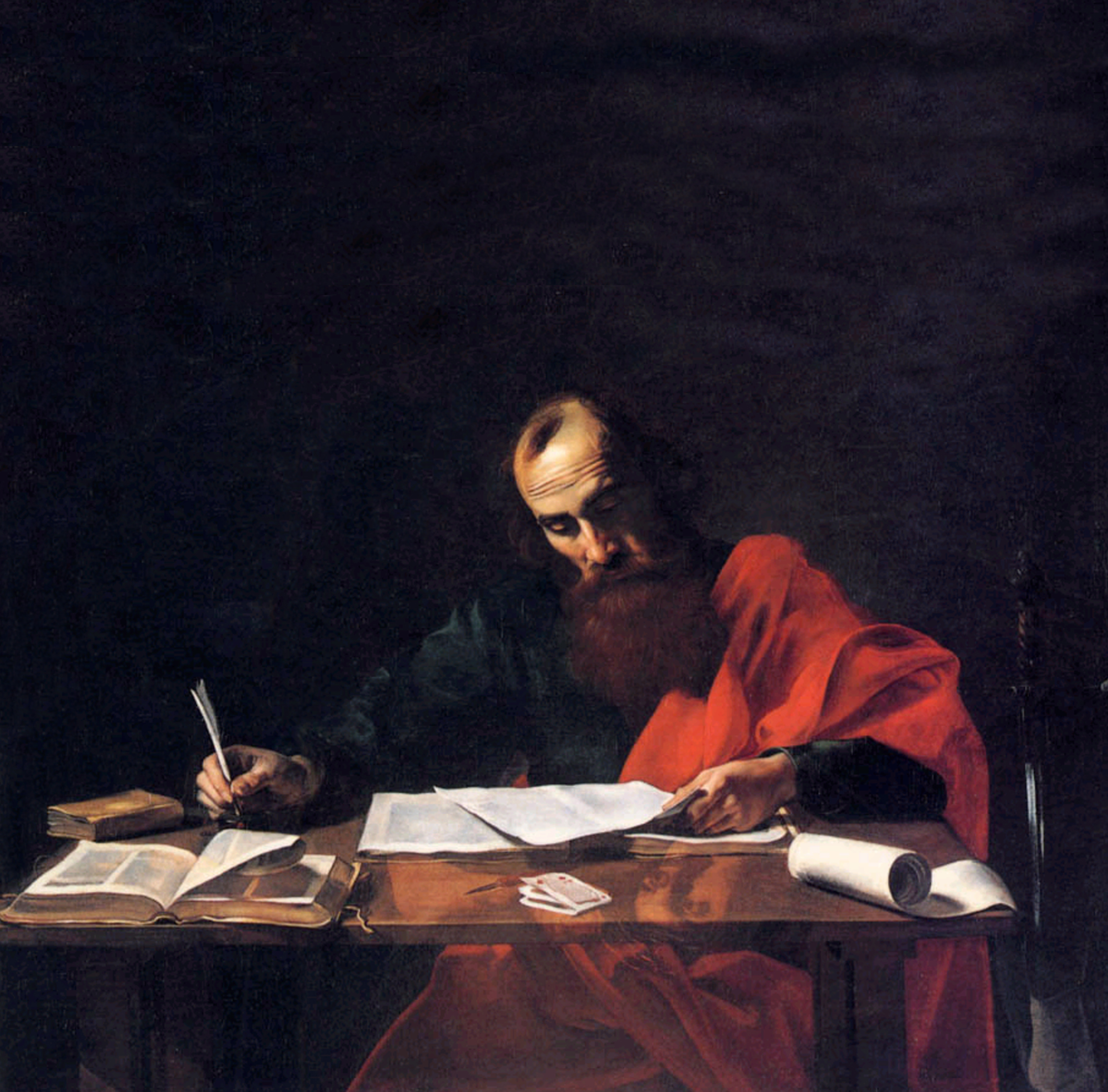
Next only to Jesus Christ, St. Paul is the figure most written about in the New Testament. Moreover, we have autobiographical materials from Paul himself (Jesus did not leave any writing; the Gospels are records of his deeds and actions, selected by the Evangelists from the many which have been handed down, and explained in view of the situation of their churches). Scholars accept seven letters as Paul’s personal compositions, and often call them Proto-Pauline works: Romans, 1 and 2 Corinthians, 1 Thessalonians, Galatians, Philippians, and Philemon. Many scholars see 2 Thessalonians, Colossians, and Ephesians as written by disciples familiar with Paul’s theological tradition and call the letters Deutero-Pauline works. Majority of scholars exclude the Pastoral Letters (1 and 2 Timothy, Titus) as coming from Paul; they consider the letters as written in the name of Paul to address situations in Pauline churches years after the death of the Apostle.
The Acts of the Apostles, Luke’s sequel to his Gospel, supplies further information about the Apostle. Because of the author’s engaging and dramatic style, people know more the Paul of Acts than of the Letters. It must, however, be remembered that Luke is not attempting to write accurate, play-by-play history but uses his researched materials to give a theological account of how Christianity moved outward from its Jewish origins to the Gentile world under the inspiration of the Holy Spirit, with Paul as instrument of bringing the gospel “to the ends of the earth.”
In getting to know Paul, Paul’s own information about himself from his letters is to take precedence. Acts is helpful as supportive and corroborative of this information.
A CITIZEN OF THE WORLD
Paul (Jewish name: Saul) was born in Tarsus in Cilicia − in the Diaspora, that is, outside the confines of the Palestine of the New Testament. As a Jew born in the Diaspora, he was exposed to values of different cultures and realities. He did not think nor act like a Jew in Jerusalem who would look at the world from the point of view of his small Jewish world, often seeing others as “outsiders” and even potential enemies.
Paul had a multicultural formation. Though born of Pharisees and trained as a Pharisee, he was exposed to the civic life of Tarsus, a “no mean city” (Acts 21:39) which, in his time, enjoyed political, economic, and intellectual prominence among the cities in the world. Paul spoke Aramaic and knew Hebrew, wrote in Greek, and quoted the Old Testament in its Greek version, the Septuagint. As regards academic training, Paul could avail himself of optimal conditions, like going to Jerusalem to learn from the great rabbis, Gamaliel among them. His letters reveal that he knew the current philosophies and was influenced by the Stoics, the Cynics, and the Epicureans.
Paul was zealous for the faith of his fathers, but he was neither bigoted nor narrow-minded. His contact with different cultures and races made him receptive to outside influences.
The Acts of the Apostles mentions that Paul was a Roman citizen, and this helped him to get out of certain dire situations. Paul does not mention his citizenship in his letters. Paul goes beyond the narrow confines of “citizenship” − he appears more as a citizen of the world. His wide horizon, brought about by his multicultural background, would be further expanded after his conversion, when he would be given “the supreme knowledge of Jesus Christ.”
CONVERSION AND CALL
What do we understand by Paul’s “conversion”? The traditional view sees conversion as a process by which a person who struggles with a sense of guilt and inferiority becomes one with a conscious sense of being right as a consequence of achieving a firmer hold of religious realties. Accordingly, Paul, a Pharisaic Jew who is conscious of his failure to keep the Law, experiences a profound inner change when it is revealed to him that he can be justified by faith in Jesus Christ. The Jewish persecutor becomes the Christian convert who preaches justification by faith in Christ Jesus.
Another view of conversion refers to a transfer from one community to the other. Accordingly, Paul, who comes from a Pharisaic community, enters a community that includes Gentiles and this community helps him understand his revelatory experience and reinterpret his past.
Scholars challenge these assumptions of Paul’s conversion. For one, Paul was quite content with the orientation of his life before his conversion. Paul says that he was “as to righteousness under the Law, blameless” (Phil 3:6). Moreover, Paul did not really change religion. He still served the same God; and as a Jew, he was to bring God’s message to the pagans.
But because of strong contrasts in Paul’s life before and after his Damascus experience, it certainly qualifies as some sort of a conversion experience. But it is also important to see it as a revelatory experience and an experience of a call, as Biblical scholars point out.
JESUS TOOK CONTROL OF HIM
• A revelatory experience: As a Pharisee, Paul knew that Jesus was crucified under Pontius Pilate as the result of Jewish charges. Jesus was a teacher to whom wonders was ascribed, but who challenged the Pharisaic legislation. That his followers proclaimed him as the Messiah and that he rose from the dead is a subversion that must severely dealt with. For the Pharisee Paul, Jesus had died a fitting death, and all it remained was the return of his followers to the fold of authentic Judaism.
On the way to Damascus, Paul encountered Jesus in glory. He was surprised by grace. Jesus took the initiative in this encounter; there had been no preparation whatsoever on Paul’s part. As he himself describes it, “Last of all, as one born abnormally, he appeared to me” (1 Cor 15:8). Paul sees it also as the initiative of God: “He was pleased… to reveal his Son to me” (Gal 1:16).
As to the sign of Jesus’ identity, Paul must have formed a mental image from the preaching of Jesus’ disciples. Coupled with the anger he must have felt against the one who had led the Jews astray, Paul must have a dark picture of Jesus. But now he has the inescapable conviction of a direct experience. Jesus really is Lord, glorified by God. The resurrection which he had contemptuously dismissed is as undeniable as his very own existence. The assertions of the followers of Jesus were not blasphemous but utter truth. This recognition completely transformed Paul’s value system. He was “apprehended by Christ Jesus” (Phil 3:12); Jesus took total control of him.
THE CALL TO SPREAD THE GOOD NEWS
• Experience of a call: Paul also views the appearance of Jesus as a call or commissioning. His description of it evokes two celebrated Old Testament vocations: the Servant of God in Isaiah and the prophet Jeremiah. The Servant declares, “From my mother’s womb he called my name… He said to me… I will give you as a light to the nations” (Is 49:1, 6). Jeremiah hears God calling: “Before I formed you in the womb, I knew you, and before you came forth from your mother, I consecrated you. I appointed you as a prophet for the nations” (Jer 1:5). Paul uses the key terms in narrating his own vocation: “God, who from my mother’s womb had set me apart and called me through his grace, was pleased to reveal his Son to me, so that I might proclaim him to the Gentiles” (Gal 1:15). As in the case of his two predecessors, Paul sees in his call the working of God’s plan to extend his grace to the Gentiles. God accomplished this in his Son Jesus and Paul is called precisely to bring this good news to those who do not belong to God’s people.
The call to be a missionary to the Gentiles belongs to Paul’s experience of the Risen Christ, not an afterthought or a product of Paul’s missionary experience. There is a hypothesis that contends that Paul originally thought of a reform movement within Judaism (using the Gospel of Jesus) and when Paul saw that this failed, he turned to the Gentiles and to make the Gospel more palatable he repudiated portions of the Law. This hypothesis contradicts Paul himself who has always considered himself as an apostle to the pagans. Paul declares that this call was acknowledged by the “pillars” of the early Church − Peter, James and John: “When they saw that I had been entrusted with the gospel to the uncircumcised, just as Peter to the circumcised… they gave their right hand in partnership, that we should go to the Gentiles and they to the circumcised” (Gal 2:7-9).
PAUL THE MISSIONARY
That the Gospel is intended not only for the Jews but also for the Gentiles came from Paul’s conviction of salvation in Christ as pure gift. Christ died for all, and no one has merited it. “Does God belong to the Jews alone? Does he not belong to Gentiles, too? Yes, also to Gentiles” (Tom 3:29). Christ came into the world to save sinners, and Paul, a persecutor of the faith, was offered God’s mercy and even appointed to the ministry. As an apostle to the Gentiles, he must proclaim to all the justification of God, achieved not by the works of the Law, but by faith in Christ Jesus.
Soon after his conversion, Paul went to (Nabatean) Arabia, probably to preach there; he did not stay long because of the threat to his life on the part of King Aretas. He returned to Damascus and later went to see Peter in Jerusalem. Finally, he worked at Antioch at the invitation of Barnabas.
Paul’s work in the community of Antioch, begun by Hellenist believers after Stephen’s death, gave him an “alternative” experience to that of Jerusalem, where Jesus’ followers were still bound to the Temple and the dietary laws. It was in Antioch that the believers were first called “Christians.” This new identity shows that the followers of Christ are not an appendix to Judaism. They have their own identity: they are Christians. This gigantic step happened in an “international community.” Paul must have been responsible for this reality, or an animator of it.
The multiracial community of Antioch soon sent out missionaries − beginning with Paul and Barnabas. If not for the initiatives of the Hellenists, Christianity would have remained an appendix to Judaism. Instead, thanks to the world vision of people like Paul, Christianity no longer has geographical, cultural or racial confines.
A LAW-FREE GOSPEL
Later, Paul and Barnabas parted ways. Luke says it was because of John Mark who displeased Paul by abandoning the group half-way in their first mission (Acts 15:39). Scholars, however, see a deeper reason behind it: a conflict between Peter and Paul in Antioch in which Barnabas seemed to have sided with Peter (Gal 1:11-14). Now, Paul was on his own: more free to course his missionary journeys and proclaim his law-free gospel.
Paul is often credited to have spearheaded the spread of Christianity in the world under the Roman Empire. Certainly, the influence of Paul’s missionary activity and his theological articulation for mission can never be underestimated. Nevertheless, the historical significance of the Pauline mission must not be overblown. Paul did not inaugurate the active proclamation of the faith to the Gentiles; some Hellenist Christians, who were persecuted in Jerusalem after the death of Stephen, went to Antioch in Syria and evangelized both Jews and Greeks (Acts 11:20). Nor did Paul initiate the inclusion of Gentiles in the Christian communities; Peter had first welcomed the “God-fearer” Cornelius in the faith, albeit with much divine prodding (Acts 10). The missionary expansion of the faith during the first generation is not to be fully credited to Paul as many other missionaries outside the Pauline circle did their share. However, Paul’s missionary effort has become a dominant model, thanks to the Acts of the Apostles which highlights Paul’s mission. In Luke’s perspective of salvation history, Paul was the protagonist after Jesus and Peter; he was to bring the Gospel to “the ends of the earth.”
A PLANNED MISSION
Paul was, by no means, the only religious propagandist in his day. There were the itinerant preachers of the Greek-Roman divinities; the devotees of mystery cults, including those of the East; the wandering philosophers; and the Jewish synagogue preachers. Then there were Christian preachers besides Paul.
What methods did Paul employ that had in common with those of the religious propagandists in his day? What Pauline models diverged from the examples of other preachers?
There were mainly two types of religious propagandists at that time. This was also true of Christian missionaries. The first was the wandering charismatic type who went around preaching the kingdom of God (or, in the case of pagans, different philosophies or divine oracles). The second type was of the organizing kind, missionaries who planned their routes and consciously founded new communities. Paul belonged to the second type.
A GEOGRAPHICAL ACCOMPLISHMENT
At least two main strategies of Pauline mission differed from the approaches of other religious propagandists. The first was the deliberateness of the geographical pattern of the Pauline mission. Towards the end of the Aegean period of his mission, Paul wrote from Corinth: “From Jerusalem all the way to Illyricum, I have finished preaching the gospel of Jesus Christ” (Rom 15:19). The narratives of Acts and Paul’s own letters confirm that for him mission is in part a geographical accomplishment. Paul moved from east to west, touching in order the areas of Syria, Cilicia, Macedonia, Achaia and Asia (Paul’s letters do not refer to the “first tour” in southern Asia Minor in Acts 13-14, while there are well known uncertainties regarding Galatia mission). At the end of the mission in the Aegean territory, Paul intended to travel to Jerusalem and then to Rome. Acts ends with a report of Paul under house arrest in Rome because, for Luke, Rome marks the “ends of the earth” (Acts 1:8). But we know that Paul planned going on further west beyond Rome − to Spain (Rom 15:22). There was no longer any room for him to work in Greece and Asia and to work in Rome would violate his principle not to go where others had already sown the faith. Paul would work only in terram incognitam evangelii − in places where the Gospel had not yet been heard − so he set his eyes on the “virgin” territory of Spain.
COMMUNITY FORMATION
The second defining dimension of Paul’s mission was his commitment to found and nurture Christian communities. This appears to lack equivalent among other religious propaganda of his world. The propagandists of mystery religions were devoted to proclamation but not to community formation. The Jewish proselyte movement (those who actively sought the conversion of Gentiles) seemed not to be a deliberate outreach. Even itinerant charismatic preachers among the early Christians aimed more at proclamation rather than at goal-oriented community organization to sustain nurturance.
Paul preached at every stage of his missionary journey and sought the conversion of individuals, but these were only preliminary steps in a larger goal which was to form communities of believers. Paul felt obligated not just to found but to nurture communities, not just to give birth to but to rear them, not just to plant but to cultivate them. Only when these communities were formed, nurtured, and thus firmly established, could Paul say that his mission was, in the fullest sense, completed. For this reason, he would revisit the communities he had founded. He would take longer residence in a city from where he could easily communicate with the Christians. He longed to see them or hear news about them. He would explain his activities to the Thessalonians: “As you know, we treated each one of you as a father treats his children, exhorting and encouraging you and insisting that you conduct yourselves as worthy of the God who calls you into his kingdom and glory” (1 Thes 2:11-12). He would even liken himself to a mother in nurturing them: “We were gentle among you as a nursing mother cares for her children. With such affection for you, we were determined to share with you not only the gospel of God, but our very selves as well” (1 Thes 2:7-8).
When Paul said that he worked more than anyone else for the Gospel, he was only slightly exaggerating. To the Corinthians, he shared the labors, hardships, and dangers he had faced. Apart from these things, his anxiety for all the churches gave him daily pressure (2 Cor 11:28). This concern and anxiety for the Christian communities is the reason we have the letters of Paul. The letters directly demonstrate Paul’s commitment for their nurturance. They are not so much Paul’s way of preaching the Gospel as his way of “teaching, refuting, correcting, and training the Christians in righteousness” − works that Paul ascribed to Scriptures (2 Tm 3:16).
PAUL’S LIVING LEGACY
Paul’s heritage is so much more than what we can ever realize. He did more than anyone else in his time to lead people to see what Jesus Christ meant for the world. However, studies of Paul often prove a block in appreciating his person. The Gospels engender spontaneous attraction, but Paul’s letters need a laborious plodding. Still, there should be ways to appreciate this great apostle.
We start by appreciating the legacy he left behind. Raymond E. Brown (An Introduction to the New Testament, pp. 450-455) names three kinds:
• Those Whom Paul Brought to Christ. These were his converts, spread throughout the Roman Empire, which today covers Syria, Turkey, Greece and Yugoslavia. They were his hope, his joy, his crown, the stars in his universe (1 Thes 2:19-20). He wrote them letters to let them know of his affection, to strengthen their faith, to supply what was lacking in them. Sometimes he could be harsh on them, but only because he was after their good.
• Paul’s Letters. No other follower of Jesus left behind a written testimony comparable to that of Paul. From his letters, we are given a good glimpse of his personality, the depth of his wisdom and intelligence, and his love for Christ Jesus. Aside from being our primary source for his life and work, his letters are a primary source for our knowledge of the beginnings of Christianity. He did not compose his letters with a careful eye for stylistic propriety and the approving eye of a wider public, yet because they express so spontaneously and eloquently his mind and his message, he is even considered as one of the great figures of Greek literature. Paul’s letters are not only literary works; they are “the word of the Lord.” They continue to be read in the liturgical assemblies of Christians, as they were read and passed to different communities during his lifetime and beyond.
• Paul’s Disciples and Their Writings. Paul’s letters give evidence that he was a man capable of engendering deep friendship. His disciples comprised a wide cast of characters. Timothy, Titus and Silvanus were his immediate collaborators; they would carry his letters and sometimes acted as his ambassadors in difficult situations. Aquilla and Priscilla worked with him in Corinth, joined him in Ephesus and prepared for his arrival in Rome. The slave Onesimus attached himself to him at the risk of offending his master. His disciples would continue his legacy, writing in his name and authority, while remaining unanimous. The Pastoral Letters were probably written by his disciples to address situations and problems that arose after his time. Paul himself was a hero to Luke, the author of the Third Gospel and the Acts of the Apostles. Luke pays an extraordinary tribute to him by devoting to him half of the book’s lengthy description of the spread of Christianity. Raymond Brown comments: “Paul’s own writings may be remarkably autobiographical, but the biography in Acts contributed enormously to his image.”