
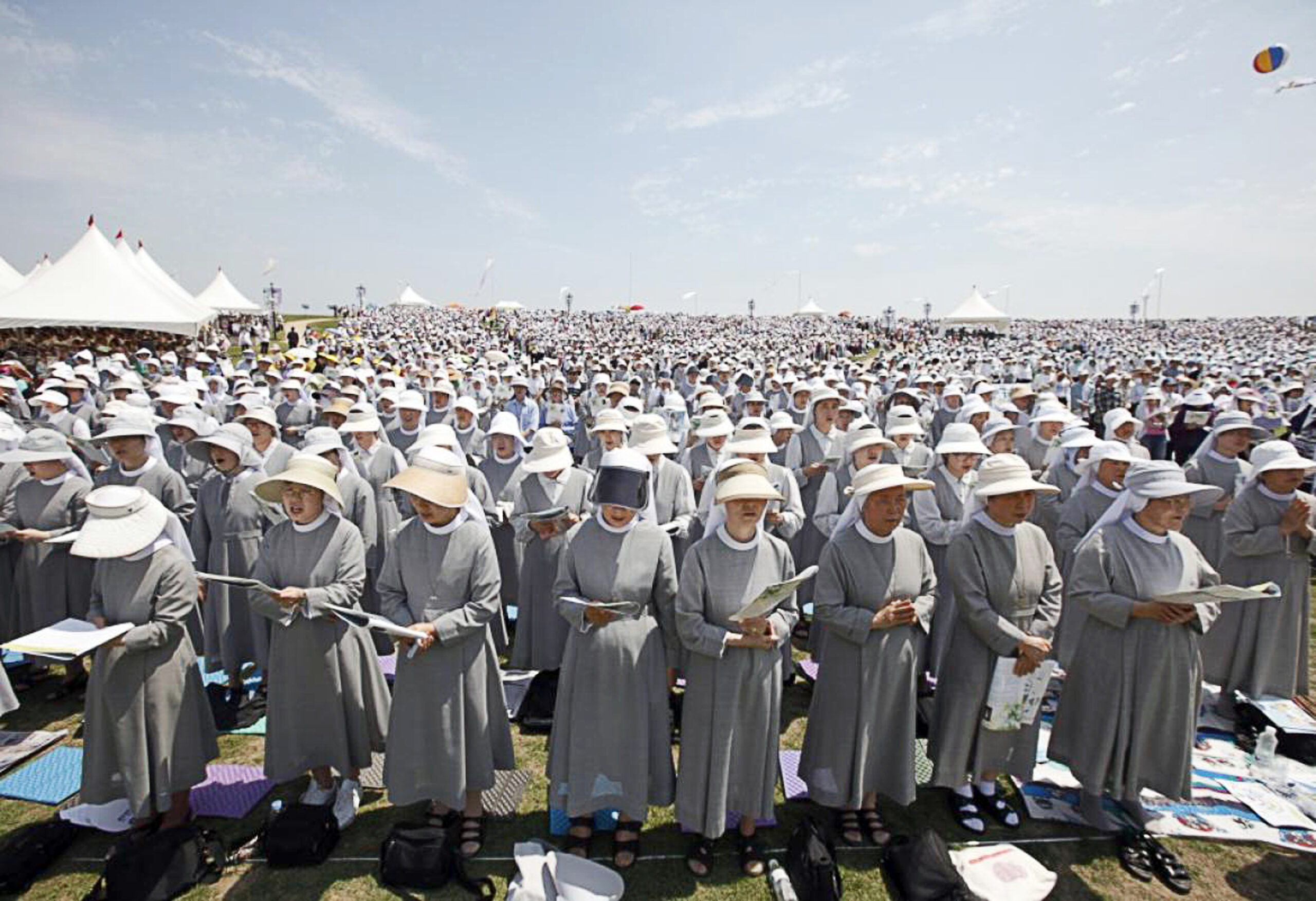
What has happened to our Sisters?” This is the question asked by many people who are looking for the nuns they knew from Hollywood movies like “The Bells of St. Mary’s” or “Come to the Stable,” or the long-garbed women who taught in Catholic schools. What has happened to our Sisters? The Second Vatican Council has happened!
It has been fifty years since the issuance of Perfectae Caritatis, the Vatican II document on the renewal of religious life. During those fifty years, religious life has undergone radical changes. Many people maintain that a new form of religious life for women emerged from the renewal initiated by many congregations. Others believe that the updating went too far and much of the former religious spirit of the life was lost. Regardless of which view you prefer, you cannot deny that religious life is not what it once was.
As radical as external changes in lifestyle may appear to be, they are nothing compared to the changes in self-understanding women religious have been required to make. Before the Council, they were considered brides of Christ, docile daughters of the church, who required very little, who were willing to serve where they were told to serve, who lived where they were told to live, and who seldom, if ever, assumed a leadership position in the local parish. Today, they understand themselves to be disciples of Jesus, apostles within the church, who, while still requiring very little, are willing to serve where there is pressing need, living in the midst of the people they serve, and holding many significant leadership positions in parishes, dioceses, even in the Vatican itself. These changes have been truly radical. Many of the external changes in the lives of women religious grew out of a radical new way they understood themselves.
Before the Council, women religious sought to harmonize two seemingly contradictory aspects of life: the active and the contemplative. For the most part, the active life was devoted to good works and the service of others. Prayer was, nonetheless, a necessary ingredient of this life for it inspired and strengthened one to act with courage and dedication. The contemplative life, on the other hand, held prayer and interior union with God as primary and everything else served that goal. Congregations addressed this tension by prescribing times of prayer throughout the day. Apostolic demands, that took a member from this responsibility, were avoided. At times, members called for more periods of prayer; at other times, they felt summoned to more involvement in apostolic works. Both of these aspects of religious life are valuable, both are essential. Many religious are still trying to balance them and are achieving varying degrees of success.
Instructed by the Council’s exhortation to recapture the original spirit of their congregation or order and inspired by the zeal of their early apostolic founders and foundresses, women religious came to see that they could no longer live a modified monastic lifestyle nor was it enough to increase their apostolic involvement. An entirely new worldview was developing, one that insisted the world should not be shunned. It should be transformed and women religious were to be a kind of leaven in this transformation. Such a worldview can only be characterized as apostolic.
APOSTOLIC CONSCIOUSNESS
This new apostolic self-consciousness has also forced religious to re-evaluate their ministerial commitments. If they had been founded to serve the poor and the neglected, the marginal and the forgotten, those rejected by society or beyond the reach of church agencies, perhaps the Spirit was calling them anew to these or to similar apostolic fields. Perhaps, like the first missionaries, they, too, were to leave the warmth and security of familiar surroundings in order to bring Christ and the Gospel to those who had no one to minister to them. For many, this has meant that the operation of well-established works be handed over to others, and that they venture out into new fields as their foundresses and founders had done. This move has frequently brought them into conflict with people accustomed to the former roles of women religious and resistant to new ones. It has catapulted them into social, political and ecclesiastical arenas where, like their spiritual ancestors, they may have to contend with structures at variance with the message of the Gospel. They may be “afflicted in every way, but not crushed; perplexed, but not driven to despair; persecuted, but not forsaken; struck down, but not destroyed” (2 Cor 4:8-9).
How do they cope in the midst of this tension? They find consolation in the conviction that they are responding to the call of God, a call that does not take them out of the world but situates them right in its heart, there to transform it by making Christ present through their presence. They do not see themselves as set apart but as sharing the life of others. Their lives witness to a way of living in the world where righteousness and tenderness, service and collaboration are the norm.
The notion of community has taken on an entirely different importance for such religious. No longer is it limited to common life with varying dimensions of uniformity. Different ministries call for different lifestyles. The pressing needs of people cannot always be programmed and so schedules vary, complicating the issues of community prayer, community meetings, and community participation. Once again, tensions abound. While all members may be committed to apostolic ministry, some see community as the incontestable wellspring from which flows authentic ministry. Others believe that community serves ministry in a supportive manner. This tension has not yet been resolved and plays its part in the present anxiety of religious life.
What shape apostolic life will eventually take is not certain, for this new self-consciousness is still relatively young. One thing is clear. Women religious are convinced of the appropriateness of the direction they have taken. They responded obediently to the challenge of the Council. They engaged their total membership in the renewal process. They believe that this is the work of the Spirit and, despite their mistakes and setbacks, they will continue on the path that lies before them.
The careful cultivation, daring experimentation, and painful pruning that have been described here all had its price and committed religious continue to pay it. When women of the pre-Vatican Church left home to join a religious congregation, they did not merely move from one locale to another, put aside one style of dress for another, and substitute one family unit for another. They really did leave the world that they knew with its values and manner of life in the hope of entering into a new way of living and acquiring a new worldview. For many, the world they left was a good world: loving, challenging, supportive, and the transition that they underwent was not without great sacrifice. Then with the Council, for a second time in their lives, they were asked to leave the warmth and security of the familiar and to venture into uncharted waters. The pain that this created was twofold. They were threatened by both a sense of loss and a recurring fear.
Much of the life to which they had committed themselves and for which they had sacrificed so much was now but a memory. Many even wondered if it had perhaps been a waste of themselves. The past, to which they had committed themselves, was not only cast aside as irrelevant but even often ridiculed. Many religious still grieve the loss of what they loved and feel that they must apologize for having loved what others consider worthless.
In addition to this, one of the most frightening aspects of post-Vatican religious life is its uncertainty. There are few contemporary customs that presume to guarantee the kind of certainty and stability that earlier customs had often dared to do. Because they are doing new things in new ways, women religious do not always have the assurance of knowing that they are right. True, ambiguity is a part of the post-Vatican experience of every serious Christian but, by their consecration, women religious have assumed certain added responsibilities that now weigh heavily on them. They struggle with doubt and confusion about these responsibilities, and the criticism that comes from so many quarters often compounds their anxiety. They cannot always turn to an authority for direction as they had done in the past. Blind obedience must give way to personal and communal discernment. A sense of security must be replaced by trust in God’s loving presence.
In another vane, if the primary task of the apostle is the transformation of the world, then a necessary ingredient of the apostolic disposition is patient endurance in the face of disappointment and failure. Apostles must face the possibility of being denied a sense of success. Identification with the poor and neglected, with the marginal and the forgotten does not guarantee that these needy people will open themselves to the ministry offered. Religious, so committed, frequently find themselves alienated from the “respectable” Christians. Gone is the myth that Sister can plant a medal of Jude, saint of the impossible, and a hospital will spring up in its place, or that the heavenly sound of nuns in choir will warm the heart of a hesitant benefactor.
Contemporary women religious know that their struggle is against the principalities and powers, against the structures of human greed and oppression. They also know that they are always vulnerable in this struggle. They know that, as apostles, they cannot withdraw. They know that, as Christians, they cannot compromise. But how can they face such a challenge? Somehow, they must be able to say with Paul: “For while we live, we are always being given up to death for Jesus’ sake, so that the life of Jesus may be manifested in our mortal flesh” (2 Cor 4:11).
Perhaps the heaviest cross that many contemporary apostolic women religious endure is the sense of being misunderstood by the very church that they have loved more than mother and father, more than husband and children. In the past, they had been treated by some as school girls, as chambermaids, as an unquestioning labor force. And yet they continued to serve. Now they have become disenchanted with these roles, with the structures that supported them, and with the theology that legitimated them. And yet they continue to serve. All too frequently, their renewal has been criticized, their ministry has been thwarted, and their commitment has been discredited. And yet they continue to serve. Is this ecclesiastical disapproval part of the birth pangs that often precede new life in the church, or is it a legitimate response to the excesses of which they have been accused? Sincere women religious are never quite sure.
Today’s women religious must be staunch in their convictions but they must also be humble in their stance. They may not live to see the resolution of their conflict. They can only trust that their struggle has not been for naught.
This unselfish trust is part of their greatness. In the meantime, they face soul-searching questions. How are they to be faithful when their new understanding of themselves is not appreciated? How is obedience to function in a collegial community? What forms should vowed poverty take in a congregation of professional women? Women religious continue to search because they have experienced God in the midst of all of the pain and excitement of the past. They are supported now by their faith in God’s compassion, and they are convinced that whatever the future holds, this same God will be there in righteousness and tenderness. Women religious are still religious women.