
Courage At Dawn

INTRODUCTION

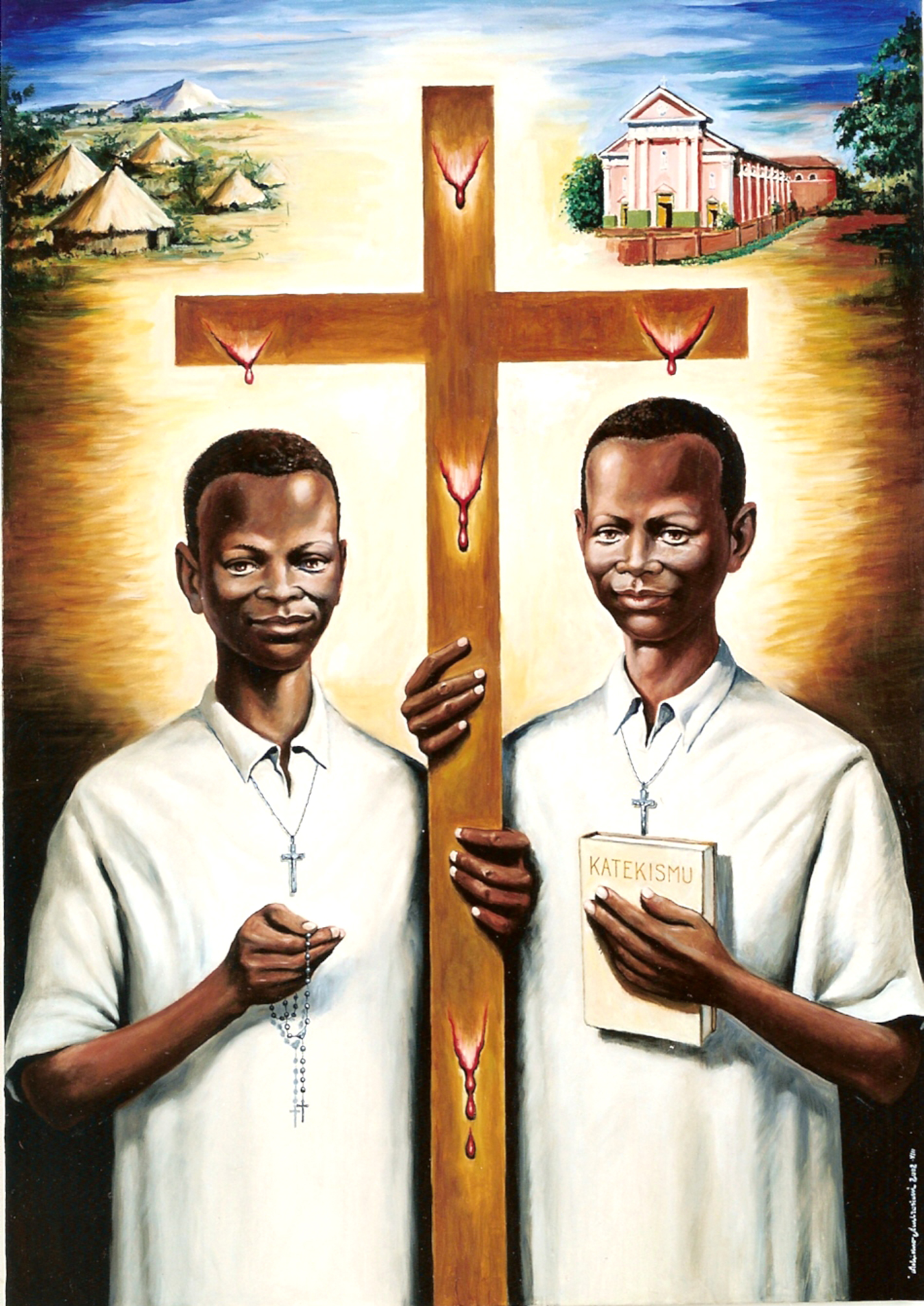
Few adolescents have the strength and the faith to answer the call and be a witness. In the beginning of the 20th century, Daudi Okelo and Jildo Irwa had it. In the Acholi region, they became very young but very active and respected catechists. When they were attacked because of sorcerers’ intrigues, they were only 18 and 16 years old. They both had the courage not to deny Jesus Christ and were killed. Their courage became a source of inspiration to the war-torn Northern Uganda.

WRITTEN BY

SHARE THE WORD

PUBLISHED ON

In the beginning of the 20th century, in the vast area of savannah in the North-Eastern part of Uganda, bordering with the Sudan, life was going on as it had from time immemorial: the antelopes, buffalos, lions and the other great games were roaming the plains as they had done since the beginning of creation and the humans were scratching the soil for the traditional crops of millet, peanuts and sesame.

In 1915, two Italian Comboni missionaries arrived in Kitgum, the main settlement of that area of northern Uganda: Fr. Antonio Vignato and Fr. Giuseppe Beduschi. They were the forerunners who had come to see the place and decide if it fitted their aims. A month later, two of their confreres arrived, Fr. Gian Battista Pedrana and Fr. Cesare Gambaretto. They settled in the midst of the people, “around the fire,” as they say there, to listen, converse, and announce the Gospel. This was something new for the tribe of the Acholi, who had always lived in fear of the white people (Arabs and Europeans) who had appeared sporadically in their land: the Arab slave traders and ivory merchants and the British colonial officers who had recently arrived and imposed forced labor, an imposition that had even produced a rebellion in the mountains.

ENCOUNTERS OF FRIENDSHIP
The missionaries soon began gathering together the listeners in the villages, initiating a catechumenate with some of them. Daudi and Jildo were among the first who joined the instruction. Jildo’s father, who later became a Christian, remembers his encounter with one of the missionaries, Fr. Cesare: “He would visit my family often. He loved the children, and Jildo was one of the first to get to know the Father.”

These were encounters of friendship. The missionary taught them the Christian prayers and spoke to them of Jesus, the Son of God, who became a man in the womb of the Virgin Mary and died on the cross to save us. He did this through the recitation and explanation of the Rosary, telling them the history, the events. Jildo and Daudi were struck by these stories and the figure of the missionary who moved about from village to village. The two boys decided, together with others, to follow the missionary as far as Kitgum. Daudi and Jildo were around 16 and 14 years old, respectively, when they started their journey to go to the mission in Kitgum, being both children of pagan families.

CHRISTIANS AND CATECHISTS
In Kitgum, they learned the catechism of St. Pius X, translated two years earlier into the Acholi language by Fr. Pasquale Crazzolara, who would become one of the greatest African linguists. Daudi had brought with him a girl he intended to marry. But after some time, the girl, struck by a devastating attack of chiggers in her feet, had to return home. Daudi put her out of his mind and continued to attend catechism classes with great determination. Jildo also showed himself to be a determined boy. His father declared that he himself would take food to the catechumenate in Kitgum, because his son was so wrapped up in his new commitment as not to be concerned in the slightest with eating.

Daudi and Jildo received Baptism and Holy Communion in 1916. The missionaries chose some of the newly baptized to train as catechists and sent them among the people in far-away villages, just as Jesus had done with His disciples. Daudi and Jildo were chosen. Both of them had shown willingness to make any sacrifice in order to proclaim the salvation of Jesus Christ. They no longer wanted to return to their villages. They were ready to go wherever they would be commissioned.

In 1917, a year after the celebration of the Sacrament of Confirmation, the two young converts were sent to Paimol, because the incumbent catechist, Antonio, had met a premature death. Paimol was a hilly area about fifty miles from Kitgum, with various villages, one of which, called Palamuku, became the place of their martyrdom. Now, after the sacrifice of Daudi and Jildo, the village is called Wi-polo (“Heaven”) by the local Christians.

DEATH IN “HEAVEN”
Before their departure, Fr Cesare spoke to them: “So you are willing to go to Paimol. What if they kill you?” Daudi replied, “We will go to heaven. Antonio is already there, isn’t he?” Jildo reiterated, “Father, you surely are not afraid like the others? Jesus and Mary are with us.” Surprised by the faith of the two youths, Fr. Cesare went silently into his room and came back with a catechism and a rosary for each of them. Kneeling, Daudi and Jildo received the tools of their apostolate. Together they recited a Hail Mary, and the Father blessed them and sent them on their way.

In Paimol, they were welcomed by the vice-chief of the clan. He offered them food, but Daudi and Jildo would not accept food without earning it by their labor. In the morning, before sunrise, they would beat the drum to call the children to the recitation of the prayers and a short period of catechism. The children would then go to their activities in the fields and pastures, while the two catechists, before going to their own work of farming the land, would recite the Rosary since they could not attend Mass.

Their daily program continued in the afternoon. After working in the fields, they would wash their feet and hands and eat, then would call the children together once again by the sound of the drum, resume their teaching of prayers and catechism, and conclude in the evening, before going to bed, with the recitation of the Rosary. We have the people’s witness for this: “When Daudi and Jildo lived in Paimol, the kids were happy to go see them and they too were glad to receive the kids. All the people in the village, with no exceptions, loved them for the good they did. They were totally devoted to doing their duty, until they were killed. They died in the precise fulfillment of their duty.”

SACRIFICE AT DAWN
From 1916 onwards, the situation had become very difficult in Paimol for a drought had brought famine to that region. The tribal chieftain of Paimol, Lakidi, had been arrested, tried, and imprisoned in Kitgum by the English colonial authorities on the false accusation of illegal possession of weapons. The local rebels and the slave traders and ivory merchants were intolerant of the commitment of the catechists, who with their teaching were introducing a disturbing element into their sinister, flourishing business and immoral conduct that was contributing to the spread of venereal diseases.

They sought the alliance of the ajwakki (sorcerers) and accused the Christian religion of Daudi and Jildo of the evils that had occurred: famine, pestilence, and oppression by foreigners. From hatred to the elimination of the catechists was a brief step. It would be a lesson to all and a diktat to abandon the Christian faith they had brought! The plan to kill the catechists was prepared. One of the attackers, Okidi Ibrahim, dragged Daudi out of the hut and beyond the fence, and having ordered him in vain to abandon the Christian faith, mortally wounded him with a spear. Jildo, who had been left in the hut because he was too young, came out and started yelling, “If you killed Daudi because he taught the new religion, then kill me too. I also taught the religion with him.” Opio Akadamoi grabbed him and ran him through with a lance, then finished him off with a dagger. It was Sunday, October 20, 1918. The two boys were 18 and 16 years old, respectively.

Their bodies were abandoned in the grass, until a merciful hand pulled their remains to a spot near an isolated anthill. Their relics were then transported to the Mission Church of Kitgum, where they had been baptized. Fr. Cesare started immediately to collect testimonies about their martyrdom. The depositions of all the witnesses affirm that the two catechists were killed “for nothing” meaning that they had nothing to do with reasons for the uprising. The witnesses added that they died “for the sole reason of teaching religion.” Daudi Okelo and Jildo Irwa were beatified in Rome, on Mission Sunday, October 20, 2002, by Pope John Paul II. It was exactly the day of their martyrdom.

Daudi and Jildo remind those who wanted to kill them that no one would ever be able to bar the door to Jesus Christ. Today, thanks also to them, Uganda definitely belongs to Christ: Christians make up 70% of Uganda’s 25 million people. The best fruit of their martyrdom has been a host of catechists in northern Uganda. Many of them have sealed the announcement of the Gospel with their blood. In the Diocese of Gulu alone – to which Kitgum belongs – at least 80 catechists have been killed in the past twenty troubled years.

Share Your Thoughts

All comments are moderated

From The Same Issue

The articles and content about this issue

From The Same Issue

The articles and content about this issue

From This Topic

The articles and content about this topic

From This Topic

The articles and content about this topic

Missionary Vocation

Noah’s Ark

Explore Other Topics

Browse other coverage

Explore Other Topics

Browse other coverage

WM SPECIAL

Presents, discusses and draws readers to reflect on issues of outmost relevance to the world today.


FRONTIERS

Very often, mission is carried out in frontier situations around the world. Those who embrace these situations have much to share.


UNITY IN DIVERSITY

Writer Ilsa Reyes will be exploring the richness of Pope Francis’s latest encyclical Fratelli Tutti with a view of helping our readers to get a grasp of the this beautiful papal document.


FRONTLINE

Puts to the front committed and inspiring people around the world who embrace humanitarian and religious causes with altruism and passion.


IN FOCUS

Focus on a given theme of interest touching upon social, economic and religious issues.


FAITH@50

As the Philippines prepares to celebrate 500 years of the arrival of Christianity. Fr. James Kroeger leads us in this series into a discovery journey of the landmark events in the history of faith in the Philippine archipelago.


INSIGHT

Aims to nurture and inspire our hearts and minds while pondering upon timely themes.


FILIPINO FOCUS

The large archipelago of the Philippines, in its richness of peoples and cultures, offers varied and challenging situations for mission.


FOLLOW ME

Reflections and vocation stories that shape up the lives of young people.


MISSION IS FUN

As humor and goodness of heart are qualities of Christian and missionary life, the new column “Mission is fun” will be publishing some anecdotes and stories that have happened in a missionary context to lighten up the spirits and trigger a smile in our faces.


LIVING COMMUNION

To help readers of World Mission live this year dedicated to Ecumenism, Interreligious Dialogue and Indigenous Peoples, Tita Puangco, writer and lecturer, shares in this section insights on the spirituality of communion.


WINDS OF THE SPIRIT

A historic view of the Catholic movements that emerged from the grassroots as an inspiration by the Holy Spirit.


BRIDGE BUILDERS

On the Year of Ecumenism, Interreligious Dialogue and Indigenous Peoples, radio host and communicator Ilsa Reyes, in her monthly column, encourages Christians and people of good will to be one with their fellow people of other sects, religions and tribes.


INTERVIEW

Questions to a personality of the Church or secular world on matters of interest that touch upon the lives of people.


WORLD TOUCH

News from the Church, the missionary world and environment that inform and form the consciences.


CARE OF THE EARTH

A feature on environmental issues that are affecting the whole world with the view of raising awareness and prompting action.


EDITORIAL

The editor gives his personal take on a given topic related to the life of the Church, the society or the world.


YOUNG HEART

A monthly column on themes touching the lives of young people in the Year of the Youth in the Philippines by radio host and communicator I lsa Reyes.


SCROLL

A missionary living in the Chinese world shares his life-experiences made up of challenges and joyous encounters with common people.


EXTRAORDINARY PEOPLE

Life stories of people who deserve to be known for who they were, what they did and what they stood for in their journey on earth.


ONE BY ONE

Stories of people whom a missionary met in his life and who were touched by Jesus in mysterious ways.


INCREASE OUR FAITH

Critical reflection from a Christian perspective on current issues.


SPECIAL MOMENTS

Comboni missionary Fr. Lorenzo Carraro makes a journey through history pinpointing landmark events that changed the course of humanity.


PROFILE

A biographical sketch of a public person, known for his/her influence in the society and in the Church, showing an exemplary commitment to the service of others.


WM REPORTS

Gives fresh, truthful, and comprehensive information on issues that are of concern to all.


LIFE'S ESSENTIALS

A column aimed at helping the readers live their Christian mission by focusing on what is essential in life and what it entails.


ASIAN FOCUS

Peoples, events, religion, culture and the society of Asia in focus.


THE SEARCHER'S PATH

The human heart always searches for greatness in God’s eyes, treading the path to the fullness of life - no matter what it takes.


INDIAN FOCUS

The subcontinent of India with its richness and variety of cultures and religions is given center stage.


AFRICAN FOCUS

The African continent in focus where Christianity is growing the fastest in the world.


JOURNEY MOMENTS

Well-known writer and public speaker, Fr. Jerry Orbos, accompanies our journey of life and faith with moments of wit and inspiration based on the biblical and human wisdom.


IGNATIUS STEPS

On the year dedicated to St. Ignatius of Loyala, Fr. Lorenzo Carraro walks us through the main themes of the Ignatian spirituality.


THE SEVEN LAST WORDS OF JESUS

Fr. John Taneburgo helps us to meditate every month on each of the Seven Last Words that Jesus uttered from the cross.


INSIDE THE HOLY BOOK

In this section, Fr. Lorenzo delves into the secrets and depths of the Sacred Scriptures opening for us the treasures of the Sacred Book so that the reader may delight in the knowledge of the Word of God.


CONVERSATIONS

Reflections about the synodal journey on a conversational and informal style to trigger reflection and sharing about the synodal path the Church has embarked upon.


VATICAN II

This 'mini-course' series provides a comprehensive exploration of Vatican II, tracing its origins, key moments, and transformative impact on the Catholic Church.


COMBONIS IN ASIA

This series offers an in-depth look at the Comboni Missionaries in Asia, highlighting their communities, apostolates, and the unique priorities guiding their mission. The articles provide insights into the challenges, triumphs, and the enduring values that define the Comboni presence in Asia.


BEYOND THE SYNOD

Following the Synod on Synodality, this series examines how dioceses, parishes, and lay organizations in the Philippines are interpreting and applying the principles of the synod, the challenges encountered, and the diverse voices shaping the synodal journey toward a renewed Church.


A TASTE OF TRADITION

This series introduces the Fathers of the Church, featuring the most prominent figures from the early centuries of Christianity. Each article explores the lives, teachings, and enduring influence of these foundational thinkers, highlighting their contributions the spiritual heritage of the Church.


A YEAR OF PRAYER

In preparation for the 2025 Jubilee Year under the theme “Pilgrims of Hope,” 2024 has been designated a Year of Prayer. World Mission (courtesy of Aleteia) publishes every month a prayer by a saint to help our readers grow in the spirit of prayer in preparation for the Jubilee Year.


OUR WORLD

In Our World, the author explores the main trends shaping contemporary humanity from a critical and ethical perspective. Each article examines pressing issues such as technological advancement, environmental crises, social justice, and shifting cultural values, inviting readers to reflect on the moral implications and challenges of our rapidly changing world.


CATHOLIC SOCIAL DOCTRINE

This series unpacks the principles of Catholic Social Doctrine, offering a deep dive into the Church's teachings on social justice, human dignity, and the common good.


HOPEFUL LIVING

Hopeful Living’ is the new section for 2026, authored by Fr. James Kroeger, who dedicated most of his missionary life to the Philippines. In this monthly contribution, he will explore various aspects of the virtue of hope. His aim is to help readers align their Christian lives more closely with a hopeful outlook.


PHILIPPINE CROSSROADS

Filipino Catholic scholar Jose Bautista writes each month about how the Philippines is at a crossroads, considering the recent flood control issues and other corruption scandals that have engulfed the nation. He incorporates the Church’s response and its moral perspective regarding these social challenges.


BIBLE QUIZ

Test your knowledge and deepen your understanding with our Bible Quiz! Each quiz offers fun and challenging questions that explore key stories, themes, and figures from both the Old and New Testaments.


Shopping Cart