
At a time when bailouts appear to be a bust, policymakers seem befuddled, and the economic crisis shows no signs of abating; people are looking for alternatives to the conventional wisdom.
Benedict XVI’s recent encyclical “Caritas in Veritate,” was a boon to the so-called “alternative economics” movement, and at least one such economic philosophy that sprang from the papal social encyclicals, distributism, is enjoying somewhat of a renaissance.
But many are skeptical, and believe distributism is simply romantic agrarianism, or worse, just an aesthetic sensibility, without any real practical solutions. John Medaille*, one of the preeminent neo-distributists, set out to address the critics. The result, a distributist manifesto entitled, “Toward a Truly Free Market: A Distributist Perspective on the Role of Government, Taxes, Health Care, Deficits, and More (ISI), could not be timelier as governments around the world wrestle with social and fiscal crises.
In this interview he explains what’s missing in current economic theory and why distributism deserves renewed appreciation.
Your book begins by examining the basic assumptions of what is generally called “economics.” What are those assumptions? Are they the cause of the current global economic crisis?
– The two most basic assumptions in economics today – and by the way, they are both wrong – are that economics is a physical rather than a human science, and that as such it can have nothing to do with questions of ethics. Since the end of the 19th century, economics has sought to do away with justice, especially distributive justice, but in doing so, it has lost the ability to accurately describe any actual economy. Therefore, no one should be surprised to learn that 90% of economists missed the warning signs of the current meltdown. The same was true during the last meltdown, and the one before that, etc. You cannot accurately predict the course of a system if you cannot accurately describe it.
Distributism, on the other hand, asserts that justice is not only a moral problem, but a practical, economic problem, and that without economic justice, you cannot reach equilibrium. When economics abandons justice, the government is constantly forced to intervene to ensure stability, even though the interventions may only work in the short run.
We have abandoned justice on a global scale, which has led to chronically unbalanced trade. When trade is chronically unbalanced, it is not really “a trade” at all. Rather, it is a system by which foreign producers finance our consumption of their goods, a system that impoverishes both parties.
Most people believe that the battle for the soul of capitalism is between the followers of Keynes and the followers of Hayek. But you believe both theories lead to what Hilaire Belloc called the “servile state.” Why is that? What are they and their followers missing?
– Capitalism and socialism are really not opposed realities; one is just the continuation of the other, and distributism is the opposite of both: it is the free market. Capitalism tends to concentrate property in the hands of a few, thereby choking off the market, and socialism continues this by concentrating ownership in the hands of the state. In practice both systems end up with control of the most important resources of the nation in the hands of a few bureaucrats – super managers who claim to represent the interests of the nominal owners, be they the shareholders or the general public, but who actually control these resources for their own benefit.
Further, in concentrating economic power, they also concentrate political power, and the large corporations are able to obtain vast privileges and subsidies for themselves, as we saw in the recent meltdown. Thus, between the gargantuan state and the gargantuan corporation, the individual is reduced to a situation of servility.
What both capitalism and socialism are missing is the willingness to admit that power follows property. Both systems claim to create freedom by concentrating capital, but because this also concentrates power, what is left for the mass of men is powerlessness. Distributism, on the other hand, seeks to build an ownership society of free men and women, conscious of their rights and with the means to defend them against the centralizing tendencies of both the state and the corporate collectives.
THE DISTRIBUTION OF POWERS
What is distributism? Isn’t it just redistributionism, or splitting the difference between capitalism and socialism? How could such a philosophy, which relies on a certain amount of government intervention, create a truly “free” market?
– Actually, it is not so much a question of what the government should do as what it should stop doing. In truth, the accumulation of property usually depends on government power; the higher the piles of capital, the thicker the walls of government necessary to protect them. There are, of course, positive things that government can do, with tax policy, for example, or simply by enforcing its own laws against monopoly and oligopoly. And there are cases where the title to land or other resources is questionable to begin with. But in general, a distributive society requires a smaller government with powers properly distributed throughout all levels of society.
In contrast to a system of concentrated economic and political power, distributist systems rely on a variety of forms of small ownership to distribute economic power: proprietors for property that can be easily used and managed by a single person or a family, cooperatives for larger enterprises, local public ownership for resources like water or sewer systems, employee stock ownership systems, when that is appropriate, and so forth. In this way, both economic and political power is distributed throughout all levels of society. There are really only two choices when it comes to property and power: concentration or distribution. The former leads to servility, and the latter to liberty.
What does a distributist society look like? Are there any examples anywhere in the world?
– Excellent question! When dealing with economic systems, it is best not to rely totally on abstract theory, but to trust only systems that are on the ground and working. For example, pure capitalism and pure communism (outside of monastic settings) have never worked, and have no functioning examples. Capitalism has always been imposed through, and sustained by, government power, while socialism has had to allow some freedom in the market in order to function at all.
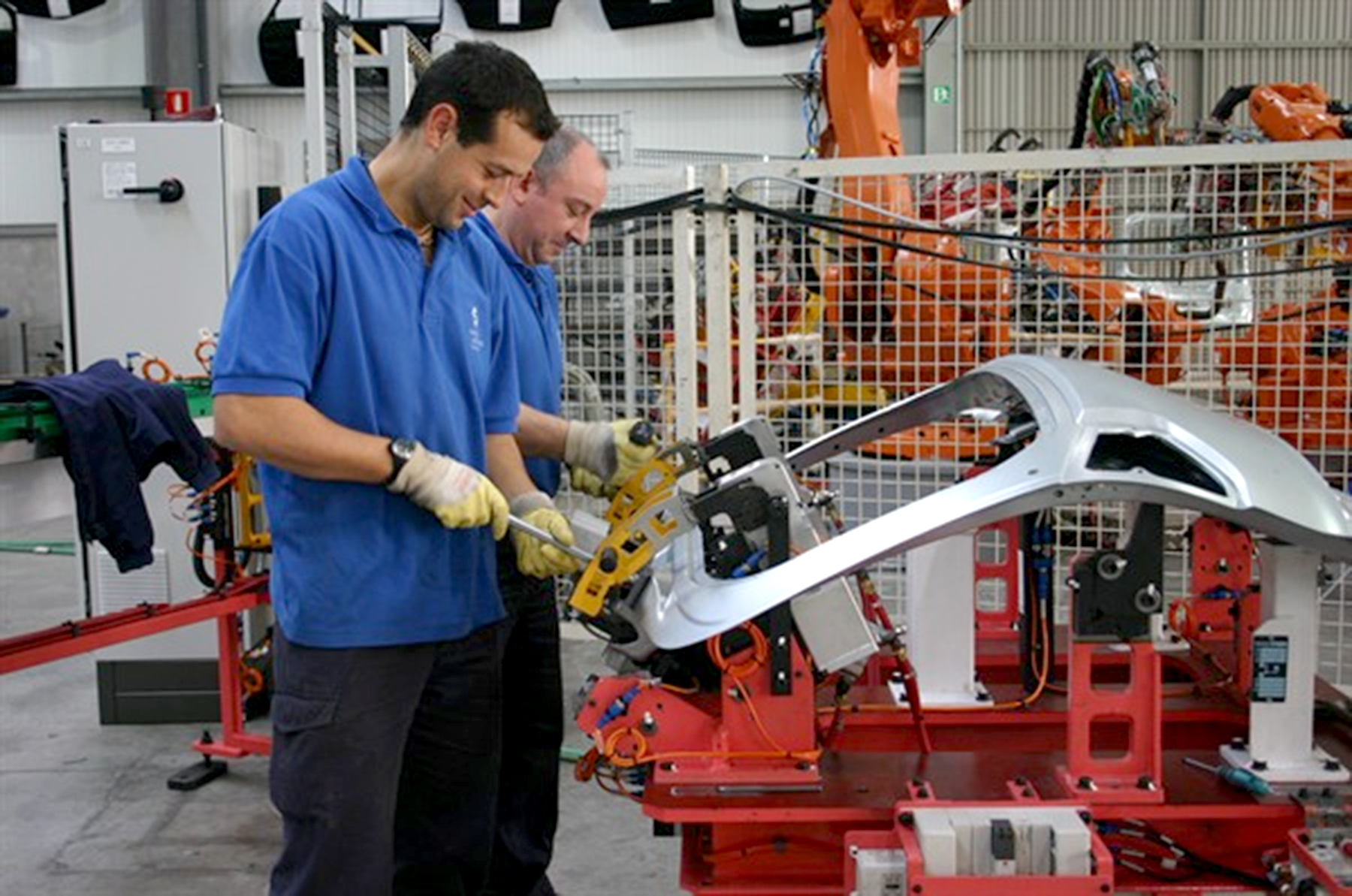
Distributism, on the other hand, can display any number of working models, both on large and small scales. There is the worker-owned Mondragón Cooperative Corporation of Spain, which has 100,000 worker-owners and makes $25 billion in sales; there is the cooperative economy of Emilia Romagna (Italy), where 40% of the GDP is from cooperatives. And there are thousands of ESOPs, cooperatives, mutual insurance companies, and credit unions. Indeed, the historical truth is that distributism goes from success to success, while capitalism stumbles from bailout to bailout.
What is especially interesting is that a distributist society like Mondragón has been able to provide its own social safety networks, school systems, training institutes, R&D centers, and a university all from its own funds and without government subsidies. It is much closer to the libertarian ideal than anything that laissez-faire has ever been able to produce.
SUBSIDIARITY AND SOLIDARITY
By offering practical solutions to today’s toughest economic problems, your book seems to address the many critics of distributism who ignore it for its supposed impracticality or its neo-agrarianism. What are the basic principles or building blocks a distributist uses to compare and construct policy alternatives?
– The major principles of distributism are subsidiarity and solidarity. By subsidiarity, we mean that the lowest levels of society, starting with the family, are the most important, and as much decision-making authority and power as possible should reside there. Higher levels justify their existence only by the help they can give to the lower levels. Solidarity dictates that any political decision must keep in mind the poorest and most vulnerable members of society.
Subsidiarity is difficult to realize in a situation where power is concentrated; only by the diffusion of economic and political power (and the two are just different aspects of the same power) can local communities and families flourish.
Does distributism have any basis in Catholic social teaching or the papal encyclicals like the recent Caritas in Veritate?
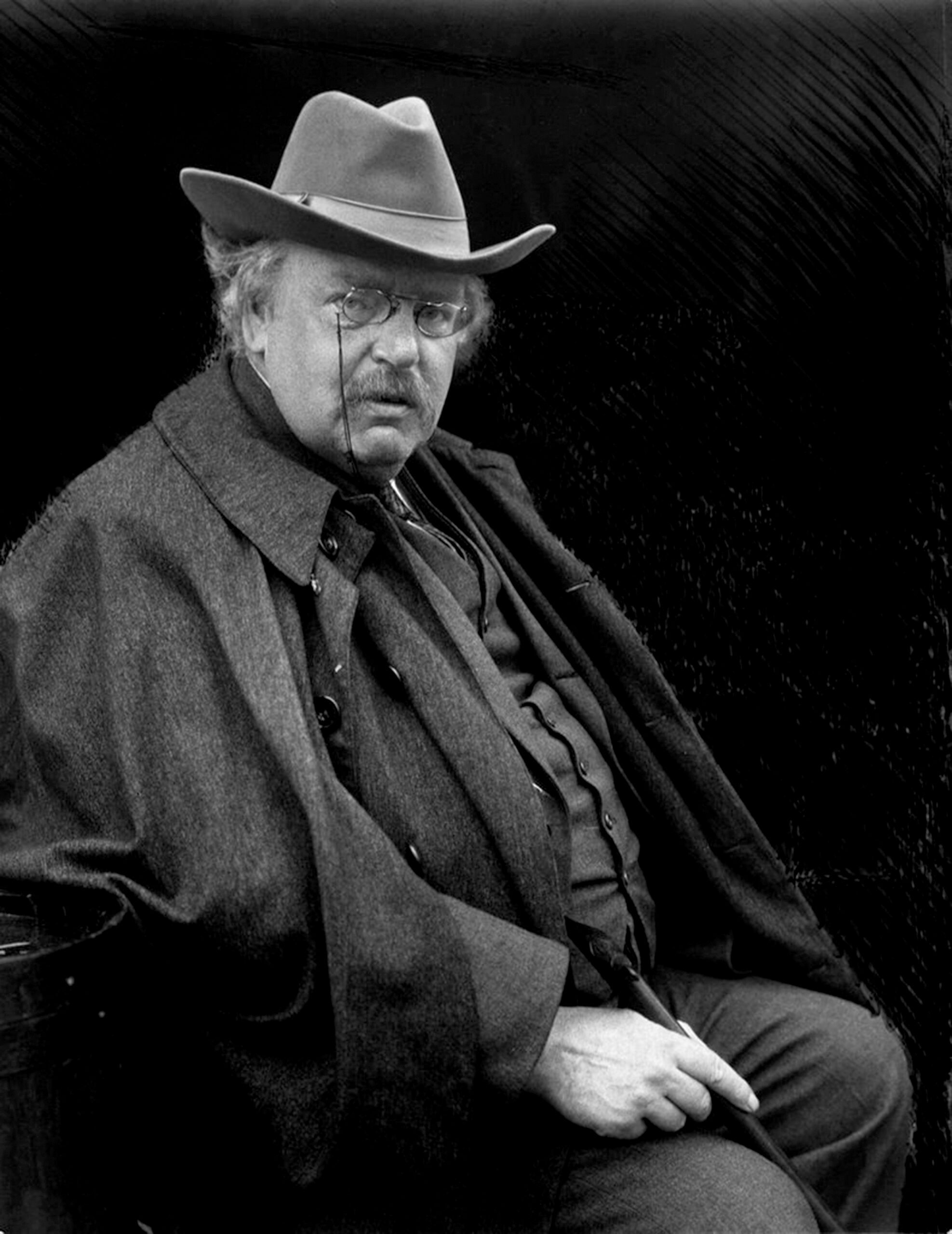
– Subsidiarity and solidarity are, of course, straight out of the social encyclicals, and distributism owes much to its Catholic founders, G. K. Chesterton and Hilaire Belloc (see pages 34-37). That being said, a distributist social order does not depend on the prior establishment of a Catholic social order. However, we believe that such a social order will thrive under a distributist system.
Can you briefly summarize the distributist solution to the seemingly intractable problem of providing as many people as possible with affordable health care?
– Our country (USA) has just been through a rather poisonous debate on this topic, one which entirely missed the real point, because it was based on a spurious distinction between socialism and the private market. The reality is that, in health care, we have neither. The government already pays 45% of all health care costs, and the “private” market is, in fact, dominated by government-enforced monopolies through patents, licenses, and “certificates of need” for hospitals. Indeed, the signature of a monopolistic market is constantly making prices rise even in the face of declining services, and that is the reality of our health care market.
Now, distributism would not be of much use unless it could solve practical problems like this, and it can. In brief, in the book, I propose an expansion of the licensing authorities to increase the supply of medical personnel; it proposes a way of expanding research and development without resorting to monopolistic patents; and proposes the formation of cooperatives of doctors and other personnel which can serve as both “insurance” companies and health care delivery firms, thereby giving the firm the ability to ensure health rather than just treat diseases.
Of course, I go into much more detail on this in my book, but yes, distributism offers a new path on many of the most vexing problems. www.zenit.org
* Medaille is co-editor of The Distributist Review webzine, and an adjunct instructor at the University of Dallas.