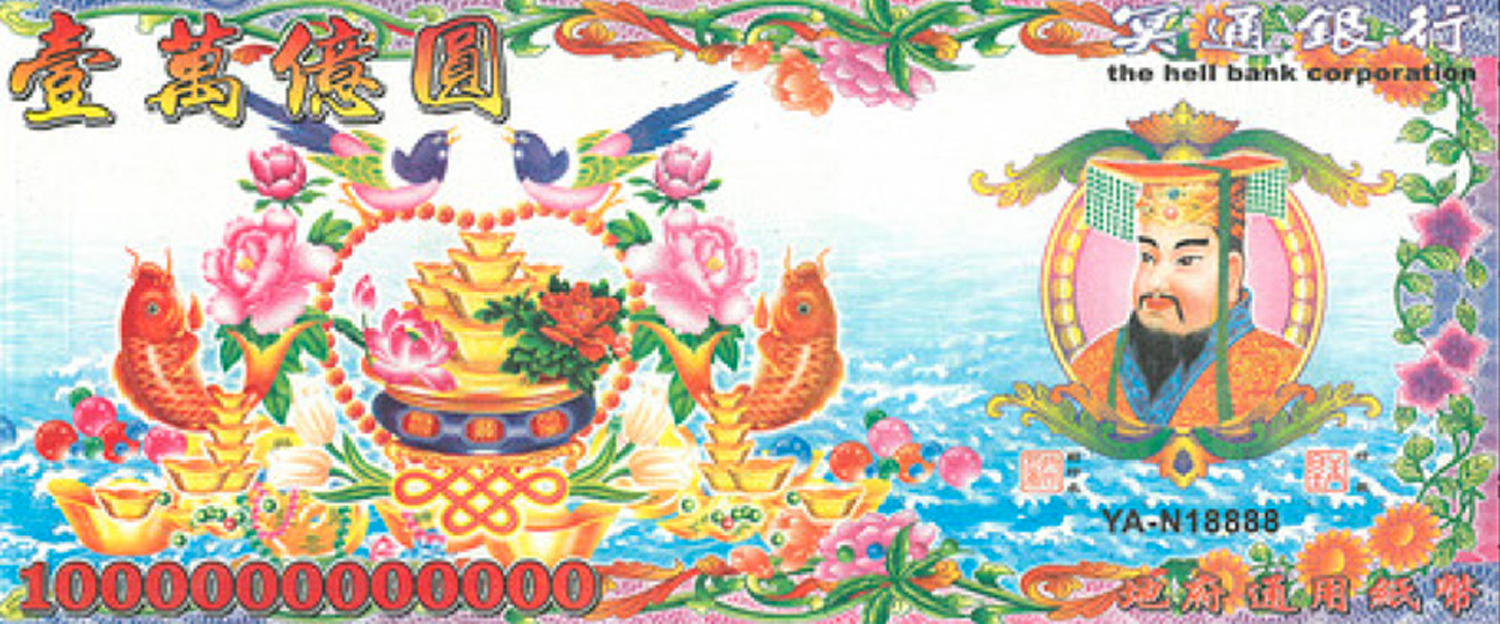
Traditionally, paper money burned in China came in small denominations of fives or tens. But more recent generations of money printers have grown less restrained. The value of the biggest bills has risen in the past few decades from the millions and, more recently, the billions. The reason: even Hong Kong’s dead try to keep up with the Joneses, and their living relatives believe that they need more and more fake bucks to pay for high-cost indulgences like condos and iPads.
This year, on the narrow Hong Kong streets that are filled with shops that specialize in offerings for the dead, there appeared a foot-long, rainbow-colored $1 trillion bill. “What we have right now is hyperinflation,” says University of Hong Kong economist Timothy Hau. “It’s like operating in Zimbabwe.”
The inflation problem worsened during this year’s Hungry Ghost Festival, when the gates of the underworld are believed to open and ghosts are allowed to wander the earth. Residents across the city staged traditional opera performances to entertain their supernatural guests (leaving the front row of seats empty for ghost spectators), cooking elaborate meals of roast meats for their enjoyment and burning wads of fake money on the sidewalks in their honor.
The inflation in the underworld mimics what is happening above ground. In recent years; both Hong Kong and mainland China have felt the impact of higher prices. With its rising cost of food and housing, Hong Kong, in particular, has its hands tied in fighting inflation, thanks, in large part, to its currency peg with the U.S. dollar, which keeps the city’s interest rates low.
“Inflation is everywhere so, of course, it happens in the underworld too,” says Li Yin-kwan, 42. The $1 trillion bill is the most popular note in her shop, she says, “because it allows the ghosts to buy many things, such as a fancy car and a big house.” Still, she said that there is also a place for burning smaller-value bills. “The ghosts need spare change to buy daily necessities, too,” she says, “such as clothes and food.”
Vendors like Ms. Li point to other worrying signs of an underworld economic crisis, including the proliferation of paper credit cards from the Bank of the Underworld – some adorned with pink diamond motifs and VIP stickers, and others colored mint green like American Express. Other symptoms of a splashed-out consumer economy are afoot, including paper iPads, flat-screen TVs with 3-D glasses and sports cars.
Economists say the problem is that the underworld has no control over how much currency enters its economy. The more “ghost money” burned, the more inflation continues to zoom upward. “Inflation is, everywhere, a monetary phenomenon,” says Mr. Hau, citing the late economist Milton Friedman. “It’s the money supply that’s causing it.”
Hong Kong’s central bank, the Hong Kong Monetary Authority, says it is powerless to address underworld inflation because it lacks the regulatory authority. “As a result, [the HKMA] does not collect monetary statistics on the amount or value of currency in circulation in the ‘afterworld’ or seek to regulate its issuance activities,” said a spokeswoman who apologized for not being funnier in her reply.
According to Chinese tradition, burning ghost money – which in many ways is more of a cultural than religious practice – is a vital part of ancestor care. The traditional view of the Chinese afterlife is that it closely mirrors the real world, with its own otherworldly bureaucracy full of officials that need careful cajoling – not to mention bribes.
“We’ve got corruption in the underworld as well,” says Maria Tam, Chinese University of Hong Kong anthropologist. For example, she says, if you burn a paper house for your ancestors, you have to burn money as well. “Otherwise some petty bureaucrat down there will probably take it for their own,” said Ms. Tam. “So you need money to bribe them.”
Cash is needed for other pursuits as well. “In the underworld, they also need money to gamble,” says Mr. Cheung. “No money, no fun.” www.online.wsj.com/Te-Ping Chen