Jesus does not answer this question because it is the wrong question. Salvation is not a line to cross, it is a process of coming out of our self-centeredness, which has to be taken off as far as possible. Focusing simply on the question, we will try to guess why Jesus doesn’t tackle it.
It is not easy to define what consists the salvation spoken about in all the gospel pages. The earthly concept seems to be that of liberation from a danger or a desperate situation. A medical doctor attends to patients in the hospital every day, but we can say that he has saved someone, when he has prevented a terminally ill patient from dying. This concept applied to spiritual life can be deceitful. The greatest danger of a spiritual journey is to stop progressing – not finding obstacles on the way. Salvation for a person means not so much to be freed from something, but to unfold to a maximum of human fullness. Let us examine some questions which, however, we should always avoid, because the proposed alternative is not real. We will try to give an answer to what doesn’t have an answer.
1. Do we save ourselves or is it God who saves us? In fact, there’s no such alternative because God’s and man’s actions are not of the same nature; therefore, one doesn’t oppose the other. God does not operate as second cause, but directly within the essence of our being. In Him, acting and being coincide. God is saving me now, but that “me” does not refer to my inner self. If I try to save my inner self, it is because I haven’t discovered God’s action, even less have I made it mine. “For whoever wishes to save his life will lose it” (Lk 9:24).
2. Is salvation for the hereafter or for the here and now? This question is of the greatest importance. Why do we insist on separating the afterlife from the here and now, the earthly reality from the spiritual, the transitory from the eternal, etc.? We won’t solve the problem if we do not arrive at a synthesis. The human being is a unit. His salvation must also be one. There cannot be salvation in the afterlife without salvation here on earth. Here and now takes place the salvation that will last forever. The present moment bears the whole eternity.
3. How does Christ save us? For every Christian, there is no doubt that it is Jesus who saves us. For that reason, the question is not on “if,” but on “how” He saves us. To be sure, we do not put in doubt the assertion; we only want to specify its meaning, because in the immense majority of the cases, it is wrongly understood. We cannot repeat today the arguments of Saint Anselm: “Christ, with an action of infinite value, paid to God the infinite offense of the human being….” The God who demands the death of His own Son to be able to pardon, besides being an ancestral myth, is not the God of the Gospel. Jesus saves us as He saves Himself as a man. He has shown us the way and has demonstrated that it is possible, also for us, if we assimilate what He lived by, and make our own what has saved Him.
4. Do religions save? Gandhi said that “religions are different roads converging to the same point.” I agree, but we must say that they are instruments we may not always know how to use and, too frequently, we use in a bad way or confuse them with the goal itself. All religions are a consequence by which people, in a certain moment of history, have felt themselves to be saved. Having found salvation for themselves, they try to take it to others. Since salvation is not transferable, norms, rites and doctrines that can help are offered. When all this is organized, a religion is created. The reality is that all religions bind more than they free; oppress more than they save. Also ours, in spite of the daring phrase: “outside the Church there is no salvation.” Badly understood, all religions are false and none saves.
5. Do sacraments save? A wrong understanding of Christ’s salvation causes that we understand wrongly all the sacraments. We tend to think that God’s action in them is external and instrumental, “ex opere operato.” The concept of the sacraments as spot removers or quick polishers brought us to a cul-de-sac. It is enough to remember the preoccupation to look for the priest, at the time of death, so that he could dispatch properly a moribund person. Such mechanistic and extrinsic vision of salvation has impoverished our religiosity to incredible limits. We must discover all the magic that hides in that vision, and how can we today leave that marsh and continue looking for the true salvation in the attitudes of each person in his/her real life.
6. Is salvation always the same for all? Take the Cro-Magnon man, we ourselves, and the man of 20,000 years from now: would we all have the same possibilities of salvation? It would be reasonable to think that, as the human being advances in his evolution, his possibilities of fullness also increase and, thus, his possibilities of salvation. It is not an idea easy to assimilate, but if we could accept that the human being is in evolution, perhaps many outright fundamentalisms would disappear. To think that we can determine what the future man can be, is to ignore our limitations, as well as the history of life that is always in evolution. From the first living organisms up to us, new perspectives of more being, and therefore, of greater perfection have always opened up. The amoeba could not imagine that, in the future, one of its descendants would run like a buck, fly like an eagle or see like a lynx. Neither can humans have the future in their hands. We must be open to new and unusual possibilities.
7. Can salvation be known before obtaining it? It refers to the possibility of speaking of salvation with propriety, so that the knowledge can be transmitted of what we will achieve if we were saved. Nobody will know what true salvation is, until he experiences it. We all will have to search half blindly (to grope), making infinite mistakes, in order to open a way. What we call “sin,” would be the manifestation of such mistakes while in search of the goal.
8. Is salvation a purely personal matter? The Old Testament almost always talks of salvation or damnation of the people. The gospel insists that salvation is personal, but also affirms that nobody can be saved without the others. As nobody can eat and grow for another, he/she neither can arrive at his/her fullness for another. Nevertheless, in the measure a person is saved, he/she is helping others to be saved. In fact, those who have been examples of salvation throughout history, are considered saviors. For us, the great example of salvation was Jesus. In other cultures, they may have other valid models of salvation. Each salvific figure faced circumstances to which he/she responded with his/her way of living. We have to demonstrate our salvation by responding to present time’s life challenges.
9. What must we be saved from? The first meaning of the verb to save (to free from a danger) can make one go astray. To insist on the “fallen man” does not have much sense today, as a starting point. Salvation doesn’t consist either in taking away from or adding something to me. It doesn’t occur in the order of having but in the order of being. It cannot consist in freeing us from our limitations and failures. Religions tend to use this myth. Our religion has insisted on the liberation from sin. We think that creation was defectively done by God in the first place; and He has to correct the error in the second creation. This is clearly a false approach. Underneath, it denies our condition of creatures. We are creatures and, therefore, contingent, limited, fallible and, indeed, we fail. God doesn’t have another way of creating something different from Himself. Those limitations are not failures of creation, but they belong to our essential condition. We shouldn’t attribute such deficiencies either to God or to the devil. Thus, salvation doesn’t consist of making us infallible, impeccable, immortal. Salvation must realize unfolding the possibilities we have as human beings, not changing our humanity by another way of existence.
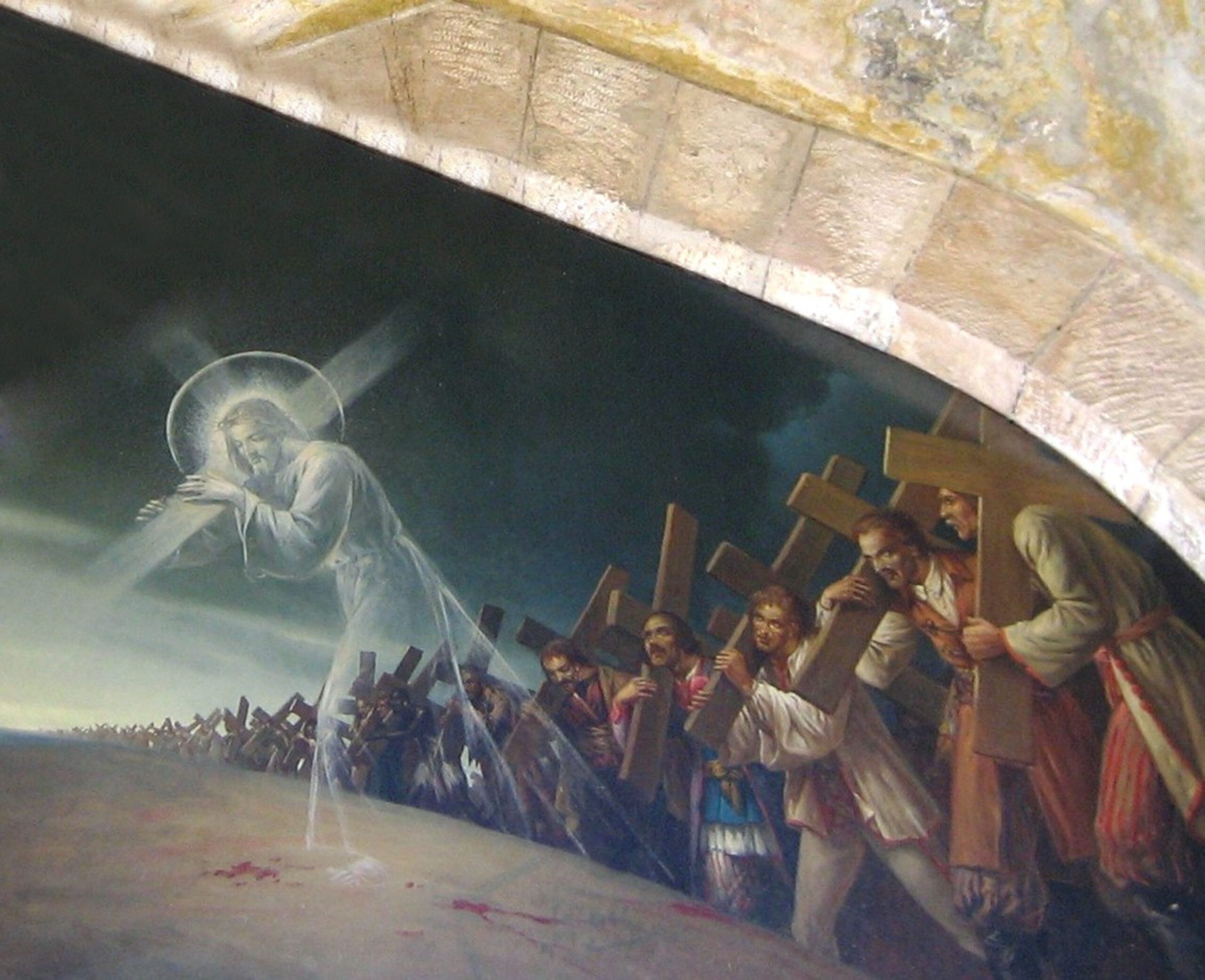
We are not here to save ourselves but to lose ourselves for the benefit of all. In another text, Jesus said: “I have come to set the earth on fire, and how I wish it were already blazing!” (Lk 12:49).
All creation must be transformed into light, and the only way to obtain it is by burning. We are like the candle that is made to illuminate by consuming itself. While it is not lit up and keeps its identity as a candle, it is a useless piece. The moment it is lighted and begins consuming itself, it starts giving light, then it confers sense to its existence. When we spend our life adorning and beautifying our candle; when we even ask God that, since it is so pretty, He may keep it next to Him for all eternity, we are renouncing our true human life – that is to burn, to be consumed to illumine others.
Excerpt from a commentary to Lk 13:22-30, the Gospel for the 21st Sunday (C) in Ordinary Time. This text is not an article, but a catechetical aid for priests and a starting point for meditation on a very complex issue.