
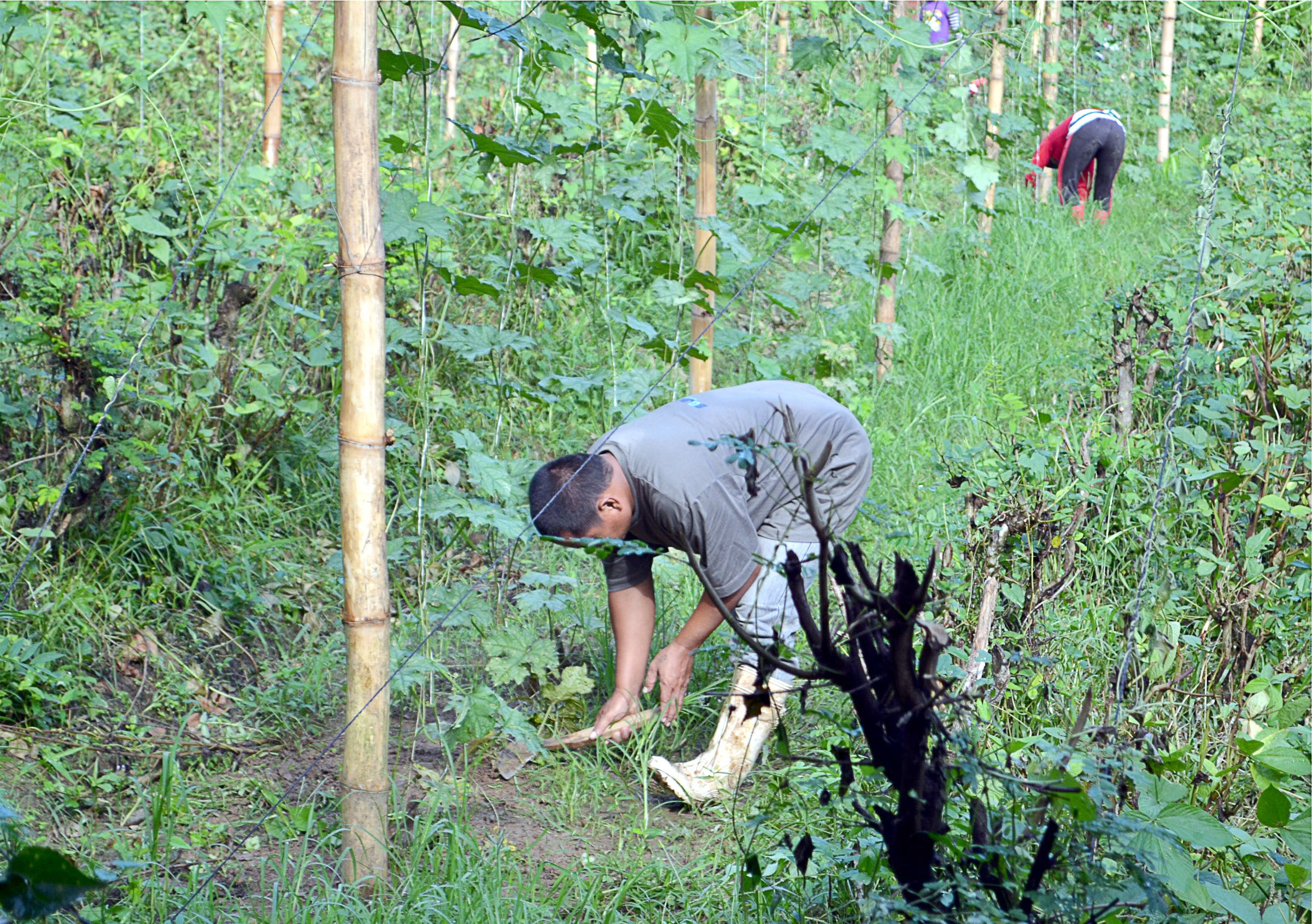
Filipino farmers are searching for a system that is not only environment-friendly but one that can improve their income. The answer to their quest: organic farming.
In Magsaysay, Davao del Sur, more farmers are now growing rice organically. In the past, they didn’t want to do so because they thought their harvest would be greatly affected. But when they saw the bountiful harvest of those who practiced the system, they immediately shifted their method of farming.
“Organic agriculture is the answer,” said Jessica Reyes-Cantos of the Manila-based Rice Watch and Action Network. “It won’t only retain soil productivity but it can make farming viable. If farmers will have additional income from their land, they will continue to plant rice.”
The United Nations Food and Agriculture Organization (FAO) supports the idea. Its report, “Organic Agriculture and Food Security,” clearly states that organic farming fights hunger, tackles climate change, and is good for farmers, consumers and the environment.
The FAO report frames a paradox within the conventional food production systems. Global food supply is sufficient but 850 million are undernourished and go hungry. Use of chemical agricultural inputs is increasing, yet grain productivity is dwindling to seriously low levels.
NOTHING NEW
“While many think of organic farming as something new, it is actually centuries old,” wrote Patrick Raymund A. Lesaca, in an article published in BAR Digest, a quarterly publication of the Bureau of Agricultural Research. “Organic farming was the original type of agriculture and had been used for thousands of years. One can surmise, therefore, that the practice of organic farming or organic agriculture in the Philippines began when man started to domesticate the land. Our forefathers used organic materials as their primary means to grow and cultivate their crops.”
The practice persisted until the dawn of the chemically-induced fertilizers. It was in the early 1970s – when the oil price along with the price of chemical fertilizer shot up – that it paved the gradual entry of organic agriculture in the mainstream of agricultural production. “It may be said that the renewed interest in organic materials as fertilizers, in search for alternative sources of nutrients, loomed in the face of escalating prices of fertilizers,” Lesaca wrote.
GAINING GROUND
The Philippines is not the only country adopting organic farming. “Organic farming is now established in international standards, and 84 countries had implemented organic regulations by 2010, up from 74 countries in 2009,” said a report from Worldwatch Institute, an environmental group based in Washington, D.C.
Definitions vary, but according to the International Federation of Organic Agriculture Movements, organic agriculture is a production system that relies on ecological processes, such as waste recycling, rather than the use of synthetic inputs, such as chemical fertilizers and pesticides.
Laura Reynolds, a researcher with the institute’s Food and Agriculture Program, said that “conventional agricultural practices often degrade the environment over both long and short term through soil erosion, excessive water extraction, and biodiversity loss.”
Organic farming, she pointed out, has the potential to contribute to sustainable food security by improving nutrition intake and sustaining livelihoods in rural areas, while simultaneously reducing vulnerability to climate change and enhancing biodiversity.
Organic agriculture uses up to 50% less fossil fuel energy than conventional farming, and common organic practices – including rotating crops, applying mulch to empty fields, and maintaining perennial shrubs and trees on farms – also stabilize soils and improve water retention, thus reducing vulnerability to harsh weather patterns.
ORGANIC FARMERS
Benefits like these are what inspired Benjamin R. Lao of Barangay Eman in Bansalan, Davao del Sur, to adopt organic farming. His endeavor paid off when the Department of Agriculture named him an outstanding organic farmer in 2012. “We want to teach Filipino farmers the right way of farming through the natural method, without using commercial fertilizer or pesticides,” he said of those people who come to Lao Integrated Farm.
Lao recommends using Eman, a homemade fertilizer, which stands for epektibo, mura, at natural (effective, cheap, and natural). “This is a concoction composed of fresh goats’ manure, kakawate, makabuhay, and hot pepper,” he informed.
In the heart of Victorias City, there is a farm, less than a hectare, which is considered one of the top agri-tourism destinations in Negros Occidental. “We can address the problem of poverty by teaching people about farming,” said Ramon Dayrit Peñalosa, Jr., the owner of the farm.
“Mr. Organic,” the moniker Peñalosa earned for venturing into organic farming and was stuck to like a glue, really never thought of becoming an agripreneur. When his former business, bus transport system, closed down, he was left with a property that was used before as garage and repair area for vehicles.
“We had to think of something that would make our property into something productive,” recalled organic guru and pillar of organic farming in Negros Island and Western Visayas. “So we tried something far off from bus lines.”
In the beginning, he planted kangkong in the property, particularly near the water-logged areas. He then raised pigs and planted fruit trees and vegetable crops. It was just a matter of time when he learned about organic farming.
Peñalosa believes that a farmer should not only be contented of merely planting seeds into the soil and seeing them grow. “To become a successful farmer, he has to understand the whole concept of agricultural production,” he explained. “He has to learn also the business side.”
FEEDING THE GROWING POPULATION
However, if the country goes organic, the primary objective should be feeding its growing population. A study conducted by the University of Michigan (UM) found out that organic farms in developing countries can yield up to three times as much food as low-intensive methods on the same land.
Professor Ivette Perfecto, one of the study’s principal investigators, said that, in developed countries, yields from organic and conventional farms were almost equal. And in developing countries, food production could double or triple using organic methods.
“My hope is that we can finally nail coffin of the idea that one cannot produce enough food through organic agriculture,” said Prof. Perfecto.
MITIGATING CLIMATE CHANGE
Another important role of organic farming is mitigating climate change. A 30-year scientific trial shows that organic practices could counteract up to 40% of global greenhouse gas output. Andre Leu, chairman of Organic Federation of Australia, claims the trial of organic and conventional farming practices has proven that organic practices “can be the single biggest way to mitigate climate change.”
Scientists at the Rodale Institute in the United States have confirmed that organic farming practices can remove about 7,000 kilograms of carbon dioxide from the air each year and sequester it in a hectare of farmland.
According to Leu, the scientists estimated that if all of America’s 100 million hectares of cropland were converted to organic practices, it would be the equivalent of taking 217 million cars off the road.