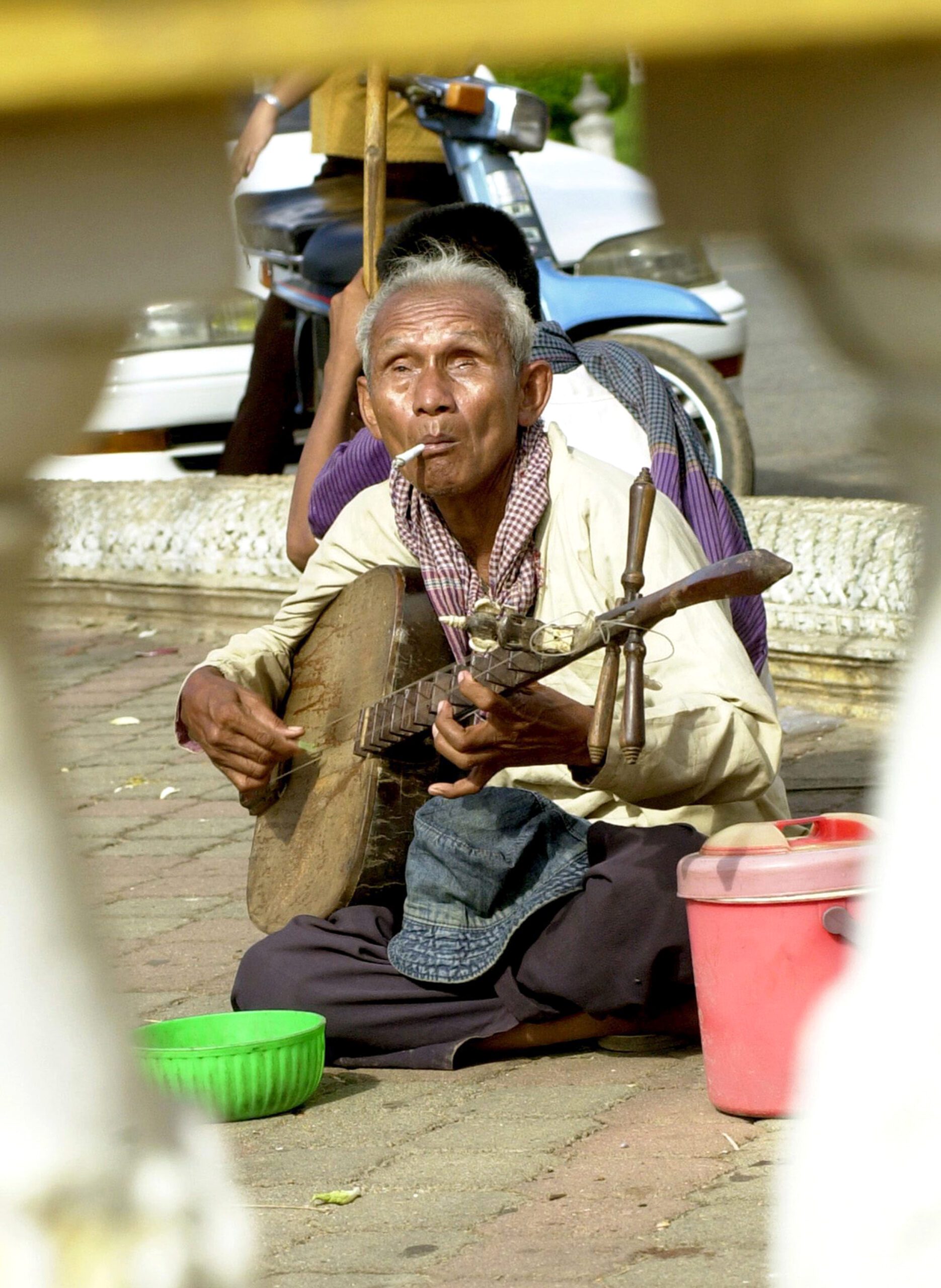

Nothing reveals a people’s spirit more than their proverbs. Thus, he who knows Kikuyus’ proverbs or Logbaras’, knows their traditions. Proverbs are a mine of wisdom from which we can learn or reaffirm certain valuable realities such as peace, social harmony, love for life, respect for the person and for property. In the old days, in the village, an improper behaviour would be made known and denounced in ways that made it easy to identify and correct the wrongs. Today, with urbanization and the anonymity that goes with it, this disciplinary exercise is left somehow to everybody and to nobody. Poor proverbs! For centuries, they have been commented in earnest and we kept repeating them. Now they are forgotten, made fun of, considered dim and childish, repetitive and boring. The time is gone when, to stop a heated discussion and shut the adversary’s mouth, it was enough to utter a solid truth of older times. This is also true for Africa, though only in part. In a sense it is true that the traditional griot (the sub-Saharan African street singers) are diminishing: their role is that of singing stories that recall and transmit the moral and social values intrinsic to their socio-cultural system; but traditionally, their role was especially that of musically entertaining the royal family and, occasionally, also acting as mediators and court counsellors. Yet the public means of transport, T-shirts, casual clothing, songs, are loudly flaunting sententious expressions. They give flavor to the speech or they can induce interest in important and practical problems. It is no longer necessary to be an outstanding person in the community to proclaim a slogan with authority. Today, everybody can do it. It is enough to have a microphone or a brush and a little paint.
AN “ETHNO-IMPLOSION”
The experts explain that, if the proverbs still survive the erosion of time and the current cultural evolution, it is because, in cultures that are still basically oral, they can offer irreplaceable elements able to give an insight into the reality in which we live, and especially in the human heart. Proverbs are an enormous deposit from which to draw enlightenment and confirmation on very relevant values of today. We all witness what is happening, now more than in the past, especially gross violations of the social order. At the village, acts of improper behavior were told − often as a story − and conveyed with a corrective approach that gave to the culprits the opportunity to admit their faults and make amends. Tensions were released. With urbanization and the anonymity that comes from it, this correction exercise is left to everybody and nobody. It has been written by researchers that, in many societies, an “ethno-implosion” is in progress, a social fragmentation caused by disastrous social conditions, wars and peoples’ displacements. This has repercussions on the transmission of knowledge. In some languages, to say a proverb meant to tell the truth. Today, this is far more difficult to prove.
A JEWEL BOX
In the Haussa language, proverbs are called karin magana, which literally means “wrapped-up words.” Those who know how to tell them, seem to have opened a little jewel box which contains the wisdom that throws a new light on events and moods. This without being an oracle that claims to have the last word. In his book The Science of Being Concrete, Claude Lévi-Strauss asserts that the so-called traditional culture is tied to “verifiable data and not to an academic and totally unchangeable approach.” And the Zambian Catholic Bishop Patrick Kalilombe wrote: “Proverbs are a mirror in which a community can look at itself and reveal itself to the others. They highlight the values, the aspirations, the worries, the behavior of people and the angle from which they see and appreciate their reality, and their response. In the proverbs, we see what we call mentality or living habits at their utmost.” Reading, or listening to them, we become more and more convinced that African wisdom is not only rich and profound, but also it is possible to collect and group it into great themes, highlighting the common points (and also the differences) with other cultures.
A WAY OF LOOKING
Many proverbs spring from an identical perception of reality, even though through different images. For example: The farmer who has never left his fields thinks that his farming system is the best (Haussa); He who has never left his village believes that no one can prepare porridge better than his mother (Ewé). The proverb is a way of looking at things. It is not the only way, but it has the merit of indicating a direction: One way only is no way (Malinké). It offers no final solutions, it does not depend on technology. Technology has no soul, ignores culture, and claims total independence from values such as ethics, religion, art, poetry, tenderness, compassion, suffering and joy. The science behind this technology is blind. It doesn’t read the world, it strips it and, in the face of its nudity, is paralyzed by its blindness and gives in to concupiscence.
TELLING THE TRUTH
Ahmadou Kourouma, a famous Ivorian novelist, wrote in the preface to his book A Giant Book of African Proverbs: “He who knows no proverb, knows nothing; he is like an inexistent person, a dead person. Let us be careful not to behave like dead people: let us live with the proverbs. It is difficult to appreciate the diversity and the richness of the proverbs if we have not put our finger into what can be considered the wisdom of another world. What may, at first, seem naïve because of their imaginative style, it may soon appear as a true realism on the part of the Africans when expressing feelings or behaviors, say, about love or hatred, envy or solidarity… This collection confirms the importance of proverbs in the African daily life, where problems and discords are often resolved in public discussions. The proverb intervenes, then, to vent an opinion on some delicate matter, to sum up public opinions, to clarify a point, to spur a debate and even to bring humor into serious matters. African wisdom has been handed down from generation to generation through the proverbs, retold by the griot, from individuals who have been defined “tellers of the truth,” “keepers of the ancient knowledge,” “people who awake the conscience.”
THE FAMILY COBWEB
The use of proverbs is still very popular to stress the importance of education and the family. Educating a child is the responsibility of the whole village, says an Igbo and Yoruba proverb. In 1996, Hillary Rodham Clinton, the USA former president’s wife, published a book entitled It Takes a Village, inspired by this proverb, on the values of the family and the necessity of educating children. God has given you a child but he will not educate him in your stead, asserts a Rundi saying, to remind parents that bringing into the world a human being is only the beginning. The education of an honest person begins when he/she still wears only a little rag (Lari); Education is more important than birth (Rundi). If later the son goes astray, the shame falls on the parents: A child playing with mud will make the parents’ skin grow grey (Mongo). Family ties, the necessity of cooperation and co-responsibility for all those who share the same blood, are constantly repeated. The spider moves only inside its web (Sango): in life, one can rely only on the members of one’s family, generally a large one. A buffalo does not abandon the swamp where it was born (Nbaka); A fish is strong only in water (Tonga); A man’s steps always lead him towards the roof of his house (Fon); The monkey said: “Your spouse must be from your clan” (Ewé)… These are the proverbs often quoted especially to denounce certain trends that seem to move away from inherited ideals or to answer critics on traditional bonds today considered absurd. Infinite are the debates that testify to the changes that are in progress and which often become prime material for stage productions, where the inherited wisdom is no longer indisputable and from which emerges the refusal of the old schemes of authoritarian structure and leadership in the community. Paulin Manwelo, a Congolese Jesuit, recently wrote: “We are tired of the theories and the monotonous, nostalgic, and generally pessimistic talks of our ancestors… We wonder why African political leaders excel in selfishness, greed and in “stomach politics” more than any other political leaders of the world. The traditional family, seen as a whole, may turn into a trap: anyone who wants to emerge is a prisoner of the clan or tribe, to the extent that no one becomes rich or dominant alone: either we are rich together, or we aren’t at all.”
USEFUL FOR POLITICS
After a football match at Kinshasa, the TV commentator encourages the losing team’s trainer not to lose heart, not to give up: The elephant never abandons his tusks on the road, however heavy they may be. On radio or TV, a death announcement may begin like this: When one is born, he is already old enough to die. Or: Death is like an eagle that snatches away a chick and leaves its mother in tears. Or again: Death is like a dress all must wear. Politicians are very clever in their sagacity, and not only in Africa. In answering press insinuations that her husband was available for a third term presidency, Bernadette Chirac, the French leader’s wife, quoted a Chinese proverb: Those who know don’t speak, those who speak don’t know. In the days of Houphuët-Boigny, in the Ivory Coast, people were saying: A thief with a full stomach is better than a hungry thief. In Guinea, a country that has known only two “strong men” since 1958 (Sékou Touré and Lansana Conté), people say: A well-fed old lion is better than a hungry young one, that is: a known dictator is better than an unknown one.
A POWERFUL WEAPON
In August 2003, ex-president Charles Taylor, leaving Liberia depleted under his leadership for 14 chaotic years, said: “I leave you with these farewell words: “God willing, I shall return” and added a number of biblical quotations and African proverbs. Sheik Yassine, Hamas group’s spiritual leader, was murdered in 2004. An Algerian website kept giving the news with a proverbial saying: Blood begets blood. When a televised round table was held in Kinshasa, attended by several political leaders, on the theme: “What kind of leader does our country need?,” the moderator opened the meeting quoting from the biblical book of Proverbs 28:2, If a land is rebellious, its princes will be many; but with a prudent man, it knows security. An opposition party candidate also forcefully quoted another biblical proverb: The less prudent the prince, the more his deeds oppress. He who hates ill-gotten gain prolongs his days. An interviewed minor opposition party leader, asserted: However long the night, in the end the sun will rise. Let people not lose hope: they will win. Do we hear rumors of a plot to assassinate the current president Kabila? A Kinshasa daily, after his father Desiré’s murder, reminds him to be on the alert: If you are not dead yet, don’t be too sure to be buried with the same head you have. A business director rewards a worker who retires. A pygmy’s shadow is greater with the setting sun, the radio speaker comments, meaning that the worker’s merits are recognized only afterwards.
A LEADER’S COUNSELORS
Belgian Foreign Minister Karel de Gouch had some harsh critical words towards the Kinshasa government. His Congolese counterpart retorted: “At this time, my government has other more important things to attend to than answering the Belgian minister’s reveries. We are attentive not to make the same mistakes. African wisdom leaves us in no doubt: When you bathe in the river and a crazy fellow steals your clothes, you too run the risk of being taken as insane if you run after him naked.” Newspapers − as much as tradition − are lavish in eulogies and counsels to the men in power: A keeper of a drove of toads must go easy with the use of the stick (Kongo). In short, people do not walk with regular steps or together and in the same direction; they are vulnerable creatures and if their leaders get worked up and start brandishing the stick violently, they may end up crushing somebody. It is the king who plants the tree, it is the king who uproots it (Tigrigna); Two chiefs never sail in the same boat, or who would throw out the water? (Ewé). Opportunism is discouraged: If the chief is limping, his subjects limp with him (Bantu).
GOOD LITERATURE
In the year 2000, the Congolese writer Norbert Mbu Mputu published a short novel, Dead Town, and obviously it began with two local proverbs: It’s the bones that hold the flesh; the flesh never sustains the bones, and A dog that lives on the bank of a brook never tires of lapping the water. Today, against a despotic ruler, a new proverb has been coined: Dictatorship always has the last word: accept it and you’ll survive. Citizens have no alternative except to fold their arms: shopkeepers, teachers, doctors, taxi-drivers…, all must stay put for twenty-four hours. The dictator’s arrest by the police must be watched with an easy attitude, especially if you happen to be in the street, among the curious bystanders who wonder what is happening: Laughing is a precious commodity. To stop laughing is the worst prison. Also because, writes the same author, “the state has only one aim: to devise slogans to fill your stomach.”
IN SONGS AND COMEDY
In the song “Bana Lunda,” the Congolese music star J-B Mpiana describes the pains of a Congolese emigrant to Angola in search of diamonds. He makes a list of the ill-treatments he received and states that he, too, is a human being: “A star is always a star; a lamp is always a lamp.” In Moussoukou Soukou, Antoine Koffi Olomide sings: “We are all children of God, we are all sinners, rich and poor: let’s make love, not war.” Pépé Kallé, another Congolese music star sang: “Money brings no happiness, God only knows.” Joseph Andjou, an i-Afrique TV newscaster, in 2003 published a collection of proverbs, the same ones he presents and comments on TV. “Too many depressing things are said about Africa. I wish to show another face of Africa, a fun-loving Africa. Reflect smiling: “If somebody fakes his death, he must also have an imaginary burial. He who looks for honey, must have the courage to face the bees. Even the fish which lives in water is always thirsty.” Burkinabé comedian Hippolite OPuangrawa, better known as Ba Bouanga, delights his spectators with his wisecracks in Mossi, delivered with an insuperable mimicry: He who sleeps on a borrowed mat is sleeping on a cold, very cold ground − You bear a child and take care of him till his teeth appear, hoping he will take care of you when yours fall out…
A TV FASHION
Zamenga Batukezanga, a most popular Congolese storyteller, wrote: “As a broom cleans a dirty house whenever it is needed, literature cleanses an ailing spirit. The proverbs, the maxims, the songs, the dance all move around humanity and honesty. A tale without proverbs and songs is a drill without sheen nor taste.” He also added: “Curiously enough, television is bringing back the whole planet to that oral interest that Africa is abandoning. In his For A White Hair, he describes a dispute between men and women near a coffin. The elders’ chief calls for calm, recalling the saying: When the woman revolts, for better or the worst, the village changes. They agree with the old master. But before the sick man passes away, somebody advises the woman to consult a soothsayer, prompted by the wise dictum: When you hunt for a lost knife, look first under the bed, you never know.”
27,000 PROVERBS
In the last two decades many studies have been made on African mentality compared with the biblical thinking (see box below). Recently the Global Mapping International has produced a CD with over 27,000 sub-Saharan African proverbs, together with a research on the relationship between these and the biblical proverbs. The traditional wisdom of Israel, amply spread out in the Old Testament, has many points of contact with the African tradition. For instance, a woman is seen in her relation to man, as a wife and mother, doing her utmost to make him comfortable. The cultural context offers several common analogies and finalities, such as the relationship between parents and children, the man and the woman, the idle and the active, the rich and the poor, life and death.
SIMILAR TO THE BIBLE
Both the biblical and the African knowledge were born in cultures where the spoken word was dominant. The Bible had been transmitted by word of mouth from generation to generation before it was written: “I will open my mouth in stories, drawing lessons from of old. We have heard them, we know them; our ancestors have recited them to us. We do not keep them from our children, we recite them to the next generation.” This closeness lies also in the fact that the wisdom we find in both the biblical and in the African proverbs has the same intent: to encourage man to live his humanity and create harmony in the group one belongs to. The final aim is obviously: to guarantee a happy life. However, in time, Israel was able to deepen its reflection on God and man through a revelation that was not to be found in the popular African culture, especially with the awareness that human wisdom has limits and cannot warrant happiness. “The fear of the Lord is the beginning of knowledge” (Prov. 1,7); “Behold, the fear of the Lord is wisdom” (Job 28,28).
LIKE A BIRD IN THE FOREST
The crisis that traditional wisdom is undergoing though is not as bad as it may look. We have to speak of transformation rather than decline. The common sense attached to the proverbs is thinning out considerably in societies where conformism is fast disappearing, adherence to the ruling powers passively accepted, submission of woman to the male unchallenged. After all, how many proverbs state only partial truths, or are even contradicted by others? Knowledge − says a Ewé proverb − is like a bird in the forest: one single person cannot catch it. One is advised, therefore, to use it in moderation. Too much honey can be sickening. In these days of plenty, it may be useful to find in the old wisdom some amusing side. God Himself does it! Like When He created the crocodile, God said to Himself: it is good enough for him to be strong (Madagascan), meaning to say that it might be ugly, but it is solid. No one can take away from us the right to laugh: The chief makes the laws, but he cannot make a law against laughing (Ewé). To be healthy, laughter must be spontaneous: There is no joy in a forced laughter (Logbara).
TURN TO GOD INSTEAD
However, you cannot laugh always and about everything: A dog cannot rejoice over the death of its friend (Logbara). Certain tricks are not to be done: Do not feast over the two sides of a knife (Chagga). In life, you cannot invest everything simply on amusements. The world is full of people who take themselves too seriously, who think they are God Almighty, like The flea that strolls amidst the hairs and walks down towards the beard and says: “This is all mine” (Nyoro). Is there a place where happiness can be found? Apparently yes: in the next world. Good people go there and do not come back. There, in the forest, something wonderful is happening (Sakata). Even proverbs must not be taken too seriously: “If you wish to live wisely, ignore the proverbs, including this one”, advises Laurence J. Peter Laurence. But then, what is the alternative? God.
630 DIVINE NAMES
Commenting on Akan proverbs, Peter Sarpong, Archbishop of Kumasi, points out that many names given to God correspond in richness of meaning to those of the Bible. He is the Creator, the Fount of Life, the Supreme Administrator. All that God has created is good; God alone is King (Akan). Joseph G. Healy, an American Maryknoll Missionary, published a research on the names and titles given to God in 102 African languages from 30 countries. He found over 630 of them! Life is God’s best gift, the rest is just an addition (Swahili); If God removes His hand, the world ends (Ibo); God does not love evil (Madagascan); God is just (Mongo). In Once Upon a Time − Stories of Wisdom and Joy, the same author states that, in African cultures, the myths concerning the origins or the creation are over two thousand. They speak, for instance, of the separation of God from man. Differently from the biblical story, in which the first couple was expelled from paradise, African versions say that it was God who withdrew to heaven, after man had done something that was not to be done.
WITHOUT WORDS
What can we say about God? God does not eat what man eats (Maasai): Words will always be inadequate: What God forbids, you cannot do (Baoule); God’s will is never forced (Luo); Heart’s designs never materialize, God’s design do (Kikuyu). Man proposes, but God disposes (Popo). If we believe in the contrary, we cheat ourselves: The man for whom God tills the land, thinks that he is doing the farming (Rwanda); The knife and the yam belong to God: it is He who cuts out what man eats (Luo); The mouth eats what God and the clouds give it (Oromo). God is everywhere: What is far away from the eyes of man, is not from the eyes of God (Popo); Man does not see you, God does (Baoule); God is like the sun: He finds His way into every house (Madagascan); God’s eye never forgets (Yaka); God is not man’s enemy (Kikuyu); though it may be difficult to admit it is so.
POPULAR “THEOLOGY”
Some proverb seems to stress some partiality in God: God favors some and ignores others (Luba); God does not argue with man: He is always right (Luba); God gives good things to some, to others only bamboos (Luba); God never overburdens you (Amhara); If God does not kill me, no chief can (Baoule). He has an infallible touchstone: God treats us as we treat our neighbour (Madagascan). God does not act on outward appearances: God kills from what He knows, man judges from what he does not know (Tigrina); God sees everything, but He lowers His eyes (Madagascan). God loves and protects His creatures: Even if man does not love me, God does (Baoule); If God is behind you, nobody can harm you (Luo). God Himself chases the flies away from tail-less animals (Mina); The snake has no hands to defend itself, but it relies on God (Madagascan); The serpent maltreated by men, leaves the vengeance to God (Madagascan). Man acknowledges God’s presence always too late: A sick person thanks God only when he/she sees a dead person. A man with a squint thanks God when he sees a blind person (Peul). Pray to God: if you cry for help, He will answer (Baoule); God gives, He never sells (Rwanda). Trust in God does not take away responsibility: Though God watches over your flock, entrusts it to a custodian (Rwanda). Don’t put your trust in idols, nor do you forget that There is no more expensive idol than the stomach, which exacts offerings every day (Yoruba). It is better to be found guilty in the eyes of God than in the eyes of men (Madagascan). And, finally, If you fear God you do not mistreat the fool (Madagascan). Wise isn’t it?