Justice at the Grass Roots

INTRODUCTION

Big problems usually start small. And so do social and societal evils. Even the simple act of trading, when done unjustly, has an impact on a small group of people, usually the powerless, and can have a lasting, sustained and systemic consequence on how things are done globally.

WRITTEN BY

SHARE THE WORD

PUBLISHED ON

In March last year, I was making my way to a meeting with some indigenous Aeta farmers on the hills of Zambales in northern Philippines, when our group of agriculturists and community workers stopped in the wet market of San Marcelino. At the open parking space, passengers of delivery jeepneys were unloading their produce for traders to buy. Most sellers were medium-sized farmers delivering to their relatives who were traders. Such is an example of a direct farm-to-market-to-customer chain of trading.

There was a group of women and children sitting there looking depressed. Perhaps, they had missed the “weapons carrier,” the converted WWII vehicle that is still being used to bring the rural poor into the rough mountain paths and over rivers. There are no roads to the mountain villages.

They were trying to open a coconut with knives and seemed so poor and hungry. I went over with Donard, an agriculturist, to talk to them. He could speak Ilocano and some Zambaleño, which most of the Aeta speak among themselves. I greeted them and squatted down to chat and was surprised to find that the two younger ones spoke Tagalog or Filipino, the national language. I speak it and so our chat started off well.

After traditional greetings and shy smiles, I asked: “Why are you here, do you want a ride to the village? We are going there and we can give you a place in our vehicle,” I said.

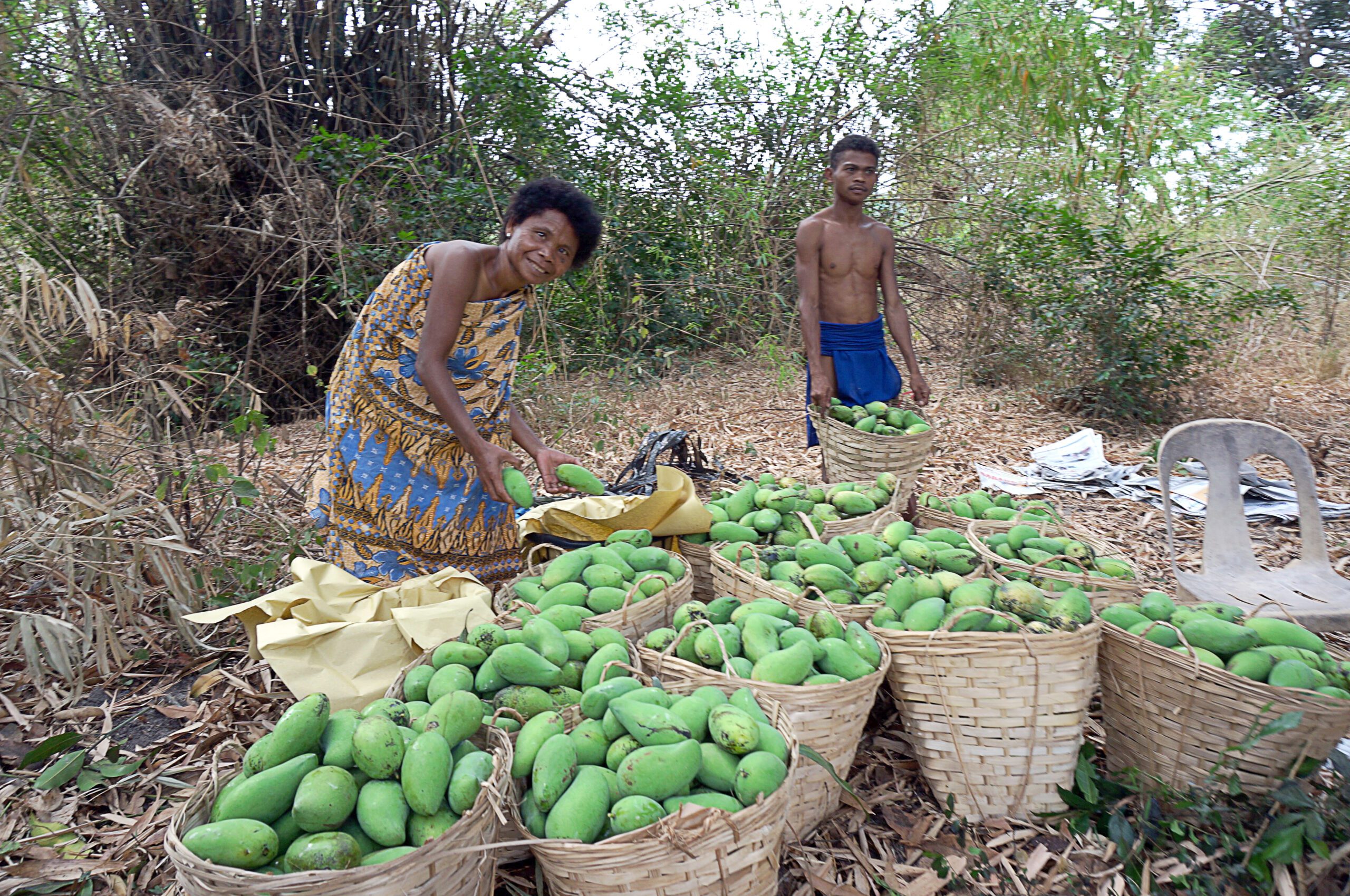
“That’s not the problem, we can walk, as we walked coming here. We have no money to buy enough rice for today and nothing for tomorrow,” a woman said. I noticed sacks with some produce and asked what they were and if they were waiting for traders to buy the products. “They are our mangoes. We carried them here, four sacks half-full. We cannot carry full sacks because we walk 15 kilometers. The traders only offered us four pesos a kilo or they would not buy them. We are many in the village.”

I had Donard estimate the number of kilos in the four sacks. There were about five kilos in each sack and, calculated, they would only earn eighty pesos (one euro and sixty cents or about 2 U.S. dollars) from the trade. That would only be enough to buy three kilos of rice, a staple food important for energy to hike and gather vegetables and fruit.

EXPLOITATIVE TRADE
The group could not fathom why, in “the outside world,” such an unjust system was in place whereas in their community, they traded and lived justly among themselves. In the villages, they would gather home-grown vegetables, wild bananas and mangoes and barter fairly among themselves. For example, a big papaya was worth six mangoes, a chicken was worth 2 sacks of mixed vegetables, and so on. This was an honest form of trade that existed for millennia and it had a trading value system of its own. It was based on a form of fair exchange respected by all.

Contrast this to the towns where, although they would not starve for a day or two by doing business with market vendors, they would end up not being able to get fair trade to buy rice and other things like kerosene and clothes.
However, since it was vital to obtain rice, which was a lowland crop, from the land which they had no ownership or possession of, they had to trade their produce in town. But it is there where they are cheated.

Imagine their frustration every time they would walk this far, only to be faced with exploitative cheating in the marketplace. There was no one to appeal to, no one who cared. The situation seems similar to that in parts of Europe, where farmers are protesting on the streets and driving tractors through Paris to protest the injustice of the artificially low price for wheat, milk and other products.

After a while, another agriculturist, Roger, joined us and brought drinks and sandwiches to share. Without hesitation, they ate quickly and hungrily. They were all smiling.

I left the group and went into the retail market and checked the prices of mangoes and rice. Mangoes were selling at 40 pesos a kilo but these same traders were offering only 4 pesos to the indigenous farmers who worked so hard climbing the trees and risked falling from them.

This was only a glimpse of the unfair trade that is being practiced in this lowly part of the Philippines.

JUST A GLIMPSE
One can only imagine the injustice being perpetrated by those who take advantage of the poor and the lowly the world over . That story and several others like it motivated the Preda Fair Trade team to expand its development and fair trade activities for small farmers to the Aeta indigenous people of the mountains of Zambales and Bataan.

The indigenous Aeta people are very poor and live in bamboo huts with grass roofs for the most part. They are the original people of these beautiful islands. They came to the Philippines thousands of years ago, when there were lower sea levels and land bridges connected the islands to the Asian Mainland. They became hunters and gathers in the rain forests. That lasted for thousands of years. After World War II, the massive destruction of the Philippine rain forests began – great ecological crime perpetuated by a few powerful politicians and international corporations. They plundered and destroyed every tree and mountain they could find. The invention of huge machines helped them do it so fast.

Today, there is only 3% of the rain forests left all over the Philippines. Wild life, hundreds of species gone, and the indigenous people have to turn to subsistence farming and yet the mining corporations and cattle farmers and sugar plantations are trying to take their ancestral lands.

LENDING A HAND
The assistance the Preda Fair Trade project could give was to help the people secure their land rights and get them fair trade prices for their mango fruit. The women I met in the market speak of the real hardship and cheating that caused them to remain so poor.

Together with a German fair trade organization, we developed a product based on the Pico variety of mango fruit that grows in abundance in mountains but is despised and considered inferior by traders, when in fact, it is a delicious high fructose fruit and grows semi-wild.

The trees are now cared for and harvested by the Aeta indigenous people, chemical-free, who produces organically-certified mango. It took three years of training in organic production and maintaining an internal control system to keep the mangoes chemical-free. But it paid off! After much expense, excessive bureaucratic procedure based on EU rules and 14.5 kilos of documents, 8,500 mango trees were counted and 4,000 tagged.

STRIKING GOLD
Eventually, we produced organically-certified mango puree. The flesh of the mango fruit is turned into a mash after the seed and skin is removed. This is pasteurized and sealed in aseptic bags and drums by a professional company and shipped to our fair trade partner in Germany.

Now we can get a higher price and a growing demand for this product. Naturland, the highly prestigious and fastidious German certification organization, along with ACT in Thailand, studied and investigated all our organic work and finally approved the certification. A big success for the Aeta people indeed!

Now we can pay 200% more for the Pico and carabao mangoes of the indigenous people. They are delighted at the high price Preda is paying to them. All mangoes are harvested, nothing goes to waste and Aetas get fair prices and other benefits, through development projects in their villages, and educational assistance for their children.
In Germany, Dritte Welt Partner (DWP) of Ravensburg, South Germany is producing yogurt and chocolate using the Aeta’s mango puree. They are marked “bio” or organic and meet their very high standards. This is fair trade at work.

It is a success that we thought we could not achieve because of the bureaucratic process and high cost of getting organic certification. This has to be changed and made easier so the poor people can have their produce certified and get into the world market.

It makes them fair organic traders and, with Preda Fair Trade, we can see a more prosperous and better life for these Aeta communities. These all happened because they got a fair price and, therefore, were given social justice…which is their right.

The women I met in the market can now afford to buy sacks of rice and clothes for their children and send them to school. There is great hope if this could be extended to many more farmers.

This is what the world of the poor needs: help, through fairness and social concern based on the moral standards of social justice.

Share Your Thoughts

All comments are moderated

From The Same Issue

The articles and content about this issue

From The Same Issue

The articles and content about this issue

From This Topic

The articles and content about this topic

From This Topic

The articles and content about this topic

Explore Other Topics

Browse other coverage

Explore Other Topics

Browse other coverage

WM SPECIAL

Presents, discusses and draws readers to reflect on issues of outmost relevance to the world today.


FRONTIERS

Very often, mission is carried out in frontier situations around the world. Those who embrace these situations have much to share.


UNITY IN DIVERSITY

Writer Ilsa Reyes will be exploring the richness of Pope Francis’s latest encyclical Fratelli Tutti with a view of helping our readers to get a grasp of the this beautiful papal document.


FRONTLINE

Puts to the front committed and inspiring people around the world who embrace humanitarian and religious causes with altruism and passion.


IN FOCUS

Focus on a given theme of interest touching upon social, economic and religious issues.


FAITH@50

As the Philippines prepares to celebrate 500 years of the arrival of Christianity. Fr. James Kroeger leads us in this series into a discovery journey of the landmark events in the history of faith in the Philippine archipelago.


INSIGHT

Aims to nurture and inspire our hearts and minds while pondering upon timely themes.


FILIPINO FOCUS

The large archipelago of the Philippines, in its richness of peoples and cultures, offers varied and challenging situations for mission.


FOLLOW ME

Reflections and vocation stories that shape up the lives of young people.


MISSION IS FUN

As humor and goodness of heart are qualities of Christian and missionary life, the new column “Mission is fun” will be publishing some anecdotes and stories that have happened in a missionary context to lighten up the spirits and trigger a smile in our faces.


LIVING COMMUNION

To help readers of World Mission live this year dedicated to Ecumenism, Interreligious Dialogue and Indigenous Peoples, Tita Puangco, writer and lecturer, shares in this section insights on the spirituality of communion.


WINDS OF THE SPIRIT

A historic view of the Catholic movements that emerged from the grassroots as an inspiration by the Holy Spirit.


BRIDGE BUILDERS

On the Year of Ecumenism, Interreligious Dialogue and Indigenous Peoples, radio host and communicator Ilsa Reyes, in her monthly column, encourages Christians and people of good will to be one with their fellow people of other sects, religions and tribes.


INTERVIEW

Questions to a personality of the Church or secular world on matters of interest that touch upon the lives of people.


WORLD TOUCH

News from the Church, the missionary world and environment that inform and form the consciences.


CARE OF THE EARTH

A feature on environmental issues that are affecting the whole world with the view of raising awareness and prompting action.


EDITORIAL

The editor gives his personal take on a given topic related to the life of the Church, the society or the world.


YOUNG HEART

A monthly column on themes touching the lives of young people in the Year of the Youth in the Philippines by radio host and communicator I lsa Reyes.


SCROLL

A missionary living in the Chinese world shares his life-experiences made up of challenges and joyous encounters with common people.


EXTRAORDINARY PEOPLE

Life stories of people who deserve to be known for who they were, what they did and what they stood for in their journey on earth.


ONE BY ONE

Stories of people whom a missionary met in his life and who were touched by Jesus in mysterious ways.


INCREASE OUR FAITH

Critical reflection from a Christian perspective on current issues.


SPECIAL MOMENTS

Comboni missionary Fr. Lorenzo Carraro makes a journey through history pinpointing landmark events that changed the course of humanity.


PROFILE

A biographical sketch of a public person, known for his/her influence in the society and in the Church, showing an exemplary commitment to the service of others.


WM REPORTS

Gives fresh, truthful, and comprehensive information on issues that are of concern to all.


LIFE'S ESSENTIALS

A column aimed at helping the readers live their Christian mission by focusing on what is essential in life and what it entails.


ASIAN FOCUS

Peoples, events, religion, culture and the society of Asia in focus.


THE SEARCHER'S PATH

The human heart always searches for greatness in God’s eyes, treading the path to the fullness of life - no matter what it takes.


INDIAN FOCUS

The subcontinent of India with its richness and variety of cultures and religions is given center stage.


AFRICAN FOCUS

The African continent in focus where Christianity is growing the fastest in the world.


JOURNEY MOMENTS

Well-known writer and public speaker, Fr. Jerry Orbos, accompanies our journey of life and faith with moments of wit and inspiration based on the biblical and human wisdom.


IGNATIUS STEPS

On the year dedicated to St. Ignatius of Loyala, Fr. Lorenzo Carraro walks us through the main themes of the Ignatian spirituality.


THE SEVEN LAST WORDS OF JESUS

Fr. John Taneburgo helps us to meditate every month on each of the Seven Last Words that Jesus uttered from the cross.


INSIDE THE HOLY BOOK

In this section, Fr. Lorenzo delves into the secrets and depths of the Sacred Scriptures opening for us the treasures of the Sacred Book so that the reader may delight in the knowledge of the Word of God.


CONVERSATIONS

Reflections about the synodal journey on a conversational and informal style to trigger reflection and sharing about the synodal path the Church has embarked upon.


VATICAN II

This 'mini-course' series provides a comprehensive exploration of Vatican II, tracing its origins, key moments, and transformative impact on the Catholic Church.


COMBONIS IN ASIA

This series offers an in-depth look at the Comboni Missionaries in Asia, highlighting their communities, apostolates, and the unique priorities guiding their mission. The articles provide insights into the challenges, triumphs, and the enduring values that define the Comboni presence in Asia.


BEYOND THE SYNOD

Following the Synod on Synodality, this series examines how dioceses, parishes, and lay organizations in the Philippines are interpreting and applying the principles of the synod, the challenges encountered, and the diverse voices shaping the synodal journey toward a renewed Church.


A TASTE OF TRADITION

This series introduces the Fathers of the Church, featuring the most prominent figures from the early centuries of Christianity. Each article explores the lives, teachings, and enduring influence of these foundational thinkers, highlighting their contributions the spiritual heritage of the Church.


A YEAR OF PRAYER

In preparation for the 2025 Jubilee Year under the theme “Pilgrims of Hope,” 2024 has been designated a Year of Prayer. World Mission (courtesy of Aleteia) publishes every month a prayer by a saint to help our readers grow in the spirit of prayer in preparation for the Jubilee Year.


OUR WORLD

In Our World, the author explores the main trends shaping contemporary humanity from a critical and ethical perspective. Each article examines pressing issues such as technological advancement, environmental crises, social justice, and shifting cultural values, inviting readers to reflect on the moral implications and challenges of our rapidly changing world.


CATHOLIC SOCIAL DOCTRINE

This series unpacks the principles of Catholic Social Doctrine, offering a deep dive into the Church's teachings on social justice, human dignity, and the common good.


HOPEFUL LIVING

Hopeful Living’ is the new section for 2026, authored by Fr. James Kroeger, who dedicated most of his missionary life to the Philippines. In this monthly contribution, he will explore various aspects of the virtue of hope. His aim is to help readers align their Christian lives more closely with a hopeful outlook.


PHILIPPINE CROSSROADS

Filipino Catholic scholar Jose Bautista writes each month about how the Philippines is at a crossroads, considering the recent flood control issues and other corruption scandals that have engulfed the nation. He incorporates the Church’s response and its moral perspective regarding these social challenges.


BIBLE QUIZ

Test your knowledge and deepen your understanding with our Bible Quiz! Each quiz offers fun and challenging questions that explore key stories, themes, and figures from both the Old and New Testaments.


Shopping Cart