
Popular Faith: Francis began with a reflection on Aparecida, Brazil’s great Marian shrine that draws an estimated ten million visitors each year. According to tradition, a statue of Mary was found by three fishermen in a nearby river in 1717. Among other aspects of the Aparecida story, Francis noted the fact that Mary appearing with dark skin was a means of breaching “the shameful wall of slavery.” In that regard, he said, popular faith teaches that the Church is always “called to be a means of reconciliation.” Francis also said it’s striking that the ordinary people were the first to welcome and assimilate the message of Aparecida, saying: “In the homes of the poor, God always finds a place.” The Pope argued that “at times, we lose people because they don’t understand what we’re saying, because we have lost the language of simplicity,” he said, “and import an intellectualism foreign to our people.” Francis said the Church must master “the grammar of simplicity.”
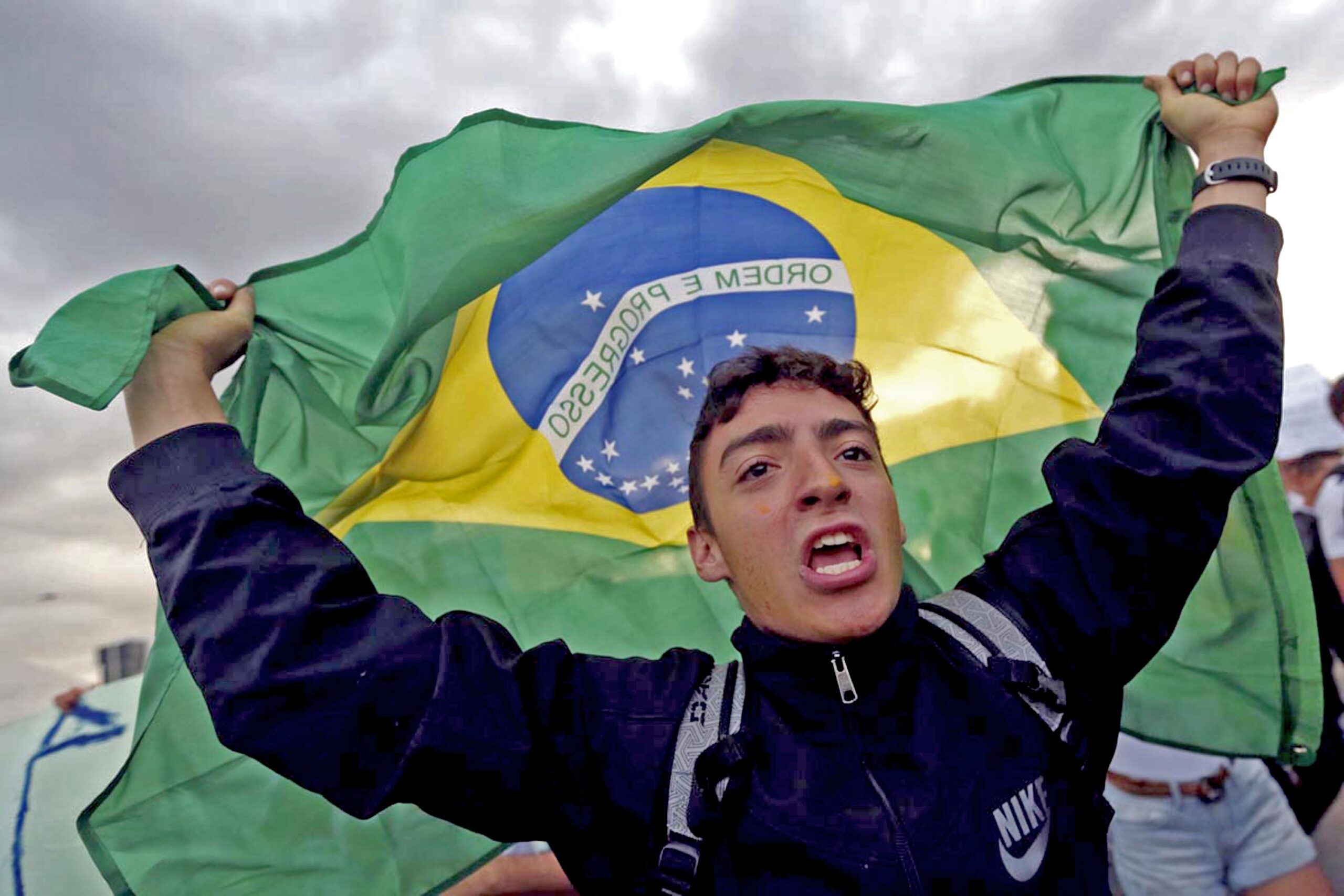
How to Get the People Back: Francis didn’t dodge the reality of massive defections from the Catholic Church in Brazil in recent decades to the evangelicals and Pentecostals, saying: “We feel like those who must tally up a losing season as we consider those who have left us, or no longer consider us credible or relevant.” Yet, Francis argued, the losses aren’t irreversible. “The reasons why people leave also contain reasons why they can eventually return,” he said. To bring people back, the Church must be “capable of warming hearts.” The way to do that, “he suggested,” is with the pastoral basics: Scripture, catechesis, sacraments, community, friendship with the Lord, Mary and the apostles.” He also counseled patience in a world that seems to move ever faster. “Is the Church still able to move slowly, to take the time to listen, to have the patience to mend and reassemble?” he asked. “Or is the Church herself caught up in the frantic pursuit of efficiency?”
Collegiality: Addressing a group of bishops, Francis dwelt on the notion of collegiality, meaning shared authority among the bishops rather than an exclusively top-down model of leadership. The remarks were directed at national bishops, but they’re also likely relevant for his understanding of his own role as pope. “The Church in Brazil needs more than a national leader,” he said. “It needs a network of regional ‘testimonies’ which speaks the same language and in every place ensure not unanimity, but true unity in the richness of diversity.”
He made a point that, once again, seems as applicable to the Vatican as it does to the bishops’ conference in Brazil. “Central bureaucracy is not sufficient,” he said. “There’s also a need for increased collegiality and solidarity.”
Permanent Mission: The idea that every member of the Church has to be a missionary, and that the Church has to get out of the sacristy and into the streets, is a constant theme in Francis’ thought. He repeated it with the bishops, adding a twist: handing on the faith has to be person-to-person, one person at a time. “It’s like the baton in a relay race,” Francis said. “You don’t throw it up in the air for whoever is able to catch it, so that anyone who doesn’t catch it has to manage without.”
Social Gospel: Francis said that the Church “claims the right to serve man in his wholeness” which, among other things, means engaging the burning social questions of the day. He urged the bishops: “Do not be afraid to offer this contribution. The Church wants to make present that spiritual patrimony, without which society falls apart and cities are overwhelmed by their own walls, pits, [and] barriers,” he said. “The Church shares with others a core desire for progress on matters such as education, health care and social harmony. What it can add is an underlying view of man, his freedom, his value, his openness to the transcendent.”
Within that panorama, Francis called on Brazil’s bishops to have a special focus on the Amazon Basin, where the bulk of the country’s impoverished indigenous persons are concentrated, as well as the scene of ferocious political and social battles over the environment and property rights. He urged the bishops to train native clergy, to form priests “suited to local conditions,” and to lift up “the Church’s Amazonian face.” www.ncronline.org/John L. Allen Jr