It is always enlightening to read an essay on hope or to search the Scriptures for the positive inspiration that it gives. A vision of hope provides a fundamental framework for living in complex and difficult times. However, we also deeply appreciate the insights provided by living witnesses who concretize beautiful ideals through their lives. People always prefer a living sample over a lengthy sermon. Concrete witnesses have an effective impact on people. As Paul VI noted: “People today listen more willingly to witnesses than to teachers, and if they listen to teachers, it is because they are also witnesses” (EN 41; cf. RM 42). These brief thoughts only serve to set the stage for eight short pieces on a variety of “witnesses of hope” who have impacted humanity (and this writer) in recent decades. They are all drawn from the “communion of saints” to which we belong as Christians. In rich and diverse ways, they manifest deep human hope that is profoundly rooted in God – humanity’s ultimate anchor of hope. In the company of such men and women, we sense a beautiful reality: we share hope because we are not alone; we stand in solidarity with these “heroes of hope.” Read about the lives and savor the words of these eight women and men. Reflect on the deep meaning manifested in the often ordinary lives of these living witnesses of hope. Recall the beacons of hope who have personally touched your life. Reverence God for His everlasting, personal love which renews all humanity in hope. Resolve to become, in simple yet profound ways, ambassadors of hope in our contemporary, peace–starved world.
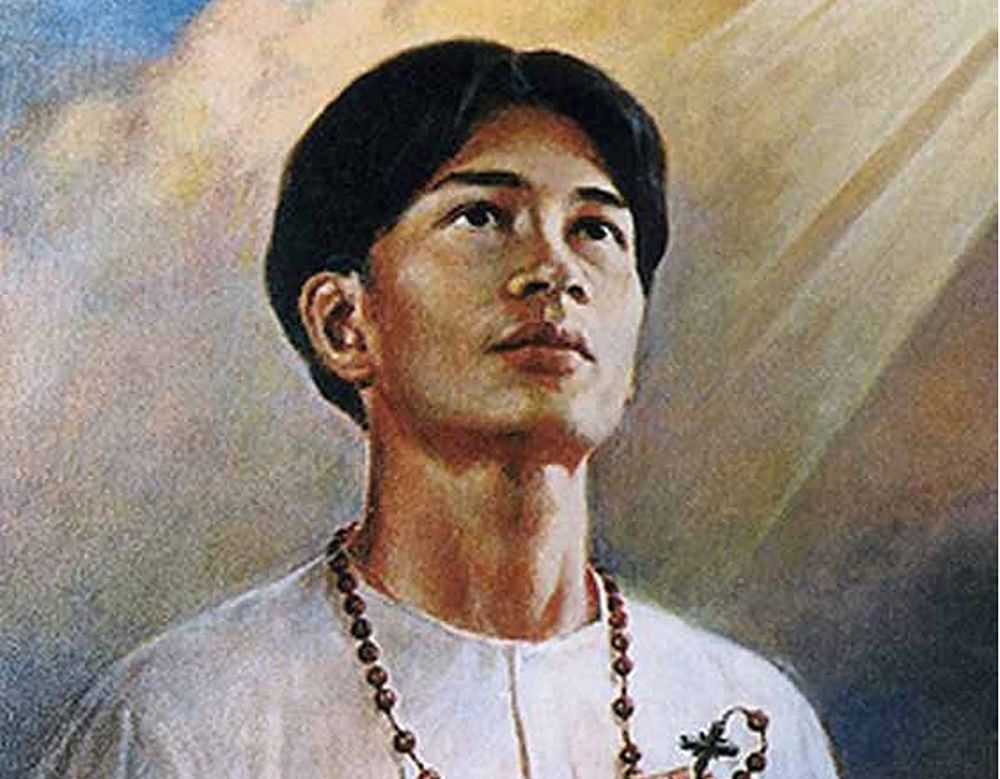
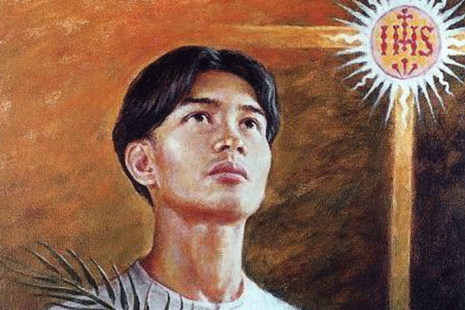
MISSIONARY WITNESSES – The Filipino people rejoice; the nation celebrates. Faith is strengthened; mission continues. These sentiments spontaneously surfaced as Saint Pedro Calungsod was canonized in Rome on October 21, 2012, joining Saint Lorenzo Ruiz who was canonized on October 17, 1987. Remarkably, both of these Filipino saints were canonized on Mission Sunday – exactly twenty–five years apart! They were known as men of deep faith; thus, they are models and witnesses of hope for the largest Christian nation in Asia. San Lorenzo Ruiz, son of a Tagala mother and Chinese father, was born and baptized in Binondo, Manila. He served as a clerk (escribano) to his dominican mentors who taught him how to read and write well. Uncertain historical circumstances forced him to leave Manila in the summer of 1636; he joined the missionaries going to Japan. A few days after their arrival, they were discovered and arrested; they languished in jail for a year. Later they were tortured and killed. Their bodies were burned and the ashes thrown into the sea. Lorenzo gave a profound testimony of his deep faith: “I am a Christian and I will remain so until the hour of my death…. I must tell you with my whole heart, as God is my witness, that I would rather die a thousand deaths than renounce my faith.” This heroic witness makes Lorenzo a beacon of hope for faithful Christians. Data on the life of Calungsod prior to his missionary work is limited. Yet, it is certain that he was a young native of the Visayan region of the Philippines, born around 1655. Probably he received his basic education at a Jesuit boarding school, learning to communicate in Spanish while developing skills in writing, translating, drawing and singing. Calungsod is one of several young catechists who travelled with some Spanish Jesuit missionaries to the Ladrones Islands (later renamed the “Marianas”) in the Western Pacific in 1668 to evangelize the Chamorros. On April 2, 1672 Calungsod was martyred, along with Jesuit Father Diego Luis de San Vitores, in the village of Tomhom on the island of Guam. Witnesses said that Pedro had several chances to escape martyrdom; he was young and agile. However, he did not wish to abandon Padre Diego. Others noted that Pedro probably could have defeated his aggressors, but he was unarmed since Padre Diego never allowed his companions to carry weapons. After Pedro was mortally hit with a spear, Padre Diego gave him sacramental absolution; then the assassins also killed Padre Diego (beatified in 1985). Their bodies were thrown into the sea; no remains were ever found. Many titles could be ascribed to both Lorenzo Ruiz and Pedro Calungsod: dedicated church–worker, young migrant, enthusiastic missionary, faithful friend, unwavering martyr. However, as the canonization of both saints was held on World Mission Sunday (1987 and 2012), the Church emphasizes the missionary dimension of their heroic witness of faith. Already in the 1600s Lorenzo and Pedro exemplified the words of Blessed Pope John Paul II: “I wish to tell you of my special desire that Filipinos will become the foremost missionaries of the Church of Asia.” Committed faith – even in the face of death – is a profound source of genuine hope!
BLAZING AND SERENE – The seventh president of the Republic of the Philippines (1986–1992), Corazon “Cory” Aquino was the first woman to hold that office as well as the first female president in Asia. Her husband, Benigno “Ninoy” Aquino, Jr. had been the opponent of strongman Ferdinand Marcos. Ninoy was assassinated on August 21, 1983 upon his return from three years of exile in the United States. The couple’s son, Benigno Aquino III (popularly known as “P–Noy”) was elected president and sworn in on June 30, 2010. Maria Corazon Sumulong Cojuangco was born in 1933 in Tarlac Province to a wealthy banking and political family. After her basic education in the Philippines, she graduated from Mount Saint Vincent College in New York with a bachelor’s degree in both mathematics and French. She married in 1954 and had four daughters and one son. “Cory” described herself as a “plain housewife.” However, after the assassination of her husband, she went on to lead the opposition against the Marcos administration. In late 1985, when Marcos called for a snap election, she ran for president. Cheated in the election, she called for massive civil disobedience. Events eventually led to the ousting of Marcos, and she was installed as President on February 25, 1986 through the “people power revolution.” During her six years as president, Aquino fended off several coup attempts by Marcos supporters and struggled to address the country’s economic problems. She oversaw the promulgation of a new Constitution in 1987; she emphasized human rights and civil liberties; she promoted peace talks with communist insurgents and Muslim secessionists. In 1992, she was succeeded by her former defense secretary, Fidel Ramos. In 2008, she learned that she had colon cancer; she passed on August 1, 2009. In the many volumes of the Speeches of President Corazon C. Aquino, one often is struck by Cory’s faith and hope. She noted the aptness of the phrase “people power,” but said that a better term might be “prayer power” (June 6, 1986). “And it is by faith that we proceed on the longer journey we have yet to take to bring progress, prosperity and justice to our land” (March 12, 1987). Cory spoke of the values that guided her life and should distinguish the Filipino nation: “faith in God and in the power of prayer, industry and honesty, love of country, and respect for the unity of the family” (June 18, 1988). The vision that guided Cory Aquino is beautifully expressed in her address, entitled “Honor and Pain, Courage and Faith,” which she delivered on May 19, 1984 when she received her first honorary doctorate from her alma mater Mount Saint Vincent College. She noted how she and Ninoy were given a “blazing and serene hope” in the midst of darkness. She said: “For me this blazing and serene hope is founded on Faith in the One who died for love and rose again and who has always been part of my life.” She noted that Ninoy and she “were nurtured in a Faith that begets courage blazing with hope among a people so often tested by tribulation. And, how often I have seen courage and hope blazing out of the Faith of my people, especially in our darkest hours.” Note that these words were spoken two years before the 1986 “people power revolution.” Without ambiguity, Cory anchored her life and mission in the faith, prayer, courage and hope that shaped her life. One may validly assert that the few quotes cited here exemplify her personal spirituality as well as her spirituality of leadership. In a word, Cory proved to be a genuine leader, a beacon of hope.
HERALD OF JOY – The missionary dedication and heroic service of Damien de Veuster of the lepers in Hawaii are well known. When he arrived in Molokai in 1873, he found the place in a state of abandonment; just about everything was lacking. Damien set about remedying the situation. He built houses, brought in a water supply, improved the port, enlarged the hospital, built a church and an orphanage, made coffins, encouraged gardening and opened a store where the sick could get supplies. He taught the people to farm, to raise animals, and even to play musical instruments. He labored with great zeal to raise the needed finances. It took years of hard work and dogged determination to provide for the physical and spiritual needs of his flock. For the occasion of Damien’s canonization in 2009, his religious family published a letter which asserted that “Damien is a universal brother, model of humanity, apostle of the lepers, hero of charity, inspiration for every human being who feels called to serve the marginalized and forgotten, pride of the Belgian and Hawaiian peoples, glory of the entire Church.” In Damien, one finds verified a simple verse of Scripture: “The love of Christ compels us” (II Cor 5:14). Pope Benedict XVI, during the canonization ceremony, said of Damien: “His missionary activity, which gave him such joy, reached its peak in charity.” What is particularly striking about Damien (as verified by his letters) is the profound joy he experienced in providing hope for the people he served. In a November 9, 1887 letter to his brother, Father Pamphile, he wrote: “The joy and contentment of heart that the Sacred Hearts deluge me with, make me consider myself the happiest missioner in the world.” He continued: “Please help me with your good prayers to obtain persevering strength, till I happily arrive at the top of Calvary.” Less than a month before death, Damien remarked:
“How happy I am to have given all…. Now I die poor, having nothing of my own.” Indeed, deep joy and profound happiness mark the life of this extraordinary missionary priest – even from his earliest days. In his final letter to his parents, before Damien set sail to Hawaii (October 30, 1863), he wrote: “It is He [Jesus] Who in the midst of trials, contradictions, and sufferings, will cause us to enjoy a happiness of which he who has never experienced it can form no idea.” In another letter to his parents, he wrote: “Do not worry about me in the least, for when one serves God, one is happy anywhere.” And also: “Impossible to express how immensely happy a missionary is,” Damien wrote to his parents after his arrival in Hawaii (March 22, 1864), “when he sees the new land that he must water with his sweat to gain civilized souls for God.” Writing to his parents and brothers from Molokai (November 25, 1873), Damien noted: “I find my greatest happiness in serving the Lord in His poor and sick children – who are rejected by others” [words inscribed on Damien’s tomb in the Louvain church’s crypt]. After six years in the leper settlement, Damien wrote on February 4, 1879 to his superior–general in Paris: “I am still happy and content among my beloved lepers of Molokai.” When his death was approaching, Damien noted: “I die as a leper, but I am the happiest missionary in the world.” Damien, the joyful evangelizer who lived “in joyful hope” with his leper community in Molokai, who calls himself the “happiest missioner in the world,” remains a contemporary witness of profound holiness, hope, and authentic charity for the entire Church.
A SHAFT OF LIGHT – With deep faith and courageous hope, Fr. Maximilian Kolbe endured the extreme horrors of Auschwitz, the notorious Nazi concentration camp in Poland. He proved that self–giving love and compassion can thrive even in extreme darkness and cruelty. His heroic life inspired other prisoners, giving them hope that kindness and self–sacrifice were possible – even in Auschwitz. This “factory of death” functioned from 1940 until 1945; studies demonstrate that between 1.1 and 1.5 million people perished there. Maximilian’s final act of Christian service came on July 30, 1941. Auschwitz had the rule that if anyone escaped from a cell–block, ten men would be consigned to an underground bunker and starved to death. One man from Kolbe’s Cell–block 14A went missing (later it was discovered that he drowned in a latrine). The commandant selected ten men to die. One of them, Franciszek Gajowniczek, cried out: “My poor wife and children! I will never see them again.” Father Kolbe volunteered to take his place. The commandant asked who he was. Kolbe replied: “I am a Catholic priest.” Kolbe’s offer was accepted. All ten were thrown into the starvation bunker. To console them and ease their suffering, Kolbe led songs and prayers each day. After two weeks four remained alive. Needing the cell for more victims, the four were put to death by an injection of carbolic acid on August 14, 1941. Survivors of Auschwitz tell of Kolbe’s patience in suffering, his forgiving attitude, and the simple hope that he brought to those enduring these brutal acts. Franciszek Gajowniczek survived and returned to his wife; he lived to be 95 years old, though his children had perished during the war. Pope John Paul II canonized Kolbe on October 10, 1982 at Saint Peter’s Square before a vast assembly. Along with other Auschwitz survivors, Franciszek Gajowniczek, wearing his striped prison uniform, was present at the moving ceremony (as was this writer who was in Rome for studies). Today, when one visits the Auschwitz concentration camp and goes to the underground starvation bunker, one sees the paschal candle prominently displayed in the middle of the cell. What a moving sight! The candle, symbol of Christ’s own death and resurrection, touches the core of Christian faith – your faith, my faith, the faith of Father Kolbe. To pray (as did this writer in 2007) at the very site of the death chamber of Cell 18 where Kolbe manifested such profound self–giving inspires deep hope. The “Saint of Auschwitz” is a true martyr of heroic charity; he genuinely lived the Gospel: “A man can have no greater love than to lay down his life for his friends” (Jn 15:13). The Polish bishops have written: “The life and death of this one man alone can be proof and witness of the fact that the love of God can overcome the greatest hatred, the greatest injustice, even death itself.” Jerzy Bielecki, a camp survivor, noted that Father Kolbe “was like a powerful shaft of light in the darkness of the camp.” As already noted, the scene at the Auschwitz concentration camp places the paschal candle at the heart of life – with all its ugliness and yet with all its heroic Christian witness. A disciple places the crucified–risen Jesus at the center of life – with all its joys and sorrows, its anxieties and hopes. Be a “paschal candle,” radiating the light of the Risen Christ to all. Serve the poor, the needy, and those in distress, giving without counting the cost.
HOPE IN THE DARKNESS – Beatified on World Mission Sunday, October 19, 2003, Mother Teresa of Calcutta (1910–1997) had, as postulator, Father Brian Kolodiejchuk, MC, who thoroughly investigated the documents and details of her life for over three years. Father Brian sees Mother Teresa’s life as unfolding in four phases: (1) Her Childhood and Youth, when she was captivated by the love of Jesus and discovered her call to become a nun; (2) The Vow of 1942, promising “to give God everything that He may ask … not to refuse Him anything”; (3) The Call within a Call on September 10, 1946 when she heard Jesus’ call to serve Him radically in the poorest of the poor; and, (4) The Dark Night when she experienced feelings of doubt, loneliness, and abandonment. After Mother Teresa left the Loreto Sisters and began the Missionaries of Charity, she experienced a profound union with Christ throughout 1946 and 1947. But, soon after beginning her work with the dying destitutes in the streets of Calcutta, she began to experience a spiritual darkness that remained with her until her death. Indeed, Father Kolodiejchuk’s investigations reveal that Mother Teresa’s life fit the model of the classic Christian mystic “whose inner life was burned through by the fire of charity, and whose fidelity was tested and purified by an intense trial of faith, a true dark night of the soul.”The 2007 book of her letters, Mother Teresa: Come, Be My Light, shows her struggling for decades. “If I ever become a saint,” she wrote in one letter, “I will surely be one of ‘darkness’.” This admission may upset some who suppose that following Christ automatically produces joy and tranquility – even a facile hope. Not true, religion costs; faith is not a warm security blanket. Faith and discipleship always lead to the foot of the Cross. What is remarkable is that, in spite of darkness and suffering in her soul, Mother Teresa did not fall into self–pity or abandon her dedicated service to the poor and needy. She simply endured the darkness, never losing hope in her God or the unique call she had received. Indeed, knowing the immense challenges she endured, her faithful service becomes even more remarkable; she struggled to be a contemplative in the heart of the world, living her call in faith.
She noted: “Many people mistake our work for our vocation; our vocation is the love of Jesus. The miracle is not that we do this work, but that we are happy to do it.” The “revelations” about the interior life and the “dark night” of Mother Teresa have come as a hidden blessing to many people – religious, clergy, and laity alike. Why? They see themselves in her journey, often walking in darkness, struggling to believe and to have hope. Appreciating the struggles that she faced, people are drawn to imitate her example of heroic love. Mother Teresa’s hope and faith remained constant – even in the dark. Thus, her many insightful bits of advice acquire a new and deeper authenticity. They emerge from tried and tested faith; they are like gold refined in fire. Listen to some of her golden words: “To show great love for God and our neighbor, we need not do great things. It is how much love we put in the doing that makes our offering something beautiful for God. I have found the paradox, that if you love until it hurts, there can be no more hurt, only more love. If you cannot feed a hundred people, then feed just one. Love is a fruit in season at all times, and within the reach of every hand.”
PROPHET OF PEACE – Widely loved and revered, Cardinal Sin, the third Filipino archbishop of Manila [Reyes–Santos–Sin], achieved in his lifetime an incredible amount of good – socially, politically, morally, culturally, and religiously. His great contributions did not spring from his desire for success or notoriety; rather, the source was the Cardinal’s daily living of his Episcopal motto: Serviam. When he declared, “I serve,” he meant it with all his heart and strength; his motto became a program of commitment, action, and generous service. One could list some of the accomplishments of the late cardinal: youngest member of the college of cardinals that elected two popes in 1978, nemesis–deposer of two corrupt presidents, spiritual leader of the world’s third–largest local Church, first cardinal to visit China after it reopened in the late 1970s, recipient of over two dozen honorary doctorates, the conscience of a nation, and beacon of hope in the dark days of Martial Law. Would another type of enumeration capture the uniqueness of the person? This writer allowed his imagination free reign and discovered several descriptive words, all beginning with the letter “p” that seem quite adequate to capture the “soul” of the man. Yes, Sin was priest, pastor, prophet, patriot, patron, and preacher. He was people power promoter, pope elector, pun–maker, politician challenger, and pro–poor ally. Sin was a peace advocate, prayer leader, president of the CBCP, and a pious Marian devotee. Each descriptive title or accolade reflects just one more opportunity through which he lived his motto: Serviam: “I serve as priest, pastor, prophet, patriot…. I come to serve.” Often it is said that the litmus test of a good pastoral bishop is his relationship with his own priests; pastoral ministry flourishes when bishop and clergy harmoniously work together. During his 7 years as bishop in Jaro and his 31 years in Manila, Sin was genuinely appreciated by his own clergy. A brief public statement by the clergy of the Archdiocese of Manila, entitled “A Prophet in Our Midst” (February 21, 2001) is a heartfelt testimony. The statement, while expressing the clergy’s admiration and love for their bishop, also captured the widespread sentiments of the Catholic faithful: “There is a prophet in our midst.
He is Jaime Cardinal Sin. He is a courageous prophet, bold in proclaiming the truth, steadfast and unwavering in delivering the message of God to his people. In being our modern–day prophet he suffers. He is irreverently branded many names. He is ridiculed for upsetting people in power. He is maligned for bringing down to the reality of everyday life, the Good News of our faith.
Through all this, he fearlessly stands his ground, even if he is a lonely voice crying out in the wilderness. This is because he stands on holy ground and his mind and heart are fixed on the people he loves, the flock God has given him to shepherd.” The statement continues: “A heroic and grace–filled prophet is rare, like a precious stone mined from the deep. But God has blessed us and put a prophet in our midst. Our prophet led us through two peaceful revolutions. Peaceful uprisings of prayer and indignation against lies, corruption and the abuses of power. Like a father, he firmly held our hand as we walked through the darkness of crisis in our nation’s leadership and governance….He is, to us, the greatest cardinal in the world. He is our pastor and friend; our patriarch and brother; a priest and patriot. A prophet.” Cardinal Sin, heartfelt thanks for restoring hope to a struggling nation! You said serviam and lived it to the full!
THE “LITTLE WAY” – Born Marie Françoise Thérèse Martin in Alençon, France on January 2, 1873, Saint Thérèse of Lisieux was fifteen years old and too young to enter the Carmelite Monastery, but she pleaded her case before Pope Leo XIII and, eventually, permission was granted. Two of her sisters had preceded her in Carmel. Her exemplary parents were Zelie and Louis Martin; they were beatified on Mission Sunday, October 19, 2008. The remaining years of Thérèse’s short life were spent within the cloister of an obscure convent. She died of tuberculosis on September 30, 1897, at the tender age of twenty–four. Thérèse would have probably attracted little notice, except for her posthumously published autobiographical manuscript, “The Story of a Soul.” This work, written out of obedience to her superior, describes her experiences and her deep insights into the spiritual life. Essentially, the work is about the path to holiness in everyday life. One spiritual writer (R. Ellsberg) suggested that a subtitle might have been: “The Making of a Saint.” Largely through the impact of that book, Thérèse was canonized on May 17, 1925, only twenty–eight years after her death. On December 14, 1927, Pope Pius XI proclaimed her the principal patroness, equal to Saint Francis Xavier, of all missionaries, men and women, and of all the missions in the whole world. More recently on World Mission Sunday (October 19, 1997), Pope John Paul II named Thérèse a Doctor of the Church. She became the third woman in the Church to be so honored, joining Catherine of Siena and Teresa of Avila, who were named Doctors of the Church by Pope Paul VI in 1970. Saint Thérèse did not found a religious order; she never performed great works and never went to the missions. However, she understood that what is important in the Christian life is great love and not great deeds. Thérèse, the saint of the “little way,” developed a spirituality of ordinariness, in which one offers each moment and every deed simply and lovingly to God. Her famous title, “the Little Flower,” derives from her self–image as only one among millions of ordinary, little flowers on the hillside, each giving its all in joy and praise to God. Thérèse is a source of deep hope to millions who desire to serve God, their loving Father, through their littleness, simplicity, and love. They find in Thérèse their own vocation and spirituality, their “doable” and “livable” pathway of daily sanctification. We listen to brief excerpts from Thérèse’s profound insights. “We can never have too much hope in God. He gives in the measure we ask.” “I love my littleness and my poverty; it is my blind hope in His mercy, this is my only treasure.” “Merit is not to be found in doing much or in giving much, but rather in receiving and in loving much.” “Perfection consists in doing His will, in being that which He wants us to be.” “I have always wanted to become a saint…. In spite of my littleness, I can aim at being a saint. It is impossible for me to grow bigger, so I put up with myself as I am, with all my countless faults. But I will look for some means of going to heaven by a little way which is very short and very straight, a little way that is quite new…. It is your arms, Jesus, which are the lift to carry me to heaven. And so, there is no need for me to grow up. In fact, just the opposite: I must stay little and become less and less.” Indeed, Thérèse’s little way is the way of hope for all desiring to be “saints of the ordinary.
A JOYFUL SOUL – Over the years of his short pontificate (1958–1963) Pope John XXIII became a beloved figure worldwide. He promoted renewal (aggiornamento) and the reading of the “signs of the times” in the Church. Beginning his pontificate at age seventy–seven, Angelo Roncalli brought a whole new pastoral and personal style to the papacy. Many laudatory things can be noted about the life of John XXIII. However, this short piece seeks to bring out how joy and joviality, humor and happiness were characteristic of his personality. These gifts fostered a spirit of hope throughout the Church – and even within the wider world. Some few humorous vignettes reveal the heart and person of John XXIII. The sedia gestatoria (the mobile papal chair used in processions) was distasteful to John XXIII; he said that it was uncomfortable and made him dizzy (he compared it to a rocking horse). One day while being carried in a procession he overheard some Italian women speaking of his appearance and that he was very old, overly fat, and quite homely, especially due to the size of his nose. Pope John turned and benignly observed: “You must remember that being pope is not exactly a beauty contest.” A new diplomat was received by the Pope. He asked how many persons worked at the Vatican. “Oh, no more than half of them!” replied John XXIII, winking an eye. Shortly before receiving President and Mrs. Kennedy, Pope John inquired as to the proper mode of addressing the wife of the President of the United States.
The monsignor in charge of protocol told him that he could choose either Madame President or simply Madame. When John XXIII entered the audience hall, he spontaneously opened his arms, smiled broadly and exclaimed: “Ah, Jacqueline!” As Apostolic Nuncio in France, a guest at a dinner banquet once asked Monsignor Roncalli: “Are you embarrassed when there are women present who wear low–necked dresses?” He replied: “When there’s a woman with a plunging neckline, the guests don’t look at her. They look at the Apostolic Nuncio to see how he’s taking it.”
Indeed, the world loved Blessed Pope John XXIII and his cheerful, affectionate nature. He was an optimist and communicated this spirit to the Church. In his diary he noted: “I have never met a pessimist who accomplished any good.” John XXIII’s outlook is, in fact, a spirituality that he communicated to the world. He took the call to holiness seriously throughout his entire life. He always wanted to be a saint – and he finally achieved that goal. “We must bear all cheerfully,” Pope John XXIII asserted. “Our life, especially that part of it that we spend in the company of others, must not be sad and gloomy; we must not let our own boredom, restlessness, and melancholy depress those who are near to us and depend on us. In this life, we have to lift ourselves ever higher. There are various kinds of poetry, but the supreme poetry of this life is found in a joyful soul.” John XXIII’s optimism and joy were infectious – and in the power of the Spirit, they certainly helped renew the Church, seeking to transform us into a truly joyful, hopeful, missionary community of Jesus’ disciples.