
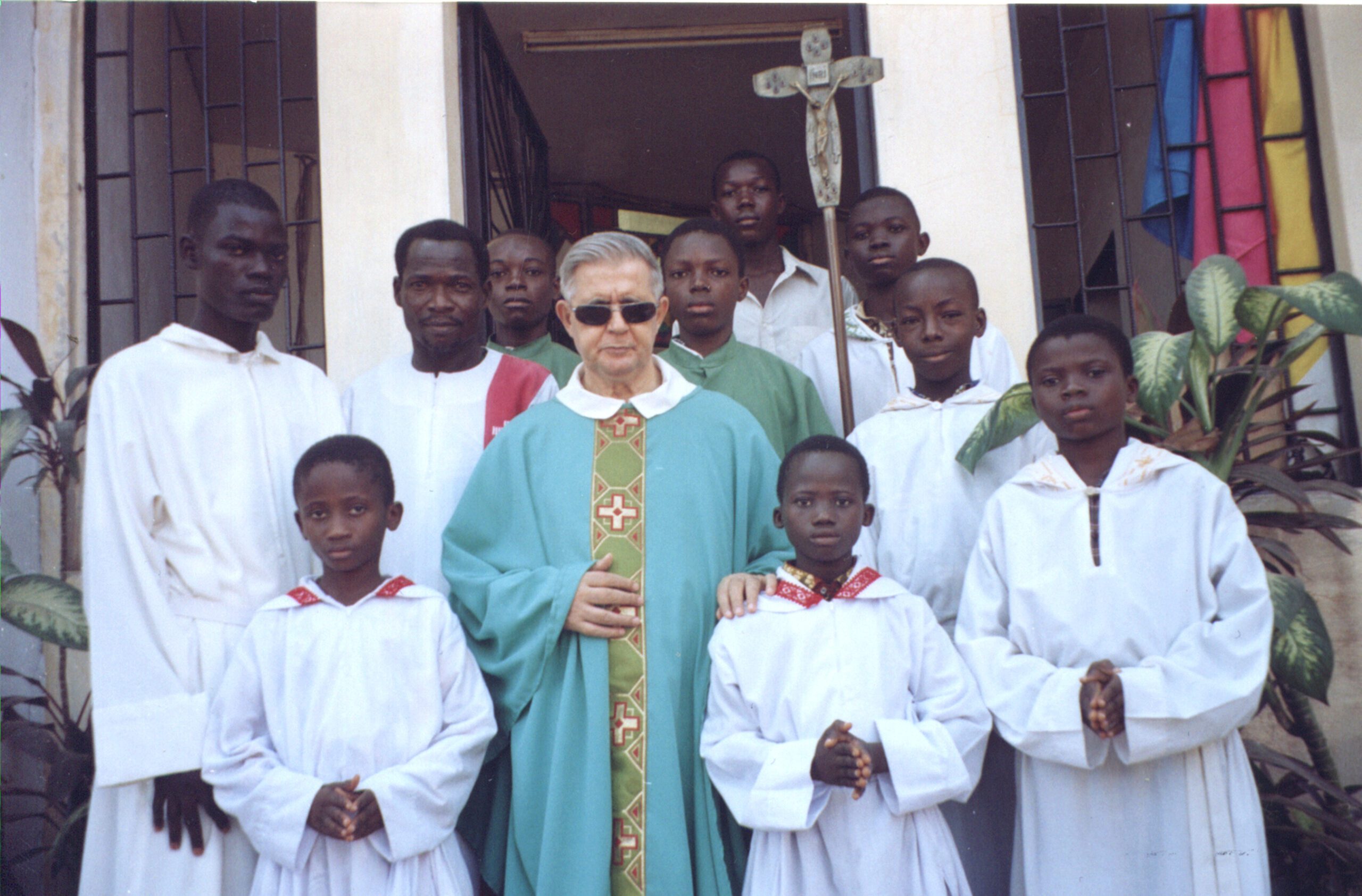
As a child, Fabio had already a poor eyesight. But he never imagined that he would, one day, become blind. He wanted to become a missionary and pursued his dream. In spite of the difficulty in reading and studying, he went through the philosophical and theological curriculum, and was ordained a priest on March 30, 1963 by the Archbishop of Milan, Cardinal Montini, who later on became Pope Paul VI.
He worked as vice-rector in a minor seminary in Italy for two years. Having been assigned to a Francophone country, he went to Paris to learn French and then left for Togo, in West Africa. He learned the local language, Éwé, known for its difficulty, quite well and worked tirelessly in a parish that the Comboni Missionaries run in the capital, Lomé.
After six years, he was due for holidays in Europe. Unknown to him, the superiors in Rome wanted him to go to Paris to be a formator of the students of theology. He came to know about it only at the airport when the Delegate Superior gave him a letter from the Vicar General, Father Ottorino Sina, saying that they had been waiting for him for over a year. So he pleaded with him to have a few months for an aggiornamento (a refresher course) which was approved.
GLOOMY NEWS
Fabio arrived in Paris on May 16, 1972. As he continued losing his sight, he went to an ophthalmologist who told him to prepare for blindness. It was the confirmation of the diagnosis made in 1956, during his Novitiate, by an eye doctor from Verona: he suffered from retinitis pigmentosa, a genetic eye condition that leads to incurable blindness.
The terrible news came as a blow. The future seemed gloomy and he went into a deep crisis. He recalls his disarray: “Leaving the ophthalmologist’s consulting-room, I met a blind beggar on the road. I immediately told myself: ‘Look, what I will be one day.’ But I heard a voice inside me saying: “But on that day I will be there. Do not worry!”
He informed the other scholasticate formator, Fr. Vittorio Moretto, and the students about his predicament – unstoppable dimming sight – and even phoned Fr. Fernando Colombo in Rome who was in charge of the formation sector.
He realized that he had to act quickly and learn Braille as soon as possible. So, in his spare time, he started to do that. It was difficult to find time, because he was busy with the scholastics and he had to read and prepare himself for the activities with them. In exchange, they were trying in their own way to help him in this time of trial to overcome his interior problem.
It was a time of confusion and tribulation. It was not easy to accept such a fatality that would prevent him from being the great missionary he wished to be. But he did not give up. He tried other means to be cured. Encouraged by the Spanish scholastics, he went to Barcelona to consult the famous doctor Barraquer, then the world’s leading eye specialist. Barraquer helped him nurture the illusion of conserving part of his sight: “He promised me heaven and earth, but the sight was dimming.”
His inner fight was not over. He wanted to leave formation and go somewhere, he didn’t know where. But the Lord helped him to cope with the situation: “One day, I was praying in a church in Paris and asked the Lord to heal me. I told him: ‘I’m sure that if you heal me, I will convert all Togolese.’ It seemed that I would be able to conquer the four cardinal points. But a voice inside me was saying: ‘It’s not the conversion of others that I want, but yours. You have to trust Me, abandon yourself to Me.’ I understood the message and I immediately said: ‘Let it be done according to Your will.’ I immediately felt great peace. The fears vanished.”
This experience enlightened and strengthened him. It was a new call to mission at 35: “I found again the pleasure to be a missionary, the pleasure to set out and proclaim the Gospel. And, above all, inside me a new light that has no sunset began to emerge. And slowly, slowly as the earthly light decreased, my inner light increased. My life is all light.”
LEARNING BRAILLE
Fr. Sandro Cadei replaced Fr. Moretto as his co-formator in Paris. The following year, in January 1978, Fr. Fabio asked the Superior General, Fr. Tarcisio Agostoni, to allow him to go to Florence to learn Braille and to go back to Africa. Braille is the writing system invented by Louis Braille (1809-1852), based on raised dots, which enables the blind and visually-impaired people to read and write through touch.
He considers that it was the right time to learn Braille. He could just see enough to move and get oriented. He joined the children and learned it with great ease. He recalls: “At first, the teacher was giving me the fables of Phoebus and Aesop. I was reading them. But, after some time, I told him I was tired of reading such stories and I asked for “I Promessi Sposi” (“The Betrothed” – a historic novel by Alessandro Manzoni, considered the most important and the first work of Italian literature – Editor’s note). The teacher didn’t want to give him that novel thinking that he wouldn’t be able to read it. Fr. Fabio insisted until the teacher gave in. After 15 days, he brought back the book, read. The teacher doubted, as the rather funny episode that ensued denotes: “He pulled down all the blinds and darkened the room believing that I was cheating him reading with my eyes. He opened the closet, grabbed a book and told me to open it on a certain page. It was a page of history mentioning ancient peoples like the Hittites, Perizzites, Amorites, Hivites, and Jebusites. I immediately got the gist and started reading while the children were obviously lost.”
The teacher was taken aback and congratulated him for making such progress as an adult. After the first volume of the novel, he read the second and the others, all 9 volumes. He would get dead tired but he went on and on and finished them.
After a year, he asked the superiors in Rome to allow him to leave for mission. Assured that the climate wouldn’t worsen his health situation, they gave him the Nihil Obstat and he was joyfully able to go back to Togo – in spite of his mom’s apprehension. He could see a glimmer of light, but he could not recognize people anymore. He had to be accompanied always. Nor was he able to read. To write, he had to use the typewriter. During the apprenticeship of Braille, he also learned typing – with all the fingers and without looking at the keyboard as typists do. He types ever since. “I make small mistakes, but people understand; even my mom was able to read and understand me,” he asserts. Now, he writes around sixty letters per month to his friends and benefactors of his projects for the blind.
THE LIGHT OF EDUCATION
Going back to Togo in February 1979, there was a proposal for him to work either in Lomé or in Togoville. Since he didn’t want to stay in town, he chose the latter where the Combonis run a Marian Shrine in honor of Our Lady of the Lake, Mother of Mercy. The priest-in-charge, Fr. Francesco Grotto, had thought of starting some social projects, such as a carpentry, a knitting school and a center for the blind. The latter had been laid out but not started. The time for the blind had come with the arrival of Fabio.
Using the rooms reserved for accommodating pilgrims, they started off the project by welcoming 4 or 5 blind people then, eventually, the number increased to 20. Meanwhile, a teacher was sent to learn Braille. He learned and came back to help the boys. To uplift the blind, education is absolutely necessary: “I believe that if one can read and write, he/she has already achieved a lot. For me, to be able to read the Bible and to communicate with others in Braille was a true resurrection.”
Their idea was that, after learning Braille, the boys would be sent to mainstream schools. But there were so many students in primary classes that the blind could not be given the attention they needed. They decided, therefore, to make a brand new center exclusively for them outside the premises of the Shrine where they had been for two years.
The new center started in 1982. It was inaugurated in 1985, during the Feast of the Epiphany, which is the Feast of Light. Fabio named it Fiat Lux (“Kekeli Neva” in Éwé – Let there be light!). It stands on a 6-acre land and is about 2 kms away from the parish. It has a primary school. The boys, older than 13, live in the village and come to school daily. Then they further their education mainly in government schools. The center is supported financially by foreign donors – especially by a missionary group from Vicenza (Italy), founded by a lady who lived 40 years blind and paralyzed. With the help of the telephone, she managed to mobilize people. Coming to know the work of Fr. Fabio, she started supporting it.
After 4 or 5 years, the blind become self-sufficient: they can read, write, cook and attend to all their needs. After high school, the more capable students move to Lomé to attend university. They enroll in the various subjects – law, history, languages… Many do not finish college. With a licentiate, they can apply to work as civil servants in the centers for the blind. About twenty of them have already been hired and are paid by the government. Others teach in the primary schools of the various centers for the blind; still others teach in government colleges – to non- blind people. Fabio points out that “they are well-prepared, often better prepared than their colleagues.” From Togoville, around 70 made it so far to the university. About 20 are currently attending it.
A BEGGAR FOR THE BLIND
Since the very beginning of the center, the management started some craft workshops, where the blind are given the opportunity to learn a trade and work – putting straw on chairs, stools, sofas and making bags, mats, brooms… The less intellectually capable, who do not manage to go far in their studies and reach the university often because they get there past a certain age, can make a living in this way.
A plaster factory was put up. It has now 26 workers. An Italian association of the blind of war sends them the powder. They work on it, color and box it. They eke out a living for themselves and their families, since some are married; and they are able to set aside a certain amount of money to ensure their sustenance after they have retired.
There has always been an effort to help them have a small garden, plant and grow their own veggies and have their crops. Besides, it is easy for them to plant mangoes and coconut trees, collect the fruits, count and sell them.
A soap factory where they also produce a cure-all ointment was started in Lomé. It gives work to 20 visually-impaired. There is also an orchestra consisting of thirty blind people. Every Sunday, they go to animate the Eucharist in a community.
In the last years, Fr. Fabio started Saint Lucy Center in Lomé and two eye clinics for the prevention and treatment of eye diseases – Saint Anne and John Paul II. The clinics’ main aim is prevention, especially of youth cataracts, a main cause of blindness. And they provide affordable medicines. Saint Lucy Center has modern facilities with departments of physiotherapy, massage, music therapy (use of music to treat depression, discouragement), information technology, a knitting school and an infirmary for first aid since it is located in a very poor neighborhood.
In September 2008, during the inauguration of Saint Lucy Center, Fr. Fabio realized an interesting coincidence of dates: “When the ophthalmologist told me on that day in Paris that I could not escape blindness, it was a Thursday, September 20. The day we were opening Saint Lucy was a Thursday, September 20. That day, in 1973, I foresaw myself becoming a blind beggar. And it came true. I beg not for myself though but for others, for Togo’s blind people. I came to realize that the Lord closed these eyes of mine to help me open up to the needs of the visually-impaired people of Togo. When I became blind, I ’clearly saw’ the blind of Togo.”
Lack of hygiene and diseases are responsible for the high incidence of blindness. More than 200 blind are connected with the institutions Fr. Fabio initiated in Togoville and Lomé. He is not directly involved in running them, but follows them at a distance and supports them in times of crisis as what happened recently with the plaster factory.
STILL VERY ACTIVE
Fr. Fabio’s ministry to the blind has never been exclusive. He always did pastoral work. For instance, on the second Sunday after his arrival from Europe, he already went out to celebrate Mass for the people. How could he manage? He used a tape recorder: he would listen to the recording and repeat it to the people. The Gospel was read by a catechist. Later on, he learned the Mass by heart. He memorized the Second Canon in Italian, French and Éwé. Every Sunday, he celebrates Mass in one community.
He stayed in Togoville for 14 years. In 1992, he moved to the outskirts of Lomé to work in the formation of those who wish to become missionaries. He did the job for 12 years. He was relieved of it six years ago. He is already 75, but he keeps busy all day long – from the time he gets up at 3.30 in the morning. “I always did what a missionary could do – to proclaim, confess, listen, doing spiritual direction, comfort, celebrate the sacraments…” As one of the penitentiaries of the diocese for the reserved cases, his motto is: “Forgive, forgive, forgive and set free as much as possible.” And many people, knowing his availability, come to talk and to confess to him.
He reads a lot. He has the whole Bible in Braille. But, he quips that reading is becoming more difficult for him: “With aging, one loses the feeling in his fingers – the impression is like that of wearing nurses’ gloves.” Therefore, he increasingly uses the tape recorder. He spends hours listening to spiritual reflections. “For example, this morning, I heard comments on baptism and temptations made by Father Silvano Fausti. He is very deep in his reflections. I listen to him again and again and meditate on the analysis he makes.”
He has heard Fr. Fausti’s comments on the Gospels of Matthew and Mark. Now, he is listening to the one of Luke. Fr. Fabio came to appreciate the biblist’s insights while in Verona for a prostate surgery – one of the four times he was operated on. He asked a confrere, the late Bro. Giovanni Cattaneo, to bring him something to listen to. He was given the Gospel of Matthew, that began with Elijah discouraged and refusing to go back to mission. He realized the message was for him.
Prayer and reflection are essential parts of his life. Without them, he wouldn’t have been able to go on – especially with such palpable peace and serenity. He assumes: “My entire life has been a failure, but I have found the rock that is Christ and His love. He is the One sustaining me. If it were not Christ and His love, I wouldn’t have made so many leaps. I understand those who shoot themselves because they no longer have hope in life, thinking that they come from nothing and go towards nothing.”
OWNING A GOOD MEMORY
Fr. Fabio has been living in the Comboni formation house of Adidogomé for the last 18 years. They explained to him its structure and, after one week, he felt at home and could move freely around. He remembers only one mishap there: he was so engrossed in a thought, that he mistook the stairs for a door … and rolled down but, fortunately, without grave consequences.
He is quite independent inside the house – but not as independent outside as those who were born blind and have a greater sense of direction, stronger sense of hearing and who use a stick mainly to be recognized. He bathes, shaves and dresses by himself. To eat, it is enough to have the plate prepared. He needs help to walk fast, to read the letters he receives, and also to write and send e-mails, because he didn’t have the patience to learn to use the computer. One of the postulants serves as his secretary and cleans his room.
He cannot distinguish whether it is day or night. To know the hours, he has a speaking clock. He has an alarm clock in Braille since 1982 (It has no glass in front and allows one to know the time by the hour.) Even if the battery of his watch goes flat, the Braille watch always works.
A positive outcome of his blindness is that he developed a greater sense of hearing and a good memory. He exercises them always. He boasts that a good part of the Bible is already in his random-access memory (RAM): “During my last holiday, I learned by heart all the Psalms of the Night Prayer for the whole week. I know by heart other passages of the Bible, like the letter to the Galatians. I recite them from memory every day. I have even memorized all the Gospels.”
Blind people internalize more because they are not so easily distracted. Especially Fabio: “I always think and reflect.”
He exudes peace and serenity: “I manage with the grace of God and the help of the confrères and the people who love me.”